International Oil Prices Open Higher Then Turn Lower, WTI Falls Over 1% Intraday, South Korean Stocks Briefly Rise Over 1%, US Stock Futures Advance

华尔街日报Publicado em 2026-03-16Última atualização em 2026-03-16

Resumo

International oil prices opened higher but turned lower, with WTI crude falling over 1% to around $97.63 per barrel after initially surging more than 3%. Brent crude also retreated to near $103 after an early jump. Asian equities rose, with South Korea’s KOSPI gaining up to 1.4%, and U.S. stock futures advanced nearly 0.5%. The moves come amid easing Middle East tensions after two Indian-flagged vessels transited the Strait of Hormuz, and U.S. President Trump stated that Iran is ready to negotiate a ceasefire, though a deal has not yet been reached. U.S. Treasury yields remain elevated, with the 10-year near 4.26%, erasing earlier yearly gains. The market continues to monitor geopolitical risks and central bank policy decisions amid ongoing inflation concerns.

Monday, despite the US military's attack on military targets on Kharg Island last week, navigation signals appeared in the Strait of Hormuz, and Trump also indicated that negotiations with Iran are still ongoing. Crude oil futures opened higher but then fell, while US stock futures and Asian stock markets moved higher.

According to CCTV News, on Friday evening Eastern Time on the 13th, US President Trump posted on social media, stating that the US military had launched "heavy airstrikes" on military targets at Kharg Island, Iran's oil export hub. On the 14th, two liquefied petroleum gas tankers flying the Indian flag and belonging to an Indian shipping company successfully transited the Strait of Hormuz.

According to Xinhua News Agency, Trump said in a telephone interview with NBC on the 14th that Iran is ready to negotiate a ceasefire, but he is not yet ready to make a deal "because the terms are not good enough."

Specifically, in terms of market movements, WTI crude oil futures fell by more than $1, to $97.63 per barrel, after earlier rising over 3%. Brent crude oil retreated to around $103 per barrel after an initial jump at the open.
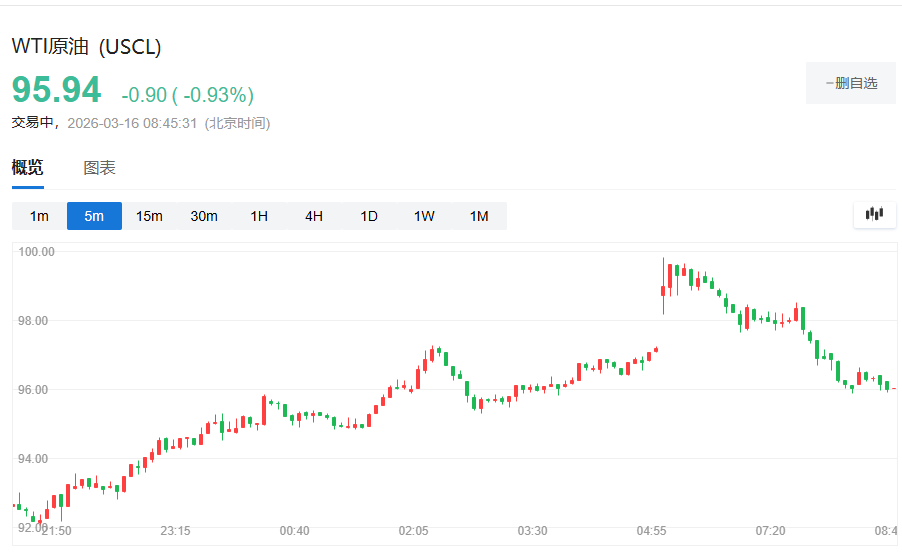
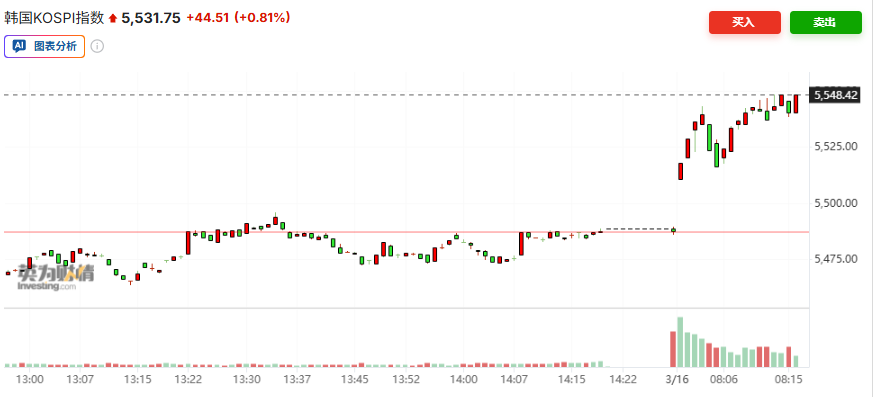
Asian stocks rose, with the MSCI Asia Pacific Index moving higher. South Korea's Seoul Composite Index saw its intraday gain widen to 1.4% at one point.
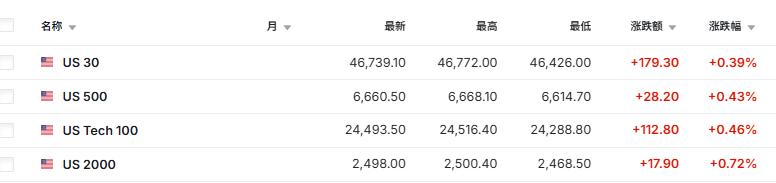
S&P 500 and Nasdaq 100 index futures rose nearly 0.5%, following three consecutive weeks of declines for the S&P 500 index.
US Treasuries erased their year-to-date returns. The 10-year Treasury yield surged more than 30 basis points in March, recently edging down slightly to 4.26%, while the 2-year yield rose to its highest level since last September.

Since the outbreak of the conflict, Brent crude has cumulatively risen 40%, global stocks have fallen over 5%, the year-to-date gains in US Treasuries have been completely wiped out, and market stress indicators are approaching the peak levels seen during the tariff shock last April. The International Energy Agency has stated it will immediately release strategic reserves to Asia to ease supply disruption pressures in the Middle East.

Inflation risks will be the core topic for markets this week. Eight of the world's ten major central banks are scheduled to announce interest rate decisions this week, as各方 need to judge the policy path against the backdrop of ongoing uncertain geopolitical developments.

Continually updating

Perguntas relacionadas

QWhat was the initial market reaction to the U.S. military strike on Iran's Kharg Island, and how did it change?

ACrude oil futures initially opened higher but then reversed course and turned lower. WTI crude oil futures fell by more than $1 to $97.63 per barrel, after having been up more than 3% earlier.

QWhich key shipping route showed signs of resumed traffic, and what was the significance of this development?

AThe Strait of Hormuz showed signals of resumed navigation. This is significant as it is a critical oil export chokepoint, and the passage of two Indian-flagged LPG tankers through it helped ease supply disruption concerns, contributing to the pullback in oil prices.

QWhat was the stated position of former U.S. President Trump regarding negotiations with Iran at the time?

AFormer President Trump stated that Iran was ready to negotiate a ceasefire, but he was not yet prepared to make a deal because the terms were 'not good enough'.

QHow did major Asian equity markets, specifically South Korea's, perform following the news?

AAsian stocks rose, with the MSCI Asia Pacific index moving higher. South Korea's Seoul Composite Index saw its intraday gains widen to 1.4%.

QWhat is the primary focus for financial markets this week, as mentioned in the article?

AThe primary focus for financial markets this week is inflation risk, as eight of the world's ten major central banks are set to announce interest rate decisions and judge their policy paths against the backdrop of ongoing uncertain geopolitical conditions.

Leituras Relacionadas

Qualcomm: AI Hype Subsides, When Will Smartphones Emerge from the Gloom?

Qualcomm reported its Q3 FY2026 results (ending June 2026), with revenue of $9.95B, down 4% YoY but above expectations. Gross margin declined to 53.1%, pressured by rising costs across manufacturing and memory. Key business segments showed mixed performance: Handset revenue fell 19.6% YoY to $5.09B, dragged by an 11% decline in non-Apple Android shipments and weaker high-end mix. Conversely, Automotive revenue surged 61% to $1.59B, and IoT grew 9% to $1.83B. Core operating profit dropped 41% YoY due to margin compression and higher expenses. Management's Q4 FY2026 guidance projects revenue of $9.7B-$10.5B, in line with consensus, but Non-GAAP EPS guidance of $2.05-$2.25 fell short of expectations. Amidst persistent weakness in its core handset market, Qualcomm is pursuing growth in AI, focusing on Edge AI (smartphones, PCs, automotive) and Data Center AI. Its data center strategy includes four pillars: AI accelerators (e.g., AI200), commercial CPUs (Dragonfly C1000), custom silicon, and connectivity solutions. While these initiatives initially boosted its stock, concerns over AI capital expenditure sustainability have since erased those gains. The company targets $5B in data center revenue for FY2027 and $15B for FY2029. The report concludes that with the traditional handset business still under pressure, the data center opportunity is currently viewed as a longer-term option, and a more conservative valuation based on core operations may be warranted until AI contributions materialize.

marsbitHá 2m

Qualcomm: AI Hype Subsides, When Will Smartphones Emerge from the Gloom?

marsbitHá 2m

From TPU to Self-Evolving Agents: How Jeff Dean Predicts the Next Step in AI

At the 2026 YC Startup School, Jeff Dean outlined his vision for AI's next phase, shifting focus from simply scaling models to building intelligent, autonomous systems. He believes AI's progress is no longer just about creating smarter models, but about integrating them into systems capable of long-term, iterative work, automated experimentation, and continuous learning. This evolution moves the competition from "who has the bigger model" to "who can best organize intelligence." Dean suggests AI capabilities are now comparable to a junior engineer, enabling the automation of complex workflows. However, the true challenge and opportunity lie in managing these AI "workers" at scale. He emphasizes the importance of **context engineering**—structuring tools, memory, and feedback loops—over raw model power. For startups, this means building deep expertise in niche domains where general models currently fail (near 0-1% success rates), leveraging proprietary data, specialized tools, and domain-specific evaluators. A recurring theme is re-examining fundamental constraints. Dean's past work, like moving Google's search index to memory or creating the TPU, stemmed from questioning outdated assumptions about hardware and cost. He sees similar inflection points today, particularly in **specialized inference hardware** to drastically reduce latency and energy consumption for real-time Agent operation. Notably, he points out that in modern AI systems, the dominant cost is often not computation but **data movement**. Reliable, long-running Agents require robust system design, borrowing concepts from distributed computing like checkpointing, state management, and parallel exploration to handle failures and maintain progress over days or weeks. As AI automates execution, the scarcest human skills will shift to **defining clear specifications**, **judging what problems are worth solving** (taste), and designing effective feedback loops. Ultimately, Dean's framework prioritizes understanding the problem deeply, identifying the true bottlenecks, and systematically building closed-loop systems where AI can not only perform tasks but also improve AI itself.

marsbitHá 2m

From TPU to Self-Evolving Agents: How Jeff Dean Predicts the Next Step in AI

marsbitHá 2m

Trading

Spot
活动图片





