Institutional Dominance in the Crypto Market: The End of Decentralization or the Dawn of a New Era?

marsbitPublicado em 2025-12-11Última atualização em 2025-12-11

Resumo

In 2025, institutional investors now account for approximately 95% of cryptocurrency inflows, while retail participation has declined to just 5–6%, marking a structural shift in the market. According to Aishwary Gupta of Polygon Labs, this transition is driven by maturing infrastructure rather than sentiment. Major asset managers like BlackRock and Apollo are allocating portions of their portfolios to digital assets via ETFs and on-chain tokenized products, leveraging blockchain for yield generation and operational efficiency. Gupta highlights that institutional adoption is progressing in two phases: first, through yield-bearing products like tokenized treasuries and regulated staking, and second, via efficiency gains such as faster settlement and programmable assets. While retail interest waned due to meme coin losses, he expects gradual return as more transparent, regulated products emerge. Addressing concerns about centralization, Gupta argues that institutional involvement can enhance blockchain’s without compromising decentralization, provided infrastructure remains open. He envisions a future financial system where DeFi, NFTs, and traditional assets coexist on public chains. Although compliance may limit some experimentation, it fosters more sustainable innovation. Increased institutional participation is expected to reduce volatility and accelerate growth in areas like real-world asset tokenization and cross-chain interoperability. Ultimately, this trend signifies cr...

Author: Centreless

In 2025, the cryptocurrency market reached a structural turning point: institutional investors have become the absolute dominant force, while retail investors have noticeably cooled. Aishwary Gupta, Global Head of Payments and Real-World Assets at Polygon Labs, recently stated in an interview that institutional capital now accounts for approximately 95% of overall cryptocurrency inflows, with retail participation dwindling to just 5%-6%, marking a significant shift in market dominance.

He explained that this institutional shift is not driven by sentiment but is a natural outcome of maturing infrastructure. Major asset management giants, including BlackRock, Apollo, and Hamilton Lane, are allocating 1%-2% of their portfolios to digital assets, accelerating their deployment through ETFs and on-chain tokenized products. Gupta cited Polygon's collaboration cases as examples, such as JPMorgan testing DeFi transactions under the supervision of the Monetary Authority of Singapore, Ondo's tokenized treasury project, and AMINA Bank's regulated staking, all demonstrating that public chains can now meet the compliance and auditing requirements of traditional finance.

The two main drivers of institutional entry are yield demand and operational efficiency. The first phase primarily focuses on generating stable returns through tokenized treasuries and bank-grade staking; the second phase is propelled by the efficiency gains brought by blockchain, such as faster settlement speeds, shared liquidity, and programmable assets, which are prompting large financial institutions to experiment with on-chain fund structures and settlement models.

In contrast, the retreat of retail investors is mainly due to losses and a loss of trust caused by previous Meme coin cycles. However, Gupta emphasized that this is not a permanent exit; as more regulated and transparent risk products emerge, retail investors will gradually return.

Addressing concerns that institutional entry might undermine the decentralized ethos of cryptocurrency, Gupta argued that as long as the infrastructure remains open, institutional participation will not centralize blockchains but instead enhance their legitimacy. He pointed out that the future financial network will be a fused system where DeFi, NFTs, treasuries, ETFs, and other asset classes coexist on the same public chain.

Regarding whether institutional dominance might stifle innovation, he acknowledged that some experimentation would be constrained in a more compliance-focused environment. However, in the long run, this will help the industry build a more robust and scalable path for innovation, rather than relying on high-speed trial-and-error that "breaks the rules."

Looking ahead, he stated that institutional liquidity will continue to enhance market stability, with reduced speculation leading to lower volatility. The tokenization of real-world assets (RWA) and institutional-grade staking networks will develop rapidly. Interoperability will also become critical, as institutions require infrastructure capable of seamlessly transferring assets across chains and cross-rollup layers.

Gupta emphasized that institutional entry is not a "takeover" of crypto by traditional finance but a collaborative process of building new financial infrastructure. Cryptocurrency is evolving from a speculative asset into a core underlying technology of the global financial system.


Criptomoedas em alta

Perguntas relacionadas

QWhat is the current proportion of institutional inflows in the cryptocurrency market, according to Aishwary Gupta?

AInstitutional investors now account for approximately 95% of the total inflows into the cryptocurrency market.

QWhat are the two main drivers for institutional entry into the crypto market as mentioned in the article?

AThe two main drivers are yield generation (through products like tokenized treasuries and bank-grade staking) and operational efficiency (faster settlement, shared liquidity, and programmable assets).

QHow does Aishwary Gupta respond to concerns that institutional participation undermines the decentralized nature of crypto?

AHe argues that as long as the infrastructure remains open, institutional involvement does not centralize the ecosystem but instead enhances its legitimacy.

QWhat long-term impact does institutional dominance have on market stability and volatility?

AIt is expected to increase market stability and reduce volatility, as speculative activity decreases.

QWhat does Gupta say about the future financial network regarding different asset types?

AHe states that the future financial network will be a fusion system where various assets like DeFi, NFTs, treasuries, and ETFs coexist on the same public blockchain.

Leituras Relacionadas

A 'Overlooked' Market Event: Joint US-Japan-South Korea Intervention, Rare US Treasury Involvement, and Bessent's Quiet 'Market Rescue'?

Summary: The United States, Japan, and South Korea executed their largest coordinated foreign exchange intervention in nearly 30 years. The action targeted depreciation pressure on the Japanese yen and South Korean won. This move is seen as a significant effort by the US to stabilize the financial markets of its key allies and prevent the spillover of risks. Key details: * Japan reportedly intervened on July 30 using approximately 8.45 trillion yen (about $52.8 billion). South Korean authorities also intervened that day, selling dollars to support the won. * Notably, the US Treasury Department intervened directly in yen markets for the first time in roughly 30 years. The New York Fed, reportedly acting on behalf of the Treasury, sold euros to buy yen via Goldman Sachs and Morgan Stanley on July 31. Analysts view the use of the euro-yen pair as a way to alleviate yen pressure without adding selling pressure to the US dollar. * Prior to the action, the New York Fed conducted "rate checks" on both USD/JPY and EUR/JPY, a newer signaling tool that falls between verbal and physical intervention. The intervention is interpreted as going beyond traditional currency stabilization. Analysts, such as Michael Hartnett of Bank of America, suggest it resembles a "Price Keeping Operation" for the AI era. The core US objectives are perceived to be: 1. Preventing rapid yen depreciation from triggering a sharp rise in Japanese government bond yields. 2. Containing financial stress from spreading across Asian markets like South Korea and Japan. 3. Reducing the risk of disorderly capital flows impacting the US bond market. This coordinated action underscores the importance of Japan and South Korea as critical partners in the US semiconductor and AI supply chain. Stabilizing their financial markets is seen as vital to mitigating risks to the broader tech industry and the US market itself. The intervention coincides with market pressures, including the KOSDAQ index hitting a low since October 2022. While seen as a move to control volatility, some analysts caution it may not fundamentally reverse existing market trends.

marsbitHá 5m

A 'Overlooked' Market Event: Joint US-Japan-South Korea Intervention, Rare US Treasury Involvement, and Bessent's Quiet 'Market Rescue'?

marsbitHá 5m

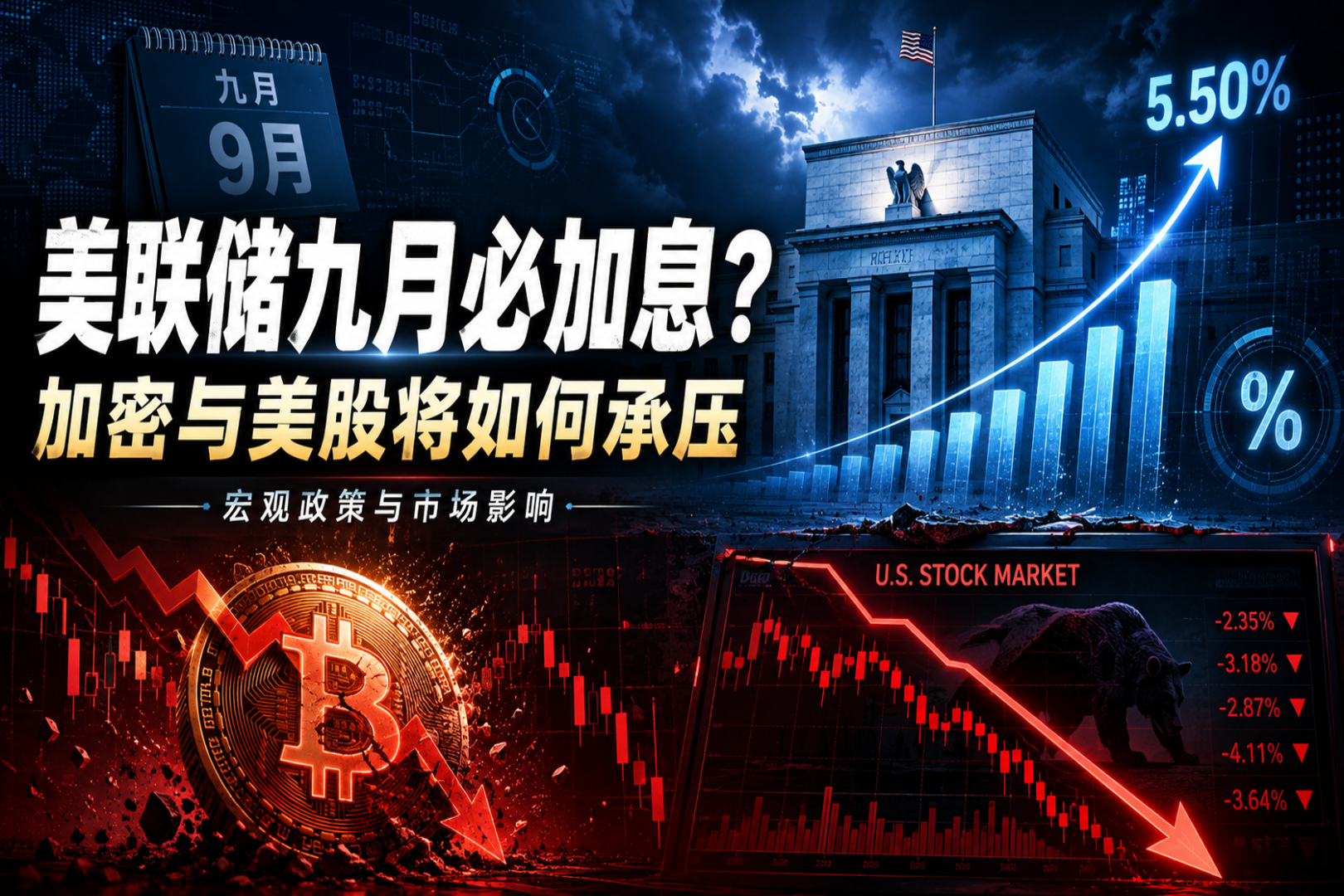
Will the Federal Reserve Definitely Raise Interest Rates in September? How Will Cryptocurrencies and US Stocks Bear the Pressure?

In early August 2024, market expectations for a September Federal Reserve rate hike surged dramatically, from below 50% to over 80%, driven by renewed inflation concerns. This shift followed a contentious July FOMC meeting where a 9-3 vote to hold rates revealed a growing hawkish faction advocating for an immediate hike, citing prolonged above-target inflation. The key catalyst is escalating conflict near the Strait of Hormuz, which has pushed oil prices up approximately 20% in July, threatening to reignite inflation. The next critical data point is the July CPI report on August 12th; a hot reading could solidify hike expectations. For crypto assets, particularly Bitcoin, this represents near-term pressure. Bitcoin continues to exhibit high-beta, risk-on characteristics, making it sensitive to tightening liquidity and higher opportunity costs. However, historical precedent suggests that if a hike is perceived as the cycle's end rather than its start, the negative impact may be brief, with markets quickly pivoting to anticipate future rate cuts. U.S. stocks, especially crypto-linked equities like Coinbase and high-valuation tech stocks, face amplified volatility. Higher rates increase discount rates in valuation models, pressuring growth stocks. This coincides with a pivotal tech earnings season where investor focus has shifted from massive AI capital expenditures to demonstrable revenue and cash flow generation. Companies with negative cash flows and weak growth narratives could see severe pressure if a September hike materializes, as financing costs would rise. Key indicators to watch include oil prices, upcoming inflation data, and Fed commentary at events like the Jackson Hole symposium.

Odaily星球日报Há 5m

Will the Federal Reserve Definitely Raise Interest Rates in September? How Will Cryptocurrencies and US Stocks Bear the Pressure?

Odaily星球日报Há 5m

From South Korea to the United States: Blue-Collar Jobs Are Becoming Increasingly Popular, Thanks to AI

AI is reshaping the labor market's value proposition. The traditional four-year college degree is losing its appeal as a guaranteed career path, while skilled blue-collar trades like electricians, welders, and plumbers are experiencing historic demand and wage premiums. This shift is driven by dual pressures: AI's displacement of certain white-collar roles and a booming need for physical infrastructure and data center construction. Data confirms the trend. In the U.S., vocational school revenue surged, and a significant portion of recent layoffs are AI-related. Surveys show a majority of Gen Z adults plan to pursue blue-collar work, citing better job security against AI automation. Vocational education interest has exploded recently. Experts cite a psychological shift as younger generations seek tangible, AI-resistant careers and avoid high student debt. In many cases, salaries for skilled trades now match or exceed those requiring a bachelor's degree. In South Korea, semiconductor vocational high schools boast near-total employment, with graduates securing high-paying roles at companies like Samsung. The shortage is structural, exacerbated by a retiring baby boomer workforce and massive infrastructure projects. Companies like JPMorgan Chase, Meta, and Lowe's are investing heavily in training programs. However, overcoming historical stigma and a "perception gap" around trade careers remains a key challenge to closing the talent gap.

marsbitHá 1h

From South Korea to the United States: Blue-Collar Jobs Are Becoming Increasingly Popular, Thanks to AI

marsbitHá 1h

Trading

Spot

Artigos em Destaque

Como comprar O

Bem-vindo à HTX.com!Tornámos a compra de O1 exchange (O) simples e conveniente.Segue o nosso guia passo a passo para iniciar a tua jornada no mundo das criptos.Passo 1: cria a tua conta HTXUtiliza o teu e-mail ou número de telefone para te inscreveres numa conta gratuita na HTX.Desfruta de um processo de inscrição sem complicações e desbloqueia todas as funcionalidades.Obter a minha contaPasso 2: vai para Comprar Cripto e escolhe o teu método de pagamentoCartão de crédito/débito: usa o teu visa ou mastercard para comprar O1 exchange (O) instantaneamente.Saldo: usa os fundos da tua conta HTX para transacionar sem problemas.Terceiros: adicionamos métodos de pagamento populares, como Google Pay e Apple Pay, para aumentar a conveniência.P2P: transaciona diretamente com outros utilizadores na HTX.Mercado de balcão (OTC): oferecemos serviços personalizados e taxas de câmbio competitivas para os traders.Passo 3: armazena teu O1 exchange (O)Depois de comprar o teu O1 exchange (O), armazena-o na tua conta HTX.Alternativamente, podes enviá-lo para outro lugar através de transferência blockchain ou usá-lo para transacionar outras criptomoedas.Passo 4: transaciona O1 exchange (O)Transaciona facilmente O1 exchange (O) no mercado à vista da HTX.Acede simplesmente à tua conta, seleciona o teu par de trading, executa as tuas transações e monitoriza em tempo real.Oferecemos uma experiência de fácil utilização tanto para principiantes como para traders experientes.

465 Visualizações TotaisPublicado em {updateTime}Atualizado em 2026.06.29

Como comprar O

Como comprar PROS

Bem-vindo à HTX.com!Tornámos a compra de Pharos (PROS) simples e conveniente.Segue o nosso guia passo a passo para iniciar a tua jornada no mundo das criptos.Passo 1: cria a tua conta HTXUtiliza o teu e-mail ou número de telefone para te inscreveres numa conta gratuita na HTX.Desfruta de um processo de inscrição sem complicações e desbloqueia todas as funcionalidades.Obter a minha contaPasso 2: vai para Comprar Cripto e escolhe o teu método de pagamentoCartão de crédito/débito: usa o teu visa ou mastercard para comprar Pharos (PROS) instantaneamente.Saldo: usa os fundos da tua conta HTX para transacionar sem problemas.Terceiros: adicionamos métodos de pagamento populares, como Google Pay e Apple Pay, para aumentar a conveniência.P2P: transaciona diretamente com outros utilizadores na HTX.Mercado de balcão (OTC): oferecemos serviços personalizados e taxas de câmbio competitivas para os traders.Passo 3: armazena teu Pharos (PROS)Depois de comprar o teu Pharos (PROS), armazena-o na tua conta HTX.Alternativamente, podes enviá-lo para outro lugar através de transferência blockchain ou usá-lo para transacionar outras criptomoedas.Passo 4: transaciona Pharos (PROS)Transaciona facilmente Pharos (PROS) no mercado à vista da HTX.Acede simplesmente à tua conta, seleciona o teu par de trading, executa as tuas transações e monitoriza em tempo real.Oferecemos uma experiência de fácil utilização tanto para principiantes como para traders experientes.

491 Visualizações TotaisPublicado em {updateTime}Atualizado em 2026.06.29

Como comprar PROS

O que é VERONA

I. Introdução ao Projeto VERONA é uma blockchain construída para todos, em todo o lado, através da abstração da cadeia. Utilizando a sua camada de Abstração Generalizada, a VERONA distingue-se por integrar funcionalidades complexas de blockchain, como contas, assinaturas e interoperabilidade, diretamente ao nível do protocolo. Esta abordagem permite a interação com aplicações de blockchain sem a necessidade de compreender as tecnologias subjacentes.1) Informação Básica Nome: VERONA (VERONA)III. Links Relacionados Link do site oficial: https://xion.burnt.com/ Whitepaper: https://xion.burnt.com/whitepaper.pdf Exploradores: https://explorer.burnt.com/ Mídias Sociais: https://x.com/burnt_xion Nota: A introdução ao projeto provém dos materiais publicados ou fornecidos pela equipa oficial do projeto, que é apenas para referência e não constitui aconselhamento de investimento. A HTX não se responsabiliza por quaisquer perdas diretas ou indiretas resultantes.

1.2k Visualizações TotaisPublicado em {updateTime}Atualizado em 2026.06.22

O que é VERONA

Discussões

Bem-vindo à Comunidade HTX. Aqui, pode manter-se informado sobre os mais recentes desenvolvimentos da plataforma e obter acesso a análises profissionais de mercado. As opiniões dos utilizadores sobre o preço de A (A) são apresentadas abaixo.

活动图片