Insider Trading Might Be the Most Valuable Part of Prediction Markets

marsbitPublicado em 2026-01-07Última atualização em 2026-01-07

Resumo

The article "Insider Trading Might Be the Most Valuable Part of Prediction Markets" examines a controversial case on Polymarket where an account achieved a 1242% return by accurately predicting the arrest of Venezuelan leader Maduro before mainstream media coverage. This event sparked debates about insider trading in decentralized prediction markets and led U.S. Representative Ritchie Torres to propose the "2026 Financial Prediction Markets Public Integrity Act," aiming to regulate such activities. The piece argues that while traditional finance bans insider trading to protect retail investors, prediction markets fundamentally serve as "truth discovery" mechanisms. Their core value lies in aggregating fragmented information into accurate price signals, even if it involves informed participants. Preventing insiders from trading could render markets less accurate, as prices would reflect public speculation rather than genuine probabilities. The article concludes that prediction markets should be viewed as tools for uncovering truth through decentralized information aggregation, not as fair trading venues. Blockchain transparency allows hidden information to become public signals through market activity, enabling rapid price correction and collective intelligence. Regulatory attempts to enforce fairness might undermine the predictive efficiency that makes these markets valuable.

Author: Chloe, ChainCatcher

Recently, Venezuelan leader Maduro was arrested. Before mainstream media released the news, a Polymarket account created in late December had already exited the market with a 1242% return. This incident prompted U.S. Representative Ritchie Torres to propose the "Public Integrity in Financial Prediction Markets Act of 2026," attempting to introduce traditional financial "insider trading" regulations into the crypto market.

This article will use the Maduro incident as a core case study to delve into the controversial issue of insider trading in prediction markets, re-examining whether we need an absolutely level playing field or a precise truth engine in decentralized prediction platforms.

Polymarket's "Prophet" Moment: Accurately Predicting Maduro's Downfall

In January 2026, Venezuelan leader Maduro was confirmed to have been arrested. While global mainstream media was still verifying sources, the data on the decentralized prediction market Polymarket had already provided the answer.

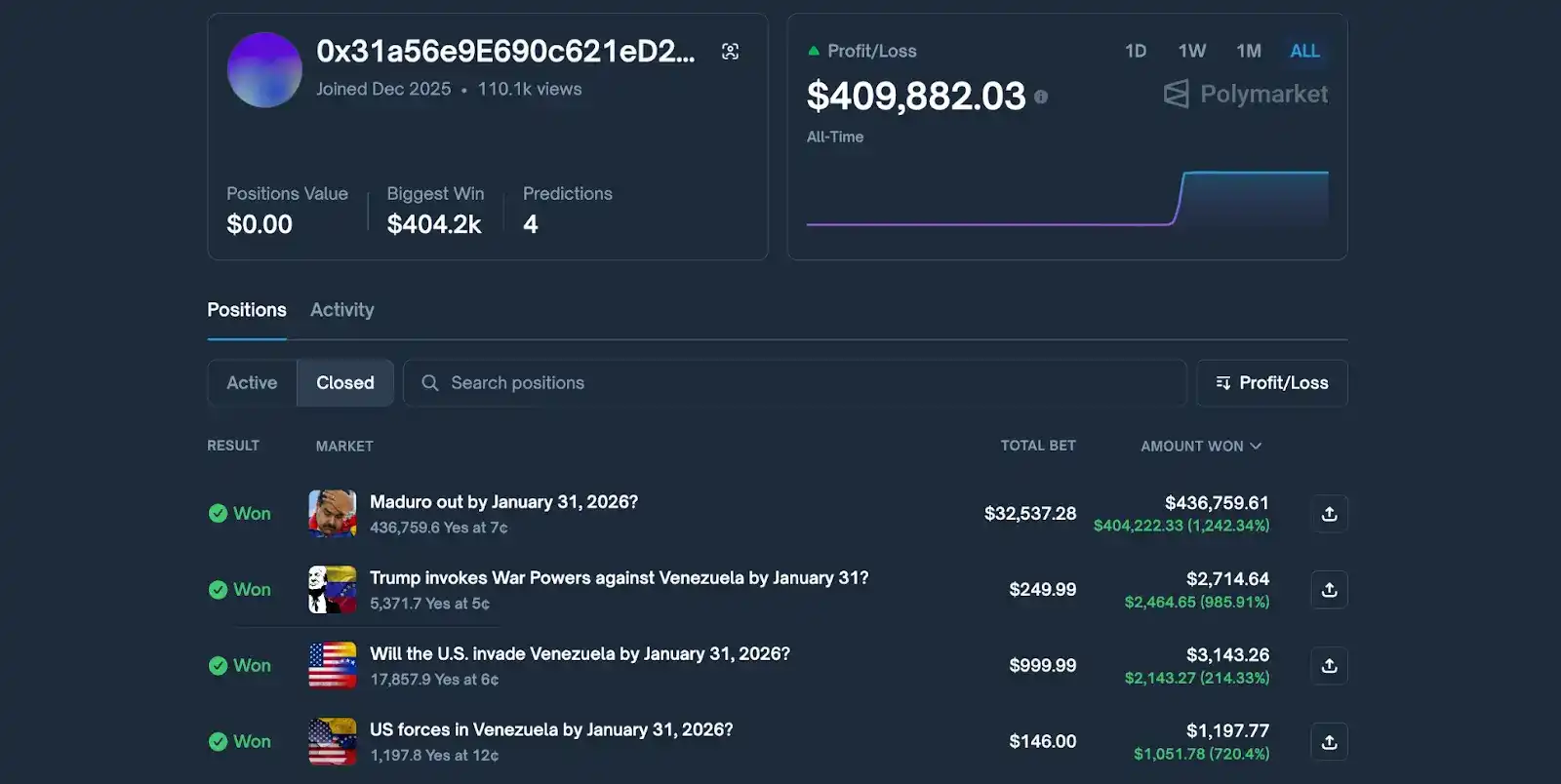
A new account created on Polymarket in late December 2025 seemed to have a god's-eye view, accurately predicting the event. The account made four predictions, all related to whether the U.S. would intervene in Venezuela, with the largest being a bet of $32,537 that "Maduro will step down by January 31." At the time, the market's expected probability for such an extreme event was in the single digits, and the account swept up contracts at the extremely low price of 7 cents.

As news of Trump confirming military action emerged early Saturday morning, these contracts instantly surged to near the $1 settlement price. The account profited over $400,000 in less than 24 hours, with a return rate of 1242%. This was not ordinary speculation but a precise snipe.
Mysterious Prophet or Insider Trading?

This god's-eye view of massive profits quickly became a focal point in the community. As discussions heated up, accusations of insider trading followed:

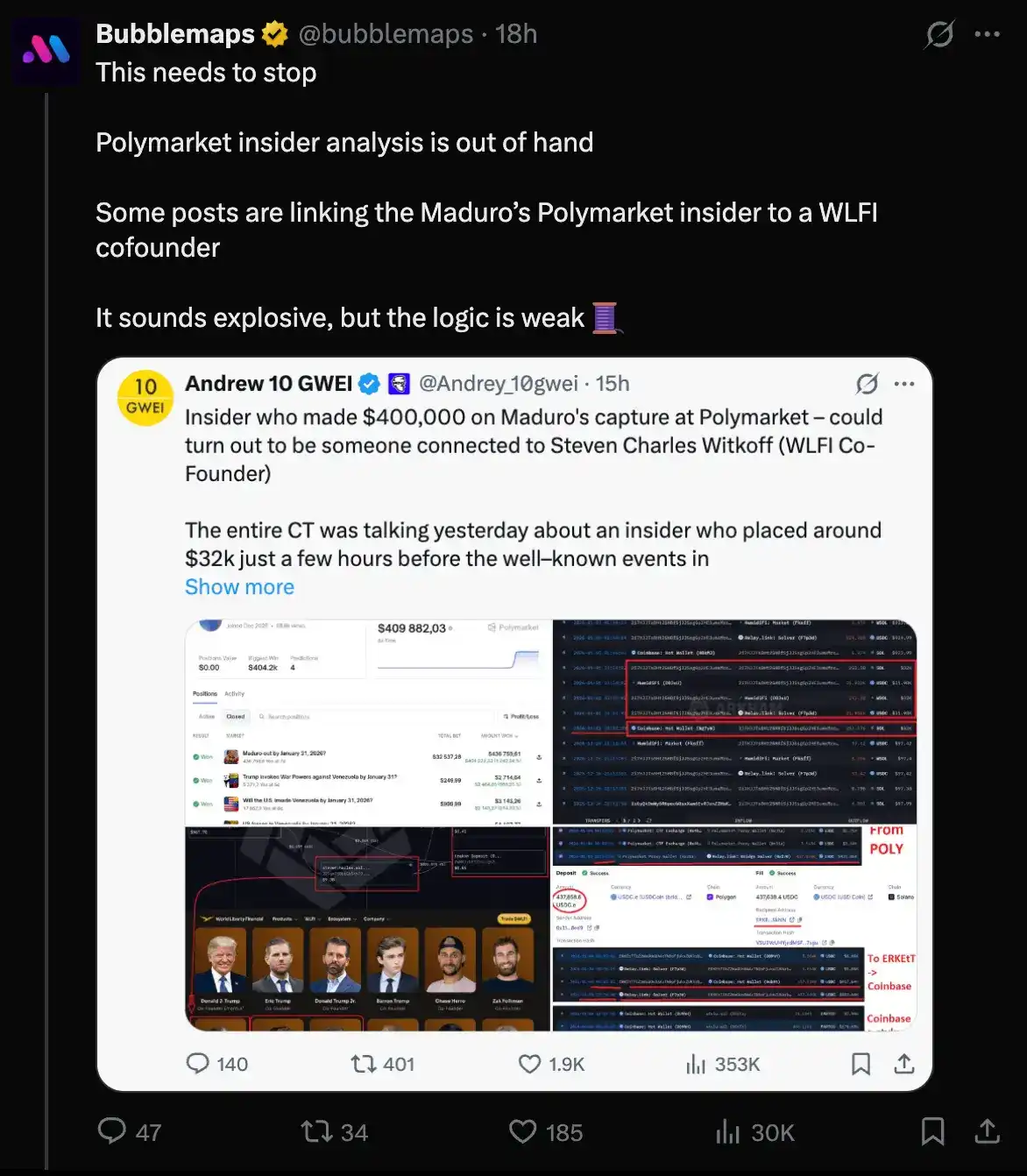
On-chain analyst Andrew 10 GWEI pointed out that the account's funding path showed high similarity: 252.39 SOL withdrawn from Coinbase on January 1 closely matched 252.91 SOL deposited by another wallet the previous day (23 hours apart),疑似通过交易所进行中转断链. More controversially, the associated wallet registered domains like StCharles.sol and had significant interactions with an address疑似 belonging to Steven Charles Witkoff, co-founder of World Liberty Finance (WLFI). Given WLFI's close ties to the Trump family, this raised strong suspicions: Was this insider trading using information from inside the White House?

On-chain analysis platform BubbleMaps later offered a different perspective. They argued that the "time and amount similarity" inference was too superficial, noting that there were at least 20 wallets on-chain that fit this pattern. They also pointed out that Andrew's argument lacked direct on-chain evidence of fund movement, so there was no reliable evidence linking the Polymarket account to the WLFI co-founder.
Congressman Proposes Integrity Act: Aiming to Regulate Insider Trading in Prediction Markets

This incident also led U.S. Representative Ritchie Torres to propose the "Public Integrity in Financial Prediction Markets Act of 2026." The core of the bill is to prohibit federally elected officials, politically appointed officials, and executive branch employees from trading in government policy-related prediction markets using "material non-public information" obtained through their official positions.

However, this bill faces a dual challenge in reality. First, the lengthy and uncertain legislative process; in the complex power dynamics of U.S. politics, such bills often undergo lengthy hearings and interest negotiations, ultimately easily becoming texts with more political posturing than substantive impact.

Second, there is an enforcement blind spot in the decentralized environment, where fund flows on-chain can easily be obscured through various privacy protocols or complex transfer mechanisms. Although the bill symbolizes the formal entry of traditional financial values into prediction markets, attempting to protect retail investors from information harvesting and maintain fair participation rights, we must consider: Will this regulatory logic, directly applied to decentralized prediction markets, conflict with core values and even cause prediction markets to fail?

The Core Value of Prediction Markets and the Paradox of Insider Trading

Returning to first principles, what is the purpose of prediction markets? Is it to give everyone a fair chance to profit, or to obtain the most accurate prediction results?

Traditional finance prohibits insider trading to protect retail investors' confidence and prevent capital markets from becoming a cash machine for the powerful. But in prediction markets, the core value may be "truth discovery."

Prediction markets are machines that aggregate fragmented information into price signals. If a market about "whether Maduro will step down" prohibits informed participants, then the market's price reflection will always be "outsiders' guesses" rather than "real probability," which would render prediction markets inaccurate.

In the Maduro incident,假设 the profiteer was not an insider but a top information analysis expert. He might have tracked abnormal radio signals at the Venezuelan border, private jet takeoffs and landings, or even the U.S. Department of Defense's public procurement lists, piecing together through model inference that military action would occur. This behavior might be highly controversial in the eyes of traditional regulation, but in the logic of prediction markets, it is an extremely valuable "information pricing behavior."

One mission of prediction markets is to break information monopolies. While各方 are interpreting ambiguous, delayed government diplomatic rhetoric, price fluctuations on prediction markets are already sending early warnings of the truth to the world. Therefore, rather than calling this insider trading, it is more accurate to say it is a博弈 that rewards hidden information surfacing through trading, thereby providing real-time risk guidance to the public.

Prediction Markets Are Tools Born from the Pursuit of Truth, Not Fair Trading Venues

The emergence of the "Public Integrity in Financial Prediction Markets Act of 2026" may reflect regulators' cognitive bias towards decentralized prediction platforms. If we pursue a "completely fair" prediction market, we will ultimately get a "completely ineffective" prediction market.

The Maduro incident profoundly reveals the true value of prediction markets: they allow hidden truths to be transformed into on-chain signals visible to all through the traces of fund flow. Blockchain transparency breaks the black box; even if we cannot immediately identify the幕后推手, when mysterious accounts heavily build positions and probabilities fluctuate剧烈, the market is actually sending a signal. This can attract smart money to quickly follow, rapidly leveling the originally unequal information gap, thereby transforming "insider information" into "public probability."

Prediction markets are not stock markets; they are essentially radars of collective human intelligence. To keep this radar accurate, it is necessary to allow the friction cost brought by information arbitrage to a certain extent. Therefore, rather than trying to block signals with bans, should we not position prediction markets as tools born from the pursuit of truth, rather than fair trading venues?


Perguntas relacionadas

QWhat was the core event that sparked the debate around insider trading in prediction markets, as described in the article?

AThe core event was a Polymarket user who, in late December 2025, made a highly profitable bet predicting the arrest of Venezuelan leader Maduro before it was publicly reported, earning a 1242% return.

QWhat was the name of the bill proposed by U.S. Representative Ritchie Torres in response to the incident, and what was its primary goal?

AThe bill was called the 'Financial Prediction Market Public Integrity Act of 2026'. Its primary goal was to prohibit federal officials and employees from using 'material non-public information' obtained through their positions to trade in prediction markets related to government policy.

QAccording to the article, what is the fundamental paradox or conflict regarding insider trading in prediction markets?

AThe paradox is the conflict between the goal of a 'fair' market that protects all participants and the goal of an 'accurate' market that serves as a 'truth discovery' engine. Banning insiders could make the market fairer but less accurate, while allowing their information to be incorporated through trading makes the market more accurate but less fair.

QHow does the article argue that the transparency of blockchain technology changes the nature of so-called 'insider trading' in prediction markets?

AThe article argues that blockchain transparency turns hidden information into a public signal. Even if the identity of a trader is unknown, their large bets and the resulting market probability shifts act as an early warning system, allowing 'smart money' to follow and quickly incorporate the 'inside' information into a public price, thus flattening the information asymmetry.

QWhat is the article's concluding stance on the primary purpose of a prediction market?

AThe article concludes that the primary purpose of a prediction market is to be a tool for pursuing truth and accurate collective forecasting ('a radar for collective human wisdom'), rather than a perfectly fair trading venue. It argues that some level of information arbitrage is a necessary cost for maintaining the market's accuracy.

Leituras Relacionadas

Apple's Desired On-Device AI Sees a Dark Horse Emerge: The First Cognitive Model is Born, 4B Matches GPT-5.4

A Chinese company, Tomorrow's Journey (Nextie), has introduced what it is calling the industry's first "cognitive model" for edge devices. Named New Journey Alpha, this 4-billion-parameter model reportedly matches the performance of trillion-parameter giants like GPT-5.4 in group intelligence tasks such as debate and collective decision-making. The development follows Andrej Karpathy's vision of stripping vast factual knowledge from large language models to retain only a smaller "cognitive core" capable of reasoning, planning, and knowing its own limits. This approach directly addresses the soaring computational costs and token expenses hindering AI's widespread deployment, as highlighted by incidents like Amazon shutting down an internal AI tool due to prohibitive costs. Trained via reinforcement learning on a corpus of academic papers from 1800-2020 to enhance generalization, the model enables three key advancements: 1) Improved decision quality in multi-agent systems, 2) Drastically reduced compute costs, allowing for cost-effective cloud or on-device (e.g., MacBook) deployment, and 3) The feasibility of "proactive" AI agents that act autonomously without user prompts, unlocking new commercial possibilities beyond today's reactive models. Built by the former Microsoft Xiaoice team—known for creating a 3.6B model that outperformed a 65B Llama model—the company is now focusing on the multi-agent systems sector, a field gaining significant investor interest. The model's economic impact is profound; by achieving high-level performance with minimal parameters, it fundamentally alters the cost structure of AI services, challenging the prevailing model of ever-larger parameter counts.

marsbitHá 2h

Apple's Desired On-Device AI Sees a Dark Horse Emerge: The First Cognitive Model is Born, 4B Matches GPT-5.4

marsbitHá 2h

OpenAI's 'Blueprint for the Future': Making AI Beneficial for Every Person on the Planet

A new transformative technology emerges every few generations. OpenAI draws a parallel with the advent of electricity in the 1920s, which initially brought convenience but ultimately enabled unprecedented progress in medicine, engineering, and living standards by empowering people to create new possibilities. AI is poised to recreate this phenomenon. Its true significance lies not in the technology itself, but in what people can achieve with it—from understanding a medical bill or starting a business to aiding scientific discovery. OpenAI believes AI should be universally accessible, allowing everyone to use it according to their own needs. This future, however, is not guaranteed. While transformative tech can centralize power, OpenAI's philosophy is that AI must serve humanity, augmenting human capabilities and broadly distributing its benefits. The company's first commitment is to build AI for human service, aiming to empower the many rather than concentrate power in a few. Safety, alignment with human intent, and oversight are paramount. OpenAI is optimistic about AI's potential to expand human welfare but remains clear-eyed about risks. The goal is to help people achieve more, not to replace them. Full automation is not the desired future; human judgment, values, and direction will become even more critical. OpenAI outlines three core goals: 1. Build automated AI researchers to accelerate and increasingly automate the research process itself, maintaining close human collaboration. The internal projection is that by March 2028, a significant portion of their research will be conducted by AI systems working alongside human researchers. 2. Accelerate economic development by advancing science, boosting productivity, and fostering growth, while ensuring the fruits are widely shared. 3. Provide a personal AGI for everyone on Earth, allowing individuals to benefit from this transformative technology in their own way. The company is entering its third phase, moving from foundational AGI research (Phase 1) to product deployment and learning from real-world use (Phase 2). The current challenge is making advanced AI abundant, affordable, safe, practical, and usable for all individuals and organizations. OpenAI concludes that a widely distributed power structure leads to a more resilient, adaptable, and free society. A positive AI future should not be controlled by a handful of entities but built, benefited from, and owned by many. If realized correctly, AI can become a cornerstone for enhancing global productivity, creativity, scientific advancement, and economic opportunity, fulfilling the mission to ensure AGI benefits all of humanity.

marsbitHá 3h

OpenAI's 'Blueprint for the Future': Making AI Beneficial for Every Person on the Planet

marsbitHá 3h

Trading

Spot
Futuros
活动图片




