Insider Trading Might Be the Most Valuable Part of Prediction Markets

比推Publicado em 2026-01-07Última atualização em 2026-01-07

Resumo

An anonymous account on the decentralized prediction market Polymarket achieved a 1,242% return by accurately predicting the arrest of Venezuelan leader Maduro before mainstream media reported the event. This triggered debates over potential insider trading and led U.S. Representative Ritchie Torres to propose the "2026 Financial Prediction Market Public Integrity Act," aiming to regulate such activities in crypto prediction platforms. The incident raised questions about whether prediction markets should prioritize fairness or accuracy. While traditional finance prohibits insider trading to protect retail participants, prediction markets may inherently rely on information asymmetry to produce more accurate forecasts. The core value of these markets lies in truth discovery—aggregating fragmented information into predictive signals—even if it allows informed participants to profit. The proposed legislation faces challenges in enforcement within decentralized environments and may conflict with the fundamental mechanism of prediction markets. Rather than enforcing absolute fairness, which could reduce market efficiency, the article argues that prediction markets should be viewed as tools for revealing truth through transparent, on-chain information flow, even when it involves informational advantages.

Author: Chloe, ChainCatcher

Original Title: Insider Trading Might Be the Most Valuable Part of Prediction Markets


Recently, Venezuelan leader Maduro was arrested. Before mainstream media released the news, a Polymarket account established in late December had quietly exited with a 1242% return. This incident prompted U.S. Representative Ritchie Torres to propose the "2026 Financial Prediction Market Public Integrity Act," attempting to introduce traditional financial "insider trading" regulations into the crypto market.

This article will use the Maduro incident as a core case study to delve into the controversial issue of "insider trading" in prediction markets, re-examining whether we need an absolutely fair casino or a precise truth engine in decentralized prediction platforms.

Polymarket's "Prophet" Moment: Accurately Predicting Maduro's Downfall

In January 2026, Venezuelan leader Maduro was confirmed to be arrested. While global mainstream media were still verifying sources, data on the decentralized prediction market Polymarket had already provided the answer.

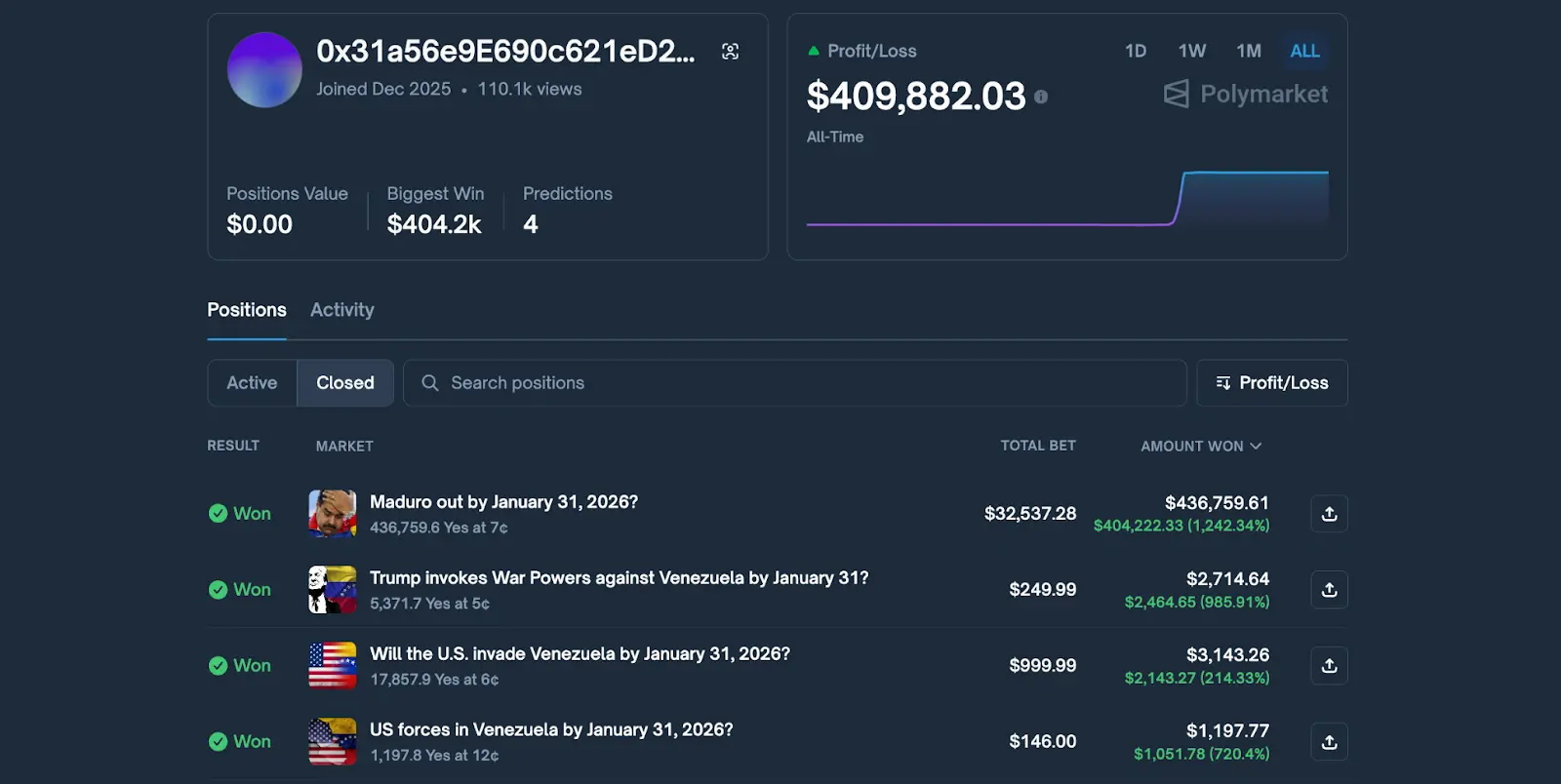
A new account created on Polymarket in late December 2025 seemed to have a god's-eye view, accurately predicting the event. The account made four predictions, all related to whether the U.S. would intervene in Venezuela, with the largest being a bet of $32,537 that "Maduro will step down before January 31." At the time, the market's expected probability for such an extreme event was only in the single digits, and the account swept up contracts at an extremely low price of 7 cents.

As news of Trump confirming military action emerged early Saturday, these contracts instantly surged to near the settlement price of $1. The account profited over $400,000 in less than 24 hours, with a yield of 1242%. This was not ordinary speculation but a precise sniper shot.
Mysterious Prophet or Insider Trading?

This god-like巨额获利 quickly became a focus in the community. As discussions heated up, accusations of insider trading followed:

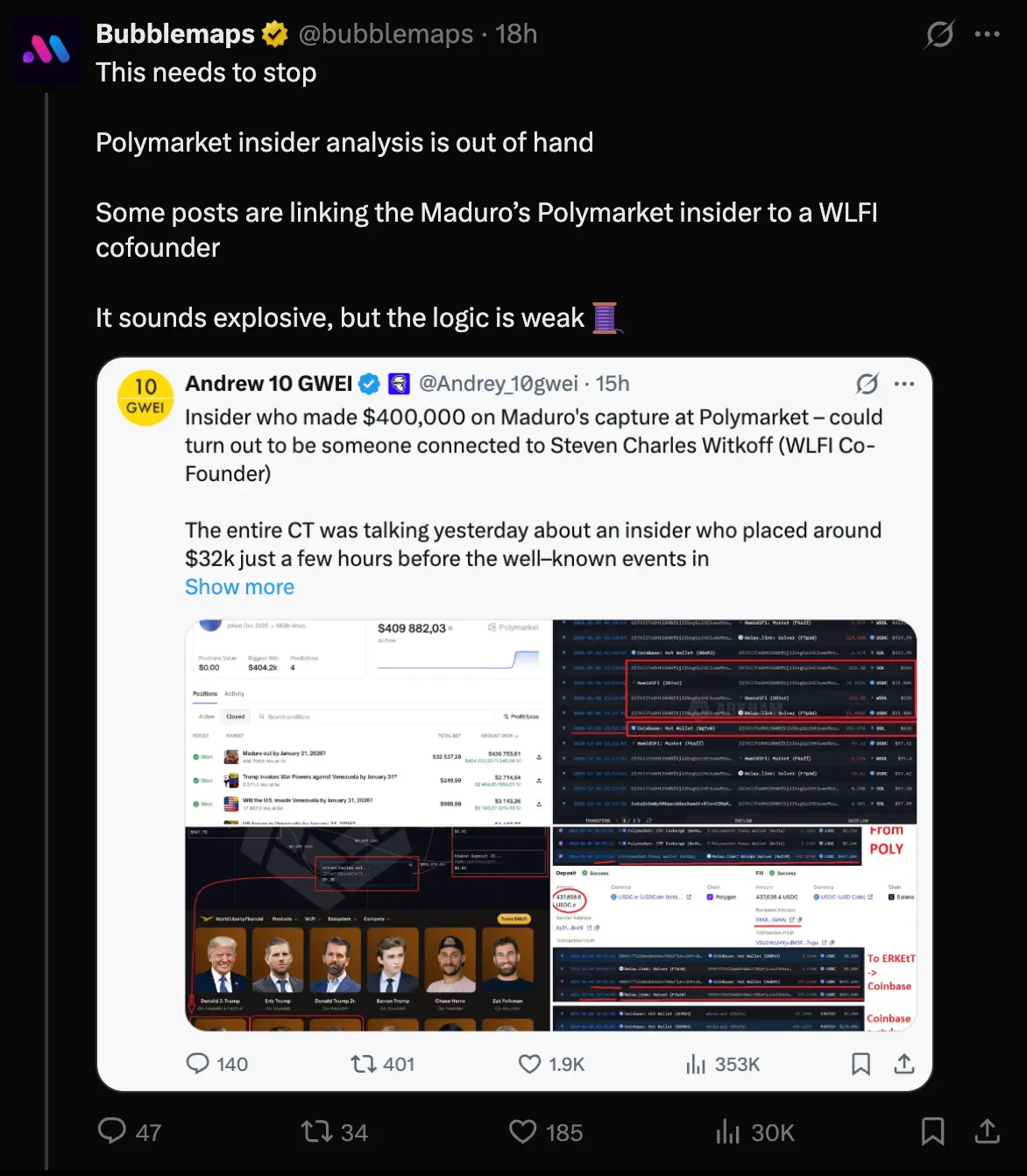
On-chain analyst Andrew 10 GWEI pointed out that the account's fund path showed extremely high similarity: 252.39 SOL withdrawn from Coinbase on January 1 closely matched 252.91 SOL deposited by another wallet the previous day in both amount and time (23 hours apart),疑似通过交易所进行中转断链. More controversially, the associated wallet registered domains like StCharles.sol and had large transactions with an address疑似 belonging to World Liberty Finance (WLFI) co-founder Steven Charles Witkoff. Given WLFI's close ties to the Trump family, this strongly raised suspicions: Was this insider trading using White House internal information?

On-chain analysis platform BubbleMaps later offered a different perspective. They argued that the "time and amount similarity" inference was too superficial, noting at least 20 wallets on-chain fit this pattern, and Andrew's argument lacked direct on-chain fund movement evidence, so there was no reliable proof linking the Polymarket account to the WLFI co-founder.
Representative Proposes Integrity Act: Aiming to Regulate Prediction Market Insider Trading

The incident also led U.S. Representative Ritchie Torres to propose the "2026 Financial Prediction Market Public Integrity Act." The core of the bill is to prohibit federally elected officials, politically appointed officials, and executive branch employees from trading in prediction markets related to government policies using "material non-public information" obtained through their official positions.

However, this bill faces a dual challenge in reality. First is the lengthy and uncertain legislative process; in the complex power dynamics of U.S. politics, such bills often undergo lengthy hearings and interest negotiations, ultimately容易沦为 political statements with little substantive impact.

Second is the enforcement blind spot in a decentralized environment. On-chain fund flows can easily be obscured through various privacy protocols or complex transfer mechanisms. Although the bill symbolizes the formal intrusion of traditional financial values into prediction markets, attempting to protect retail investors from information harvesting and maintain fair participation rights, we must consider: Will directly applying this regulatory logic to decentralized prediction markets create conflicts due to differing core values,甚至导致 prediction markets失灵?

The Core Value of Prediction Markets and the Paradox of Insider Trading

Returning to first principles, what is the purpose of prediction markets? Is it to give everyone a fair chance to profit, or to obtain the most accurate prediction results?

Traditional finance prohibits insider trading to protect retail investors' confidence and prevent capital markets from becoming cash machines for the powerful. But in prediction markets, the core value might be "truth discovery."

Prediction markets are machines that aggregate fragmented information into price signals. If a market about "whether Maduro will step down" prohibits informed participants, then the market's price will always reflect "laypeople's guesses" rather than "true probability," causing the prediction market to lose accuracy.

In the Maduro incident,假设 the profiteer was not an insider but a top information analysis expert. He might have pieced together the likelihood of military action by tracking abnormal radio signals at the Venezuela border, private jet movements, or even the U.S. Department of Defense's public procurement lists, after model inference. This behavior might be highly controversial in traditional regulation, but in the logic of prediction markets, it is an extremely valuable "information pricing behavior."

One mission of prediction markets is to break information monopolies. While各方 are interpreting ambiguous, lagging government diplomatic rhetoric, price fluctuations on prediction markets are already sending early warnings of the truth to the world. Therefore, rather than calling this insider trading, it is more apt to see it as a博弈 that rewards hidden information surfacing through trading, thereby providing real-time risk guidance for the public.

Prediction Markets Are Tools Born for Pursuing Truth, Not Fair Trading Venues

The emergence of the "2026 Financial Prediction Market Public Integrity Act" may reflect regulators' cognitive bias towards decentralized prediction platforms. If we pursue a "completely fair" prediction market, we will ultimately get a "completely ineffective" prediction market.

The Maduro incident深刻揭示了 the true value of prediction markets: It allows hidden truths to be transformed into on-chain signals visible to all through the traces of fund flow. Blockchain transparency breaks the black box; even if we cannot immediately identify the幕后推手, when mysterious accounts heavily build positions and probabilities fluctuate剧烈, the market is actually sending signals. This attracts smart money to quickly follow, rapidly leveling the originally unequal information gap, thereby transforming "insider information" into "public probability."

Prediction markets are not stock markets; they are essentially radars of collective human intelligence. To keep this radar precise, it is necessary to allow the friction cost brought by information arbitrage to a certain extent. Therefore, rather than trying to block signals with bans, should we not instead consider positioning prediction markets as tools born for pursuing truth, rather than fair trading venues?


Twitter:https://twitter.com/BitpushNewsCN

Bitpush TG Group:https://t.me/BitPushCommunity

Bitpush TG Subscription: https://t.me/bitpush

Original Link:https://www.bitpush.news/articles/7600733

Perguntas relacionadas

QWhat was the core event that sparked the debate around insider trading in prediction markets, as discussed in the article?

AThe core event was the arrest of Venezuelan leader Maduro, which was accurately predicted by a Polymarket account that achieved a 1242% return before mainstream media reported the news.

QWhat legislative response did the Maduro prediction incident trigger in the United States?

AIt prompted U.S. Representative Ritchie Torres to propose the 'Financial Prediction Market Public Integrity Act of 2026', aiming to regulate insider trading in crypto prediction markets by prohibiting federal officials from using material non-public information.

QAccording to the article, what is the fundamental purpose of prediction markets: fairness or accuracy?

AThe article argues that the core purpose of prediction markets is accuracy and 'truth discovery', as they are designed to aggregate fragmented information into price signals that reflect real-world probabilities, rather than ensuring fair profit opportunities for all participants.

QHow does the article differentiate between traditional financial markets and prediction markets regarding insider trading?

ATraditional financial markets ban insider trading to protect retail investors and maintain confidence, while prediction markets may benefit from informed trading because it helps produce more accurate predictions, turning hidden information into public signals.

QWhat technological challenge does the article highlight for enforcing insider trading regulations in decentralized prediction markets?

AThe article points out the enforcement blind spot in decentralized environments, where chain fund flows can easily be obscured through privacy protocols or complex transfer mechanisms, making it difficult to track and regulate insider trading.

Leituras Relacionadas

Apple Also Has to Pay Rent Now

Apple Pays Rent Too: The Two-Way Flow of "Traffic Tax" and "AI Capability Rent" Between Tech Giants For over two decades, Google has paid Apple an estimated $20 billion annually to remain the default search engine on Safari, a "traffic tax" for a critical user entry point. However, in 2026, the direction of this cash flow partially reversed. Apple agreed to pay Google roughly $1 billion per year to license its Gemini AI models, as Apple's own models reportedly struggled with complex tasks. This creates a unique dynamic: Apple acts as the "landlord" in the established search ecosystem, collecting rent from Google for access. Simultaneously, in the emerging AI arena, Apple becomes the "tenant," paying Google for access to cutting-edge AI capabilities it cannot currently match internally. While Apple claims its new models are "distilled" from Gemini outputs and contain "not a drop" of Google's original code, core dependencies remain. Its knowledge base is refined using Gemini's outputs, and its most powerful cloud model runs on Google's infrastructure. Apple has structured the deal as non-exclusive, allowing it to theoretically switch AI suppliers—a hedge against over-reliance. The future hinges on whether advanced AI models become a commodity (cheap and abundant) or remain a concentrated, scarce resource (expensive and controlled by few). Apple is betting on the former, leveraging its massive device ecosystem to be a powerful, choosy customer. If the latter proves true, its bargaining power could erode. This power dynamic is extending to developers. Apple, Google, and WeChat are all pushing for apps to expose their core functions as standardized "actions" or "intents" that their respective AI assistants (Siri, Gemini, WeChat AI) can directly call. The new scarce resource is no longer just app store visibility, but "being selected by the AI." The currency of "rent" has changed from a 30% revenue share to ceding control over how users interact with an app's functions.

marsbitHá 1h

Apple Also Has to Pay Rent Now

marsbitHá 1h

Missed the SpaceX IPO? WEEX's "First Trade Protection" Lets You Experience US Stock Trading Risk-Free.

With the excitement around SpaceX's recent public listing reigniting interest in the US stock market, Chinese investors face significant challenges accessing compliant and convenient trading channels following regulatory actions against major online brokers. This article explores the available options, highlighting their risks and limitations. Traditional paths for US stock investments remain problematic. Qualified Domestic Institutional Investor (QDII) and Listed Open-Ended Fund (LOF) products, while compliant, suffer from high fees, significant purchase premiums, and a very limited selection of assets. Small, unregulated offshore brokers pose substantial risks, including potential insolvency. While secure, VIP accounts at banks in Hong Kong or Singapore require high minimum deposits (often 1-2 million RMB) and in-person visits, placing them out of reach for most retail investors. The article positions cryptocurrency exchanges, specifically their TradFi (traditional finance on-chain) offerings, as a compelling alternative. Platforms like WEEX are noted for providing access to a wide range of US stocks and ETFs, including SpaceX (SPCXON), through tokenized assets. This method offers advantages such as a single account for both crypto and traditional assets, USDT-based settlement avoiding fiat complexities, flexible leverage, and robust risk management. To attract users, WEEX is promoting a "First Trade Guarantee" campaign. Running from June 15 to July 8 (UTC+8), it features a $30,000 prize pool. Users who trade $500 worth of US stock contracts can qualify for a guarantee on their first eligible trade: 100% loss coverage up to $30 or a 20% bonus on profits up to $30. The campaign is presented as a low-risk opportunity for both crypto natives and traditional investors to experience US stock trading.

marsbitHá 1h

Missed the SpaceX IPO? WEEX's "First Trade Protection" Lets You Experience US Stock Trading Risk-Free.

marsbitHá 1h

How Difficult is Chip Making? A Division Error Costs 475 Million Dollars

How Hard Is It to Make a Chip? A Division Error Cost $475 Million Chip expert Shi Kan, a researcher at the Chinese Academy of Sciences and a popular tech creator, explains the immense challenges of chip development. Chips are foundational to modern technology, but their creation is extraordinarily difficult. The journey from sand to a functional chip involves complex design and manufacturing, but a critical bottleneck is verification—ensuring the design works flawlessly before costly production. A single, undetected bug can have catastrophic consequences, as illustrated by the infamous 1994 Intel Pentium FDIV bug. A flaw in the floating-point division unit forced a recall costing $475 million. Unlike software, chips cannot be easily patched after manufacture, making "first-time success" paramount. However, industry surveys show only 24% of chip projects achieve this; over three-quarters require at least one costly re-spin due to design flaws. Verification has thus become the dominant phase, consuming up to 70% of the design cycle. The core challenge is a "verification impossible triangle" between high performance, good debuggability, and low cost. Exhaustively verifying a modern CPU core could take 15,000 years with software simulation, or 30 years with advanced hardware emulation—timeframes utterly impractical for development. Despite being essential, verification is often seen as unglamorous "dirty work," receiving less academic attention than fields like AI. Shi and his team are tackling this by developing an agile verification research framework called ENCORE, based on FPGA technology, to improve verification efficiency and debug capability. Beyond research, Shi engages in public science communication through long-form video content, aiming to demystify chip technology, AI, and computer science. He argues for the value of pursuing "hard and long-term" endeavors, whether in the meticulous world of chip verification or in creating substantive educational content, believing such sustained effort is likely the right path forward.

marsbitHá 1h

How Difficult is Chip Making? A Division Error Costs 475 Million Dollars

marsbitHá 1h

Trading

Spot
Futuros
活动图片





