ING Now Allows Crypto Investments as SUBBD Token Soars

bitcoinistPublicado em 2026-02-03Última atualização em 2026-02-03

Resumo

The cryptocurrency market is experiencing a divergence, with institutional players like ING adopting crypto services—adding legitimacy—while retail traders pursue high-risk assets. Tokens like SUBBD are surging, reflecting a strong risk-on appetite. SUBBD Token targets the $85 billion creator economy by offering a decentralized platform with AI tools, aiming to solve Web2 issues like high fees and limited control. It has raised $1.4M and offers a 20% APY staking reward to incentivize holding. This represents a shift toward utility-driven crypto projects.

The cryptocurrency market is showing a fascinating divergence: institutional giants are building the floor while retail traders are aggressively testing the ceiling.

Reports that major banking institutions like ING are warming up to direct crypto services signal a critical shift in market structure.

That’s not just about accessibility, it’s about the legitimization of digital assets as a standard portfolio component for conservative European wealth. (Frankly, when a legacy bank moves, it validates the asset class for risk-averse capital that has remained on the sidelines for a decade).

Meanwhile, the retail sector is operating with a totally different risk profile. Just look at the parabolic moves in assets like $SUBBD. The surge in these niche, community-driven tokens suggests that despite macroeconomic headwinds, risk-on appetite remains voracious.

The dichotomy is stark: while bankers analyze Bitcoin ETFs, the ‘degen’ economy is hunting for 100x multipliers in the AI infrastructure sector. This barbell structure, stability on one end, high volatility on the other, implies liquidity is returning to the system, but it’s bifurcated.

But the most astute capital is looking beyond the safety of banks or the casino-like nature of memes. Smart money is positioning itself in the middle ground: utility-driven protocols that solve tangible Web2 problems using Web3 infrastructure.

Specifically, the intersection of Artificial Intelligence and the creator economy is emerging as the next major growth narrative. Investors are increasingly rotating profits from high-volatility plays into infrastructure projects like SUBBD Token that offer sustainable revenue models.

Visit SUBBD Token’s official page.

SUBBD Token Targets the $85 Billion Creator Economy

While the broader market debates regulatory frameworks, SUBBD Token is executing a targeted strike on the $85 billion content creation industry. The current Web2 model? It’s fundamentally broken for creators. Platforms often extract up to 70% of earnings in fees, impose arbitrary bans, and enforce strict geographical payment restrictions.

SUBBD uses Ethereum-based EVM-compatible smart contracts to dismantle these barriers, offering a decentralized alternative where creators actually retain control over their content and revenue.

The project differentiates itself by integrating proprietary AI models directly into its ecosystem. This isn’t merely about payment processing, it’s about workflow automation. The platform features an AI Personal Assistant for automated interactions and advanced AI Voice Cloning technology, allowing influencers to scale their presence without scaling their workload.
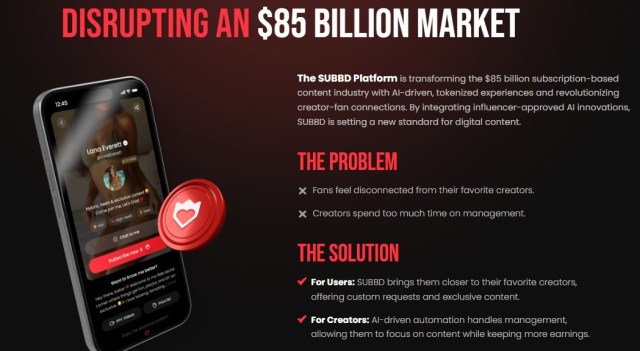
For fans, the utility is equally tangible: token-gated access creates an exclusive layer of interaction that fiat subscriptions can’t replicate.

From a portfolio standpoint, this represents a shift from speculative assets to productive ones. By merging Web3 transparency with AI-driven influencer tools, the project addresses the fragmentation of current software. Instead of subscribing to five different services for chatbots, voice generation, and payments, creators access a unified ecosystem. That consolidation of utility is precisely what transforms a token from a trading vehicle into a fundamental infrastructure play.

Explore the SUBBD ecosystem.

Early Capital Flows and Staking Metrics

The market’s appetite for this AI-Web3 hybrid model is reflected in the early capital inflows. According to official data, the project has already raised $1.4M, a figure that suggests significant conviction from early entrants despite the broader market’s volatility.
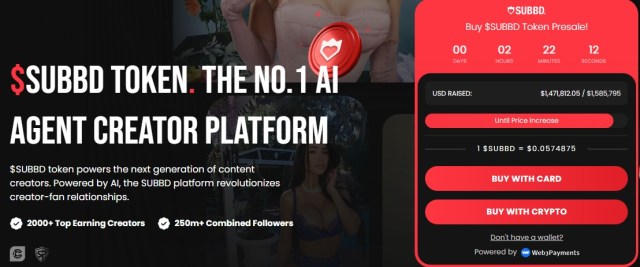
With tokens currently priced at $0.0574875, the entry point allows for position sizing that’s difficult to achieve in established large-cap assets.

Beyond the capital raise, the protocol’s retention mechanics are designed to mitigate the sell pressure often seen in new launches. The staking structure offers a fixed 20% APY for the first year, creating a compelling incentive for holders to lock supply. This isn’t just an inflationary reward; it’s a mechanism to align user behavior with long-term platform growth.

Stakers also gain access to XP multipliers and exclusive ‘behind the scenes’ content drops, gamifying the holding process.
This approach, combining high-yield staking with functional platform benefits, creates a liquidity sink that stabilizes the token economy.

While ING clients are limited to market-beta returns, SUBBD offers a third path: early-stage exposure to a utility protocol with built-in yield generation.

As the presale advances, the window to acquire tokens at the $0.0002802 valuation tightens, placing a premium on early decision-making.

View the official SUBBD presale site.

The information provided in this article does not constitute investment advice, financial advice, trading advice, or any other sort of advice and you should not treat any of the article’s content as such. Cryptocurrency markets are highly volatile and carry significant risk. Always conduct your own due diligence before making any investment decisions.


Perguntas relacionadas

QWhat major shift in the cryptocurrency market does the article highlight regarding traditional banking institutions like ING?

AThe article highlights that major banking institutions like ING are warming up to direct crypto services, signaling a critical shift in market structure. This move legitimizes digital assets as a standard portfolio component for conservative European wealth and validates the asset class for risk-averse capital.

QHow does SUBBD Token differentiate itself in the cryptocurrency market according to the article?

ASUBBD Token differentiates itself by targeting the $85 billion creator economy with a decentralized alternative that allows creators to retain control over their content and revenue. It integrates proprietary AI models for workflow automation, including an AI Personal Assistant and AI Voice Cloning technology, and provides token-gated access for fans.

QWhat is the current price of SUBBD Token and what incentive does the staking structure offer?

AThe current price of SUBBD Token is $0.0574875. The staking structure offers a fixed 20% APY for the first year, which incentivizes holders to lock supply and aligns user behavior with long-term platform growth. Stakers also gain access to XP multipliers and exclusive content.

QWhat problem in the current Web2 model for creators does SUBBD Token aim to solve?

ASUBBD Token aims to solve the problems in the current Web2 model where platforms often extract up to 70% of earnings in fees, impose arbitrary bans, and enforce strict geographical payment restrictions. It offers a decentralized alternative that allows creators to retain control and revenue.

QHow much capital has SUBBD Token raised according to the official data mentioned in the article?

AAccording to official data, SUBBD Token has raised $1.4M, indicating significant conviction from early entrants despite the broader market's volatility.

Leituras Relacionadas

Why Do You Always Lose Money on Polymarket? Because You're Betting on News, While the Pros Read the Rules

Why do you always lose money on Polymarket? Because you bet on news, while the pros study the rules. This article explains how top traders ("che tou") profit by meticulously analyzing market rules, not just predicting events. Polymarket, a prediction market platform, often sees disputes over event outcomes due to ambiguous rule wording. For instance, a market asking "Who will be the leader of Venezuela by the end of 2026?" was misinterpreted by many who bet on Delcy Rodríguez, assuming she held power. However, the rules specified "officially holds" as the formally appointed, sworn-in individual. Since Nicolás Maduro was still recognized as president officially, he won the market—even being in prison. To resolve such disputes, Polymarket uses a decentralized arbitration system via UMA protocol. The process involves: 1. Proposal: Anyone can propose a market outcome by staking 750 USDC, earning 5 USDC if unchallenged. 2. Dispute: A 2-hour window allows challenges with a 750 USDC stake; successful challengers earn 250 USDC. 3. Discussion: A 48-hour period on UMA Discord for evidence and debate. 4. Voting: UMA token holders vote in two 24-hour phases (blind then public). Outcomes require >65% consensus and 5M tokens voted; otherwise, four re-votes occur before Polymarket intervention. 5. Settlement: Results are final and automatic. Unlike traditional courts, Polymarket’s system lacks separation between arbitrators and stakeholders—voters often hold market positions, creating conflicts of interest. This leads to herd mentality in discussions and non-transparent outcomes without explanatory rulings, preventing precedent formation. Thus, success on Polymarket hinges on deep rule interpretation, not just event prediction, exploiting gaps between reality and contractual wording.

marsbitHá 35m

Why Do You Always Lose Money on Polymarket? Because You're Betting on News, While the Pros Read the Rules

marsbitHá 35m

DeepSeek Funding: Liang Wenfeng's 'Realist' Pivot

DeepSeek, a leading Chinese AI company, has initiated its first external funding round, aiming to raise at least $300 million at a valuation of no less than $10 billion. This move marks a significant shift from its founder Liang Wenfeng’s previous idealistic stance of rejecting external capital to maintain independence. Despite strong financial backing from its parent company, quantitative trading firm幻方量化 (Huanfang Quant), which provided an estimated $700 million in revenue in 2025 alone, DeepSeek faces mounting challenges. Key issues include a 15-month gap in major model updates, delays in its flagship V4 release, and the loss of several core researchers to competitors offering significantly higher compensation. The company is also undergoing a strategic pivot by migrating its infrastructure from NVIDIA’s CUDA to Huawei’s Ascend platform, a move aligned with China’s push for technological self-reliance amid U.S. export controls. However, DeepSeek lags behind rivals like智谱AI and MiniMax—both now publicly listed—in areas such as product ecosystem, multimodal capabilities, and commercialization. The funding round, though relatively small in scale, is seen as a way to establish a market-validated valuation anchor, making employee stock options more competitive and facilitating talent retention. It also signals DeepSeek’s transition from a pure research-oriented organization to a commercially-driven player in the global AI ecosystem.

marsbitHá 1h

DeepSeek Funding: Liang Wenfeng's 'Realist' Pivot

marsbitHá 1h

Trading

Spot
Futuros
活动图片