Infini Exploiter Hackers Resurface to Buy the $ETH Dip: How $BMIC Adds Security for the Future

bitcoinistPublicado em 2026-02-09Última atualização em 2026-02-09

Resumo

Infini Exploiter hackers have resurfaced, using approximately $13 million in stolen funds to buy the $ETH dip, highlighting persistent vulnerabilities in legacy blockchain security. This event underscores a critical failure in current architecture, where compromised funds can be monitored but not frozen, revealing the ecosystem's fragility. In response, the article highlights $BMIC as a next-generation solution deploying a quantum-secure finance stack. It uses post-quantum cryptography and a Zero Public-Key Exposure model to prevent 'Harvest Now, Decrypt Later' attacks, making wallet exploits mathematically impossible. The $BMIC presale has raised over $444K, signaling strong market demand for AI-enhanced, quantum-proof financial tools that offer protection against evolving threats and future quantum computing risks.

Trusted Editorial content, reviewed by leading industry experts and seasoned editors. Ad Disclosure

Quick Facts:

  • ➡️ The Infini exploiter resurfaced to purchase approximately $13M in $ETH, highlighting persistent vulnerabilities in legacy blockchain security.
  • ➡️ BMIC introduces post-quantum cryptography and Zero Public-Key Exposure to prevent future ‘Harvest Now, Decrypt Later’ attacks.
  • ➡️ The BMIC presale has raised over $444K, signaling strong market demand for AI-enhanced, quantum-proof financial tools.

The ghost of a past exploit has returned to the blockchain. On-chain data confirms that the wallet associated with the notorious Infini exploit has broken its silence, moving significant capital to accumulate Ethereum during the recent market dip.

This isn’t just a simple buy order. It’s a strategic reallocation of illicit funds totaling approximately $13M, timed perfectly with $ETH’s local bottom.
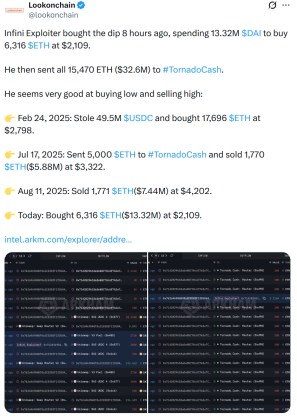
That re-emergence signals a troubling shift in crypto market structure: bad actors are becoming sophisticated asset managers. Instead of immediately laundering stolen funds through mixers, these entities are holding, staking, and trading to compound their gains. The market reaction has been mixed. While some traders view the whale-sized buy pressure as a bullish signal for $ETH, security analysts see it as a glaring reminder of the ecosystem’s fragility. Frankly, it’s a wake-up call.

This event exposes a critical failure in current blockchain architecture. If a wallet can be compromised and the funds monitored but not frozen, the underlying security model isn’t ready for institutional adoption. The industry is effectively playing a game of whack-a-mole with legacy vulnerabilities.

But a shift is happening. While hackers exploit the transparency of current chains, next-generation protocols are building immune systems against them. That’s where BMIC ($BMIC) comes in, a project deploying quantum-secure cryptography to render these types of wallet exploits mathematically impossible.

Closing The Door On ‘Harvest Now, Decrypt Later’

The Infini incident highlights a specific vulnerability: the exposure of public keys and the persistence of compromised data. In the current EVM landscape, once a wallet interacts with a malicious contract, the user’s assets are often exposed forever.

BMIC fundamentally alters this dynamic by introducing the first full Quantum-Secure Finance Stack. By utilizing post-quantum cryptography (PQC) and ERC-4337 Smart Accounts, BMIC ensures that even if a bad actor intercepts data today, they can’t decrypt it. Not now, and not when quantum computers eventually break standard encryption.
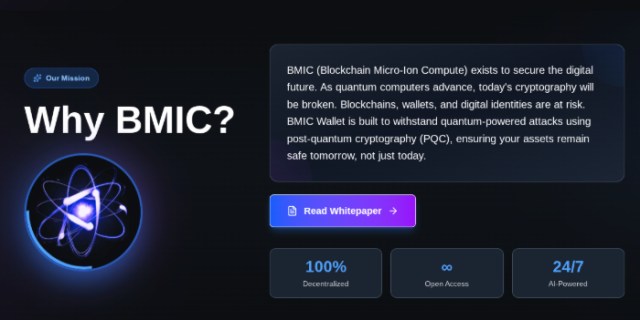
Why does this matter? Because the threat vector is evolving. The ‘Harvest Now, Decrypt Later’ strategy means hackers are scraping encrypted data today to unlock it when computing power advances. BMIC counters this with a proprietary Zero Public-Key Exposure model. Unlike traditional wallets that broadcast keys, BMIC transactions remain shielded. It offers a level of sovereign protection that legacy wallets simply can’t match.

Plus, the integration of AI-Enhanced Threat Detection adds a proactive layer to this defense. While the Infini hacker relied on the passive nature of the blockchain to execute their trades unnoticed until it was too late, BMIC’s infrastructure actively monitors for anomalies. This creates a secure environment for ecosystem fuel, governance, and staking, ensuring that users, not exploiters, retain control of their digital future.

FIND OUT MORE ABOUT THE BMIC QUANTUM STACK

Smart Money Rotation Into Quantum Infrastructure

While the Infini hacker buys $ETH for short-term gains, forward-looking investors are positioning themselves in infrastructure plays that solve the security crisis permanently. The $BMIC presale has emerged as a focal point for this capital rotation, already raising over $444K from early adopters who recognize that the quantum transition is inevitable.

At the current token price of $0.049474, the entry point offers a distinct asymmetry compared to buying established Layer-1s. The market is beginning to value ‘insurance’ protocols, tech that protects the trillions of dollars in TVL from catastrophic failure. BMIC ($BMIC) isn’t merely a wallet; it’s a ‘Burn-to-Compute’ utility token powering a Quantum Meta-Cloud. It bridges the gap between decentralized finance and high-performance computing, making it one of the best crypto presales.

The utility here extends beyond simple storage. By enabling quantum-secure staking with no exposed keys, $BMIC solves the dilemma of earning yield without risking the principal. As regulatory scrutiny tightens on money laundering (highlighted by the Infini hacker’s movements), enterprises will be forced to migrate to compliant, secure environments.

BMIC provides that sanctuary. The current presale phase represents a rare opportunity to acquire the standard for future digital security before the wider market reprices the risk of legacy chains.

EXPLORE THE $BMIC PRESALE

The content of this article does not constitute financial or investment advice. Cryptocurrencies are highly volatile assets, and presales carry significant risk. Always conduct your own due diligence before making any financial decisions.

Editorial Process for bitcoinist is centered on delivering thoroughly researched, accurate, and unbiased content. We uphold strict sourcing standards, and each page undergoes diligent review by our team of top technology experts and seasoned editors. This process ensures the integrity, relevance, and value of our content for our readers.

Ben Wallis

Follow

Ben is a freelance writer, and AI editor specializing in crypto developments (mainly altcoins) and the intricate ways global economics shape the digital asset space. His B.Ed. in Education provides a unique foundation for his writing, enabling him to distill complex crypto concepts and market shifts into clear, digestible insights. This skill is key to helping readers adapt and apply their understanding to the ever-evolving world of crypto investment. Passionate about making crypto accessible, Ben crafts content designed to educate a broad audience, from current market events to the essential foundational knowledge that underpins them. His goal is to empower readers through understanding. When he’s not immersed in crypto analysis and breaking down complex topics, Ben is an avid Pokémon fan and enjoys all things Disney.

Full Profile

Related Posts

Bessent Urges Senate to Fast-Track Warsh Nomination as Institutional Liquidity Pivot Favors LiquidChain

Turkey & Tether Freeze $544M: Why $BMIC Is The Safe Haven

Tether’s $23B Gold Hoard Rivals Nation States As Smart Money Pivots To $HYPER

Story Co-Founder Defends Token Unlock Delays; Why Long-Term Scaling Matters For $MAXI

Takaichi’s Victory Sends Nikkei to Records as Bitcoin Reclaims $72K; What this Means for $HYPER

Crypto.com Founder Buys AI.com For $70M As The AI-Crypto Synergy Propels SUBBD Forward

Perguntas relacionadas

QWhat recent action did the Infini exploiter take, and what does it signify about blockchain security?

AThe Infini exploiter resurfaced to purchase approximately $13 million worth of Ethereum ($ETH) during a market dip. This action signifies a troubling trend where bad actors are becoming sophisticated asset managers, holding and trading stolen funds instead of immediately laundering them. It highlights persistent vulnerabilities in legacy blockchain security models, demonstrating that compromised funds can be monitored but not frozen, which is a critical failure for institutional adoption.

QHow does BMIC ($BMIC) address the 'Harvest Now, Decrypt Later' threat in blockchain security?

ABMIC counters the 'Harvest Now, Decrypt Later' threat by implementing a full Quantum-Secure Finance Stack. It uses post-quantum cryptography (PQC) and ERC-4337 Smart Accounts to ensure that intercepted data cannot be decrypted, even with future quantum computing advances. Its proprietary Zero Public-Key Exposure model prevents public keys from being broadcast, rendering wallet exploits mathematically impossible and providing sovereign protection for users.

QWhat is the current status of the BMIC presale, and why is it attracting investor interest?

AThe BMIC presale has raised over $444,000, indicating strong market demand. Investors are attracted because BMIC offers a quantum-proof security solution at an early stage, with a current token price of $0.049474. It addresses the growing need for 'insurance' protocols that protect against catastrophic failures in blockchain security, positioning itself as a standard for future digital safety amid increasing regulatory scrutiny.

QWhat unique technologies does BMIC integrate to enhance its security features?

ABMIC integrates several advanced technologies: post-quantum cryptography (PQC) to resist quantum attacks, ERC-4337 Smart Accounts for secure transactions, a Zero Public-Key Exposure model to prevent key broadcasting, and AI-Enhanced Threat Detection for proactive anomaly monitoring. These features combine to create a quantum-secure environment for staking, governance, and ecosystem operations, far surpassing the security of legacy wallets.

QHow does the Infini exploiter incident reflect broader issues in the crypto market's structure?

AThe Infini exploiter incident reflects broader issues such as the sophistication of bad actors in crypto, who now manage illicit funds like asset managers by holding, staking, and trading to compound gains. It exposes the fragility of current blockchain architectures, where transparency allows exploits to persist without recourse. This undermines institutional confidence and underscores the urgent need for next-generation, quantum-secure solutions like BMIC to prevent similar vulnerabilities.

Leituras Relacionadas

A 'Overlooked' Market Event: Joint US-Japan-South Korea Intervention, Rare US Treasury Involvement, and Bessent's Quiet 'Market Rescue'?

Summary: The United States, Japan, and South Korea executed their largest coordinated foreign exchange intervention in nearly 30 years. The action targeted depreciation pressure on the Japanese yen and South Korean won. This move is seen as a significant effort by the US to stabilize the financial markets of its key allies and prevent the spillover of risks. Key details: * Japan reportedly intervened on July 30 using approximately 8.45 trillion yen (about $52.8 billion). South Korean authorities also intervened that day, selling dollars to support the won. * Notably, the US Treasury Department intervened directly in yen markets for the first time in roughly 30 years. The New York Fed, reportedly acting on behalf of the Treasury, sold euros to buy yen via Goldman Sachs and Morgan Stanley on July 31. Analysts view the use of the euro-yen pair as a way to alleviate yen pressure without adding selling pressure to the US dollar. * Prior to the action, the New York Fed conducted "rate checks" on both USD/JPY and EUR/JPY, a newer signaling tool that falls between verbal and physical intervention. The intervention is interpreted as going beyond traditional currency stabilization. Analysts, such as Michael Hartnett of Bank of America, suggest it resembles a "Price Keeping Operation" for the AI era. The core US objectives are perceived to be: 1. Preventing rapid yen depreciation from triggering a sharp rise in Japanese government bond yields. 2. Containing financial stress from spreading across Asian markets like South Korea and Japan. 3. Reducing the risk of disorderly capital flows impacting the US bond market. This coordinated action underscores the importance of Japan and South Korea as critical partners in the US semiconductor and AI supply chain. Stabilizing their financial markets is seen as vital to mitigating risks to the broader tech industry and the US market itself. The intervention coincides with market pressures, including the KOSDAQ index hitting a low since October 2022. While seen as a move to control volatility, some analysts caution it may not fundamentally reverse existing market trends.

marsbitHá 1m

A 'Overlooked' Market Event: Joint US-Japan-South Korea Intervention, Rare US Treasury Involvement, and Bessent's Quiet 'Market Rescue'?

marsbitHá 1m

Will the Federal Reserve Definitely Raise Interest Rates in September? How Will Cryptocurrencies and US Stocks Bear the Pressure?

In early August 2024, market expectations for a September Federal Reserve rate hike surged dramatically, from below 50% to over 80%, driven by renewed inflation concerns. This shift followed a contentious July FOMC meeting where a 9-3 vote to hold rates revealed a growing hawkish faction advocating for an immediate hike, citing prolonged above-target inflation. The key catalyst is escalating conflict near the Strait of Hormuz, which has pushed oil prices up approximately 20% in July, threatening to reignite inflation. The next critical data point is the July CPI report on August 12th; a hot reading could solidify hike expectations. For crypto assets, particularly Bitcoin, this represents near-term pressure. Bitcoin continues to exhibit high-beta, risk-on characteristics, making it sensitive to tightening liquidity and higher opportunity costs. However, historical precedent suggests that if a hike is perceived as the cycle's end rather than its start, the negative impact may be brief, with markets quickly pivoting to anticipate future rate cuts. U.S. stocks, especially crypto-linked equities like Coinbase and high-valuation tech stocks, face amplified volatility. Higher rates increase discount rates in valuation models, pressuring growth stocks. This coincides with a pivotal tech earnings season where investor focus has shifted from massive AI capital expenditures to demonstrable revenue and cash flow generation. Companies with negative cash flows and weak growth narratives could see severe pressure if a September hike materializes, as financing costs would rise. Key indicators to watch include oil prices, upcoming inflation data, and Fed commentary at events like the Jackson Hole symposium.

Odaily星球日报Há 1m

Will the Federal Reserve Definitely Raise Interest Rates in September? How Will Cryptocurrencies and US Stocks Bear the Pressure?

Odaily星球日报Há 1m

From South Korea to the United States: Blue-Collar Jobs Are Becoming Increasingly Popular, Thanks to AI

AI is reshaping the labor market's value proposition. The traditional four-year college degree is losing its appeal as a guaranteed career path, while skilled blue-collar trades like electricians, welders, and plumbers are experiencing historic demand and wage premiums. This shift is driven by dual pressures: AI's displacement of certain white-collar roles and a booming need for physical infrastructure and data center construction. Data confirms the trend. In the U.S., vocational school revenue surged, and a significant portion of recent layoffs are AI-related. Surveys show a majority of Gen Z adults plan to pursue blue-collar work, citing better job security against AI automation. Vocational education interest has exploded recently. Experts cite a psychological shift as younger generations seek tangible, AI-resistant careers and avoid high student debt. In many cases, salaries for skilled trades now match or exceed those requiring a bachelor's degree. In South Korea, semiconductor vocational high schools boast near-total employment, with graduates securing high-paying roles at companies like Samsung. The shortage is structural, exacerbated by a retiring baby boomer workforce and massive infrastructure projects. Companies like JPMorgan Chase, Meta, and Lowe's are investing heavily in training programs. However, overcoming historical stigma and a "perception gap" around trade careers remains a key challenge to closing the talent gap.

marsbitHá 1h

From South Korea to the United States: Blue-Collar Jobs Are Becoming Increasingly Popular, Thanks to AI

marsbitHá 1h

Trading

Spot
活动图片