Indonesia lists 29 licensed crypto platforms as big exchanges explore market

cointelegraphPublicado em 2025-12-22Última atualização em 2025-12-22

Resumo

Indonesia's Financial Services Authority (OJK) has published a whitelist of 29 licensed cryptocurrency platforms, including major international players like Upbit, to help users identify legally authorized exchanges. The move comes as global firms such as Robinhood and OSL Group expand into Indonesia—one of the world’s fastest-growing crypto markets with over 17 million traders. The list follows stricter regulations (OJK Regulation No. 23/2025) that enhance oversight of digital assets, require prior approval for derivatives trading, and mandate investor knowledge tests. These measures aim to align with international standards and strengthen consumer protection in the rapidly expanding crypto economy.

Indonesia’s Financial Services Authority (OJK) has published a whitelist of 29 licensed crypto platforms, officially spelling out which exchanges are legally allowed to operate in the country.

The list, which includes names of entities and their apps or platforms, is meant to serve as an official reference for users to verify whether a provider is properly licensed before trading.

OJK has urged the public to transact only with entities on the list and to treat unlisted platforms as unlicensed operators.
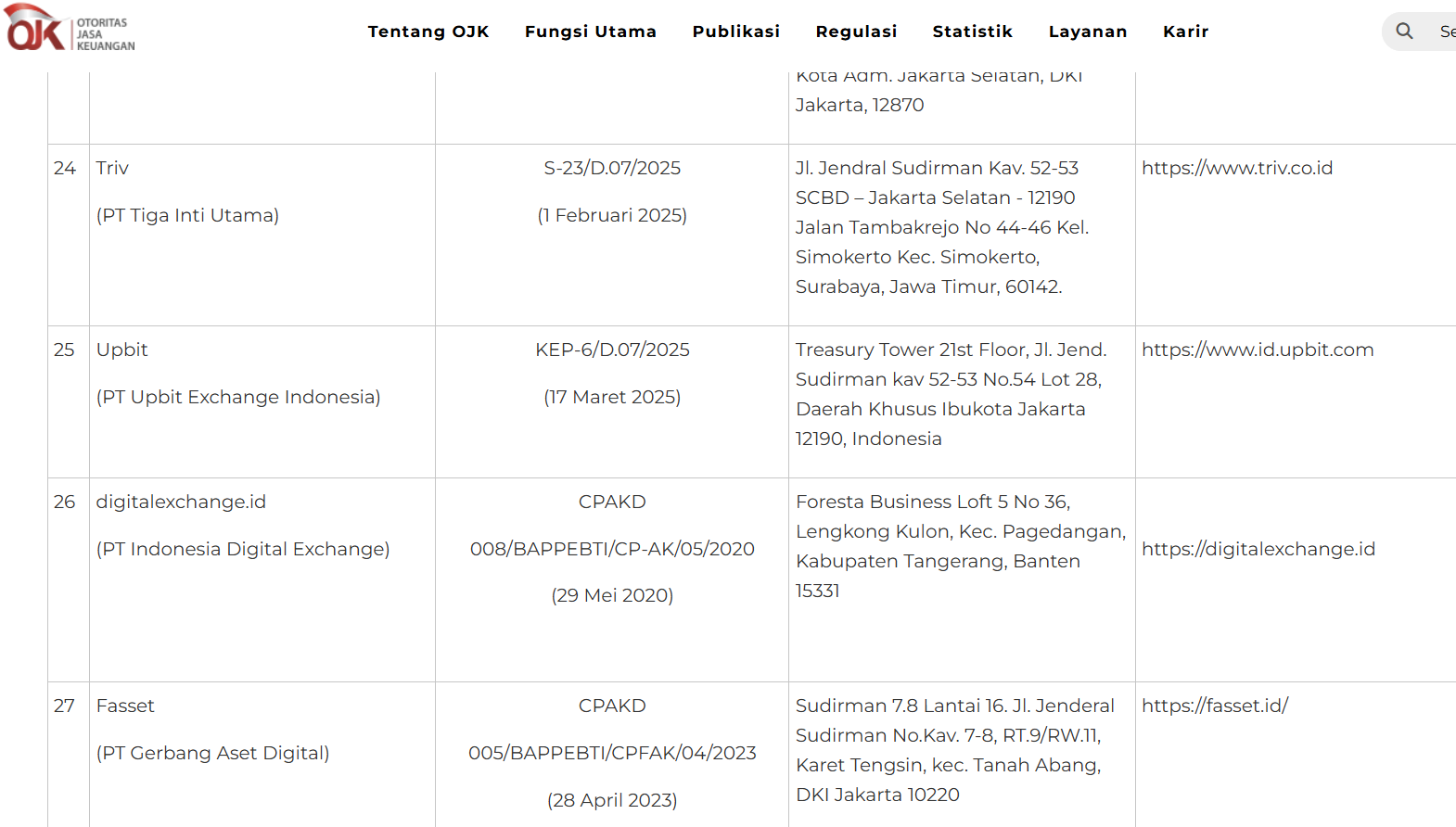
South Korea’s largest exchange, Upbit, is included among licensed exchanges. Source: OJK

​Global crypto players eyeing Indonesia

The clarification of who can legally offer crypto services lands as global players move to lock in Indonesian footholds.

Robinhood signed deals earlier this month to acquire Indonesian brokerage Buana Capital and licensed digital asset trader PT Pedagang Aset Kripto, a move that gives it entry to a market with more than 19 million capital‐market investors and about 17 million crypto traders.

Related: Indonesia’s digital rupiah CBDC to get ‘stablecoin’ companion backed by government bonds

Hong Kong–based OSL Group completed its acquisition of licensed local exchange Koinsayang in September, securing regulatory approval to offer spot and derivatives trading.

Related: Survey finds 6 in 10 of Asia’s rich plan to ramp up crypto buying

Tightening oversight of digital assets

The whitelist follows OJK Regulation No. 23/2025, which tightens oversight of digital financial assets, including crypto and related derivatives. The rule bars exchanges from facilitating trades in assets that are not registered or approved by a licensed digital asset exchange, and it introduces a framework for digital asset derivatives that requires prior OJK approval at the exchange level.

Platforms must implement margin mechanisms via segregated funds or digital assets, and consumers have to pass a knowledge test before accessing derivatives. These are measures the regulator said were designed to align with international supervisory standards and strengthen investor protection.

Related: Ripple’s big Singapore win: What the expanded license allows now

Among fastest-growing markets worldwide

Indonesia’s tightening grip on licensing comes as the country cements its place as a major crypto market. Robinhood and industry data providers describe Indonesia as one of Southeast Asia’s fastest‐growing crypto economies, with tens of millions of investors across capital markets and digital assets.

Chainalysis’ 2025 Global Crypto Adoption Index places Indonesia in the global top 10 for crypto adoption and notes that the country has been among the most dynamic markets worldwide, highlighting its growing presence in global digital asset activity.

Perguntas relacionadas

QHow many licensed crypto platforms has Indonesia's Financial Services Authority (OJK) officially listed?

AIndonesia's Financial Services Authority (OJK) has published a whitelist of 29 licensed crypto platforms.

QWhat major South Korean exchange is included in Indonesia's list of licensed crypto platforms?

ASouth Korea's largest exchange, Upbit, is included among the licensed exchanges in Indonesia.

QWhich company recently acquired Indonesian brokerage Buana Capital and licensed digital asset trader PT Pedagang Aset Kripto?

ARobinhood signed deals to acquire Indonesian brokerage Buana Capital and licensed digital asset trader PT Pedagang Aset Kripto.

QWhat does OJK Regulation No. 23/2025 introduce for digital asset derivatives trading?

AOJK Regulation No. 23/2025 introduces a framework for digital asset derivatives that requires prior OJK approval at the exchange level and mandates that consumers pass a knowledge test before accessing derivatives.

QHow does Indonesia rank globally in terms of crypto adoption according to Chainalysis' 2025 index?

AAccording to Chainalysis' 2025 Global Crypto Adoption Index, Indonesia is placed in the global top 10 for crypto adoption.

Leituras Relacionadas

From the "National Fortune ETF" to "Bloody July": How to Defuse South Korea's Stock Market Leverage Crisis?

From "National Destiny ETF" to "Bloody July": How South Korea's Stock Market Leverage Crisis Unfolded In mid-July, South Korea's stock market experienced an epic "deleveraging" storm. Leveraged ETFs tied to semiconductor giants like Samsung and SK Hynix, once marketed as a shortcut to wealth, turned into financial shredders as market sentiment reversed. Over nine trading days, losses in popular leveraged ETFs exceeded 59.5 billion USD, with retail investors bearing 60% of the impact. Data shows散户 investors suffered losses of around 1.45 billion USD in a month. A severe wave of margin calls affected over 1.2 million accounts, leading to the complete liquidation of 460,000 accounts, 62% of which belonged to investors in their 20s and 30s. The crisis peaked around July 13th, with SK Hynix plunging over 15% and related 2x leveraged ETFs crashing 30%. The daily rebalancing mechanism within leveraged ETFs amplified the sell-off into a stampede. The situation was worsened by a credit crunch, as major banks neared their annual household lending caps, leaving散户 unable to borrow funds to meet margin calls. An unexpected 25-basis-point rate hike by the Bank of Korea on July 16th further intensified the panic. Facing mounting political pressure, President李在明 intervened. Financial authorities quickly announced seven stringent measures, including banning new sales of single-stock leveraged ETFs, raising investment thresholds, and strengthening risk warnings. The regulatory approach focused not on forcibly liquidating existing products but on restricting new inflows, aiming for a gradual market cool-down. However, risks persist, with over 235.5 billion USD in margin loan balances still outstanding in the market. The crisis served as a stark reminder of the dangers of excessive leverage, especially for retail investors, when speculative bubbles built on easy credit and complex products inevitably burst.

marsbitHá 49m

From the "National Fortune ETF" to "Bloody July": How to Defuse South Korea's Stock Market Leverage Crisis?

marsbitHá 49m

Trading

Spot
活动图片