Indiana Advances Bitcoin Rights Law as U.S. States Deepen Crypto Integration

bitcoinistPublicado em 2026-02-26Última atualização em 2026-02-26

Resumo

Indiana lawmakers have passed House Bill 1042, known as the Bitcoin Rights Bill, which now awaits the governor's signature. If enacted, the law would allow state-managed investment funds—including retirement plans for public employees and education savings programs—to offer cryptocurrency ETFs as voluntary investment options. It also establishes legal protections for individuals using or holding digital assets, including the right to accept crypto payments and use self-custodied wallets, while prohibiting public agencies from restricting lawful crypto activities. The bill aligns with a broader trend of U.S. states integrating digital assets into public financial systems and is set to take effect in July 2026.

Indiana is moving closer to formally embedding crypto into its public financial system after lawmakers approved House Bill 1042, commonly referred to as the Bitcoin Rights Bill. The legislation has cleared both legislative chambers and now awaits the signature of Governor Mike Braun.

Related Reading: Binance Faces US Senate Inquiry Tied To $1.7 Billion In Sanctions-Related Transactions

If enacted, the law would allow certain public investment programs to provide exposure to crypto through regulated ETFs and establish legal protections for individuals who use or hold digital assets. The measure reflects a broader shift among U.S. states as they explore how crypto fits within traditional finance.
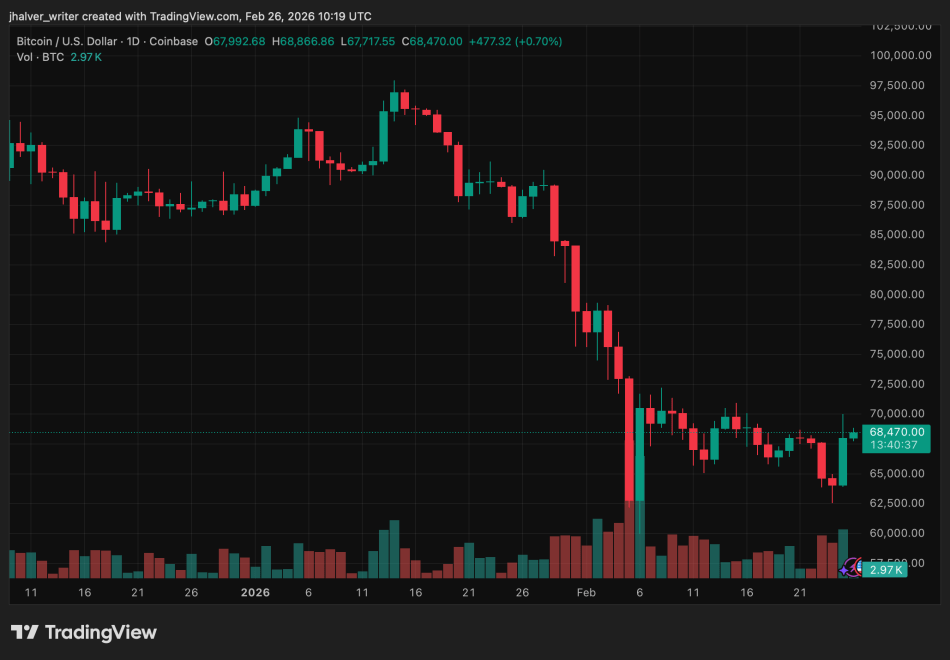
BTC's price trends to the downside with some sideways action on low timeframes as seen on the daily chart. Source: BTCUSD on Tradingview

Public Funds and Retirement Plans Open to Crypto ETFs

HB 1042 permits state-managed investment funds to include cryptocurrency ETFs as investment options rather than allowing direct token purchases. The approach aims to provide exposure through regulated financial products while maintaining oversight mechanisms.

Under the bill, several state-administered programs must offer self-directed brokerage accounts containing at least one digital asset investment option. These include retirement plans for teachers, public employees, and legislators, as well as the Hoosier START 529 education savings program.

Participation would remain voluntary, meaning individuals could choose whether to allocate funds toward crypto-related investments. Before rollout, the state must establish approved investment structures designed to manage compliance and risk oversight.

The legislation also allows eligible investment funds from outside Indiana to allocate assets into crypto ETFs under the state’s framework, potentially expanding institutional participation beyond state borders.

Legal Protections for Digital Asset Users

Beyond access to investment, the bill introduces protections for cryptocurrency users. Public agencies, with limited exceptions, would be restricted from banning or limiting lawful digital asset activities.

Residents would retain the right to accept crypto payments for legal goods and services and to store assets in self-custodied or hardware wallets. The proposal also prevents the state from imposing special taxes on crypto transactions and requires taxation rules to align with those applied to other financial activities.

Supporters argue that these provisions provide legal clarity for individuals and businesses operating in the digital asset space, while critics continue to highlight concerns about market volatility and retirement risk exposure.

Part of a Broader U.S. Policy Shift

Indiana’s move comes amid growing institutional interest in cryptos, following the expansion of crypto ETFs and evolving federal policy discussions on retirement portfolio diversification. Other states are considering similar measures, signaling a gradual shift toward incorporating digital assets into public finance structures.

HB 1042, introduced by State Representative Kyle Pierce, completed the legislative process after the House approved Senate amendments. If Governor Braun signs the bill, the law is scheduled to take effect on July 1, 2026, triggering implementation by state agencies and retirement administrators.

Related Reading: Netherlands To Amend Controversial 36% Tax On Unrealized Crypto, Stock Gains

As more states evaluate crypto-focused legislation, Indiana’s decision could serve as another trigger to the continued adoption of crypto in other states’ financial systems.

Cover image from ChatGPT, BTCUSD chart on Tradingview

Perguntas relacionadas

QWhat is the main purpose of Indiana's House Bill 1042, also known as the Bitcoin Rights Bill?

AThe main purpose is to allow certain public investment programs to provide exposure to cryptocurrency through regulated ETFs and to establish legal protections for individuals who use or hold digital assets.

QWhich specific state-administered programs must offer a digital asset investment option under this bill?

AThe programs include retirement plans for teachers, public employees, and legislators, as well as the Hoosier START 529 education savings program.

QWhat are some of the key legal protections for cryptocurrency users provided by this legislation?

AThe bill prevents public agencies from banning lawful digital asset activities, allows residents to accept crypto payments and use self-custodied wallets, and prohibits special taxes on crypto transactions, requiring taxation to align with other financial activities.

QHow does the bill propose to provide crypto exposure to public funds without allowing direct token purchases?

AIt permits state-managed investment funds to include cryptocurrency ETFs as investment options, providing exposure through these regulated financial products.

QWhen is the Indiana Bitcoin Rights Bill scheduled to take effect if signed by the governor?

AThe law is scheduled to take effect on July 1, 2026, if signed by Governor Mike Braun.

Leituras Relacionadas

Can a Hair Dryer Earn $34,000? Deciphering the Reflexivity Paradox in Prediction Markets

An individual manipulated a weather sensor at Paris Charles de Gaulle Airport with a portable heat source, causing a Polymarket weather market to settle at 22°C and earning $34,000. This incident highlights a fundamental issue in prediction markets: when a market aims to reflect reality, it also incentivizes participants to influence that reality. Prediction markets operate on two layers: platform rules (what outcome counts as a win) and data sources (what actually happened). While most focus on rules, the real vulnerability lies in the data source. If reality is recorded through a specific source, influencing that source directly affects market settlement. The article categorizes markets by their vulnerability: 1. **Single-point physical data sources** (e.g., weather stations): Easily manipulated through physical interference. 2. **Insider information markets** (e.g., MrBeast video details): Insiders like team members use non-public information to trade. Kalshi fined a剪辑师 $20,000 for insider trading. 3. **Actor-manipulated markets** (e.g., Andrew Tate’s tweet counts): The subject of the market can control the outcome. Evidence suggests Tate’sociated accounts coordinated to profit. 4. **Individual-action markets** (e.g., WNBA disruptions): A single person can execute an event to profit from their pre-placed bets. Kalshi and Polymarket handle these issues differently. Kalshi enforces strict KYC, publicly penalizes insider trading, and reports to regulators. Polymarket, with its anonymous wallet-based system, has historically been more permissive, arguing that insider information improves market accuracy. However, it cooperated with authorities in the "Van Dyke case," where a user traded on classified government information. The core paradox is reflexivity: prediction markets are designed to discover truth, but their financial incentives can distort reality. The more valuable a prediction becomes, the more likely participants are to influence the event itself. The market ceases to be a mirror of reality and instead shapes it.

marsbitHá 16m

Can a Hair Dryer Earn $34,000? Deciphering the Reflexivity Paradox in Prediction Markets

marsbitHá 16m

First Day Review of "Musk's WeChat" XChat: Even Worse Than Expected

Elon Musk's much-anticipated "WeChat-like" app, XChat, has officially launched after multiple delays. The initial review reveals a product that falls short of expectations, offering an experience largely similar to X Platform's (formerly Twitter) direct messages, despite being marketed as an encrypted communication tool. Key observations from the first-day test include: 1. The app's promoted "end-to-end encryption" and its claimed relation to Bitcoin's architecture were criticized by experts as a superficial attempt to capitalize on crypto buzz, with no real technical connection. 2. Musk's vision of an ad-free "secure communication system" is technically met, but only because the app is currently extremely basic, featuring only a single chat interface. 3. A promised anti-screenshot feature appears inconsistent; it works in X Platform group chats but fails within the XChat app itself, where screenshots still capture avatars. 4. The app supports 45 languages and has a 16+ age rating, indicating a broader tolerance for content compared to WeChat's 13+ rating. 5. A puzzling login process requires users to verify the email associated with their X account. 6. The touted encryption" feels minimal in practice, with its presence only indicated by a simple "Encrypted - Yes" label on messages. 7. Disappearing message timers for groups can be set from 5 minutes to 4 weeks, with the timer starting upon being read by a user. 8. Group invite links are shared with X Platform groups. 9. Group size limits are planned to be increased, aiming for 1000 members, a move that has drawn user criticism. 10. The app offers 8 different colored icons, and its chat bubbles are notably similar to WeChat's. Message deletion options mimic Telegram's. Crucially, many pre-announced features like importing X contacts, integrating Grok AI, X Money payments, and Cashtags are not yet available. The initial release is seen as a bare-bones and underwhelming first step.

Odaily星球日报Há 1h

First Day Review of "Musk's WeChat" XChat: Even Worse Than Expected

Odaily星球日报Há 1h

Trading

Spot
Futuros
活动图片





