In the Eyes of Algorithms, Oil and Memecoin Are No Different

marsbitPublicado em 2026-03-12Última atualização em 2026-03-12

Resumo

In 1974, Henry Kissinger’s “petrodollar” deal with Saudi Arabia helped sustain the global dominance of the U.S. dollar after the collapse of the gold standard. Fifty years later, oil markets are being shaken not by physical supply chains, but by digital signals. A single social media post by U.S. Energy Secretary Chris Wright on X triggered a flash crash in oil prices. He claimed the U.S. Navy had escorted a tanker through the Strait of Hormuz—a critical chokepoint for global oil transit. Within minutes, WTI crude fell 17%, erasing billions in market value. The post was soon deleted after a White House denial, and prices partially rebounded, but the damage was done. The incident highlights how algorithmic trading systems now drive market reactions. Algorithms scanned the post, detected keywords like “Navy,” “escorted,” and “Hormuz,” and executed sell orders in milliseconds—far faster than human traders could react. Oil, once governed by physical supply and geopolitical agreements, now behaves like a meme-driven instrument, vulnerable to unverified information. This event underscores a broader shift: the “memefication” of assets. In an age of AI and social media, even traditional commodities like oil can be swayed by narratives, emotions, and digital misinformation. The very foundations of market consensus have grown fragile, accelerated by algorithms that trade on speed, not substance. Perhaps, in the end, the meme has won.

In 1974, then-U.S. Secretary of State Henry Kissinger flew to Riyadh and struck a deal that would reshape the world order: Saudi Arabia would sell oil, accepting only U.S. dollars; and these dollars would then be recycled to purchase U.S. Treasury bonds.

At that time, Nixon had just severed the link between the dollar and gold. Inflation was spiraling out of control in the U.S., dollar reserves were depleted, gold was flowing out in large quantities, and the Bretton Woods system had collapsed. At that moment, many believed the golden age of the U.S. dollar was over.

But the deal Kissinger struck with Saudi Arabia established what later became known as the "petrodollar" system. It was this system that gave the U.S. dollar another half-century of life after the collapse of the gold standard.

This is also why any threat to block oil shipping lanes is not merely an energy issue for the United States, but a shock to the very foundation of the dollar system. This explains why the narrow, throat-like Strait of Hormuz has been regarded by the U.S. as a critical chokepoint that must be defended for the past fifty years, even resorting to military force if necessary.

Understanding this historical background helps us make sense of today's situation.

In the early hours this morning, while most of China was still asleep, a violent shock lasting less than an hour in the global crude oil futures market wiped out tens of billions of dollars in market value.

The cause was a social media post.

U.S. Secretary of Energy Chris Wright posted on platform X: "The U.S. Navy has successfully escorted an oil tanker through the Strait of Hormuz to ensure oil continues to flow to global markets."
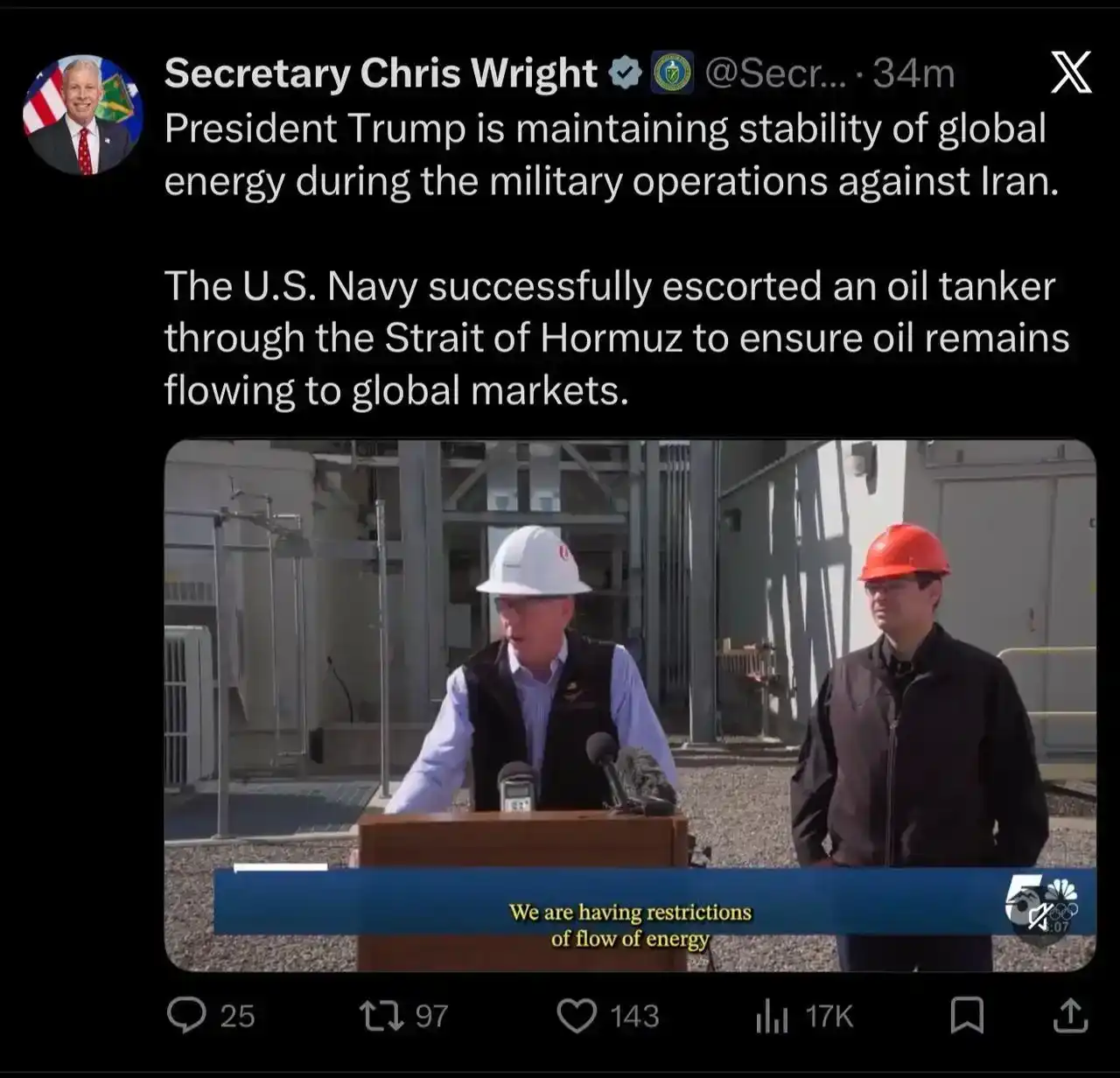
After this tweet was posted, the price of WTI crude oil plummeted within minutes, at one point falling by 17% and briefly dropping below $80 per barrel. In the preceding weeks, due to tensions in the Middle East, Brent crude had just surged from $70 to $120.
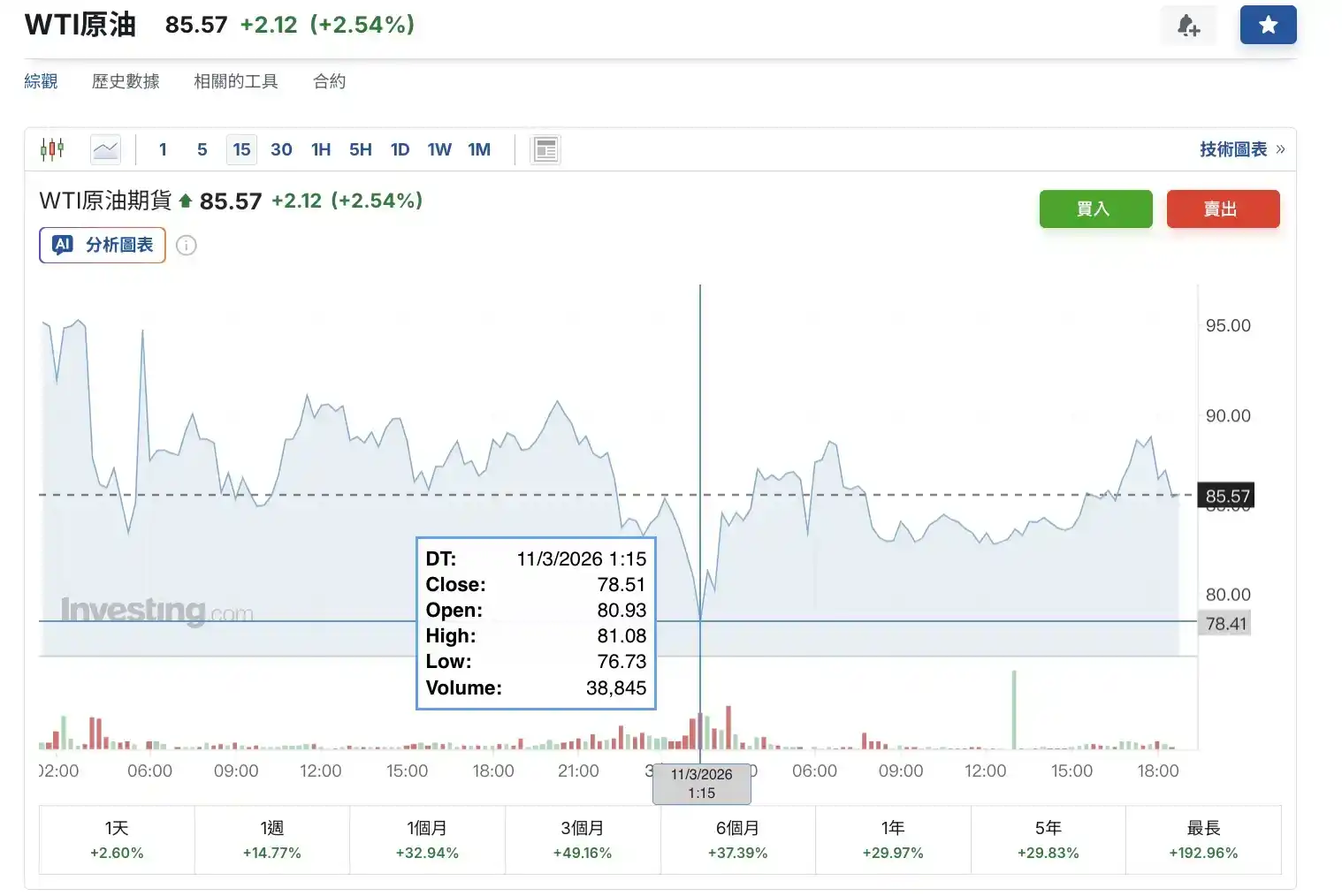
For traders betting on further oil price increases, this moment was a nightmare.

However, the plot quickly reversed.

Less than an hour later, White House Press Secretary Karoline Leavitt urgently clarified at a press briefing: the U.S. Navy is currently not escorting any oil tankers. Subsequently, Energy Secretary Chris Wright silently deleted the post without any explanation. Oil prices rebounded but failed to return to their initial levels.

One post, from publication to deletion, lasted less than sixty minutes. But the mark it left on the global financial markets far exceeded that single hour.

Since the escalation of U.S.-Iran tensions in late February, the博弈 (game) around oil has intensified. Especially after Iran announced the blockade of the Strait of Hormuz, the sudden closure of this narrow waterway, which handles about one-fifth of global crude oil shipments, caused a massive shock to the global energy market. As the situation escalated, international oil prices soared from $70 to $120 per barrel within days, putting the energy market in a state of high tension.

Almost every trader was waiting for the same signal: when will the Strait of Hormuz reopen. Under this collective anxiety, any slight movement could trigger violent price fluctuations. The rapid decline triggered by the Energy Secretary's post was a concentrated manifestation of this sentiment.

So, why could the oil price fall 17% in just a few minutes? Because humans can hardly react that fast, but algorithms can. A significant portion of today's financial market trading volume comes from high-frequency trading algorithms and AI trading systems. They scan the entire internet in real-time, including government officials' social media accounts, grabbing keywords and automatically placing orders.

That post contained three keywords: Navy, Escorted, Hormuz. The algorithms identified these words, combined with contextual semantics, and quickly reached a conclusion: the blockade is lifted, supply is restored, the logic for rising oil prices is weakened.

So the programs immediately sold.

All this happened in about 0.003 seconds.

The algorithm does not call to confirm if a tanker has actually traversed the strait; it only recognizes text and pursues speed. An unverified post, within this mechanistic "collective unconscious," was instantly converted into tens of billions of dollars in evaporated market value.

A real oil tanker crossing the Strait of Hormuz requires hours of sailing, actual military escort, and bears the cost of fuel and real-world risks. A post about an "escort" took only 0.003 seconds to cause violent fluctuations in the price of this major commodity.

In other words, oil, the king of commodities once dominated by supply and demand fundamentals, inventory data, and production agreements, has now, to some extent, become not much different from a Meme.

During the last U.S. election, Trump and Musk keenly sensed that this is an information age. One created Truth Social, the other bought Twitter.

And as the information age has developed to its current state, government officials' social media accounts have become one of the market's most sensitive information sources. This also means that power itself has begun to possess a certain Meme attribute: extremely fast propagation,极高 (extremely high) emotional concentration, and极易 (extremely easy) to be misread and amplified.

Traditional policy information transmission is slow and meticulous. White House statements, State Department bulletins, Defense Department press conferences—these mechanisms inherently involve verification, proofreading, and layers of confirmation. But when officials directly post policy-related information on X, these steps are skipped.

We can foresee that as we delve further into the AI Agent era, the speed of information capture and trading will increase exponentially, with sharp rises and falls occurring in mere milliseconds.

From a more macro perspective, this incident perhaps indicates a larger change: we are entering an era of "comprehensive asset Meme-ification." Almost any financial asset can, at some point, be driven by sentiment, narrative, and social media.

Kissinger used oil to extend the dollar's life for fifty years. But he probably never imagined that one day oil itself would also become a Meme.

No asset possesses a truly unbreakable fundamental moat. All moats are essentially built upon a certain consensus. And under the dual acceleration of social media and algorithmic trading, this consensus is more fragile and more dangerous than ever before.

Perhaps, in a sense, this is also the victory of the Meme.

Perguntas relacionadas

QWhat was the significance of the deal between Henry Kissinger and Saudi Arabia in 1974?

AThe deal established the 'petrodollar' system, where Saudi Arabia sold oil exclusively for US dollars, and those dollars were then reinvested in US Treasury bonds. This system helped sustain the US dollar's dominance after the collapse of the Bretton Woods system.

QHow did a social media post cause a sharp drop in oil prices?

AA post by US Energy Secretary Chris Wright on X claimed the US Navy escorted a tanker through the Strait of Hormuz, signaling eased supply constraints. Algorithmic trading systems quickly parsed the keywords and sold oil futures, causing prices to drop 17% in minutes.

QWhy is the Strait of Hormuz strategically important?

AThe Strait of Hormuz is a critical chokepoint for global oil transport, handling about one-fifth of the world's oil supply. Its closure or threat of closure can significantly impact global energy markets and geopolitical stability.

QWhat role do algorithms play in modern financial markets?

AAlgorithms and AI trading systems execute trades at high speeds by scanning real-time data, including social media, for keywords and market signals. They can trigger massive market movements within milliseconds based on unverified information.

QWhat does the article suggest about the nature of assets in today's economy?

AThe article argues that assets, including traditional commodities like oil, are becoming 'meme-like'—driven by narratives, emotions, and social media rather than fundamental supply-demand dynamics, making markets more volatile and consensus-based.

Leituras Relacionadas

Must-Watch Events Next Week|CLARITY Act Could Face Senate Vote; SpaceX, Circle to Report Earnings (8.3-8.9)

**Summary: Key Events and Developments to Watch (August 3-9)** The upcoming week is marked by significant financial disclosures, key legislative deadlines, and notable product updates. **Major Financial Events:** Several companies are scheduled to release their Q2 2026 earnings. American Bitcoin (ABTC) will report on August 3, followed by SpaceX and Hut 8 Mining Corp. on August 4, and Circle on August 5. Notably, a significant portion of SpaceX shares (up to 12% of total shares) will be unlocked on August 6 following their earnings release. **Key Legislative Deadline:** The U.S. Senate faces an August 7 deadline to secure 60 votes for the CLARITY Act, a bipartisan bill aiming to establish a federal regulatory framework for cryptocurrencies. The Senate may hold a full vote on the bill during the week. **Economic Data:** The U.S. July Non-Farm Payrolls report will be released on August 7, providing crucial labor market data. **Technology & Product Updates:** * **Shutdowns:** DeFi portfolio tracker Zapper and wallet app Ctrl Wallet will cease operations on August 3. * **Upgrades:** LayerZero will deprecate its v1 relayers on August 3. XRP Ledger's new version 3.3.0, featuring five new functions, is expected next week. * **AI:** Elon Musk announced that the advanced Grok 4.6 AI model is set for release around August 7. * **Bitcoin:** The BIP-110 forced signaling for a potential Bitcoin network change is scheduled to begin around August 8. **Other Notable Events:** Chinese robotics firm Unitree Tech has set its preliminary price inquiry for its IPO for August 5. South Korean exchange Upbit will delist AQT and AERGO tokens on August 3.

marsbitHá 1h

Must-Watch Events Next Week|CLARITY Act Could Face Senate Vote; SpaceX, Circle to Report Earnings (8.3-8.9)

marsbitHá 1h

Stocks Are Plummeting More Sharply Than Cryptocurrencies. Where Has the Money Gone?

Stock Markets Plunge Deeper Than Cryptocurrencies: Where Did the Money Go? In late July, Seoul's Kospi index triggered circuit breakers for two consecutive days, plummeting over 40% from its June high. The collapse was led by heavyweight stocks like SK Hynix, whose record profits still disappointed investors, and devastating leveraged ETFs, with one major product losing over 83% of its value. This signaled a global, forced deleveraging targeting the most crowded trades. Interestingly, while stocks exhibited extreme volatility akin to crypto markets, Bitcoin rose nearly 15% in July after a prior steep drop. Analysis shows the money fleeing equities did not flow into Bitcoin. Instead, Bitcoin had already absorbed its sell-off in May-June, when U.S. spot Bitcoin ETFs saw historic outflows. The true safe-haven beneficiary was gold, whose price rose over 20% year-on-year, highlighting a decoupling between Bitcoin and gold as "digital gold." The sell-off was a targeted unwinding of leveraged positions in tech and semiconductors, accelerated by broker-dealer risk management and shifts in the AI narrative, including new competition from Chinese memory chipmakers. The retreat path was clear: from high-valuation tech stocks to cash and U.S. Treasuries, then to gold. For Bitcoin to attract sustained institutional inflows, conditions like eased global liquidity pressure, a "soft-landing" Fed rate cut, and U.S. regulatory clarity via legislation like the stalled CLARITY Act are needed. Currently, Bitcoin is not a safe haven but an already-cleared asset. Its low correlation with tech stocks, however, makes it a potential diversification play for institutional portfolios once the storm passes. The money isn't here yet, but the positioning is underway.

marsbitHá 1h

Stocks Are Plummeting More Sharply Than Cryptocurrencies. Where Has the Money Gone?

marsbitHá 1h

In Conversation with Ray Dalio: We Are Currently in an AI Bubble, with 1% of My Portfolio in Bitcoin

Ray Dalio, founder of Bridgewater Associates, warns in an interview that the current AI boom shows classic bubble characteristics, which could lead to significant economic downturns as seen in past cycles like 1929 or 2000. He explains that speculative enthusiasm, fueled by debt and overvaluation, often precedes a crash when rising rates or taxation force asset sales, causing widespread losses and recession. Dalio also outlines his "Big Cycle" theory, describing an approximate 80-year pattern where widening wealth gaps, massive government deficits, and shifting geopolitical power (like China's rise) create internal conflict and global instability. He emphasizes that we are in a late-cycle, transitional phase where traditional powers like the US and UK face decline. For personal wealth protection, Dalio advises diversification beyond cash into assets like stocks, bonds, real estate, and particularly gold, which he prefers over Bitcoin. While he holds about 1% of his portfolio in Bitcoin as a non-printable hard asset, he views gold as more secure from technological or governmental threats. Regarding AI's impact, Dalio believes it will disproportionately benefit capital owners, worsening inequality by replacing both physical and cognitive labor. He suggests that human intuition and emotional intelligence, combined with AI, will be key for future workers. On taxation, Dalio argues that wealth taxes are impractical and risk triggering asset sell-offs, reducing productive investment. He points to the UK as a cautionary example of debt, low productivity, and political strife. Geopolitically, Dalio foresees a more regionalized world, with the US showing weakness in prolonged conflicts like with Iran, akin to past imperial declines. The ideal outcome, he suggests, is coexisting powerful blocs (e.g., Americas, China-Asia Pacific) without major war.

marsbitHá 5h

In Conversation with Ray Dalio: We Are Currently in an AI Bubble, with 1% of My Portfolio in Bitcoin

marsbitHá 5h

Trading

Spot
活动图片





