In the AI Era, How Do GitHub Stars Become Developers' 'Proof of Execution'?

比推Publicado em 2026-03-10Última atualização em 2026-03-10

Resumo

"The article argues that GitHub has evolved from a code hosting platform into an 'execution stock exchange' in the AI era, where stars serve as verifiable proof of attention and execution. Key metrics like stars, forks, issues, and pull requests are framed as forms of developer capital: stars represent public confidence, forks indicate real investment of time, issues drive progress, and PRs enable compounding collaboration. The author highlights real-time data from fast-growing AI-related repositories, such as openclaw and paperclip, to demonstrate how GitHub signals market trends. The platform is presented as a transparent, actionable market for developer attention, where users can build a quantifiable 'social capital ledger' by tracking and investing in promising projects early."

Author: AttentionVC

Compiled by: Deep Tide TechFlow

Original title: In the Era of Universal AI, the Star on GitHub Is the New Social Capital


Deep Tide Introduction: AttentionVC posted a widely noticed long tweet, with the core argument being: GitHub is no longer just a code hosting platform; it is the 'execution exchange' of the AI era.

Star count is a verifiable attention signal, Fork is real investment, and PR is compound collaboration. They tracked over 4,600 code repositories and 474 developers, 71% of which are AI-related.

This tweet itself is also a promotion for their product GitHubVC, but the observation of GitHub as a 'developer social capital ledger' is indeed interesting.

Full text as follows:

You released something amazing. A feature that improves workflow efficiency by 10 times. The code is so clean it's heartbreaking. Yet... your repo only has 10 stars. Maybe 100 if you're lucky.

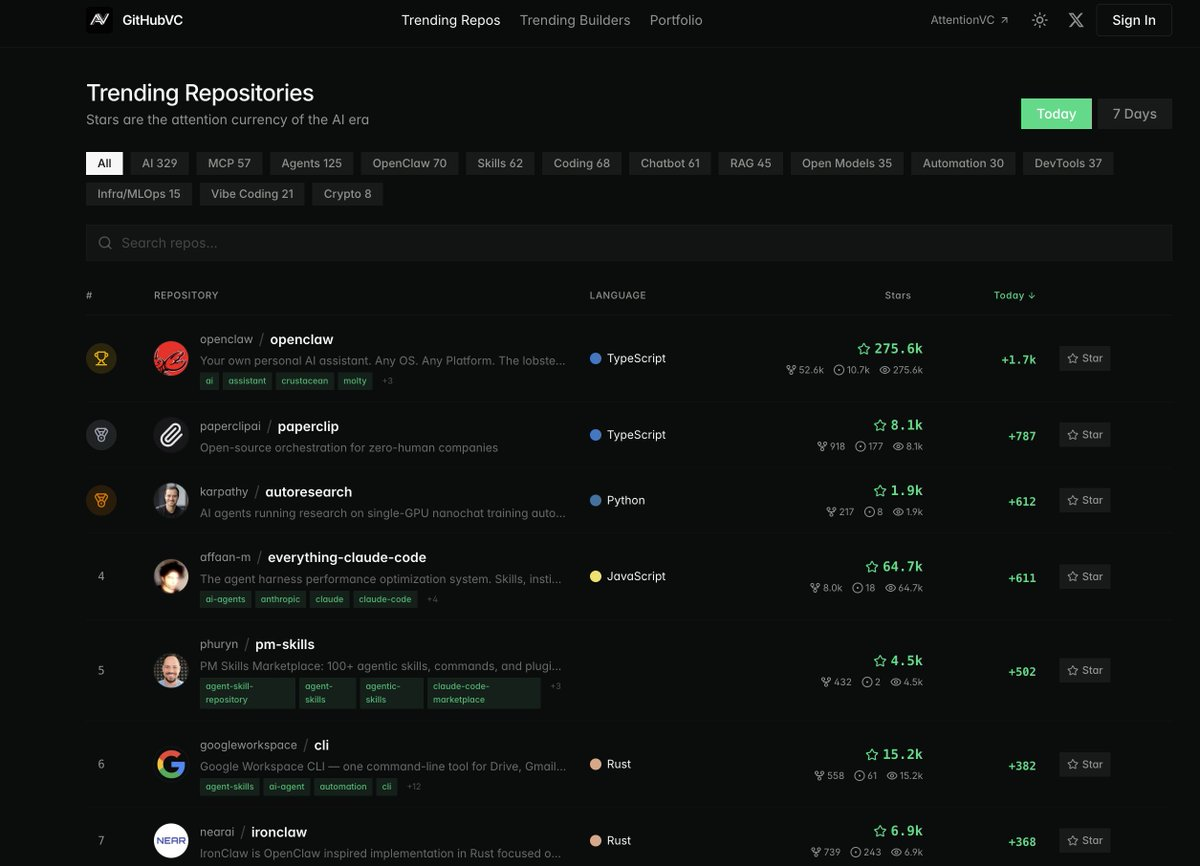
Meanwhile, @openclaw just surpassed 275,000 stars, with a daily increase of 2,870 stars, overtaking many long-standing top projects and securing one of the highest star counts on GitHub.
That moment wasn't luck. It proved something irreversible:

GitHub has evolved. It is no longer just 'code hosting.' It is the execution exchange of the AI era, and execution signals are the scarcest, most verifiable form of attention.

On X, You Express; On GitHub, You Execute

X gives you emotion, virality, reach. GitHub gives you proof. A viral tweet dies in 48 hours. A steep star growth curve lives forever—founders track it, investors do due diligence, and Agents will soon rank by it.

As you read this:

  • paperclipai/paperclip grows by +1,191 stars daily

  • Google Workspace CLI, launched just days ago, already has 15,000 stars, growing by +935 daily

  • OpenAI Symphony reached 8,400 stars, growing by +834 daily

These are not vanity metrics—they are real-time market signals, indicating where developer attention is flowing.

No matter how killer your feature is, it's useless if no one sees the signal.

Star = Vote, Fork = Commitment, Issue = Conversation, PR = Delivery

These are no longer just mechanisms. They are the atomic units of developer capital:

  • Star → Public deposits of confidence

  • Fork → I'm betting real time and energy on you

  • Issue → Conversations that actually move things forward

  • PR → Collaborations that compound into production

Junk traffic bounces off. Only real developer attention compounds here.

We are currently tracking over 4,600 code repositories and 474 developers. 71% of them are AI-related. The frontier is being built here—the signals are all public, if you know where to look.

Currently Fastest-Growing Repos (Real-Time Data)

  • openclaw/openclaw — 275k stars (today +2,870)

  • paperclipai/paperclip — 7.7k stars (today +1,191)

  • googleworkspace/cli — 15k stars (today +935)

  • openai/symphony — 8.4k stars (today +834)

  • everything-claude-code — 64k stars (today +802)

Full list:

https://github.attentionvc.ai/trending/repos

Your Personal Attention Portfolio, Now Quantifiable

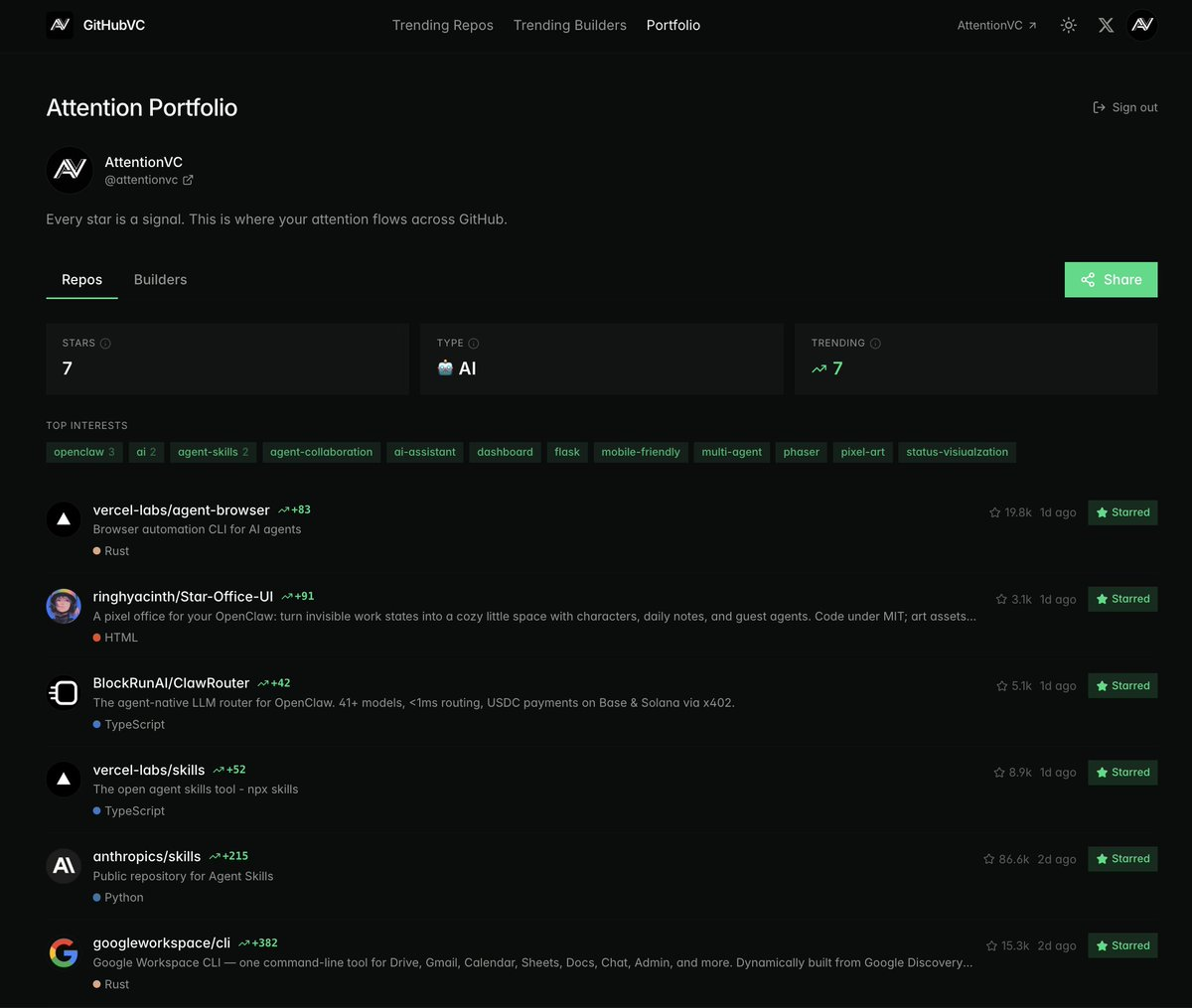
Log in with your GitHub account. See a repo you believe in? Star it directly in GitHubVC. Then watch in real time:

Does your bet appear on the daily fastest-growing list? Did your early star follow the curve from 200 → 20k → 200k?

This is the missing闭环: You're not just consuming signals—you're creating them and tracking them. Your star becomes a verifiable bet with public ROI.

Every Developer Gets a Dynamic Social Layer

GitHubVC turns your GitHub identity into something far more powerful—your personal capability network.

You start building:

  • A curated portfolio of repos, recording where you placed attention early

  • A visible trust trail: which developers you believed in at 200 stars, who grew to 200k

  • An influence score that rises whenever a repo you starred explodes

This isn't about having more followers. It's about having a trust trail—a permanent record of who believed in whom first.

Your GitHub is no longer a static profile. It becomes your public, verifiable social capital ledger in the developer economy.
GitHub Is Now a Real-Time Market for Developer Attention

In the real world, judging execution is slow, subjective, private. On GitHubVC, it's instant, public, actionable.

The era of treating GitHub attention as serious capital has arrived.

Stop wondering why your killer product remains unseen. Come build your portfolio. Place your attention bets on the next 200k-star repo. Leave a trust trail that compounds forever.


Twitter: https://twitter.com/BitpushNewsCN

BitPush TG Discussion Group: https://t.me/BitPushCommunity

BitPush TG Subscription: https://t.me/bitpush

Original link: https://www.bitpush.news/articles/7618433

Perguntas relacionadas

QWhat is the core argument of the article regarding GitHub in the AI era?

AThe core argument is that GitHub has evolved beyond a code hosting platform into an 'execution stock exchange' for the AI era, where stars serve as a verifiable signal of developer attention and execution capability.

QAccording to the article, what do the different GitHub actions (Star, Fork, Issue, PR) represent?

AStar represents a public vote of confidence; Fork represents investing real time and effort; Issue represents dialogue that drives progress; and PR represents collaborative work that compounds into the production environment.

QWhat percentage of the 4600+ repositories and 474 developers tracked by GitHubVC are AI-related?

A71% of the tracked repositories and developers are AI-related.

QWhich repository had the highest number of stars and the highest daily growth according to the real-time data mentioned?

AThe openclaw/openclaw repository had the highest number of stars at 275,000 and the highest daily growth with an increase of 2,870 stars.

QHow does GitHubVC enhance a developer's GitHub profile according to the article?

AGitHubVC transforms a developer's GitHub profile into a dynamic social capital ledger, allowing them to build a curated portfolio of repos, a visible trust trail of early support for successful projects, and an influence score that increases when their starred repos gain popularity.

Leituras Relacionadas

Near Returns to the AI Stage: Transformation into a Public Chain Due to 'Payroll Difficulties,' Agent and Privacy Emerge as New Growth Narratives

NEAR Returns to AI Origins: From Payroll Struggles to Blockchain, Now Focusing on AI Agents and Privacy NEAR Protocol's journey began not with grand blockchain ambitions, but from a practical hurdle: its AI startup founders, including Transformer paper co-author Illia Polosukhin, couldn't efficiently pay international developers in 2017. This led them to pivot and build a high-performance, scalable blockchain. After years navigating various crypto narratives like sharding and cross-chain interoperability, NEAR is now leveraging its AI roots to re-enter the AI arena. A key driver is its "NEAR Intents" layer, which abstracts complex cross-chain transactions. Users simply state their goal (e.g., swap BTC for ETH), and a solver network finds the optimal route. This system has processed over $20B in cross-chain volume, generating significant fee revenue. A major growth area is private transactions via "Confidential Intents/Swaps," which hide trade details until settlement to protect against MEV and front-running. Remarkably, private swaps recently accounted for over 40% of NEAR's transaction volume, highlighting strong demand but also potential regulatory scrutiny. With its AI-founder pedigree, NEAR is positioning itself at the intersection of blockchain, AI agents, and privacy, aiming to become infrastructure for the emerging agent economy while navigating the challenges of its rapid adoption.

marsbitHá 1h

Near Returns to the AI Stage: Transformation into a Public Chain Due to 'Payroll Difficulties,' Agent and Privacy Emerge as New Growth Narratives

marsbitHá 1h

From Ethereum to AI's 'CROPS': What Exactly is This Set of 'Slow Variables' That Vitalik Repeatedly Emphasizes?

In recent discussions, Vitalik Buterin has frequently emphasized the concept of "CROPS," a framework defining core values for Ethereum's development. CROPS stands for Censorship Resistance, Capture Resistance, Open Source, Privacy, and Security. Initially outlined in the Ethereum Foundation's "EF Mandate," it represents a commitment to user sovereignty, ensuring that the network resists external control, remains open, protects privacy, and prioritizes security. The relevance of CROPS extends beyond Ethereum's foundational principles, becoming crucial in the context of AI integration. As AI agents begin handling wallet operations and automated transactions, the risk increases that users may cede control over their digital assets, privacy, and intentions to centralized AI service providers. A "CROPS AI" would therefore emphasize local execution where possible, privacy-preserving remote model calls (e.g., using zero-knowledge proofs), and transparent, verifiable processes to maintain user agency. Vitalik highlights a significant convergence between "CROPS Ethereum access layer" and "CROPS AI." Both address the same fundamental challenge: how users can access powerful services—be it blockchain data via RPCs or AI models—without exposing sensitive information or relinquishing ultimate control. This intersection points toward a future digital entry point that is more private, secure, and user-controlled. Ultimately, CROPS is not merely an abstract ideal but a practical guidepost. It steers development—from protocol resilience and wallet design to AI agent safety—towards a future where users retain self-sovereignty even as digital systems grow more complex and powerful. In an era of accelerating AI adoption, these "slow variables" of censorship resistance, openness, privacy, and security may define Ethereum's enduring value.

marsbitHá 1h

From Ethereum to AI's 'CROPS': What Exactly is This Set of 'Slow Variables' That Vitalik Repeatedly Emphasizes?

marsbitHá 1h

Silicon Valley 'Startup Guru' Steve Hoffman: Web3 + AI Could Be a Trap

Silicon Valley investor and "Godfather of Startups" Steve Hoffman warns that combining Web3 with AI is likely a trap, not a promising venture. In an interview, Hoffman argues that while AI is a foundational technology touching all industries, Web3 adds complexity, friction, and regulatory risk without solving mainstream consumer or business needs. He advises founders to focus on deep, specialized applications where startups can out-iterate giants, rather than on generic features easily replicated by large tech companies. Hoffman observes that Silicon Valley will lead foundational AI research, while China excels at rapid, large-scale application and commercialization, particularly in robotics. He stresses that AI-driven autonomous agents capable of collaborative, multi-step tasks are 2-4 years away, which will cause significant job displacement. The solution is not to slow AI but to redesign business models around human-AI collaboration and reform social systems like education and retraining. For startups, Hoffman recommends focusing on vertical, expertise-heavy domains to build defensibility. He sees major opportunities in AI fraud detection and cybersecurity. Key founder mindsets include systemic thinking over feature-focus, relentless customer centricity, building adaptive teams, and deeply understanding AI's capabilities and limits. Hoffman is also leading a non-profit initiative to establish university centers aimed at training future leaders in responsible, human-value-aligned AI innovation.

marsbitHá 3h

Silicon Valley 'Startup Guru' Steve Hoffman: Web3 + AI Could Be a Trap

marsbitHá 3h

Token Inefficient, Economy Tokenless

The article "Tokens Aren't Economical, Economics Aren't Tokenized" analyzes a pivotal shift in the AI industry from a technology-driven narrative to one dominated by capital efficiency. It highlights two concurrent trends: a severe capital shortage due to the exorbitant and recurring costs of compute (e.g., OpenAI's high burn rate) and a wave of corporate spin-offs where major tech companies are separating their AI units (like Kuaishou's Kling and Baidu's Kunlunxin). The core argument is that AI's "anti-internet" business model, where user growth increases costs rather than profits, has created a disconnect between high valuations and actual cash flow. Spin-offs address this by allowing AI assets to be valued independently. Within a parent company, they are seen as cost centers, but as standalone entities, they are priced based on their growth potential and scarcity in the primary market, leading to massive valuation premiums (e.g., Kling's estimated value tripling post-spin-off). The industry is at an inflection point, moving from "model worship" to "value realization." The competition is evolving from a pure compute (GPU) race to a broader focus on systemic efficiency and full-stack engineering (involving CPUs and orchestration) to achieve viable commercialization. The year 2026 is framed as a critical moment where the industry must definitively answer how to economically translate AI capability into tangible business value, reshaping the sector's future power structure.

marsbitHá 3h

Token Inefficient, Economy Tokenless

marsbitHá 3h

Trading

Spot
Futuros

Artigos em Destaque

Como comprar ERA

Bem-vindo à HTX.com!Tornámos a compra de Caldera (ERA) simples e conveniente.Segue o nosso guia passo a passo para iniciar a tua jornada no mundo das criptos.Passo 1: cria a tua conta HTXUtiliza o teu e-mail ou número de telefone para te inscreveres numa conta gratuita na HTX.Desfruta de um processo de inscrição sem complicações e desbloqueia todas as funcionalidades.Obter a minha contaPasso 2: vai para Comprar Cripto e escolhe o teu método de pagamentoCartão de crédito/débito: usa o teu visa ou mastercard para comprar Caldera (ERA) instantaneamente.Saldo: usa os fundos da tua conta HTX para transacionar sem problemas.Terceiros: adicionamos métodos de pagamento populares, como Google Pay e Apple Pay, para aumentar a conveniência.P2P: transaciona diretamente com outros utilizadores na HTX.Mercado de balcão (OTC): oferecemos serviços personalizados e taxas de câmbio competitivas para os traders.Passo 3: armazena teu Caldera (ERA)Depois de comprar o teu Caldera (ERA), armazena-o na tua conta HTX.Alternativamente, podes enviá-lo para outro lugar através de transferência blockchain ou usá-lo para transacionar outras criptomoedas.Passo 4: transaciona Caldera (ERA)Transaciona facilmente Caldera (ERA) no mercado à vista da HTX.Acede simplesmente à tua conta, seleciona o teu par de trading, executa as tuas transações e monitoriza em tempo real.Oferecemos uma experiência de fácil utilização tanto para principiantes como para traders experientes.

472 Visualizações TotaisPublicado em {updateTime}Atualizado em 2026.06.02

Como comprar ERA

Discussões

Bem-vindo à Comunidade HTX. Aqui, pode manter-se informado sobre os mais recentes desenvolvimentos da plataforma e obter acesso a análises profissionais de mercado. As opiniões dos utilizadores sobre o preço de ERA (ERA) são apresentadas abaixo.

活动图片