If MSCI Removes MSTR, Will the Stock Price Actually Fall? Historical Backtesting Reveals a Surprising Answer

marsbitPublicado em 2025-12-15Última atualização em 2025-12-15

Resumo

The article examines whether MSCI's potential removal of MicroStrategy (MSTR) from its index would actually cause a significant drop in its share price, based on historical backtesting. MSCI index changes can trigger forced selling by passive funds, reducing liquidity and investor confidence. However, historical data from the November 2025 MSCI rebalancing shows that most of the price decline for removed stocks occurred during the pre-announcement anticipation phase (average drop of 24.5%), not after the official announcement (average drop of only 0.7%) or on the effective date. Some stocks even rebounded after removal. MSTR has already fallen 51% from its October high, suggesting the market may have already priced in the risk of removal. Additionally, Nasdaq 100's recent decision to retain MSTR indicates strong fundamentals and liquidity. The core driver of MSTR’s price remains Bitcoin’s performance. If MSCI retains MSTR on January 15, it could be a positive surprise. The current setup may present an asymmetric risk-reward opportunity for MSTR.

The discussion about whether MSCI should remove MicroStrategy from its index has become a Sword of Damocles hanging over the company.

The market seems to be waiting for the official announcement on January 15th to deliver the final verdict on $MSTR.

How influential is MSCI really? If removed, will MicroStrategy's stock actually fall? I backtested historical data, and the answer is surprising.

Let's state the conclusion first: even if MSCI removes MSTR, it's highly likely that MSTR won't experience a significant drop because of it.

I. Why We Care About MSCI

First, we need to understand why MSCI's decision is so important.

The MSCI index is not just a simple list of stocks; it's the benchmark for trillions of dollars in global asset allocation.

1⃣ Forced Buying and Selling by Passive Funds:

Globally, trillions of dollars in ETFs (like iShares, Vanguard) and index funds strictly track the MSCI USA Index.

Once MSCI announces the removal of a stock, these funds must unconditionally sell that stock on the effective date (usually at the market close on the last day of the month), regardless of cost.

2⃣ A Double Blow to Liquidity and Attention:

Removal typically means the company is kicked out of the "core asset" club. Many actively managed funds, constrained by risk control rules (e.g., only allowed to invest in major index constituents), are also forced to follow suit and reduce their positions. This leads to decreased stock liquidity and a lower valuation benchmark.

II. Echoes from History: The Big Drop Often Happens *Before* the Announcement

However, based on my backtest of data from the last MSCI index review, the decline often doesn't begin on the day of the index adjustment.

The rule in financial markets is: the price always moves ahead of the news.

The most recent MSCI index adjustment occurred this November, removing companies like Whirlpool, Sensata, and ZoomInfo.

The timeline for an MSCI index adjustment is as follows:

November 5th: Announcement of the changes

November 25th: Changes become effective

Through calculation, I found that the maximum decline for the removed stocks did not occur *after* the removal took effect, but rather during the anticipation phase *before* the announcement.

The data is shown in the chart below
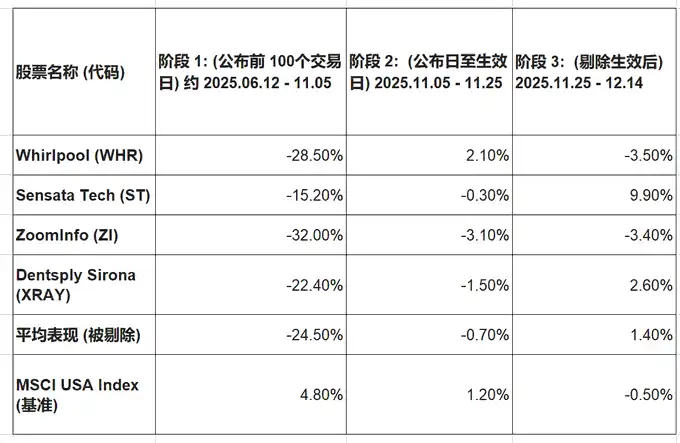
Phase 1 (Panic Brewing Period, 100 days before announcement):

During this period, stocks that were eventually removed fell by an average of 24.5%. The market anticipated the removal outcome in advance through deteriorating fundamentals and shrinking market capitalization.

Smart money had already front-run the move.

Phase 2 (Bad News Realization Period, Announcement day to Effective day):

When MSCI officially announced the removal list, stock performance was反而 stable, with an average decline of only 0.7%.甚至, individual stocks like Whirlpool (WHR)反而 saw a 2.1% rebound after the announcement.

Phase 3 (Post-Effect Recovery Period):

After the official removal took effect, some oversold individual stocks (like Sensata) even recorded gains of nearly 10%.

Overall, the average decline was 24.5% *before* the announcement, and 0.7% *after* the announcement.

Back to our protagonist 【MSTR】

MSCI announced in October that it was considering removing stocks of MSTR's type from the index.

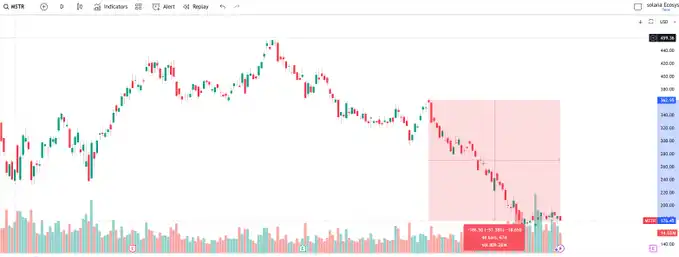
And MSTR's stock price has fallen 51% from its October high, far exceeding the decline in BTC over the same period.

Just like other companies removed from the MSCI index, the market has already started front-running the passive funds *before* MSCI's decision.
III. The Signal from the Nasdaq 100

When analyzing whether MicroStrategy will truly be removed by MSCI,

we cannot ignore a key leading indicator: the Nasdaq 100 index.

Although the Nasdaq 100 and MSCI USA indices have different construction rules, their core logic is highly overlapping: both place extreme importance on market capitalization and liquidity.

This past Friday, the Nasdaq 100 index announced it would retain MicroStrategy's constituent status.
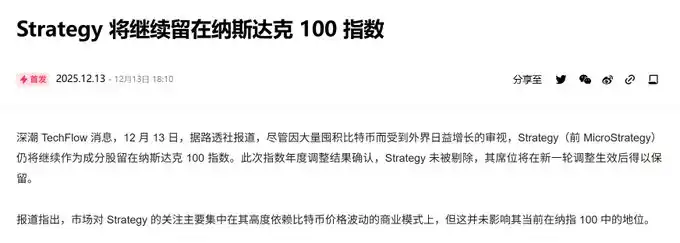
This means that, from an index compilation perspective, MicroStrategy's average daily trading volume and free-float market capitalization still meet the stringent standards for being among the top 100 largest non-financial technology companies in the US.

Since MicroStrategy managed to hold its ground in the Nasdaq 100, it indicates that its fundamentals and liquidity have not deteriorated to an irreparable point.

Although MSCI has its own qualitative industry classification considerations, in terms of hard metrics, MicroStrategy still possesses strong competitiveness.

Conclusion

MSCI potentially removing MSTR from its index is definitely a significant negative.

But negatives are often提前 priced in by the market. According to historical backtesting, the impact on the stock price after the negative news materializes is反而 not significant.

The core variable真正 affecting MSTR's direction right now is still the trend of BTC.

甚至, because MSCI's potential removal of MSTR is still only in the discussion phase, if the announcement on January 15th next year ends up retaining MSTR's constituent status, that would be a major positive. Retention = big rise! Removal = small fall. I believe MSTR presents an opportunity for asymmetric returns in the period ahead.


Perguntas relacionadas

QWhat is the main conclusion of the article regarding MSTR's stock price if it is removed from the MSCI index?

AThe main conclusion is that even if MSCI removes MSTR from its index, MSTR's stock price is unlikely to fall significantly, as the negative impact has likely already been priced in by the market.

QAccording to the historical backtest, when did the largest average price drop occur for stocks removed from the MSCI index?

AThe largest average price drop of 24.5% occurred during the 'panic fermentation phase,' which is the 100 days before the official announcement of the removal.

QWhat is the significance of the Nasdaq 100 index's recent decision regarding MSTR?

AThe Nasdaq 100 index's decision to retain MSTR as a component is a key leading indicator, suggesting that MSTR's average trading volume and free-float market cap still meet the stringent standards for a top-100 non-financial tech company, which could influence MSCI's decision.

QWhat does the article identify as the core variable that will truly influence MSTR's future price movement?

AThe article identifies the price movement of Bitcoin (BTC) as the core variable that will truly influence MSTR's future price direction.

QWhat potential asymmetric opportunity does the article suggest exists for MSTR?

AThe article suggests an asymmetric opportunity exists because if MSCI announces on January 15th that it will retain MSTR, it would be a major positive catalyst causing the stock to rise significantly, whereas a removal is expected to have only a minor negative impact, creating a favorable risk-reward scenario.

Leituras Relacionadas

How Many Tokens Away Is Yang Zhilin from the 'Moon Chasing the Light'?

The article explores the intense competition between two leading Chinese AI companies, DeepSeek and Kimi (Moon Dark Side), and the mounting pressure on Yang Zhilin, the founder of Kimi. While DeepSeek re-emerged after 15 months of silence with its powerful V4 model—boasting 1.6 trillion parameters and low-cost, long-context capabilities—Kimi has been focusing on long-context processing and multi-agent systems with its K2.6 model. Yang faces a threefold challenge: technological rivalry, commercialization pressure, and investor expectations. Despite Kimi’s high valuation (reaching $18 billion), its revenue heavily relies on a single product with low paid conversion rates, while DeepSeek’s strategic silence and open-source influence have strengthened its market position and valuation prospects, now targeting over $20 billion. Both companies reflect broader trends in China’s AI ecosystem: Kimi aims for global influence through open-source contributions and agent-based advancements, while DeepSeek prioritizes foundational innovation and hardware independence, notably shifting to Huawei’s chips. Their competition is seen as vital for China’s AI progress, with the gap between top Chinese and U.S. models narrowing to just 2.7% on the Elo rating scale. Ultimately, the article argues that this rivalry, though anxiety-inducing for leaders like Zhilin, is essential for driving innovation and solidifying China’s role in the global AI landscape.

marsbitHá 6h

How Many Tokens Away Is Yang Zhilin from the 'Moon Chasing the Light'?

marsbitHá 6h

TechFlow Intelligence Bureau: ChatGPT Helps Amateur Mathematician Crack 60-Year-Old Problem, CFTC Sues New York Regulator Over Coinbase and Gemini

An amateur mathematician, with the assistance of ChatGPT, has solved a combinatorial mathematics puzzle originally proposed by Hungarian mathematician Paul Erdős in the 1960s. This marks another milestone in AI-aided mathematical research, demonstrating the evolving capabilities of large language models in formal reasoning. In other AI developments, OpenAI introduced a new privacy filter tool for enterprise API usage, automatically screening sensitive data. Meanwhile, the Qwen3.6-27B model achieved 100 tokens per second on a single RTX 5090 GPU using quantization, significantly lowering the cost barrier for local AI deployment. In crypto and Web3, the U.S. CFTC sued New York’s financial regulator, challenging its oversight of Coinbase and Gemini—a first-of-its-kind federal-state regulatory clash. Following a vulnerability, KelpDAO and major DeFi protocols established a recovery fund. Tether froze $344 million in assets linked to Iran’s central bank upon U.S. Treasury request, highlighting the centralized control risks in stablecoins. Separately, Litecoin underwent a 3-hour chain reorganization to undo a privacy-layer exploit. In the U.S., former President Trump invoked the Defense Production Act to address power grid bottlenecks affecting AI data centers and dismissed the entire National Science Board, raising concerns over research independence. A retail trader gained 250% on a $600k Intel options bet amid AI-related speculation. Xiaomi announced its first performance electric vehicle, targeting rivals like Tesla. Meanwhile, iPhone users reported devices automatically reinstalling a hidden app daily, suspected to be MDM-related. A Chinese securities report noted that A-share institutional crowding has reached its second-longest streak since 2007, signaling high valuations and potential style rotation. The day’s developments reflect a dual narrative: AI is enabling unprecedented individual breakthroughs, while centralized power structures—whether governmental or corporate—are becoming more assertive, underscoring that decentralization is as much a political-economic challenge as a technical one.

marsbitHá 6h

TechFlow Intelligence Bureau: ChatGPT Helps Amateur Mathematician Crack 60-Year-Old Problem, CFTC Sues New York Regulator Over Coinbase and Gemini

marsbitHá 6h

Trading

Spot
Futuros

Artigos em Destaque

O que é WL

I. Introdução ao ProjetoWorldLand é uma L2 ou side chain do Ethereum, concebida como uma solução de baixo para cima para melhorar o ecossistema Ethereum.II. Informação sobre o Token1) Informação BásicaNome do token: WL (WorldLand)III. Links RelacionadosWebsite:https://worldland.foundation/Exploradores:https://bscscan.com/address/0x8aaB31fbc69C92fa53f600910Cf0f215531F8239Redes Sociais:https://x.com/WorldLand_space Nota: A introdução ao projeto provém dos materiais publicados ou fornecidos pela equipa oficial do projeto, que é apenas para referência e não constitui aconselhamento de investimento. A HTX não se responsabiliza por quaisquer perdas diretas ou indiretas resultantes.

213 Visualizações TotaisPublicado em {updateTime}Atualizado em 2026.03.28

O que é WL

Como comprar WL

Bem-vindo à HTX.com!Tornámos a compra de WorldLand (WL) simples e conveniente.Segue o nosso guia passo a passo para iniciar a tua jornada no mundo das criptos.Passo 1: cria a tua conta HTXUtiliza o teu e-mail ou número de telefone para te inscreveres numa conta gratuita na HTX.Desfruta de um processo de inscrição sem complicações e desbloqueia todas as funcionalidades.Obter a minha contaPasso 2: vai para Comprar Cripto e escolhe o teu método de pagamentoCartão de crédito/débito: usa o teu visa ou mastercard para comprar WorldLand (WL) instantaneamente.Saldo: usa os fundos da tua conta HTX para transacionar sem problemas.Terceiros: adicionamos métodos de pagamento populares, como Google Pay e Apple Pay, para aumentar a conveniência.P2P: transaciona diretamente com outros utilizadores na HTX.Mercado de balcão (OTC): oferecemos serviços personalizados e taxas de câmbio competitivas para os traders.Passo 3: armazena teu WorldLand (WL)Depois de comprar o teu WorldLand (WL), armazena-o na tua conta HTX.Alternativamente, podes enviá-lo para outro lugar através de transferência blockchain ou usá-lo para transacionar outras criptomoedas.Passo 4: transaciona WorldLand (WL)Transaciona facilmente WorldLand (WL) no mercado à vista da HTX.Acede simplesmente à tua conta, seleciona o teu par de trading, executa as tuas transações e monitoriza em tempo real.Oferecemos uma experiência de fácil utilização tanto para principiantes como para traders experientes.

239 Visualizações TotaisPublicado em {updateTime}Atualizado em 2026.03.28

Como comprar WL

Como comprar BASED

Bem-vindo à HTX.com!Tornámos a compra de Based (BASED) simples e conveniente.Segue o nosso guia passo a passo para iniciar a tua jornada no mundo das criptos.Passo 1: cria a tua conta HTXUtiliza o teu e-mail ou número de telefone para te inscreveres numa conta gratuita na HTX.Desfruta de um processo de inscrição sem complicações e desbloqueia todas as funcionalidades.Obter a minha contaPasso 2: vai para Comprar Cripto e escolhe o teu método de pagamentoCartão de crédito/débito: usa o teu visa ou mastercard para comprar Based (BASED) instantaneamente.Saldo: usa os fundos da tua conta HTX para transacionar sem problemas.Terceiros: adicionamos métodos de pagamento populares, como Google Pay e Apple Pay, para aumentar a conveniência.P2P: transaciona diretamente com outros utilizadores na HTX.Mercado de balcão (OTC): oferecemos serviços personalizados e taxas de câmbio competitivas para os traders.Passo 3: armazena teu Based (BASED)Depois de comprar o teu Based (BASED), armazena-o na tua conta HTX.Alternativamente, podes enviá-lo para outro lugar através de transferência blockchain ou usá-lo para transacionar outras criptomoedas.Passo 4: transaciona Based (BASED)Transaciona facilmente Based (BASED) no mercado à vista da HTX.Acede simplesmente à tua conta, seleciona o teu par de trading, executa as tuas transações e monitoriza em tempo real.Oferecemos uma experiência de fácil utilização tanto para principiantes como para traders experientes.

218 Visualizações TotaisPublicado em {updateTime}Atualizado em 2026.03.30

Como comprar BASED

Discussões

Bem-vindo à Comunidade HTX. Aqui, pode manter-se informado sobre os mais recentes desenvolvimentos da plataforma e obter acesso a análises profissionais de mercado. As opiniões dos utilizadores sobre o preço de A (A) são apresentadas abaixo.

活动图片