Identity, Recourse, Attribution: Decoding the Three Breakthrough Points of the Next-Generation AI Agent Economy

深潮Publicado em 2025-12-22Última atualização em 2025-12-22

Resumo

Identity, Recourse, Attribution: Decoding the Three Breakthrough Points of the Next-Generation AI Agent Economy As AI agents begin to handle transactions, new standards like OpenAI's ACP and Google's AP2 are emerging to facilitate payments, while protocols like x402 enable machine-to-machine micropayments. However, these systems lack the trust infrastructure—identity verification, fraud detection, and dispute resolution—that underpins traditional commerce. This creates a critical gap: while blockchain enables fast, irreversible settlements, agents operate without mechanisms for recourse when errors occur. The solution requires building new layers for the agent economy: a "Know Your Agent" (KYA) identity system to establish persistent, verifiable credentials; a recourse mechanism to handle disputes and provide insurance-like protection; and an attribution layer to track influence on purchasing decisions. Established players like card networks and AI labs are unlikely to lead this effort due to misaligned incentives, creating opportunities for startups. The development of agent commerce will unfold in three stages: as an interface (current stage), executing under human supervision (where trust layers become critical), and fully autonomous transactions. Startups that build identity, recourse, and attribution infrastructure will enable the transition to an economy where agents transact freely and securely at scale.

Written by: Decentralised.co

Compiled by: AididaoJP, Foresight News

In the article "Internet Pricing," we once argued: when metered payments are frictionless, machines will automatically pay. Humans have not fully embraced micropayments because monitoring the metering process consumes energy and mental effort. But machines are different; they only see 1s and 0s. Mental capacity or task switching does not affect their execution ability. If breaking down to sub-cent levels makes the process more efficient, they will do it, unlike humans.

We ended the last article with a question: what happens when an agent messes up? It doesn't matter if the agent's intent is correct. The key point is, it's impossible to supervise the agent step by step.

This leaves us in a dilemma: the new technology fails to inherit a major advantage of the old infrastructure, such as the ability to reverse payments when things go wrong. This is precisely the issue this article will explore. We will discuss what is needed for agents to achieve autonomy, who is building the foundation for this, and why new startups are emerging at the intersection of blockchain payment channels and autonomous agents.

Emerging Standards

Any commercial activity involves three parties: the buyer, the seller, and the intermediary that enables the transaction. The intermediary can be a platform or marketplace like Amazon, or a card network like Visa that processes payments.
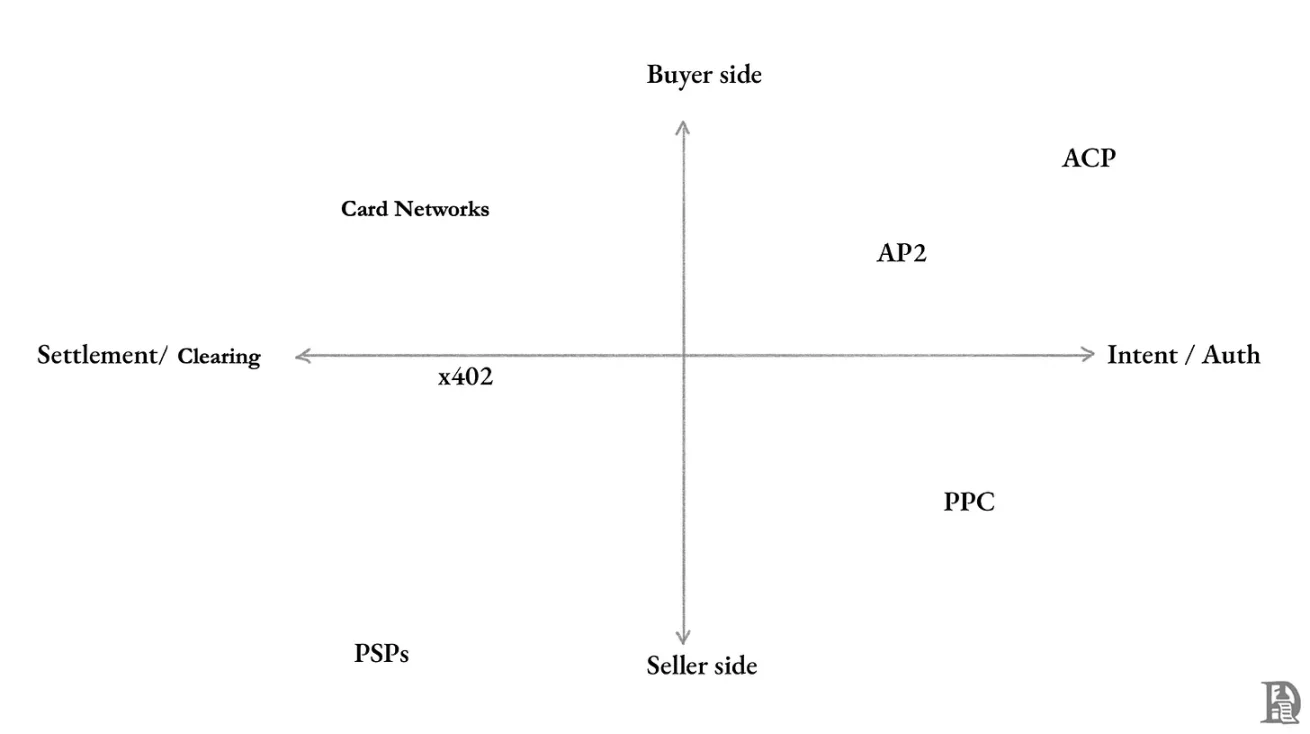
Buyer

Consumer applications are typically responsible for handling funds or transactions and take a cut. But what happens when the consumer is an AI acting on our behalf? Several emerging standards are currently seeking answers.

ChatGPT has 700 million active users, all trying to obtain information or services through AI. Although we are not yet directly buying and selling goods through agent interfaces, it is common to use it to "discover" goods. Whether buying running shoes or finding a hotel in El Calafate, I use AI for price comparison. It would be much more convenient to be able to purchase directly within the same interface. This is precisely the purpose of OpenAI's collaboration with Stripe to launch the Autonomous Commercial Protocol (ACP).
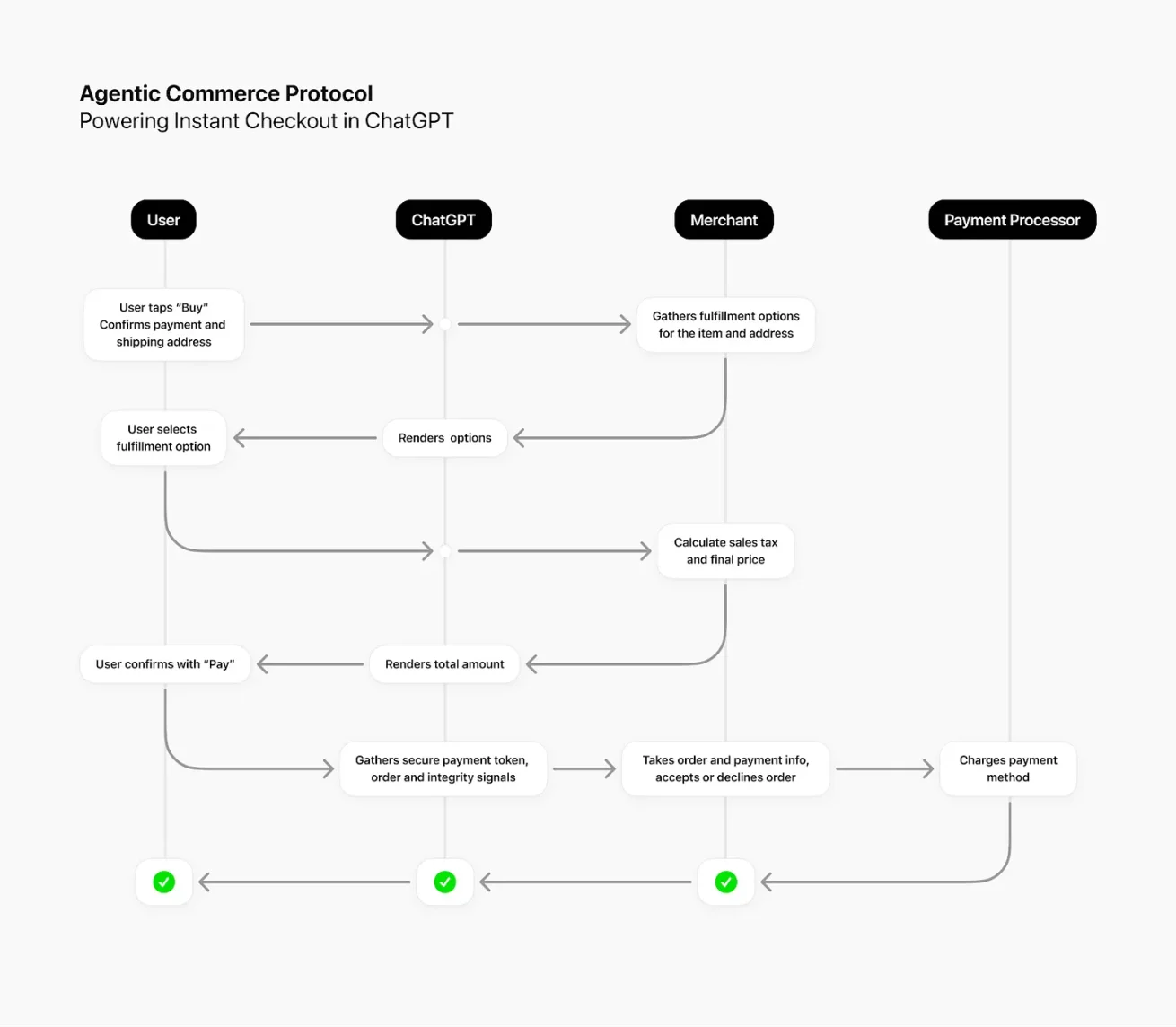
Source: OpenAI

This is currently the most direct way for agents to handle funds: the user is in control throughout. After the user places an order, ChatGPT sends the necessary information to the merchant's backend via ACP. The merchant then decides to accept or reject the order, processes the payment through their existing payment service provider, and handles shipping and customer service as usual.

Think of ACP commerce like this: you authorize an intern with a fixed budget, but you have the final say on which product/service to choose, from which merchant, and complete the payment.

OpenAI and Stripe have ACP, while Google has introduced the Agent Payment Protocol (AP2). Before diving into AP2, let's take a step back. Google wants to solve the "interoperability" problem. Currently, AI agents operate in silos: Gemini doesn't talk to Claude, and ChatGPT doesn't know what's happening in Perplexity.

Ideally, when tasks become complex and require collaboration, we want these agents to communicate using a common language. To this end, Google developed A2A (Agent-to-Agent Protocol), allowing different agents to communicate and coordinate.

But being able to talk is not enough. Agents also need to be able to use tools, access APIs, and services. The Model Context Protocol (MCP) allows agents to use tools like Google Calendar, Notion, Figma, etc.
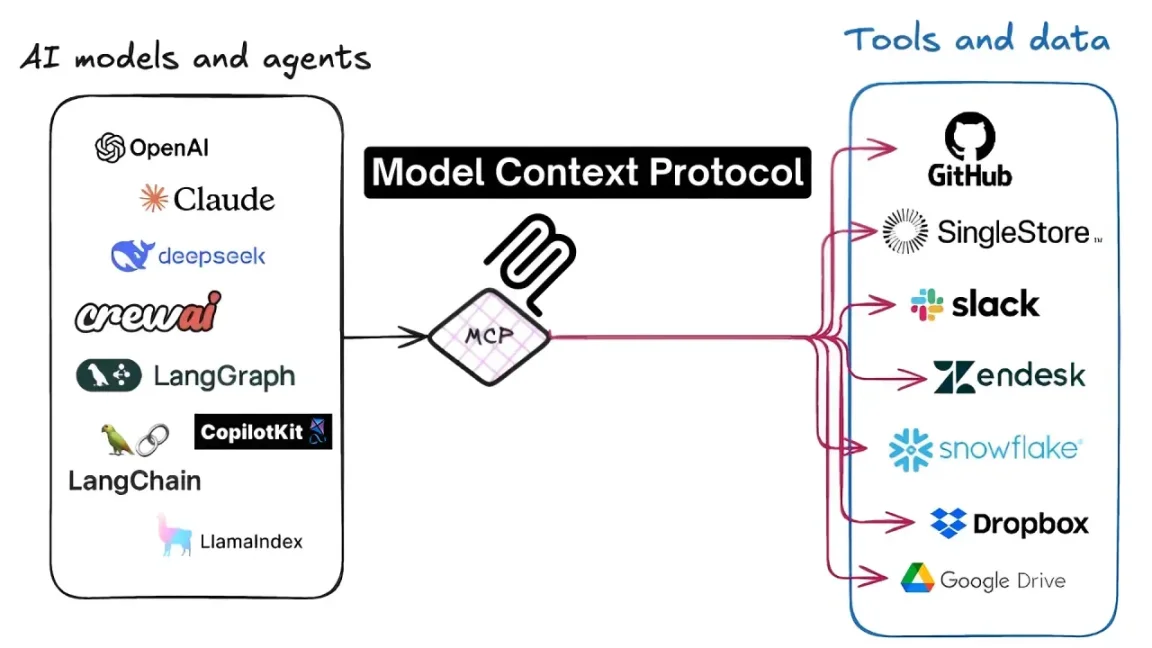
Source: Level Up Coding

MCP defines a universal language. As long as they all "speak" MCP, agents can use any tool without additional custom code. The protocol was created by Anthropic, but the specification is open and is being rapidly adopted by various companies. An MCP server is essentially a translation layer placed in front of a company's existing API, exposing the service in a standardized format to any MCP-compatible agent.

Back to AP2, it can be simply understood as: MCP gives agents the ability to obtain data, files, and tools; A2A gives them a voice to talk to each other; and AP2 gives them a wallet, allowing them to spend money safely.

All these protocols place the user at the control center, with agents having limited spending permissions. This solves the distribution and process problems, but none have yet solved: what to do when the agent makes a mistake?

Seller

The story isn't just happening on the buyer's side. New standards are also emerging on the seller's side, focusing on how machines pay for access to APIs, data, and content.

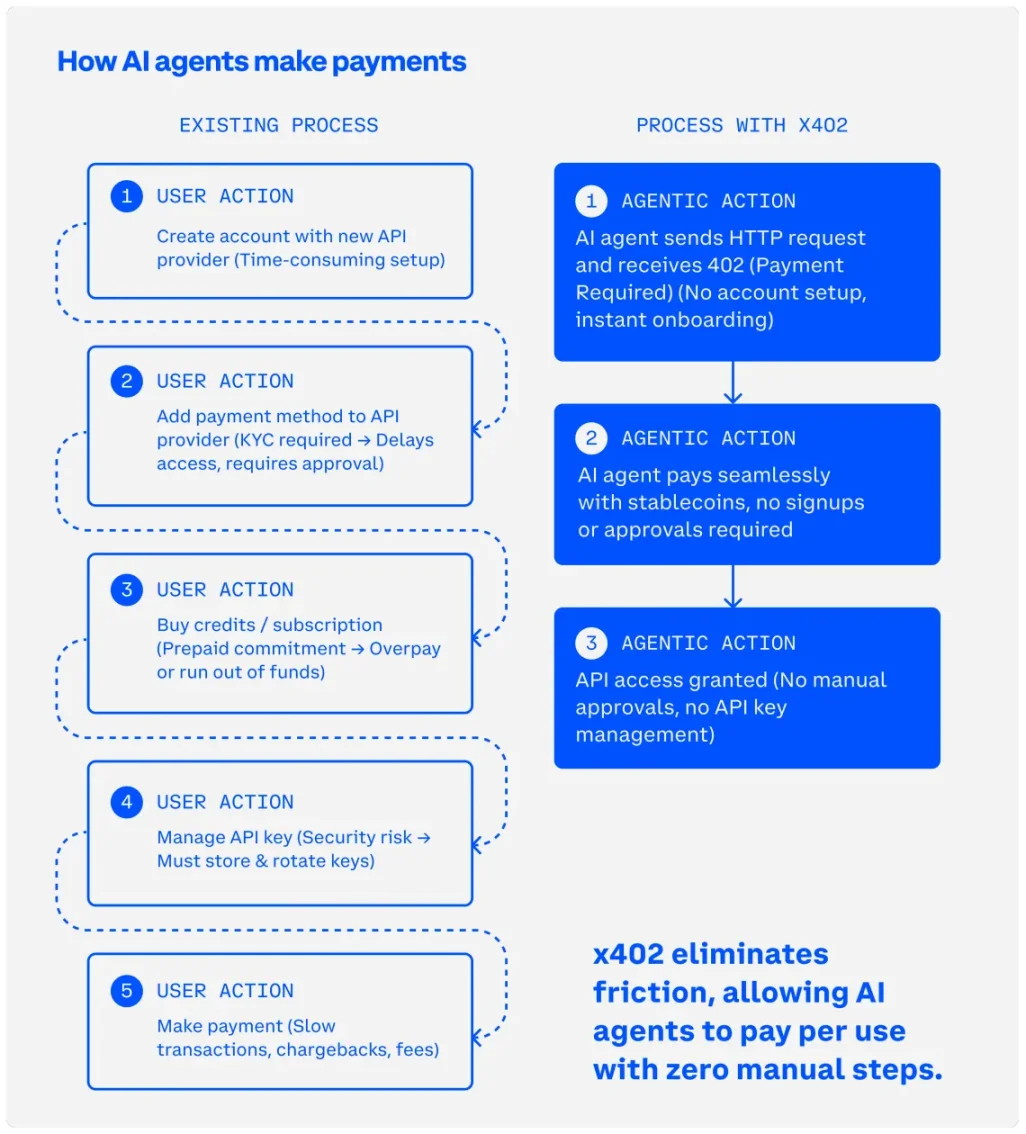
Currently, the most talked about is the x402 standard, an open protocol developed by Coinbase. It revives the HTTP status code 402—"Payment Required"—which was defined as early as 1997 but never used. x402 brings this status code back to life by combining it with stablecoin payments, making micropayments economically viable to settle.

x402 turns HTTP requests into paid requests. Whenever payment is required, the server makes the request. Since the agent has a preset budget, it pays the server and obtains the data within the same flow. This makes "pay-per-request" or "pay-per-call" feasible in machine-to-machine transactions.

With x402, agents can pay precisely for what they need at the moment. For example, spending 2 cents to read a paid article, or paying a fraction of a cent for an API call. Transactions settle on-chain in seconds, without the need to establish long-term relationships.
Source: Coinbase's x402 Paper

Cloudflare has borrowed this concept to build a more specific "Pay for Crawl" system. It also uses HTTP 402 underneath, but the key is Cloudflare's market dominance, with 20% of global web traffic passing through its network, giving it significant influence.

"Pay for Crawl" leverages Cloudflare's edge network to require payment before providing content to AI crawlers. This turns access to content into enforced metering. Publishers are facing plummeting traffic because people no longer click through to websites from search engines but instead read AI-generated summaries. Through this system, publishers can charge AI labs directly each time a crawler accesses their content.

Card networks are also trying to extend existing payment channels to handle agent transactions. Visa has launched an MCP server and an Agent Acceptance Toolkit. Mastercard has a project called "Agent Payments." Both are in early pilot stages, but they are important because Visa and Mastercard already have global distribution networks, issuer relationships, and extensive merchant acceptance networks. The basic idea is: register the agent, set spending controls, and allow the agent to initiate transactions on the existing human credit card payment network.

An Urgent Need to Fill the Trust Gap

All the above standards assume that payments will proceed smoothly and the results will meet expectations. ACP and AP2 involve humans at the checkout stage, providing some security. The x402 variants handle machine-to-machine data access, where risks are typically lower. Card networks extend their familiar protection mechanisms, but at the cost of slow settlement and high fees.

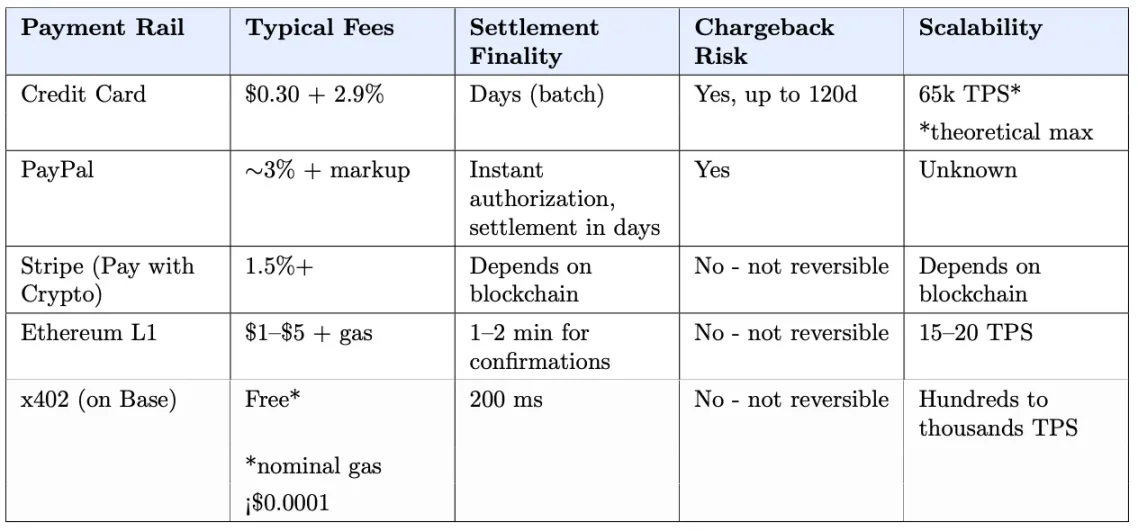
Achieving large-scale micropayments requires speed as the primary goal. Card payment networks take days to settle, and merchants pay a few percent of the transaction amount in fees. Cryptocurrency channels settle in seconds, costing less than a cent. But this efficiency comes with irreversibility; cryptocurrency payments cannot be reversed once completed.

Traditional commerce has built an entire infrastructure around "things that can go wrong." When something goes wrong with a credit card purchase, you have a process to follow: contact the bank, initiate a dispute, the card network investigates and temporarily withholds funds, and finally rules for a refund or supports the merchant. In 2025, there were 261 million disputed transactions, totaling $34 billion.

However, agents running on stablecoin channels have none of these protections.

The problem becomes more complex when agents start collaborating. When hundreds or thousands of multi-agent workflows intertwine, clarifying responsibility can become a nightmare.

Card networks will not take on this risk, at least not under their current profit model. Visa and Mastercard's agent projects still charge standard interchange fees, and settlement still takes days. They could move to instant stablecoin settlement, but that would mean abandoning the dispute handling system that forms the basis of their fees.

The dispute resolution mechanism in traditional finance was not inherent. The first credit card (Diners Club) appeared around 1950, but consumers waited another 24 years to gain the right to dispute transactions. The modern infrastructure we take for granted today was built gradually as problems emerged.

Autonomous agent commerce does not have this much time to waste. API requests already account for 60% of the dynamic HTTP traffic handled by Cloudflare. Bots and automated traffic already account for nearly half of web traffic. ChatGPT's 700 million users can already checkout directly on Etsy through ACP, and Shopify integration is coming soon. The transaction volume already exists, users have the potential need to handle tasks through agents, and it's only a matter of time before agents are used for commercial activities.

Therefore, we face a choice: do we let traditional financial infrastructure continue its slow settlement, or do we consciously build trust infrastructure to match fast blockchain settlement? The former will limit the potential of agents, while the latter is an opportunity and an inevitable extension of the development of autonomous agent commerce.

So, how exactly should it be done?

Unsurprisingly, this involves both pre-transaction and post-transaction parts.
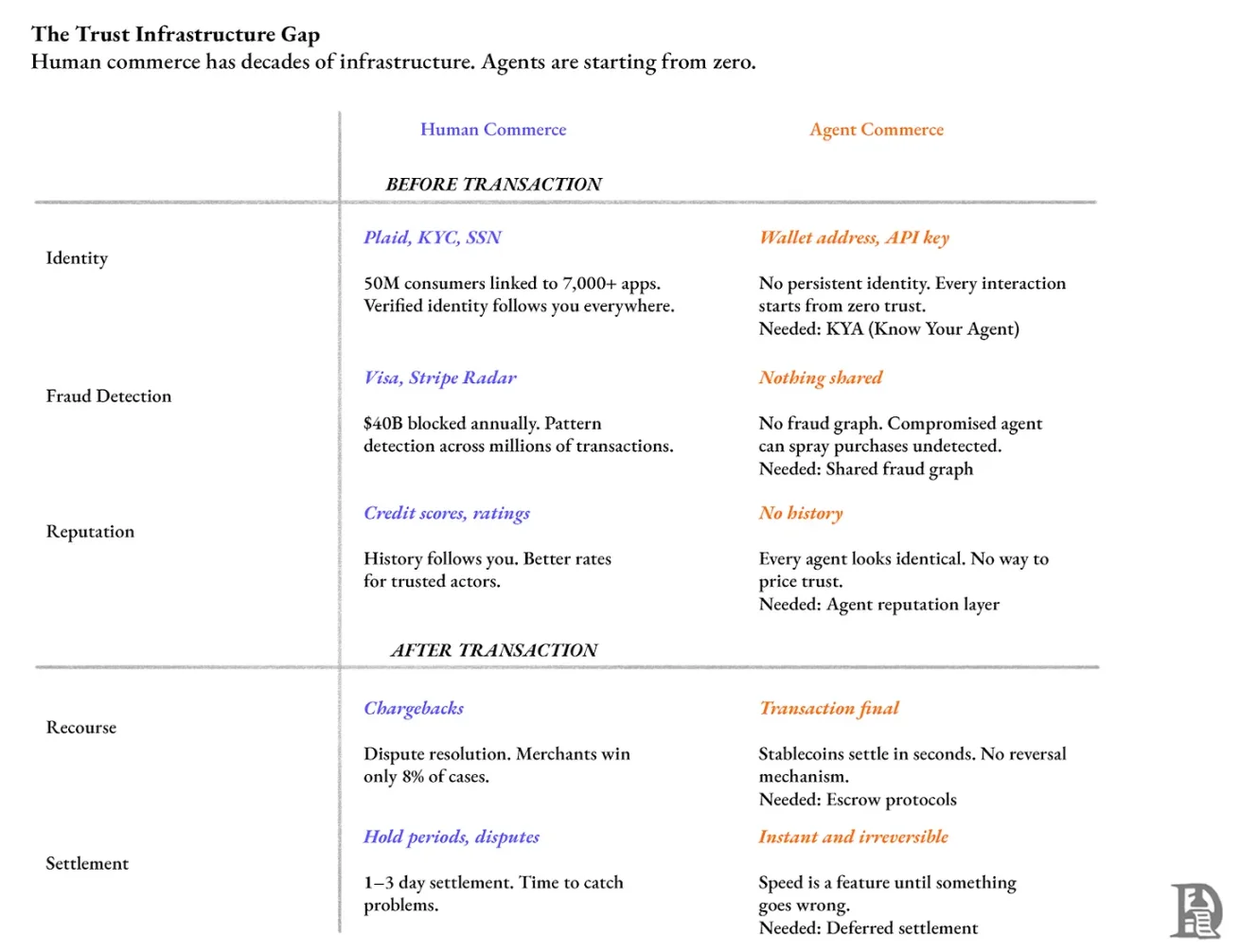
Pre-Transaction: Should the agent transaction be allowed?

This depends on three points: identifying the counterparty, fraud detection, and using reputation scores to determine pricing and access permissions.

In the US, Plaid connects nearly half of all bank accounts, processing millions of account verifications daily. When you verify your identity on Venmo, you are using Plaid.

Currently, any agent interacting with APIs, scraping web pages, or initiating payments lacks equivalent identity verification. The server sees only a vague ID (like a wallet address or API key), not knowing who the caller is. Without a universal identity across services, there is no way to accumulate reputation, and every interaction starts from "zero trust."

In 2024, US adults lost approximately $47 billion due to identity fraud.

We need a "Know Your Agent" (KYA) layer, similar to how Plaid provides identity infrastructure for fintech. It should issue persistent and revocable credentials, binding the agent to the human or organization behind it.

Card networks spent decades building systems that can identify suspicious patterns from millions of transactions. They understand normal human consumption behavior and can flag anomalies in real-time. If an agent is compromised and makes unauthorized purchases from multiple merchants, there is currently no shared fraud graph to detect it.

Visa claims that after investing $11 billion in security between 2019-24, its systems prevented $40 billion in fraud attempts. Stripe processes over $1.4 trillion in payments annually and uses this to train its Radar anti-fraud system. During Black Friday and Cyber Monday 2024, Radar prevented 20.9 million fraudulent transactions worth $917 million.

Agent transactions currently lack such a fraud detection layer. When an agent makes an x402 payment, there is no shared system to flag abnormal behavior, such as a surge in spending or abnormal frequency.

Without persistent identity and reputation, every agent interaction starts from zero. Reputation is deeply embedded in human commerce: the ads you see are based on browsing history, your Uber rating affects driver acceptance, and your credit score follows you to every financial institution. The same should be true for agents.

Post-Transaction: What to do if something goes wrong?

Chargebacks are how card networks handle disputes: after a customer disputes a transaction through their bank, funds are withdrawn from the merchant. But this is also often abused. In 2023, chargebacks cost merchants approximately $117.47 billion in losses. For every $1 lost to a chargeback, merchants typically bear an additional $3.75-$4.61 in other costs (including fees, loss of goods, and administrative overhead).
Source: Coinbase's x402 Paper

Merchants win only 8.1% of disputes they actively contest. 84% of customers believe it is easier to initiate a chargeback directly with their bank than to seek a refund from the merchant.

Agent-initiated stablecoin transactions settle in seconds and are currently irreversible. Cloudflare has proposed a delayed settlement extension to x402, allowing a "waiting period" to be set before funds are finally transferred.

Developers are already building prototypes of this infrastructure. At the ETHGlobal Buenos Aires hackathon, a team created Private-Escrow x402. Their escrow scheme is: the buyer pre-funds a smart contract, and when paying, signs a "payment intent" off-chain. A coordinator batches hundreds of such signatures into a single settlement transaction, reducing Gas fees by 28 times.

But this is just a basic component; it still needs to be productized.

Who will build all this?

This reminds me of the era when telecom operators dominated the industry. They owned the billing relationship for every mobile user but missed out on the value created by smartphones. App distribution and mobile advertising created hundreds of billions of dollars in revenue, which could have been captured by the operators.

Card networks now face a similar situation. What Visa and Mastercard built over decades is precisely the trust infrastructure lacking in the autonomous agent economy. But their business model relies entirely on interchange fees, and these fees exist precisely because they control the payment channels. They spent huge sums maintaining this facility, funded by a few percent of the transaction volume. Providing consumer protection for stablecoin transactions would mean subsidizing a competitor's payment channel with their own revenue.

If the card networks don't do it, the next candidates are AI labs like OpenAI, Google, and Anthropic. They all want their agents to be widely used. But operating a centralized identity registry means they must take responsibility when agents misbehave. They don't want to become the arbitration court for your "wrong hotel booking."

They would prefer a third party to build the identity and recourse infrastructure for them to plug into directly, just like they plug into payments or search engines today.

Cloudflare is in a unique position. They already handle massive web traffic, already run bot detection, and their "AI Audit" tool allows publishers to track crawler access. The technical leap from "identifying bots" to "verifying agent identity and reputation" is not huge.

But Cloudflare has always positioned itself as neutral infrastructure. Once it starts issuing trust scores or adjudicating disputes, it becomes more like a regulatory body—that's a different business and implies different responsibilities.

Three Entry Points for Startups

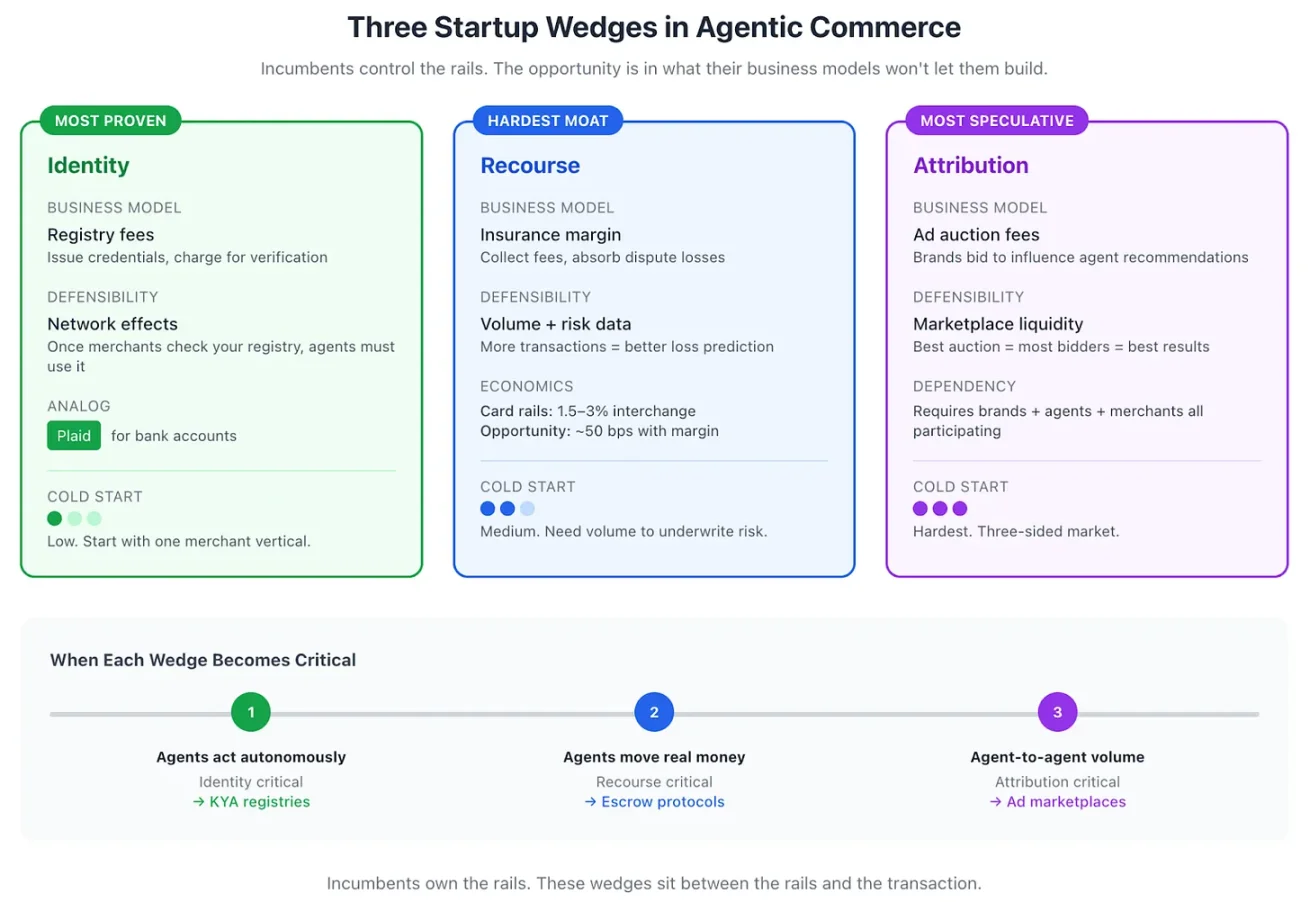
You can't beat OpenAI on model quality, nor can you surpass Cloudflare on traffic. You have to find parts of the tech stack that their business models (at least currently) don't allow them to touch, but where value still exists. I see three entry points: Identity, Recourse, and Attribution.

Agent Identity is the most straightforward. The registry model is proven. Although Plaid is a classic case, it's apt: they did identity verification for bank accounts. A startup could do the same for agents: issue credentials, accumulate reputation, and allow merchants to check reputation scores before accepting payment. Its moat comes from network effects: once enough merchants check through your registry, agents will be forced to maintain a good reputation record.

Recourse Mechanism is harder because it requires taking on risk. Think of it as insurance: charge a small fee per transaction and cover the loss when things go wrong. Scale is key. Card interchange rates are 1.5%-3%, which includes the cost of dispute handling. Stablecoin channel costs are much lower, so a recourse layer could provide comparable protection at a 0.5% fee and still be profitable.

Attribution Mechanism is the most forward-looking but will inevitably emerge. When agents start influencing purchasing decisions, brands will pay to influence the recommended content. Auction mechanisms can be designed. But it has a "cold start" problem, requiring brands, agents, and merchants to participate in a market together for it to work, unlike the first two entry points.

The importance of these three entry points changes with the stage of agent economic development:

  • Identity becomes critical when agents no longer require human approval for each transaction.

  • Recourse is essential when agents start handling real money.

  • Attribution will only start when the volume of transactions between agents is sufficient to support an advertising market.

This leads to the actual development trajectory:
Source—Chart generated using Claude

Startups Will Build Part of the Agent Economy Infrastructure

The development of agents can be divided into three stages:

  • As an interaction interface

  • Executing under human supervision

  • Autonomously transacting with each other
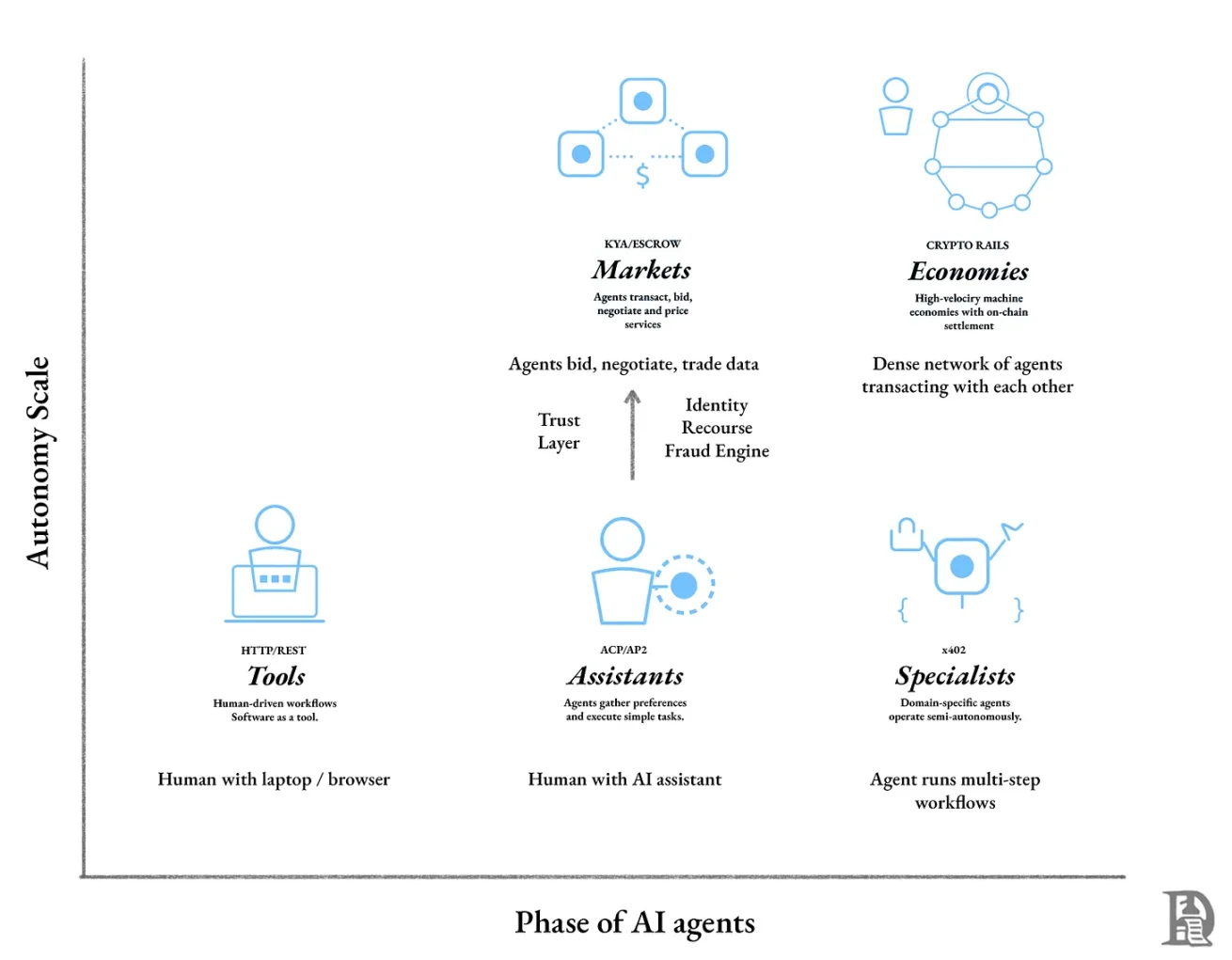
We are in the first stage. ChatGPT's Etsy checkout integration is a good example: we browse products in the chat interface (though not exclusively), the agent recommends options, but the human makes the final decision. Trust is entirely borrowed from existing facilities.

This stage belongs to the existing giants because it's a distribution game for争夺 the user entry point. Value accumulates with the players who own the interface where purchase decisions are made.

The second stage is marked by agents gaining more autonomy. Agents no longer just suggest itineraries but directly book flights, rent cars, and reserve hotels. We give goals or constraints, the agent executes, and we accept the results.

At this point, the trust layer becomes indispensable. Without a recourse mechanism, users will not authorize agents; without identity verification, merchants will not accept agent payments.

This is precisely the opportunity for startups. Existing giants may lack sufficient incentive to build trust facilities for stablecoin channels because they already have huge growth potential in the current stage (which they still dominate). OpenAI's revenue this year reached $13 billion. In comparison, Tether's profit in the first ten months of 2025 alone was $10 billion, with even higher annual profit expected.

The identity, recourse, and attribution layers will be built by new companies dedicated to solving the specific problems at the boundary of agent capabilities and user authorization.

The third stage is autonomous agent commerce. Your agent no longer needs to ask for routine decisions; it can negotiate with other agents, bid for computing resources, participate in advertising auctions, and continuously settle thousands of small transactions. Stablecoins, due to the volume, speed, and granularity required for machine-to-machine transactions, will become the default settlement layer.

The competitive focus at this stage will no longer be the best model or the fastest blockchain, but who builds the most trusted infrastructure: the "passport" for agents, the "court" for adjudicating disputes, the "credit system" that allows transactions beyond balances. These institutions for software services will determine which agents can participate in the economy and under what conditions.

Conclusion

We have laid the pipes for agents to "spend money," but we haven't built the mechanisms to verify "whether they should spend." HTTP 402 slept for thirty years and finally woke up because micropayments became feasible. The technical problems are solved. But the trust facilities that underpin human commerce, such as identity verification, fraud detection, and dispute resolution, still lack their agent counterparts. We solved the easy part. It will take time for agents to do business with each other with confidence.


Perguntas relacionadas

QWhat are the three key areas (breakthrough points) for the next-generation AI agent economy as discussed in the article?

AThe three key breakthrough points are Identity, Recourse, and Attribution.

QWhich protocol, developed by Coinbase, revives the HTTP 402 status code to enable machine-to-machine micropayments?

AThe protocol is called x402.

QWhat is the main limitation of using stablecoin channels for AI agent payments that creates a 'trust gap'?

AThe main limitation is that stablecoin payments are fast and irreversible, offering no built-in consumer protections like chargebacks or dispute resolution when transactions go wrong.

QAccording to the article, what are the three potential entry points for startups to build infrastructure for the agent economy?

AThe three potential entry points for startups are building solutions for Agent Identity, Recourse mechanisms, and Attribution systems.

QWhat is the role of the Model Context Protocol (MCP) in the AI agent ecosystem?

AThe Model Context Protocol (MCP) provides a common language that allows AI agents to use various tools and access APIs (like Google Calendar, Notion, Figma) in a standardized format, without needing custom code for each service.

Leituras Relacionadas

TechFlow Intelligence Bureau: KelpDAO Attack Causes Nearly $300 Million Loss, Triggers Aave Withdrawal Wave, RAVE Crashes 95% in a Single Day

China's AI firm DeepSeek is seeking external funding for the first time, with a valuation exceeding $10 billion, signaling intensifying competition and high R&D costs in the domestic large model sector. Meanwhile, OpenAI CEO Sam Altman faces scrutiny over potential conflicts of interest between his personal investments and OpenAI’s business ahead of a possible IPO. In Web3, KelpDAO suffered a $294 million attack due to forged cross-chain messages on LayerZero, leading to massive withdrawals from Aave and a resulting 18% drop in AAVE tokens. Separately, RAVE cryptocurrency collapsed by 95% in a single day amid suspected insider manipulation. Geopolitically, Iran is now demanding Bitcoin payments for transit through the Strait of Hormuz, reflecting both internal governmental discord and the growing adoption of crypto in tense regions. In semiconductors, Nvidia CEO Jensen Huang showed rare public frustration over questions regarding chip sales to China, while the industry faces renewed price hikes. Tesla continues expanding its Robotaxi service, and a Chinese humanoid robot outperformed humans in a half-marathon, marking a milestone in robotics. Despite Middle East tensions and market uncertainties, U.S. stocks continue to rise, prompting discussions about market optimism versus risk blindness. Overall, today’s developments highlight systemic vulnerabilities—in tech, finance, and geopolitics—while also showcasing innovation in crises.

marsbitHá 5h

TechFlow Intelligence Bureau: KelpDAO Attack Causes Nearly $300 Million Loss, Triggers Aave Withdrawal Wave, RAVE Crashes 95% in a Single Day

marsbitHá 5h

Trading

Spot
Futuros

Artigos em Destaque

O que é GROK AI

Grok AI: Revolucionar a Tecnologia Conversacional na Era Web3 Introdução No panorama em rápida evolução da inteligência artificial, a Grok AI destaca-se como um projeto notável que liga os domínios da tecnologia avançada e da interação com o utilizador. Desenvolvida pela xAI, uma empresa liderada pelo renomado empreendedor Elon Musk, a Grok AI procura redefinir a forma como interagimos com a inteligência artificial. À medida que o movimento Web3 continua a florescer, a Grok AI visa aproveitar o poder da IA conversacional para responder a consultas complexas, proporcionando aos utilizadores uma experiência que é não apenas informativa, mas também divertida. O que é a Grok AI? A Grok AI é um sofisticado chatbot de IA conversacional projetado para interagir com os utilizadores de forma dinâmica. Ao contrário de muitos sistemas de IA tradicionais, a Grok AI abraça uma gama mais ampla de perguntas, incluindo aquelas tipicamente consideradas inadequadas ou fora das respostas padrão. Os principais objetivos do projeto incluem: Raciocínio Fiável: A Grok AI enfatiza o raciocínio de senso comum para fornecer respostas lógicas com base na compreensão contextual. Supervisão Escalável: A integração de assistência de ferramentas garante que as interações dos utilizadores sejam monitorizadas e otimizadas para qualidade. Verificação Formal: A segurança é primordial; a Grok AI incorpora métodos de verificação formal para aumentar a fiabilidade das suas saídas. Compreensão de Longo Contexto: O modelo de IA destaca-se na retenção e recordação de um extenso histórico de conversas, facilitando discussões significativas e contextualizadas. Robustez Adversarial: Ao focar na melhoria das suas defesas contra entradas manipuladas ou maliciosas, a Grok AI visa manter a integridade das interações dos utilizadores. Em essência, a Grok AI não é apenas um dispositivo de recuperação de informações; é um parceiro conversacional imersivo que incentiva um diálogo dinâmico. Criador da Grok AI A mente por trás da Grok AI não é outra senão Elon Musk, um indivíduo sinónimo de inovação em vários campos, incluindo automóvel, viagens espaciais e tecnologia. Sob a égide da xAI, uma empresa focada em avançar a tecnologia de IA de maneiras benéficas, a visão de Musk visa reformular a compreensão das interações com a IA. A liderança e a ética fundacional são profundamente influenciadas pelo compromisso de Musk em ultrapassar os limites tecnológicos. Investidores da Grok AI Embora os detalhes específicos sobre os investidores que apoiam a Grok AI permaneçam limitados, é reconhecido publicamente que a xAI, a incubadora do projeto, é fundada e apoiada principalmente pelo próprio Elon Musk. As anteriores empreitadas e participações de Musk fornecem um forte apoio, reforçando ainda mais a credibilidade e o potencial de crescimento da Grok AI. No entanto, até agora, informações sobre fundações ou organizações de investimento adicionais que apoiam a Grok AI não estão prontamente acessíveis, marcando uma área para exploração futura potencial. Como Funciona a Grok AI? A mecânica operacional da Grok AI é tão inovadora quanto a sua estrutura conceptual. O projeto integra várias tecnologias de ponta que facilitam as suas funcionalidades únicas: Infraestrutura Robusta: A Grok AI é construída utilizando Kubernetes para orquestração de contêineres, Rust para desempenho e segurança, e JAX para computação numérica de alto desempenho. Este trio assegura que o chatbot opere de forma eficiente, escale eficazmente e sirva os utilizadores prontamente. Acesso a Conhecimento em Tempo Real: Uma das características distintivas da Grok AI é a sua capacidade de aceder a dados em tempo real através da plataforma X—anteriormente conhecida como Twitter. Esta capacidade concede à IA acesso às informações mais recentes, permitindo-lhe fornecer respostas e recomendações oportunas que outros modelos de IA poderiam perder. Dois Modos de Interação: A Grok AI oferece aos utilizadores a escolha entre “Modo Divertido” e “Modo Regular”. O Modo Divertido permite um estilo de interação mais lúdico e humorístico, enquanto o Modo Regular foca em fornecer respostas precisas e exatas. Esta versatilidade assegura uma experiência adaptada que atende a várias preferências dos utilizadores. Em essência, a Grok AI combina desempenho com envolvimento, criando uma experiência que é tanto enriquecedora quanto divertida. Cronologia da Grok AI A jornada da Grok AI é marcada por marcos fundamentais que refletem as suas fases de desenvolvimento e implementação: Desenvolvimento Inicial: A fase fundamental da Grok AI ocorreu ao longo de aproximadamente dois meses, durante os quais o treinamento inicial e o ajuste do modelo foram realizados. Lançamento Beta do Grok-2: Numa evolução significativa, o beta do Grok-2 foi anunciado. Este lançamento introduziu duas versões do chatbot—Grok-2 e Grok-2 mini—cada uma equipada com capacidades para conversar, programar e raciocinar. Acesso Público: Após o seu desenvolvimento beta, a Grok AI tornou-se disponível para os utilizadores da plataforma X. Aqueles com contas verificadas por um número de telefone e ativas há pelo menos sete dias podem aceder a uma versão limitada, tornando a tecnologia disponível para um público mais amplo. Esta cronologia encapsula o crescimento sistemático da Grok AI desde a sua concepção até ao envolvimento público, enfatizando o seu compromisso com a melhoria contínua e a interação com o utilizador. Principais Características da Grok AI A Grok AI abrange várias características principais que contribuem para a sua identidade inovadora: Integração de Conhecimento em Tempo Real: O acesso a informações atuais e relevantes diferencia a Grok AI de muitos modelos estáticos, permitindo uma experiência de utilizador envolvente e precisa. Estilos de Interação Versáteis: Ao oferecer modos de interação distintos, a Grok AI atende a várias preferências dos utilizadores, convidando à criatividade e personalização na conversa com a IA. Base Tecnológica Avançada: A utilização de Kubernetes, Rust e JAX fornece ao projeto uma estrutura sólida para garantir fiabilidade e desempenho ótimo. Consideração de Discurso Ético: A inclusão de uma função de geração de imagens demonstra o espírito inovador do projeto. No entanto, também levanta considerações éticas em torno dos direitos autorais e da representação respeitosa de figuras reconhecíveis—uma discussão em curso dentro da comunidade de IA. Conclusão Como uma entidade pioneira no domínio da IA conversacional, a Grok AI encapsula o potencial para experiências transformadoras do utilizador na era digital. Desenvolvida pela xAI e impulsionada pela abordagem visionária de Elon Musk, a Grok AI integra conhecimento em tempo real com capacidades avançadas de interação. Esforça-se por ultrapassar os limites do que a inteligência artificial pode alcançar, mantendo um foco nas considerações éticas e na segurança do utilizador. A Grok AI não apenas incorpora o avanço tecnológico, mas também representa um novo paradigma de conversas no panorama Web3, prometendo envolver os utilizadores com conhecimento hábil e interação lúdica. À medida que o projeto continua a evoluir, ele permanece como um testemunho do que a interseção da tecnologia, criatividade e interação humana pode alcançar.

344 Visualizações TotaisPublicado em {updateTime}Atualizado em 2024.12.26

O que é GROK AI

O que é ERC AI

Euruka Tech: Uma Visão Geral do $erc ai e as suas Ambições no Web3 Introdução No panorama em rápida evolução da tecnologia blockchain e das aplicações descentralizadas, novos projetos surgem frequentemente, cada um com objetivos e metodologias únicas. Um desses projetos é a Euruka Tech, que opera no vasto domínio das criptomoedas e do Web3. O foco principal da Euruka Tech, particularmente do seu token $erc ai, é apresentar soluções inovadoras concebidas para aproveitar as capacidades crescentes da tecnologia descentralizada. Este artigo tem como objetivo fornecer uma visão abrangente da Euruka Tech, uma exploração das suas metas, funcionalidade, a identidade do seu criador, potenciais investidores e a sua importância no contexto mais amplo do Web3. O que é a Euruka Tech, $erc ai? A Euruka Tech é caracterizada como um projeto que aproveita as ferramentas e funcionalidades oferecidas pelo ambiente Web3, focando na integração da inteligência artificial nas suas operações. Embora os detalhes específicos sobre a estrutura do projeto sejam um tanto elusivos, ele é concebido para melhorar o envolvimento dos utilizadores e automatizar processos no espaço cripto. O projeto visa criar um ecossistema descentralizado que não só facilita transações, mas também incorpora funcionalidades preditivas através da inteligência artificial, daí a designação do seu token, $erc ai. O objetivo é fornecer uma plataforma intuitiva que facilite interações mais inteligentes e um processamento eficiente de transações dentro da crescente esfera do Web3. Quem é o Criador da Euruka Tech, $erc ai? Neste momento, a informação sobre o criador ou a equipa fundadora da Euruka Tech permanece não especificada e algo opaca. Esta ausência de dados levanta preocupações, uma vez que o conhecimento sobre o histórico da equipa é frequentemente essencial para estabelecer credibilidade no setor blockchain. Portanto, categorizamos esta informação como desconhecida até que detalhes concretos sejam disponibilizados no domínio público. Quem são os Investidores da Euruka Tech, $erc ai? De forma semelhante, a identificação de investidores ou organizações de apoio para o projeto Euruka Tech não é prontamente fornecida através da pesquisa disponível. Um aspeto que é crucial para potenciais partes interessadas ou utilizadores que consideram envolver-se com a Euruka Tech é a garantia que vem de parcerias financeiras estabelecidas ou apoio de empresas de investimento respeitáveis. Sem divulgações sobre afiliações de investimento, é difícil tirar conclusões abrangentes sobre a segurança financeira ou a longevidade do projeto. Em linha com a informação encontrada, esta seção também se encontra no estado de desconhecido. Como funciona a Euruka Tech, $erc ai? Apesar da falta de especificações técnicas detalhadas para a Euruka Tech, é essencial considerar as suas ambições inovadoras. O projeto procura aproveitar o poder computacional da inteligência artificial para automatizar e melhorar a experiência do utilizador no ambiente das criptomoedas. Ao integrar IA com tecnologia blockchain, a Euruka Tech visa fornecer funcionalidades como negociações automatizadas, avaliações de risco e interfaces de utilizador personalizadas. A essência inovadora da Euruka Tech reside no seu objetivo de criar uma conexão fluida entre os utilizadores e as vastas possibilidades apresentadas pelas redes descentralizadas. Através da utilização de algoritmos de aprendizagem automática e IA, visa minimizar os desafios enfrentados por utilizadores de primeira viagem e agilizar as experiências transacionais dentro do quadro do Web3. Esta simbiose entre IA e blockchain sublinha a importância do token $erc ai, que se apresenta como uma ponte entre interfaces de utilizador tradicionais e as capacidades avançadas das tecnologias descentralizadas. Cronologia da Euruka Tech, $erc ai Infelizmente, devido à informação limitada disponível sobre a Euruka Tech, não conseguimos apresentar uma cronologia detalhada dos principais desenvolvimentos ou marcos na jornada do projeto. Esta cronologia, tipicamente inestimável para traçar a evolução de um projeto e compreender a sua trajetória de crescimento, não está atualmente disponível. À medida que informações sobre eventos notáveis, parcerias ou adições funcionais se tornem evidentes, atualizações certamente aumentarão a visibilidade da Euruka Tech na esfera cripto. Esclarecimento sobre Outros Projetos “Eureka” É importante abordar que múltiplos projetos e empresas partilham uma nomenclatura semelhante com “Eureka.” A pesquisa identificou iniciativas como um agente de IA da NVIDIA Research, que se concentra em ensinar robôs a realizar tarefas complexas utilizando métodos generativos, bem como a Eureka Labs e a Eureka AI, que melhoram a experiência do utilizador na educação e na análise de serviços ao cliente, respetivamente. No entanto, estes projetos são distintos da Euruka Tech e não devem ser confundidos com os seus objetivos ou funcionalidades. Conclusão A Euruka Tech, juntamente com o seu token $erc ai, representa um jogador promissor, mas atualmente obscuro, dentro do panorama do Web3. Embora os detalhes sobre o seu criador e investidores permaneçam não divulgados, a ambição central de combinar inteligência artificial com tecnologia blockchain destaca-se como um ponto focal de interesse. As abordagens únicas do projeto em promover o envolvimento do utilizador através da automação avançada podem diferenciá-lo à medida que o ecossistema Web3 avança. À medida que o mercado cripto continua a evoluir, as partes interessadas devem manter um olhar atento sobre os avanços em torno da Euruka Tech, uma vez que o desenvolvimento de inovações documentadas, parcerias ou um roteiro definido pode apresentar oportunidades significativas no futuro próximo. Neste momento, aguardamos por insights mais substanciais que possam desvendar o potencial da Euruka Tech e a sua posição no competitivo panorama cripto.

395 Visualizações TotaisPublicado em {updateTime}Atualizado em 2025.01.02

O que é ERC AI

O que é DUOLINGO AI

DUOLINGO AI: Integrar a Aprendizagem de Línguas com Inovação Web3 e IA Numa era em que a tecnologia transforma a educação, a integração da inteligência artificial (IA) e das redes blockchain anuncia uma nova fronteira para a aprendizagem de línguas. Apresentamos DUOLINGO AI e a sua criptomoeda associada, $DUOLINGO AI. Este projeto aspira a unir o poder educativo das principais plataformas de aprendizagem de línguas com os benefícios da tecnologia descentralizada Web3. Este artigo explora os principais aspectos do DUOLINGO AI, analisando os seus objetivos, estrutura tecnológica, desenvolvimento histórico e potencial futuro, mantendo a clareza entre o recurso educativo original e esta iniciativa independente de criptomoeda. Visão Geral do DUOLINGO AI No seu cerne, DUOLINGO AI procura estabelecer um ambiente descentralizado onde os alunos podem ganhar recompensas criptográficas por alcançar marcos educativos em proficiência linguística. Ao aplicar contratos inteligentes, o projeto visa automatizar processos de verificação de habilidades e alocação de tokens, aderindo aos princípios do Web3 que enfatizam a transparência e a propriedade do utilizador. O modelo diverge das abordagens tradicionais de aquisição de línguas ao apoiar-se fortemente numa estrutura de governança orientada pela comunidade, permitindo que os detentores de tokens sugiram melhorias ao conteúdo dos cursos e à distribuição de recompensas. Alguns dos objetivos notáveis do DUOLINGO AI incluem: Aprendizagem Gamificada: O projeto integra conquistas em blockchain e tokens não fungíveis (NFTs) para representar níveis de proficiência linguística, promovendo a motivação através de recompensas digitais envolventes. Criação de Conteúdo Descentralizada: Abre caminhos para educadores e entusiastas de línguas contribuírem com os seus cursos, facilitando um modelo de partilha de receitas que beneficia todos os colaboradores. Personalização Através de IA: Ao empregar modelos avançados de aprendizagem de máquina, o DUOLINGO AI personaliza as lições para se adaptar ao progresso de aprendizagem individual, semelhante às características adaptativas encontradas em plataformas estabelecidas. Criadores do Projeto e Governança A partir de abril de 2025, a equipa por trás do $DUOLINGO AI permanece pseudónima, uma prática frequente no panorama descentralizado das criptomoedas. Esta anonimidade visa promover o crescimento coletivo e o envolvimento das partes interessadas, em vez de se concentrar em desenvolvedores individuais. O contrato inteligente implementado na blockchain Solana indica o endereço da carteira do desenvolvedor, o que significa o compromisso com a transparência em relação às transações, apesar da identidade dos criadores ser desconhecida. De acordo com o seu roteiro, o DUOLINGO AI pretende evoluir para uma Organização Autónoma Descentralizada (DAO). Esta estrutura de governança permite que os detentores de tokens votem em questões críticas, como implementações de funcionalidades e alocação de tesouraria. Este modelo alinha-se com a ética de empoderamento comunitário encontrada em várias aplicações descentralizadas, enfatizando a importância da tomada de decisão coletiva. Investidores e Parcerias Estratégicas Atualmente, não existem investidores institucionais ou capitalistas de risco publicamente identificáveis ligados ao $DUOLINGO AI. Em vez disso, a liquidez do projeto origina-se principalmente de trocas descentralizadas (DEXs), marcando um contraste acentuado com as estratégias de financiamento das empresas tradicionais de tecnologia educacional. Este modelo de base indica uma abordagem orientada pela comunidade, refletindo o compromisso do projeto com a descentralização. No seu whitepaper, o DUOLINGO AI menciona a formação de colaborações com “plataformas de educação blockchain” não especificadas, com o objetivo de enriquecer a sua oferta de cursos. Embora parcerias específicas ainda não tenham sido divulgadas, estes esforços colaborativos sugerem uma estratégia para misturar inovação em blockchain com iniciativas educativas, expandindo o acesso e o envolvimento dos utilizadores em diversas vias de aprendizagem. Arquitetura Tecnológica Integração de IA O DUOLINGO AI incorpora dois componentes principais impulsionados por IA para melhorar as suas ofertas educativas: Motor de Aprendizagem Adaptativa: Este motor sofisticado aprende a partir das interações dos utilizadores, semelhante a modelos proprietários de grandes plataformas educativas. Ele ajusta dinamicamente a dificuldade das lições para abordar desafios específicos dos alunos, reforçando áreas fracas através de exercícios direcionados. Agentes Conversacionais: Ao empregar chatbots alimentados por GPT-4, o DUOLINGO AI oferece uma plataforma para os utilizadores se envolverem em conversas simuladas, promovendo uma experiência de aprendizagem de línguas mais interativa e prática. Infraestrutura Blockchain Construído na blockchain Solana, o $DUOLINGO AI utiliza uma estrutura tecnológica abrangente que inclui: Contratos Inteligentes de Verificação de Habilidades: Esta funcionalidade atribui automaticamente tokens aos utilizadores que passam com sucesso em testes de proficiência, reforçando a estrutura de incentivos para resultados de aprendizagem genuínos. Emblemas NFT: Estes tokens digitais significam vários marcos que os alunos alcançam, como completar uma seção do seu curso ou dominar habilidades específicas, permitindo-lhes negociar ou exibir as suas conquistas digitalmente. Governança DAO: Membros da comunidade com tokens podem participar na governança votando em propostas-chave, facilitando uma cultura participativa que incentiva a inovação nas ofertas de cursos e funcionalidades da plataforma. Cronologia Histórica 2022–2023: Conceituação O trabalho preliminar para o DUOLINGO AI começa com a criação de um whitepaper, destacando a sinergia entre os avanços em IA na aprendizagem de línguas e o potencial descentralizado da tecnologia blockchain. 2024: Lançamento Beta Um lançamento beta limitado introduz ofertas em línguas populares, recompensando os primeiros utilizadores com incentivos em tokens como parte da estratégia de envolvimento comunitário do projeto. 2025: Transição para DAO Em abril, ocorre um lançamento completo da mainnet com a circulação de tokens, promovendo discussões comunitárias sobre possíveis expansões para línguas asiáticas e outros desenvolvimentos de cursos. Desafios e Direções Futuras Obstáculos Técnicos Apesar dos seus objetivos ambiciosos, o DUOLINGO AI enfrenta desafios significativos. A escalabilidade continua a ser uma preocupação constante, particularmente no equilíbrio dos custos associados ao processamento de IA e à manutenção de uma rede descentralizada responsiva. Além disso, garantir a criação e moderação de conteúdo de qualidade num ambiente descentralizado apresenta complexidades na manutenção dos padrões educativos. Oportunidades Estratégicas Olhando para o futuro, o DUOLINGO AI tem o potencial de aproveitar parcerias de micro-certificação com instituições académicas, proporcionando validações verificadas em blockchain das habilidades linguísticas. Além disso, a expansão cross-chain poderia permitir que o projeto acedesse a bases de utilizadores mais amplas e a ecossistemas de blockchain adicionais, melhorando a sua interoperabilidade e alcance. Conclusão DUOLINGO AI representa uma fusão inovadora de inteligência artificial e tecnologia blockchain, apresentando uma alternativa focada na comunidade aos sistemas tradicionais de aprendizagem de línguas. Embora o seu desenvolvimento pseudónimo e o modelo económico emergente tragam certos riscos, o compromisso do projeto com a aprendizagem gamificada, educação personalizada e governança descentralizada ilumina um caminho a seguir para a tecnologia educativa no domínio do Web3. À medida que a IA continua a avançar e o ecossistema blockchain evolui, iniciativas como o DUOLINGO AI poderão redefinir a forma como os utilizadores interagem com a educação linguística, empoderando comunidades e recompensando o envolvimento através de mecanismos de aprendizagem inovadores.

377 Visualizações TotaisPublicado em {updateTime}Atualizado em 2025.04.11

O que é DUOLINGO AI

Discussões

Bem-vindo à Comunidade HTX. Aqui, pode manter-se informado sobre os mais recentes desenvolvimentos da plataforma e obter acesso a análises profissionais de mercado. As opiniões dos utilizadores sobre o preço de AI (AI) são apresentadas abaixo.

活动图片