IBIT Records $1.3 Billion Outflow in a Single Week, Bitcoin's Largest ETF Becomes a Wall of Selling Pressure That Bulls Must Break Through

marsbitPublicado em 2026-06-29Última atualização em 2026-06-29

Resumo

BlackRock's iShares Bitcoin Trust (IBIT), the largest U.S. spot bitcoin ETF, saw $1.3 billion in net outflows for the week ending June 26, accounting for roughly 73% of total ETF outflows ($1.79B). This significant, concentrated selling pressure from the primary vehicle that previously funneled institutional demand into bitcoin is now testing the market at a key support level near $60,000. The article notes a narrative shift: the same ETF that served as a major entry ramp for compliant investment is now operating in reverse as a potential exit lane. While ETF outflows represent a transmission risk rather than direct spot selling, they create a new structural headwind. Bitcoin's next move hinges on whether non-ETF buyers can absorb this pressure. Two scenarios are presented: if IBIT outflows slow and bitcoin reclaims the $59,000-$62,000 range, the event could be seen as a clearing of weak hands. However, if IBIT continues to lead significant redemptions while bitcoin struggles to hold $60k, the ETF complex itself may become a persistent source of selling pressure, challenging the long-held "institutional demand" thesis. The coming trading sessions will determine if this is a one-time purge or the start of sustained outflows.

Author: Liam 'Akiba' Wright

Compiled by: TechFlow

TechFlow Insights: BlackRock's IBIT accounted for nearly 73% of the net outflows from US spot Bitcoin ETFs last week, with a single-week redemption of $1.3 billion. When this major gateway, which once brought Wall Street buying power to Bitcoin, starts operating in reverse, the bulls at the $60,000 level are no longer facing retail selling pressure but structural ETF selling pressure. The fund flows over the next few trading days will determine whether this is a clearing event or the beginning of sustained bleeding.

BlackRock's iShares Bitcoin Trust (IBIT) is becoming a test that Bitcoin bulls least want to face. This ETF, which helped Bitcoin open compliant funding channels and turned 'institutional demand' into a simple narrative, is now where price-sensitive holders are making their presence felt.

Bitcoin ETF flow data from Farside Investors shows that during the trading week of June 22-26, US spot Bitcoin ETFs collectively saw a net outflow of approximately $1.789 billion. IBIT alone accounted for about $1.303 billion, close to 73% of the total weekly outflow.

The latest trading day's data makes the signal even clearer: Farside's data for June 26 shows a net outflow of $444.5 million from the ETF complex, with all negative values coming from IBIT.

This concentration changes the conditions for Bitcoin's rebound test. The ETF complex can still be a demand channel, but the largest spot Bitcoin ETF must now also be viewed as a redemption channel.

If this shell, which once helped Bitcoin gain acceptance from brokerage account investors, becomes the primary exit lane, then spot buyers outside the ETFs must absorb these exposures when ETF holders reduce their positions.

IBIT Leads ETF Fund Exodus

The reason Farside's data constitutes a market structure signal is that the pressure is concentrated on Bitcoin's most prominent ETF.
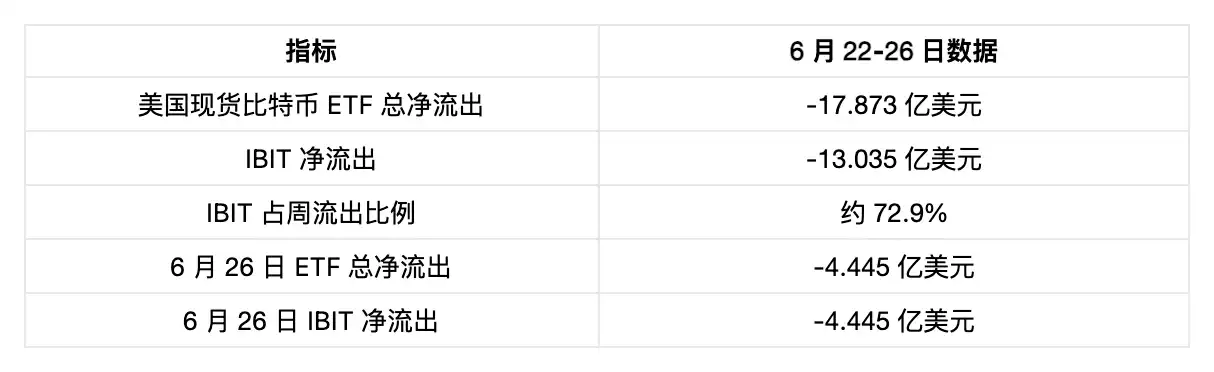
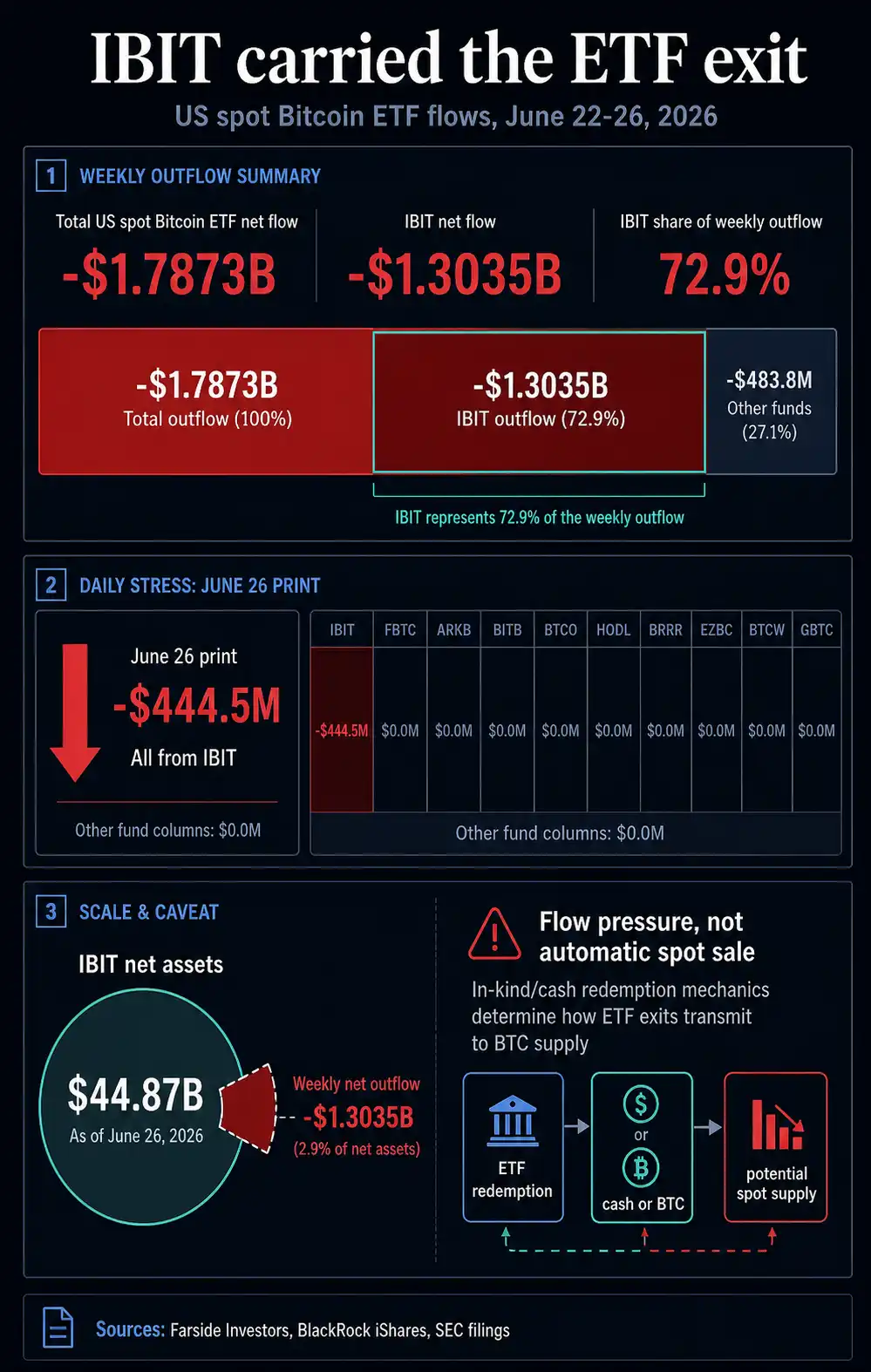
Caption: IBIT accounted for 72.9% of the total weekly outflows from US spot Bitcoin ETFs ($1.3035 billion / $1.7873 billion), data source Farside Investors.

IBIT is not just a ticker in the ETF complex. It is one of the clearest channels for Bitcoin to achieve compliant access through existing brokerage accounts. Its scale gives its fund flows more market weight than redemptions from smaller funds.

When this product contributes the majority of fund outflows in a week, the signal is no longer just 'the ETF market is cooling down.' It is a stress test on the strongest access channel Bitcoin has gained since the launch of spot ETFs.

These outflows occurred while Bitcoin itself was under pressure. CryptoSlate market data shows BTC was trading around $60,000 on June 28, with negative price changes over both 7-day and 30-day periods.

Previous CryptoSlate reports have tracked the broader context of collective ETF surrender and Bitcoin's struggle in the $58,000 to $60,000 range. The new added pressure now is that IBIT itself has become the marginal flow to watch.

Narrative Flip: The Same Channel, Operating in Both Directions

The early spot ETF story was simple: compliant channels broadened the buyer base, ETF demand reduced available supply, and Bitcoin gained a more familiar holding path for institutions and brokerage account investors.

The latest data preserves that history while revealing that the same entry point can operate in reverse when ETF holders decide to exit.

IBIT's scale is both why this week's outflow matters and provides a proportional reference. BlackRock iShares' official product page shows IBIT had net assets of $44.87 billion as of June 26, with a benchmark price around $59,813.

A $1.3 billion weekly outflow is enough to dominate the ETF complex but remains a small percentage relative to the fund's total assets. IBIT is still an important compliant Bitcoin wrapper. The market's question is what this scale means at the margin.

When IBIT was attracting capital, its scale reinforced the 'institutional demand' narrative. When IBIT is bleeding, its scale makes this outflow hard for the rest of the market to ignore.

Smaller funds can bleed continuously without altering the overall ETF narrative. IBIT cannot. Its redemptions indicate that ETF holdings may be becoming more price-sensitive near Bitcoin's support levels.

This distinction is crucial at the $60,000 level. The optimistic read: the largest redemptions have already worked through the system, outflows will slow from here, and Bitcoin reclaiming the $59,000-$62,000 range would mean the market has absorbed the selling pressure.

The cautious read: the next recovery rally must not only rebound from liquidation shocks but also withstand new ETF selling pressure.

This is the 'wall of selling pressure' version of the IBIT story. It doesn't require BlackRock to be bearish on Bitcoin or IBIT holders to exit all at once. It's a market structure argument: the largest access product can become where price-sensitive holdings surface first.

Precise Definition of the ETF Mechanism

ETF flow data is a pressure signal, not a record of direct on-chain selling.

In July 2025, the SEC approved a physical creation/redemption mechanism for crypto ETPs. IBIT's filings also show the redemption mechanism can involve cash proceeds from selling Bitcoin or Bitcoin in-kind, depending on the path used.

Therefore, ETF outflows should be seen as transmission risk, not direct evidence that for every dollar redeemed, a dollar is automatically dumped into the spot market.

The risk remains real. A large, liquid ETF can translate investors' de-risking moves into a recurring source of pressure on Bitcoin's supply side (or the expectation thereof), especially if redemptions are settled in cash or if the Bitcoin obtained from redemptions is subsequently sold.

The signal carries weight even without perfect mechanistic certainty. If IBIT continues to post large net outflow days, buyers must ask: who is absorbing these exposures when ETF holders exit?

If Bitcoin cannot reclaim $60,000 during this period, the old 'institutional demand' narrative weakens. If flows stabilize quickly, the same dataset may later be viewed as just a clearing of crowded trades.

The real test is: have ETF holdings matured into a two-way source of price pressure? Spot ETFs provided investors with a more convenient holding path. More convenient holding also means more convenient exiting.

IBIT's outflows last week placed this trade-off precisely at a fragile spot on Bitcoin's chart.

Two Scenarios

If IBIT outflows slow, Bitcoin holds the high $50,000s range, and reclaims the $59,000-$62,000 level, this week can be interpreted as a potential capitulation flush or flow reset.

In this version, the ETF holders who wanted to leave have done so, the market absorbed the transmission risk, and the largest compliant product remains a net positive for Bitcoin over a longer timeframe.

If IBIT continues to lead redemptions and Bitcoin persistently fails to re-establish a footing above $60,000, the interpretation changes. The ETF complex will define the conditions for the next recovery test: non-ETF spot buyers must hold the market on their own, without the help of the shell that once offered the simplest bullish narrative.

The IBIT-led capital withdrawal leaves Bitcoin with a live test, not a conclusion. One week of flow data cannot determine investor motives, and the redemption mechanism doesn't allow for simple 'one dollar out = one dollar spot sale' inference.

But the data does indicate that at a time when Bitcoin most needs demand from outside the ETF system, the market's most prominent Bitcoin ETF can become a primary source of outflow pressure.

For Bitcoin, the next few trading days carry unusual weight. If IBIT's bleeding slows, this week will be seen as a selling pressure exhaustion. Another round of large redemptions, and the 'wall of selling pressure' narrative becomes harder to ignore.


Criptomoedas em alta

Perguntas relacionadas

QAccording to the article, which Bitcoin ETF was the main source of outflow for U.S. spot Bitcoin ETFs during the week of June 22-26, and how much did it contribute to the total outflow?

AAccording to the article, BlackRock's iShares Bitcoin Trust (IBIT) was the main source of outflow. It contributed approximately $1.3035 billion in outflows, representing about 72.9% of the total $1.7873 billion weekly outflow for U.S. spot Bitcoin ETFs during that period.

QWhat is the core change in the role of IBIT that the article highlights, and why is this significant for the Bitcoin market?

AThe article highlights that IBIT has transformed from being the primary compliant on-ramp bringing institutional demand into Bitcoin to now also becoming a significant off-ramp. This is significant because it means the largest and most visible Bitcoin ETF is now a source of structural selling pressure. When price-sensitive holders exit through IBIT, it creates a new challenge for the market, forcing non-ETF buyers to absorb that selling pressure, especially at a critical price point like $60,000.

QWhat are the two contrasting scenarios the article presents for Bitcoin's market depending on the future behavior of IBIT's flows?

AThe article presents two contrasting scenarios. Scenario 1 (Optimistic): IBIT outflows slow down, and Bitcoin holds the high $50,000s range and reclaims the $59,000-$62,000 area. This would be interpreted as a capitulation event or flow reset, where the selling pressure has been absorbed. Scenario 2 (Cautious): IBIT continues to dominate outflows, and Bitcoin fails to re-establish a footing above $60,000. This would confirm that the ETF complex, particularly IBIT, has become a structural headwind, forcing a market recovery without the support of its previously bullish narrative.

QDoes the article state that every dollar of ETF outflow directly results in a dollar of Bitcoin being sold in the spot market? If not, how should ETF outflows be interpreted?

ANo, the article clarifies that ETF outflow data is not a direct record of Bitcoin being sold on-chain. It explains that ETF redemptions can be settled in cash or in-kind (bitcoin), depending on the mechanism. Therefore, outflows should be interpreted as a transmission risk or a source of supply pressure, not as a 1:1 equivalent of spot market selling. The risk is that large, liquid ETFs can convert investor de-risking into recurring pressure on Bitcoin's supply side, especially if redemptions are cash-settled.

QWhat key price level is Bitcoin struggling with according to the article, and why is the timing of IBIT's significant outflows particularly problematic?

ABitcoin is struggling with the $60,000 price level. The timing of IBIT's significant outflows is problematic because it adds a new layer of selling pressure precisely when Bitcoin is trying to defend a crucial psychological and technical support area. Instead of facing just retail selling, the market must now contend with potential structural selling from the largest Bitcoin ETF, making a recovery at this level more difficult.

Leituras Relacionadas

Margin Exhausted, "Brother Huang Li Cheng" Begins Selling Monkeys at a Loss

Taiwanese crypto whale "Machi Big Brother" Jeffrey Huang has been forced to sell his prized Bored Ape Yacht Club (BAYC) NFTs at significant losses to cover mounting losses from a highly leveraged ETH long position on Hyperliquid. Over the past month, Huang sold 34 BAYC NFTs for 326 ETH (approx. $514,000), realizing a loss of 399 ETH (approx. $631,000). The proceeds were transferred to Hyperliquid to replenish margin for his perpetual contract trades. One ape, BAYC #6057, bought for 76.84 ETH four years ago, was sold for just 7.65 ETH, a 90% loss in ETH terms. Huang began his high-leverage (25-40x) ETH long strategy in September 2025 when ETH was around $4,700. While his account once showed over $45 million in unrealized profit, the subsequent crash of ETH to the $1,600 range erased all gains. As of June 26, his cumulative losses on Hyperliquid reached $33.85 million, with over 335 liquidations earning him the community nickname "King of Liquidations." With conventional funds depleted, Huang's once-valuable NFT collection, which at its peak included around 200 BAYCs and was worth tens of millions, has become a lifeline. His remaining ~150 BAYCs, valued at roughly $1.6 million at current floor prices, provide only limited runway for his persistent high-stakes trading. Huang rose to prominence in crypto as a key figure in popularizing BAYC NFTs in Asia during the 2021 bull market. His pivot to perpetual contracts has now led to a cycle where his iconic "monkeys" are being sold to fund a failing trading strategy.

Foresight NewsHá 36m

Margin Exhausted, "Brother Huang Li Cheng" Begins Selling Monkeys at a Loss

Foresight NewsHá 36m

Quantum Computing Approaches "Q-Day": How Encryption Policy, Investment Logic, and Risk Management Are Reshaping the Landscape

Quantum Computing Nears 'Q-Day': Shaping Encryption Policy, Investment Logic, and Risk Management Quantum technology is increasingly intersecting with cryptocurrency policy and cybersecurity discussions as the potential 'Q-Day'—when quantum computers could break current encryption—approaches. While summer brings fast-paced crypto market dynamics, new U.S. legislation, and AI debates, the emerging dimension is how quantum advancements will reshape the digital asset landscape. The next phase of crypto investment is being shaped by two converging forces: clearer regulatory frameworks and cryptographic evolution driven by quantum computing. Investors stand to benefit from reduced uncertainty, but must also recognize that quantum readiness is becoming a core risk factor. Public blockchains rely on cryptography for security, and sufficiently advanced quantum machines could undermine these foundations. This does not mean imminent network collapse, but investors can no longer dismiss the timeline as irrelevant. Key questions now include whether projects have identified their cryptographic dependencies, formulated migration plans to post-quantum cryptography, and established governance for upgrades. For policymakers, the link is clear. Effective crypto policy must look beyond token classification and disclosure to address the underlying infrastructure. As stablecoins, tokenized assets, and blockchain payments integrate deeper into finance, cryptographic resilience becomes a systemic issue. Failure to prepare could lead to investor losses, operational failures, and legal disputes. Policy should encourage risk disclosure, require major intermediaries to maintain upgrade and response plans, and foster coordination across the ecosystem—rather than impose a single technical fix. The sustainability of cryptocurrencies will increasingly depend on their security infrastructure's ability to adapt to these accelerating technological pressures.

Foresight NewsHá 1h

Quantum Computing Approaches "Q-Day": How Encryption Policy, Investment Logic, and Risk Management Are Reshaping the Landscape

Foresight NewsHá 1h

Bitcoin's Five-Wave Adjustment Nears End, Opportunities Emerge in HYPE Support Zone | Invited Analysis

**Bitcoin's Five-Wave Adjustment Nears End, HYPE Support Zone Presents Opportunity | Guest Analysis** This week, Bitcoin (BTC) is in the final stage of a five-wave corrective structure. The formation of 'Endpoint 44' is key: a level above $58,110 suggests a high probability of a technical rebound, leading likely to wide-range consolidation. A break below $58,110 without bullish divergence warrants caution for further downside. Mid-term bearish positions are maintained at 20%, with 30% of capital reserved for short-term scalping opportunities based on predefined support/resistance levels and three scenario-based plans (A/B/C). Simultaneously, HYPE has entered the 55-56 segment of its own five-wave correction from its $76.94 high. If 'Endpoint 56' forms above the prior low (Endpoint 54), creating a double-bottom pattern, a rebound is significantly likely. A light long position (under 30% allocation) can be considered upon stabilization in the support zone. Last week's BTC short-term strategy, guided by proprietary quantitative models, successfully executed two short trades (1x leverage), yielding a total return of approximately 6.21%. The market move validated the prior weekly forecast of a retest towards the $59,100 support. **Core Trading Views Summary:** * **BTC:** Focus on the formation of 'Endpoint 44'. A scenario above $58,110 allows for tentative longs. Key resistances: $60,900-$62,300, ~$65,500, $67,300-$69,500. Key supports: ~$58,100, ~$55,000. * **HYPE:** Monitor the final position of 'Endpoint 56'. Key resistances: ~$65.5, ~$71.5. Key supports: ~$58.5, $52-$54 zone. Strategy favors buying on dips upon stabilization in support areas with confirmed model signals, with strict position control. **Risk Disclaimer:** Financial markets are volatile. All analysis, models, and strategies herein are based on personal technical analysis for journaling purposes only, not investment advice. Trade at your own risk.

Odaily星球日报Há 1h

Bitcoin's Five-Wave Adjustment Nears End, Opportunities Emerge in HYPE Support Zone | Invited Analysis

Odaily星球日报Há 1h

Trading

Spot

Artigos em Destaque

O que é BITCOIN

Compreender o HarryPotterObamaSonic10Inu (ERC-20) e a Sua Posição no Espaço Cripto Nos últimos anos, o mercado de criptomoedas assistiu a um aumento na popularidade das moedas meme, cativando não apenas os traders, mas também aqueles que procuram envolvimento comunitário e valor de entretenimento. Entre estes tokens únicos está o HarryPotterObamaSonic10Inu (ERC-20), um projeto intrigante que mistura referências culturais no tecido das criptomoedas. Este artigo explora os principais aspetos do HarryPotterObamaSonic10Inu, examinando os seus mecanismos, a sua ética orientada pela comunidade e o seu envolvimento com o vasto panorama cripto. O que é o HarryPotterObamaSonic10Inu (ERC-20)? Como o nome sugere, o HarryPotterObamaSonic10Inu é uma moeda meme construída na blockchain Ethereum, classificada sob o padrão ERC-20. Ao contrário das criptomoedas tradicionais, que podem enfatizar a utilidade prática ou o potencial de investimento, este token prospera no valor de entretenimento e na força da sua comunidade. O projeto visa promover um ambiente onde utilizadores envolvidos possam reunir-se, partilhar ideias e participar em atividades inspiradas por diversos fenómenos culturais. Uma característica notável do HarryPotterObamaSonic10Inu é a zero taxa sobre transações. Este elemento atraente visa encorajar a negociação e o envolvimento da comunidade, isento de encargos adicionais que podem desencorajar os traders de pequena escala. A oferta total da moeda está fixada em mil milhões de tokens, uma cifra que marca a sua intenção de manter uma circulação substancial dentro da comunidade. Criador do HarryPotterObamaSonic10Inu (ERC-20) As origens do HarryPotterObamaSonic10Inu estão um pouco envoltas em mistério; os detalhes sobre o criador permanecem desconhecidos. O desenvolvimento deste token carece de uma equipa identificável ou de um plano explícito, o que não é raro no setor das moedas meme. Em vez disso, o projeto surgiu de forma orgânica, com o seu progresso a depender fortemente do entusiasmo e da participação da sua comunidade. Investidores do HarryPotterObamaSonic10Inu (ERC-20) No que diz respeito a investimentos externos e apoios, o HarryPotterObamaSonic10Inu também permanece ambíguo. O token não lista quaisquer fundações de investimento conhecidas ou apoio organizacional significativo. Em vez disso, o “sangue vital” do projeto é a sua comunidade de base, que informa o seu crescimento e sustentabilidade através da ação coletiva e do envolvimento no espaço cripto. Como Funciona o HarryPotterObamaSonic10Inu (ERC-20)? Como uma moeda meme, o HarryPotterObamaSonic10Inu opera principalmente fora dos quadros tradicionais que muitas vezes governam o valor dos ativos. Existem vários aspetos distintivos que definem como o projeto funciona: Transações Sem Taxas: Sem taxas sobre transações, os utilizadores podem comprar e vender o token livremente, sem a preocupação de custos ocultos. Envolvimento da Comunidade: O projeto prospera na interação da comunidade, aproveitando plataformas de redes sociais para criar entusiasmo e facilitar a participação. Discussões, partilha de conteúdo e envolvimento são elementos cruciais que ajudam a expandir o seu alcance e a fomentar a lealdade entre os apoiantes. Sem Utilidade Prática: Deve ser notado que o HarryPotterObamaSonic10Inu não oferece utilidade concreta dentro do ecossistema financeiro. Em vez disso, é classificado como um token principalmente para entretenimento e atividades comunitárias. Referência Cultural: O token incorpora de forma inteligente elementos da cultura popular para atrair interesse, conectando-se tanto com entusiastas de memes como com seguidores de criptomoedas. HarryPotterObamaSonic10Inu exemplifica como as moedas meme operam de forma diferente de projetos de criptomoedas mais tradicionais, entrando no mercado como construções sociais inovadoras em vez de ativos utilitários. Linha do Tempo do HarryPotterObamaSonic10Inu (ERC-20) A história do HarryPotterObamaSonic10Inu é marcada por vários marcos notáveis: Criação: O token surgiu de um meme viral, capturando a imaginação de muitos entusiastas de criptomoedas. Datas específicas de criação não estão disponíveis, sublinhando a sua ascensão orgânica. Listagem em Exchanges: O HarryPotterObamaSonic10Inu conseguiu entrar em várias exchanges, permitindo um acesso e negociação mais fáceis pela comunidade. Iniciativas de Envolvimento da Comunidade: Atividades contínuas direcionadas a melhorar a interação comunitária, incluindo concursos, campanhas em redes sociais e geração de conteúdo por fãs e defensores. Planos de Expansão Futura: O roteiro do projeto inclui o lançamento de uma coleção de NFTs, mercadorias e um site de eCommerce relacionado aos seus temas culturais, envolvendo ainda mais a comunidade e tentando adicionar mais dimensões ao seu ecossistema. Pontos-Chave sobre o HarryPotterObamaSonic10Inu (ERC-20) Natureza Orientada pela Comunidade: O projeto prioriza a contribuição coletiva e a criatividade, assegurando que o envolvimento dos utilizadores está na vanguarda do seu desenvolvimento. Classificação como Moeda Meme: Representa o epítome da criptomoeda baseada em entretenimento, destacando-se dos veículos de investimento tradicionais. Sem Afiliação Direta com o Bitcoin: Apesar da semelhança no nome do ticker, o HarryPotterObamaSonic10Inu é distinto e não tem qualquer relação com o Bitcoin ou outras criptomoedas estabelecidas. Foco na Colaboração: O HarryPotterObamaSonic10Inu é projetado para criar um espaço de colaboração e partilha de histórias entre os seus detentores, proporcionando uma via para a criatividade e o fortalecimento da comunidade. Perspectivas Futuras: A ambição de expandir além da sua premissa inicial para NFTs e mercadorias delineia um caminho para o projeto potencialmente entrar em avenidas mais mainstream dentro da cultura digital. À medida que as moedas meme continuam a capturar a imaginação da comunidade cripto, HarryPotterObamaSonic10Inu (ERC-20) destaca-se devido aos seus laços culturais e abordagem centrada na comunidade. Embora possa não se encaixar no molde típico de um token orientado para utilidade, a sua essência reside na alegria e camaradagem fomentadas entre os seus apoiantes, destacando a natureza em evolução das criptomoedas em uma era cada vez mais digital. À medida que o projeto continua a desenvolver-se, será importante observar como as dinâmicas comunitárias influenciam a sua trajetória no panorama em constante mudança da tecnologia blockchain.

1.7k Visualizações TotaisPublicado em {updateTime}Atualizado em 2024.12.03

O que é BITCOIN

Como comprar BTC

Bem-vindo à HTX.com!Tornámos a compra de Bitcoin (BTC) simples e conveniente.Segue o nosso guia passo a passo para iniciar a tua jornada no mundo das criptos.Passo 1: cria a tua conta HTXUtiliza o teu e-mail ou número de telefone para te inscreveres numa conta gratuita na HTX.Desfruta de um processo de inscrição sem complicações e desbloqueia todas as funcionalidades.Obter a minha contaPasso 2: vai para Comprar Cripto e escolhe o teu método de pagamentoCartão de crédito/débito: usa o teu visa ou mastercard para comprar Bitcoin (BTC) instantaneamente.Saldo: usa os fundos da tua conta HTX para transacionar sem problemas.Terceiros: adicionamos métodos de pagamento populares, como Google Pay e Apple Pay, para aumentar a conveniência.P2P: transaciona diretamente com outros utilizadores na HTX.Mercado de balcão (OTC): oferecemos serviços personalizados e taxas de câmbio competitivas para os traders.Passo 3: armazena teu Bitcoin (BTC)Depois de comprar o teu Bitcoin (BTC), armazena-o na tua conta HTX.Alternativamente, podes enviá-lo para outro lugar através de transferência blockchain ou usá-lo para transacionar outras criptomoedas.Passo 4: transaciona Bitcoin (BTC)Transaciona facilmente Bitcoin (BTC) no mercado à vista da HTX.Acede simplesmente à tua conta, seleciona o teu par de trading, executa as tuas transações e monitoriza em tempo real.Oferecemos uma experiência de fácil utilização tanto para principiantes como para traders experientes.

4.2k Visualizações TotaisPublicado em {updateTime}Atualizado em 2026.06.02

Como comprar BTC

O que é $BITCOIN

OURO DIGITAL ($BITCOIN): Uma Análise Abrangente Introdução ao OURO DIGITAL ($BITCOIN) OURO DIGITAL ($BITCOIN) é um projeto baseado em blockchain que opera na rede Solana, com o objetivo de combinar as características dos metais preciosos tradicionais com a inovação das tecnologias descentralizadas. Embora partilhe um nome com o Bitcoin, frequentemente referido como “ouro digital” devido à sua percepção como uma reserva de valor, o OURO DIGITAL é um token separado projetado para criar um ecossistema único dentro da paisagem Web3. O seu objetivo é posicionar-se como um ativo digital alternativo viável, embora os detalhes sobre as suas aplicações e funcionalidades ainda estejam em desenvolvimento. O que é o OURO DIGITAL ($BITCOIN)? OURO DIGITAL ($BITCOIN) é um token de criptomoeda explicitamente projetado para uso na blockchain Solana. Em contraste com o Bitcoin, que fornece um papel amplamente reconhecido como armazenamento de valor, este token parece focar em aplicações e características mais amplas. Aspectos notáveis incluem: Infraestrutura Blockchain: O token é construído na blockchain Solana, conhecida pela sua capacidade de lidar com transações de alta velocidade e baixo custo. Dinâmicas de Oferta: O OURO DIGITAL tem um fornecimento máximo limitado a 100 quatrilhões de tokens (100P $BITCOIN), embora os detalhes sobre o seu fornecimento circulante ainda não tenham sido divulgados. Utilidade: Embora as funcionalidades precisas não estejam explicitamente delineadas, existem indicações de que o token poderia ser utilizado para várias aplicações, potencialmente envolvendo aplicações descentralizadas (dApps) ou estratégias de tokenização de ativos. Quem é o Criador do OURO DIGITAL ($BITCOIN)? Neste momento, a identidade dos criadores e da equipa de desenvolvimento por trás do OURO DIGITAL ($BITCOIN) permanece desconhecida. Esta situação é típica entre muitos projetos inovadores no espaço da blockchain, particularmente aqueles alinhados com finanças descentralizadas e fenómenos de moedas meme. Embora tal anonimato possa fomentar uma cultura orientada pela comunidade, intensifica as preocupações sobre governança e responsabilidade. Quem são os Investidores do OURO DIGITAL ($BITCOIN)? As informações disponíveis indicam que o OURO DIGITAL ($BITCOIN) não tem apoiantes institucionais conhecidos ou investimentos proeminentes de capital de risco. O projeto parece operar num modelo peer-to-peer focado no apoio e adoção da comunidade, em vez de rotas de financiamento tradicionais. A sua atividade e liquidez estão principalmente situadas em exchanges descentralizadas (DEXs), como a PumpSwap, em vez de plataformas de negociação centralizadas estabelecidas, destacando ainda mais a sua abordagem de base. Como Funciona o OURO DIGITAL ($BITCOIN) A mecânica operacional do OURO DIGITAL ($BITCOIN) pode ser elaborada com base no seu design de blockchain e nas características da rede: Mecanismo de Consenso: Ao aproveitar o exclusivo proof-of-history (PoH) da Solana combinado com um modelo de proof-of-stake (PoS), o projeto assegura uma validação eficiente das transações, contribuindo para o alto desempenho da rede. Tokenomics: Embora mecanismos deflacionários específicos não tenham sido extensivamente detalhados, o vasto fornecimento máximo de tokens implica que pode atender a microtransações ou casos de uso de nicho que ainda estão por definir. Interoperabilidade: Existe o potencial para integração com o ecossistema mais amplo da Solana, incluindo várias plataformas de finanças descentralizadas (DeFi). No entanto, os detalhes sobre integrações específicas permanecem não especificados. Cronologia de Eventos Chave Aqui está uma cronologia que destaca marcos significativos relacionados ao OURO DIGITAL ($BITCOIN): 2023: O lançamento inicial do token ocorre na blockchain Solana, marcado pelo seu endereço de contrato. 2024: O OURO DIGITAL ganha visibilidade ao tornar-se disponível para negociação em exchanges descentralizadas como a PumpSwap, permitindo que os utilizadores o negociem contra SOL. 2025: O projeto testemunha atividade de negociação esporádica e potencial interesse em envolvimentos liderados pela comunidade, embora não tenham sido documentadas parcerias ou avanços técnicos notáveis até ao momento. Análise Crítica Forças Escalabilidade: A infraestrutura subjacente da Solana suporta altos volumes de transações, o que pode aumentar a utilidade do $BITCOIN em vários cenários de transação. Acessibilidade: O potencial preço de negociação baixo por token pode atrair investidores de retalho, facilitando uma participação mais ampla devido a oportunidades de propriedade fracionada. Riscos Falta de Transparência: A ausência de apoiantes, desenvolvedores ou um processo de auditoria publicamente conhecidos pode gerar ceticismo em relação à sustentabilidade e confiabilidade do projeto. Volatilidade do Mercado: A atividade de negociação depende fortemente do comportamento especulativo, o que pode resultar em volatilidade significativa dos preços e incerteza para os investidores. Conclusão O OURO DIGITAL ($BITCOIN) surge como um projeto intrigante, mas ambíguo, dentro do ecossistema em rápida evolução da Solana. Embora tente aproveitar a narrativa do “ouro digital”, a sua divergência do papel estabelecido do Bitcoin como reserva de valor sublinha a necessidade de uma diferenciação mais clara da sua utilidade pretendida e estrutura de governança. A aceitação e adoção futuras dependerão provavelmente da abordagem da atual opacidade e da definição mais explícita das suas estratégias operacionais e económicas. Nota: Este relatório abrange informações sintetizadas disponíveis até outubro de 2023, e desenvolvimentos podem ter ocorrido além do período de pesquisa.

106 Visualizações TotaisPublicado em {updateTime}Atualizado em 2025.05.13

O que é $BITCOIN

Discussões

Bem-vindo à Comunidade HTX. Aqui, pode manter-se informado sobre os mais recentes desenvolvimentos da plataforma e obter acesso a análises profissionais de mercado. As opiniões dos utilizadores sobre o preço de BTC (BTC) são apresentadas abaixo.

活动图片