Hyperliquid's Monthly Trading Volume of $225 Billion: How Will HIP-4 Ignite the Prediction Market?

marsbitPublicado em 2026-02-05Última atualização em 2026-02-05

Resumo

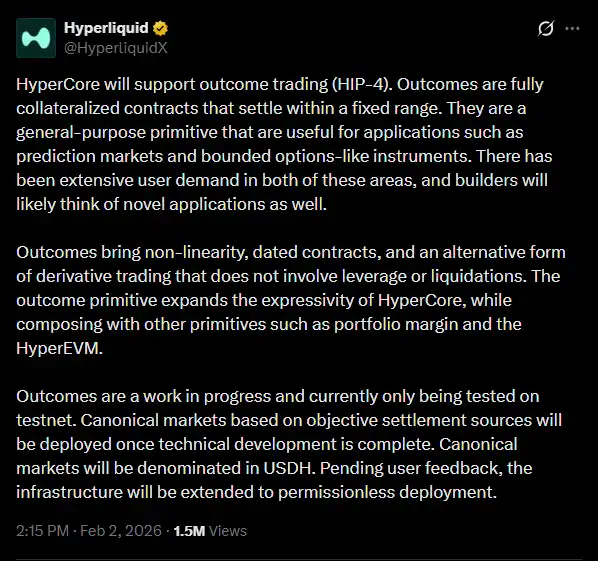
Hyperliquid processed over $225 billion in monthly trading volume in January 2026, while the entire prediction market sector handled around $23 billion. The introduction of HIP-4 aims to integrate outcome contracts—binary event-based derivatives—into the same margin framework as perpetual futures, enabling shared collateral and unified risk management. This integration allows traders to manage event exposure alongside perpetual positions within a single portfolio, improving capital efficiency and enabling sophisticated strategies like hedging and volatility trading. As a result, prediction markets could see significant volume growth: conservative estimates project $28 billion in monthly trading, with medium and strong adoption scenarios reaching $33 billion and over $40 billion, respectively. By merging event-driven contracts with core derivatives infrastructure, HIP-4 transforms prediction markets from isolated betting platforms into integral components of broader crypto trading strategies, potentially unlocking billions in new activity.

Author: Predictefy

Compiled by: Deep Tide TechFlow

Deep Tide Guide: In January 2026, prediction markets processed over $23 billion in nominal trading volume. In the same month, Hyperliquid alone processed over $225 billion. Outcome trading could bring tens of billions of dollars in new trading volume to prediction markets.

Predictefy analysis indicates that the key to HIP-4 lies in integrating outcome contracts into the same margin framework as perpetual futures, bringing event trading into the same environment as other crypto derivatives.

This could bring tens of billions of dollars in new trading volume and open interest to prediction markets in a short period. Conservative estimates suggest partial adoption could reach $28 billion in monthly trading volume, moderate adoption $33 billion, and strong integration over $40 billion.

Full text below:

Prediction markets processed over $23 billion in nominal trading volume in January 2026. Hyperliquid alone processed over $225 billion in the same month. Outcome trading could bring tens of billions of dollars in new trading volume to prediction markets.

Prediction markets are growing rapidly, but they primarily operate in isolation. You can trade event outcomes, but these positions are not within the same systems traders use to manage broader market risks.

HIP-4 changes this. On Hyperliquid, outcome contracts share the same margin framework with perpetual futures, bringing event trading into the same environment as other crypto derivatives.

This could bring tens of billions of dollars in new trading volume and open interest to prediction markets in a short time. Here’s how it works.
Prediction Markets Are Already Substantial

Over the past year, prediction markets have moved beyond niche activity.

  • Weekly trading volume on major platforms has repeatedly exceeded $6 billion
  • A recent month recorded approximately $23.8 billion in nominal trading volume
  • Market share remains concentrated, with platforms like Polymarket, Opinion, and Kalshi dominating most activity

Despite this growth, prediction markets still primarily function as standalone venues. Event exposure, directional crypto exposure, and volatility exposure typically require separate platforms, collateral pools, and risk systems. This fragmentation limits capital efficiency and constrains the types of strategies traders can implement.

Outcome Contracts Bring Risk into Core Infrastructure

Outcome contracts introduced via HIP-4 have several defining characteristics:

  • Positions are fully collateralized
  • Settlement occurs within a fixed and bounded payment range
  • No liquidation mechanism
  • Contracts are event-based or time-based
  • Positions are integrated into the same margin framework as perpetual futures

Binary contracts themselves are not new. The structural change lies in their integration into a unified derivatives engine. Event exposure can now share collateral with perpetual positions, allowing risk to be managed at the portfolio level rather than the individual market level.

Improvements in Capital Efficiency

Previously, implementing event-driven strategies typically required traders to:

  • Deposit collateral on a prediction market platform
  • Deposit separate collateral on a perpetual futures venue for hedging
  • Manage risk and margin independently across venues

This setup increased capital requirements and operational complexity.

With outcome contracts in a shared trading environment, event exposure and directional hedging can be managed together. Portfolio margin systems can recognize offsetting risks, reducing total margin usage. This aligns event trading with established derivatives risk management practices.

Current Market Size and Trading Volume Growth Potential

Prediction markets processed approximately $20-25 billion in monthly trading volume in January 2026 under today's isolated structure, with event trading located outside the broader derivatives stack.

In contrast, Hyperliquid recorded over $225 billion in perpetual futures volume in the same month, with daily perpetual trading volumes reaching the multi-billion dollar range. The pool of derivatives liquidity is already much deeper than standalone prediction market activity.

If HIP-4 improves capital efficiency and makes event positions easier to hedge within the same system, trading activity could expand through structural churn—more strategies running on the same capital.

Conservative scenario suggests:

  • Partial adoption → $28 billion monthly prediction market trading volume
  • Moderate adoption → $33 billion
  • Strong integration → Over $40 billion

These estimates reflect strategy integration, not hype cycles, and do not include the ongoing monthly growth already seen in prediction market volume, which could push total volumes even higher.

Prediction Markets Begin to Resemble Options Infrastructure

Outcome contracts introduce:

  • Non-linear payouts
  • Event-driven settlement
  • Bounded risk profiles

These characteristics overlap with options-like exposure. This creates a foundation for:

  • Event volatility strategies
  • Structured products incorporating outcome positions
  • Systematic portfolios combining event and market risks
  • Protocols building new products on top of outcome primitives

Prediction markets shift from being primarily narrative-driven to becoming available components in broader financial strategies.

Competitive Landscape

Standalone prediction market platforms retain advantages in brand recognition, liquidity depth, and simplicity. However, platforms integrating event risk with perpetual contracts and other derivatives offer:

  • Shared collateral pools
  • Instant hedging within the same environment
  • Portfolio-level risk netting

Even partial migration of more advanced trading flows could affect where capital-efficient and hedge-intensive activities concentrate.

Signals of Adoption

Structural adoption will be reflected in trading behavior, not just headline volume:

  • Pairing of outcome positions with perpetual hedges
  • Growth in open interest around macro and policy events
  • Emergence of vaults or structured strategies built on outcome exposure
  • Narrowing spreads relative to standalone prediction market venues

These signals indicate outcomes are being used as financial instruments, not isolated event trades.

Conclusion

Prediction markets have achieved scale but have until now been structurally separated from the broader derivatives stack.

HIP-4 introduces a framework where event risk can coexist with perpetual futures within shared trading infrastructure. As this model evolves, prediction markets may increasingly function as components of diversified risk portfolios, rather than standalone betting venues.


Criptomoedas em alta

Perguntas relacionadas

QWhat is the key innovation of HIP-4 on Hyperliquid, and how does it impact prediction markets?

AHIP-4 introduces outcome contracts integrated into the same margin framework as perpetual futures, allowing event trading to occur within the same environment as other crypto derivatives. This integration enhances capital efficiency and enables portfolio-level risk management, potentially bringing billions in new trading volume to prediction markets.

QHow does the trading volume of prediction markets compare to Hyperliquid's perpetual futures volume in January 2026?

AIn January 2026, prediction markets processed over $23 billion in nominal trading volume, while Hyperliquid alone handled over $225 billion in perpetual futures volume during the same month.

QWhat are the potential trading volume scenarios for prediction markets with the adoption of HIP-4?

AConservative adoption could reach $28 billion monthly trading volume, medium adoption $33 billion, and strong integration could exceed $40 billion, reflecting strategic integration rather than hype cycles.

QHow do outcome contracts on Hyperliquid improve capital efficiency for traders?

AOutcome contracts allow event exposure and directional hedges to be managed together within a shared trading environment. The portfolio margin system recognizes offsetting risks, reducing total margin usage and aligning event trading with established derivatives risk management practices.

QWhat competitive advantages do platforms with integrated event risk and perpetual contracts offer compared to standalone prediction markets?

AThey provide shared collateral pools, instant hedging within the same environment, and portfolio-level risk netting, which may attract capital-efficient and hedge-intensive activities even if standalone platforms retain advantages in brand recognition and simplicity.

Leituras Relacionadas

Soaring 20% Then Dropping 5%: When Will the Bottom of the Korean Stock Market Be?

"South Korean stocks face a turbulent period as the KOSPI index, after a 20% surge, fell 5% to 6257 points. The market is grappling with severe issues: over 500,000 leveraged retail accounts have been liquidated, and more than 24 trillion won has flowed from stocks into bank deposits for safety. This reflects a significant loss of market liquidity and shaken investor confidence. In response, Korean financial regulators are taking action. They have tripled the minimum保证金 (margin) requirement for single-stock leveraged ETF trades to 30 million won and are considering granting themselves "emergency intervention" powers. These could include capping leverage ratios and setting investment limits on these ETFs, seen by many as amplifying market volatility. Initial results show a 75% drop in these products' trading volume post-regulation. The market downturn has political repercussions, pushing President Yoon Suk-yeol's approval rating to a new low. Meanwhile, foreign investors made a record net purchase of 7.18 trillion won during a recent rebound, while domestic retail investors sold off massively. Morgan Stanley has upgraded South Korean stocks to "overweight," citing the ongoing "leverage unwinding" and potential for a 36% upside, with giants like Samsung Electronics and SK Hynix providing valuation support. However, analysts caution that the market's structure remains vulnerable to foreign capital flows, and the current low may not be the bottom."

marsbitHá 12m

Soaring 20% Then Dropping 5%: When Will the Bottom of the Korean Stock Market Be?

marsbitHá 12m

Goldman Sachs Stakes a Clear Position: This Is the Largest Capital Demand Cycle in Human History, and the Fed Is Just an Observer

Goldman Sachs argues that the world is entering the most capital-intensive investment cycle in history, driven by concurrent massive demands from AI infrastructure, reindustrialization, defense reinvestment, power grid rebuilding, supply chain realignment, and sovereign debt financing. This structural competition for capital is pushing its cost higher, fundamentally altering investment paradigms. Goldman's Mark Wilson states that the Federal Reserve is merely a "passenger, not the driver" in this shift, with rising yields rooted in these real economy demands rather than just monetary policy. While major indices appeared calm in July, underlying market movements were historic, featuring extreme stock dispersion and a severe momentum factor crash, leading to significant de-risking by fund managers. Wilson cautions against expecting a quick reversal in August, citing ongoing digestion of higher rates, disrupted risk models, and typically muted market performance ahead of US midterm elections. Corporate fundamentals remain robust with strong earnings, though growth rates are peaking in the US while accelerating in Europe. Notably, hyperscale cloud companies like Amazon and Microsoft are announcing staggering capital expenditure projections for 2027-2028, justified by explosive AI-related revenue growth and high returns. Amazon revealed its AI revenue run-rate exceeds $25 billion, growing triple-digits annually, and expressed confidence that AWS could become a trillion-dollar revenue business. The report concludes that a transitional period is underway, marked by a growing tension between aggressively investing private tech giants and increasingly capital-constrained sovereign governments. The AI super-cycle continues, with August likely being a consolidation phase.

marsbitHá 17m

Goldman Sachs Stakes a Clear Position: This Is the Largest Capital Demand Cycle in Human History, and the Fed Is Just an Observer

marsbitHá 17m

Outflow of Stablecoins from South Korea Continues for 18 Consecutive Months, Exceeding $360 Million in June

In June 2026, South Korea experienced a net outflow of stablecoins to overseas crypto exchanges, amounting to 560.3 billion won ($367 million). This represents approximately 78% of the net value of foreign stocks purchased by Korean investors in the same period. According to the Financial Supervisory Service (FSS), this marks the 18th consecutive month of net outflows, a trend ongoing since January 2025. The FSS reported that 2.76 trillion won ($1.8+ billion) in stablecoins were withdrawn from the country's five major exchanges to foreign platforms in June, while 2.2 trillion won ($1.4 billion) flowed back in. The second quarter of 2026 saw a significant net outflow of 1.69 trillion won (~$1.1 billion), surpassing net sales of foreign stocks in the same period. Analysts cite access to unavailable domestic financial instruments as a primary driver. Foreign platforms offer crypto derivatives, spot and futures products tied to major Korean stocks like Samsung and Hyundai, along with RWA tokenization, DeFi, staking, and leveraged products. Lawmaker Lee Jong-wook warned that the stablecoin outflows constitute capital flight, exposing investors to risks on unregulated foreign platforms. He called for accelerated regulatory reform and enhanced investor protection measures. The government is reportedly working on a digital assets law to foster the blockchain sector.

cryptonews.ruHá 22m

Outflow of Stablecoins from South Korea Continues for 18 Consecutive Months, Exceeding $360 Million in June

cryptonews.ruHá 22m

Trading

Spot

Artigos em Destaque

Como comprar 4

Bem-vindo à HTX.com!Tornámos a compra de 4 (4) simples e conveniente.Segue o nosso guia passo a passo para iniciar a tua jornada no mundo das criptos.Passo 1: cria a tua conta HTXUtiliza o teu e-mail ou número de telefone para te inscreveres numa conta gratuita na HTX.Desfruta de um processo de inscrição sem complicações e desbloqueia todas as funcionalidades.Obter a minha contaPasso 2: vai para Comprar Cripto e escolhe o teu método de pagamentoCartão de crédito/débito: usa o teu visa ou mastercard para comprar 4 (4) instantaneamente.Saldo: usa os fundos da tua conta HTX para transacionar sem problemas.Terceiros: adicionamos métodos de pagamento populares, como Google Pay e Apple Pay, para aumentar a conveniência.P2P: transaciona diretamente com outros utilizadores na HTX.Mercado de balcão (OTC): oferecemos serviços personalizados e taxas de câmbio competitivas para os traders.Passo 3: armazena teu 4 (4)Depois de comprar o teu 4 (4), armazena-o na tua conta HTX.Alternativamente, podes enviá-lo para outro lugar através de transferência blockchain ou usá-lo para transacionar outras criptomoedas.Passo 4: transaciona 4 (4)Transaciona facilmente 4 (4) no mercado à vista da HTX.Acede simplesmente à tua conta, seleciona o teu par de trading, executa as tuas transações e monitoriza em tempo real.Oferecemos uma experiência de fácil utilização tanto para principiantes como para traders experientes.

708 Visualizações TotaisPublicado em {updateTime}Atualizado em 2026.06.02

Como comprar 4

Discussões

Bem-vindo à Comunidade HTX. Aqui, pode manter-se informado sobre os mais recentes desenvolvimentos da plataforma e obter acesso a análises profissionais de mercado. As opiniões dos utilizadores sobre o preço de 4 (4) são apresentadas abaixo.

活动图片