Hyperliquid's Monthly Trading Volume of $225 Billion: How Will HIP-4 Ignite the Prediction Market?

marsbitPublicado em 2026-02-05Última atualização em 2026-02-05

Resumo

Hyperliquid processed over $225 billion in monthly trading volume in January 2026, while the entire prediction market sector handled around $23 billion. The introduction of HIP-4 aims to integrate outcome contracts—binary event-based derivatives—into the same margin framework as perpetual futures, enabling shared collateral and unified risk management. This integration allows traders to manage event exposure alongside perpetual positions within a single portfolio, improving capital efficiency and enabling sophisticated strategies like hedging and volatility trading. As a result, prediction markets could see significant volume growth: conservative estimates project $28 billion in monthly trading, with medium and strong adoption scenarios reaching $33 billion and over $40 billion, respectively. By merging event-driven contracts with core derivatives infrastructure, HIP-4 transforms prediction markets from isolated betting platforms into integral components of broader crypto trading strategies, potentially unlocking billions in new activity.

Author: Predictefy

Compiled by: Deep Tide TechFlow

Deep Tide Guide: In January 2026, prediction markets processed over $23 billion in nominal trading volume. In the same month, Hyperliquid alone processed over $225 billion. Outcome trading could bring tens of billions of dollars in new trading volume to prediction markets.

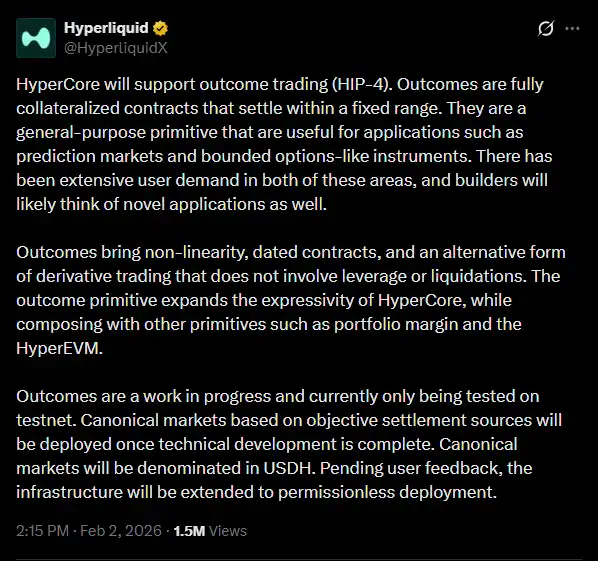
Predictefy analysis indicates that the key to HIP-4 lies in integrating outcome contracts into the same margin framework as perpetual futures, bringing event trading into the same environment as other crypto derivatives.

This could bring tens of billions of dollars in new trading volume and open interest to prediction markets in a short period. Conservative estimates suggest partial adoption could reach $28 billion in monthly trading volume, moderate adoption $33 billion, and strong integration over $40 billion.

Full text below:

Prediction markets processed over $23 billion in nominal trading volume in January 2026. Hyperliquid alone processed over $225 billion in the same month. Outcome trading could bring tens of billions of dollars in new trading volume to prediction markets.

Prediction markets are growing rapidly, but they primarily operate in isolation. You can trade event outcomes, but these positions are not within the same systems traders use to manage broader market risks.

HIP-4 changes this. On Hyperliquid, outcome contracts share the same margin framework with perpetual futures, bringing event trading into the same environment as other crypto derivatives.

This could bring tens of billions of dollars in new trading volume and open interest to prediction markets in a short time. Here’s how it works.
Prediction Markets Are Already Substantial

Over the past year, prediction markets have moved beyond niche activity.

  • Weekly trading volume on major platforms has repeatedly exceeded $6 billion
  • A recent month recorded approximately $23.8 billion in nominal trading volume
  • Market share remains concentrated, with platforms like Polymarket, Opinion, and Kalshi dominating most activity

Despite this growth, prediction markets still primarily function as standalone venues. Event exposure, directional crypto exposure, and volatility exposure typically require separate platforms, collateral pools, and risk systems. This fragmentation limits capital efficiency and constrains the types of strategies traders can implement.

Outcome Contracts Bring Risk into Core Infrastructure

Outcome contracts introduced via HIP-4 have several defining characteristics:

  • Positions are fully collateralized
  • Settlement occurs within a fixed and bounded payment range
  • No liquidation mechanism
  • Contracts are event-based or time-based
  • Positions are integrated into the same margin framework as perpetual futures

Binary contracts themselves are not new. The structural change lies in their integration into a unified derivatives engine. Event exposure can now share collateral with perpetual positions, allowing risk to be managed at the portfolio level rather than the individual market level.

Improvements in Capital Efficiency

Previously, implementing event-driven strategies typically required traders to:

  • Deposit collateral on a prediction market platform
  • Deposit separate collateral on a perpetual futures venue for hedging
  • Manage risk and margin independently across venues

This setup increased capital requirements and operational complexity.

With outcome contracts in a shared trading environment, event exposure and directional hedging can be managed together. Portfolio margin systems can recognize offsetting risks, reducing total margin usage. This aligns event trading with established derivatives risk management practices.

Current Market Size and Trading Volume Growth Potential

Prediction markets processed approximately $20-25 billion in monthly trading volume in January 2026 under today's isolated structure, with event trading located outside the broader derivatives stack.

In contrast, Hyperliquid recorded over $225 billion in perpetual futures volume in the same month, with daily perpetual trading volumes reaching the multi-billion dollar range. The pool of derivatives liquidity is already much deeper than standalone prediction market activity.

If HIP-4 improves capital efficiency and makes event positions easier to hedge within the same system, trading activity could expand through structural churn—more strategies running on the same capital.

Conservative scenario suggests:

  • Partial adoption → $28 billion monthly prediction market trading volume
  • Moderate adoption → $33 billion
  • Strong integration → Over $40 billion

These estimates reflect strategy integration, not hype cycles, and do not include the ongoing monthly growth already seen in prediction market volume, which could push total volumes even higher.

Prediction Markets Begin to Resemble Options Infrastructure

Outcome contracts introduce:

  • Non-linear payouts
  • Event-driven settlement
  • Bounded risk profiles

These characteristics overlap with options-like exposure. This creates a foundation for:

  • Event volatility strategies
  • Structured products incorporating outcome positions
  • Systematic portfolios combining event and market risks
  • Protocols building new products on top of outcome primitives

Prediction markets shift from being primarily narrative-driven to becoming available components in broader financial strategies.

Competitive Landscape

Standalone prediction market platforms retain advantages in brand recognition, liquidity depth, and simplicity. However, platforms integrating event risk with perpetual contracts and other derivatives offer:

  • Shared collateral pools
  • Instant hedging within the same environment
  • Portfolio-level risk netting

Even partial migration of more advanced trading flows could affect where capital-efficient and hedge-intensive activities concentrate.

Signals of Adoption

Structural adoption will be reflected in trading behavior, not just headline volume:

  • Pairing of outcome positions with perpetual hedges
  • Growth in open interest around macro and policy events
  • Emergence of vaults or structured strategies built on outcome exposure
  • Narrowing spreads relative to standalone prediction market venues

These signals indicate outcomes are being used as financial instruments, not isolated event trades.

Conclusion

Prediction markets have achieved scale but have until now been structurally separated from the broader derivatives stack.

HIP-4 introduces a framework where event risk can coexist with perpetual futures within shared trading infrastructure. As this model evolves, prediction markets may increasingly function as components of diversified risk portfolios, rather than standalone betting venues.


Criptomoedas em alta

Perguntas relacionadas

QWhat is the key innovation of HIP-4 on Hyperliquid, and how does it impact prediction markets?

AHIP-4 introduces outcome contracts integrated into the same margin framework as perpetual futures, allowing event trading to occur within the same environment as other crypto derivatives. This integration enhances capital efficiency and enables portfolio-level risk management, potentially bringing billions in new trading volume to prediction markets.

QHow does the trading volume of prediction markets compare to Hyperliquid's perpetual futures volume in January 2026?

AIn January 2026, prediction markets processed over $23 billion in nominal trading volume, while Hyperliquid alone handled over $225 billion in perpetual futures volume during the same month.

QWhat are the potential trading volume scenarios for prediction markets with the adoption of HIP-4?

AConservative adoption could reach $28 billion monthly trading volume, medium adoption $33 billion, and strong integration could exceed $40 billion, reflecting strategic integration rather than hype cycles.

QHow do outcome contracts on Hyperliquid improve capital efficiency for traders?

AOutcome contracts allow event exposure and directional hedges to be managed together within a shared trading environment. The portfolio margin system recognizes offsetting risks, reducing total margin usage and aligning event trading with established derivatives risk management practices.

QWhat competitive advantages do platforms with integrated event risk and perpetual contracts offer compared to standalone prediction markets?

AThey provide shared collateral pools, instant hedging within the same environment, and portfolio-level risk netting, which may attract capital-efficient and hedge-intensive activities even if standalone platforms retain advantages in brand recognition and simplicity.

Leituras Relacionadas

Misjudged A-Shares: Resilience, Expectations, and Confidence

China's A-share market recently faced selling pressure, especially in tech sectors, initially triggered by a global tech sell-off that began in South Korea. However, the article argues this is a case of "mistaken injury" and highlights the market's underlying resilience. This resilience stems from three main pillars: **1) Tech Sector Fundamentals:** Unlike Korea's market dominated by a few memory chip stocks, China's tech sector is diversified across computing, communications, electronics, and semiconductors, supported by dual narratives of global AI supply chains and domestic substitution. Core areas like optical modules and fiber optics continue to show strong earnings growth. **2) "National Team" Support:** State-backed institutions and large corporations have made significant market purchases and announced buybacks, providing liquidity and signaling confidence. This is seen as a stabilizing policy signal, often associated with market bottoms. **3) Broader Market Pillars:** Other major sectors are showing endogenous recovery momentum. Consumer stocks benefit from stabilizing CPI and signs of sector recovery (e.g., liquor price hikes). Cyclical sectors like aluminum have high earnings, potential price increases due to tight supply, and low valuations. The financial sector offers stable dividends and low valuations. The conclusion is that the sell-off was driven by external contagion, not a collapse in fundamentals. With strong policy support and recovering momentum across key sectors, the A-share market possesses the toughness to regain stability.

marsbitHá 32m

Misjudged A-Shares: Resilience, Expectations, and Confidence

marsbitHá 32m

The Clarity Act's Journey Through Congress: The Thorny Path of Bipartisan Compromise in the U.S.

The U.S. Congress is struggling to advance the crypto market structure bill known as the Clarity Act, with bipartisan compromise proving difficult. Key hurdles include unresolved disputes over "yield" products and, more critically, the inclusion of strong ethics provisions for elected officials—a non-negotiable demand for many Democrats. While a compromise on yield was reached in May, securing only limited Democratic support in committee, the separate Senate Agriculture Committee version later passed with no Democratic votes due to the ethics impasse. As Republicans push for a full Senate vote in July, demands for ethics rules have expanded, and other contentious issues like developer protections and concerns from law enforcement and large banks further complicate negotiations. Despite consensus on the need for legislation, the path forward is unclear. Recent discussions between senators and White House officials aim to find acceptable ethics language. Some lawmakers question whether a compromise text can garner enough bipartisan support, with one Democrat stating the current proposal lacks the strong ethics provisions required for their vote. Potential short-term goals for the crypto community include symbolic Senate action before the August recess, a longer-term aim for passage by 2026, or establishing a detailed framework that addresses ethics and other compromises. The process remains arduous, relying on the traditional, vote-by-vote effort to build bipartisan support.

marsbitHá 51m

The Clarity Act's Journey Through Congress: The Thorny Path of Bipartisan Compromise in the U.S.

marsbitHá 51m

Are Kalshi and Polymarket Founders at Odds? This Business Rivalry Is More Brutal Than You Think

"The Rivalry Between Kalshi and Polymarket Founders Turns Bitter and Litigious" The intense feud between Tarek Mansour, CEO of Kalshi, and Shayne Coplan, founder of Polymarket, has escalated far beyond typical business competition into personal animosity and regulatory battles. Both lead billion-dollar prediction market platforms, but their approaches differ sharply. Kalshi positions itself as the compliant operator, securing U.S. regulatory approval before launching. In contrast, Polymarket initially operated offshore, allowing U.S. users to access its platform via VPN, which drew regulatory scrutiny. The conflict reached a peak in November 2024 when FBI agents raided Coplan's New York apartment. While Coplan publicly blamed political motives, his team privately suspected Kalshi was involved. According to sources, Kalshi's lawyers had previously reported Polymarket's operations to federal prosecutors, highlighting its accessibility to U.S. users despite a ban. This incident fueled mutual accusations and underhanded tactics, including social media smear campaigns and attempts to sabotage each other's major business deals. Their rivalry also played out in Washington, influencing regulatory debates. Kalshi actively lobbied against Polymarket's practices, framing them as illegal and unethical. Polymarket, after facing a CFTC fine and investigation, later acquired a licensed U.S. firm to launch a domestic app, regaining a foothold. Despite the hostility, both companies have seen massive growth, with combined trading volumes soaring. However, increased regulatory scrutiny, particularly around insider trading on Polymarket's platform, continues to pose challenges. The founders' deep-seated mutual disdain ensures their battle for market dominance remains as much a personal vendetta as a commercial one.

marsbitHá 1h

Are Kalshi and Polymarket Founders at Odds? This Business Rivalry Is More Brutal Than You Think

marsbitHá 1h

Trading

Spot

Artigos em Destaque

Como comprar 4

Bem-vindo à HTX.com!Tornámos a compra de 4 (4) simples e conveniente.Segue o nosso guia passo a passo para iniciar a tua jornada no mundo das criptos.Passo 1: cria a tua conta HTXUtiliza o teu e-mail ou número de telefone para te inscreveres numa conta gratuita na HTX.Desfruta de um processo de inscrição sem complicações e desbloqueia todas as funcionalidades.Obter a minha contaPasso 2: vai para Comprar Cripto e escolhe o teu método de pagamentoCartão de crédito/débito: usa o teu visa ou mastercard para comprar 4 (4) instantaneamente.Saldo: usa os fundos da tua conta HTX para transacionar sem problemas.Terceiros: adicionamos métodos de pagamento populares, como Google Pay e Apple Pay, para aumentar a conveniência.P2P: transaciona diretamente com outros utilizadores na HTX.Mercado de balcão (OTC): oferecemos serviços personalizados e taxas de câmbio competitivas para os traders.Passo 3: armazena teu 4 (4)Depois de comprar o teu 4 (4), armazena-o na tua conta HTX.Alternativamente, podes enviá-lo para outro lugar através de transferência blockchain ou usá-lo para transacionar outras criptomoedas.Passo 4: transaciona 4 (4)Transaciona facilmente 4 (4) no mercado à vista da HTX.Acede simplesmente à tua conta, seleciona o teu par de trading, executa as tuas transações e monitoriza em tempo real.Oferecemos uma experiência de fácil utilização tanto para principiantes como para traders experientes.

653 Visualizações TotaisPublicado em {updateTime}Atualizado em 2026.06.02

Como comprar 4

Discussões

Bem-vindo à Comunidade HTX. Aqui, pode manter-se informado sobre os mais recentes desenvolvimentos da plataforma e obter acesso a análises profissionais de mercado. As opiniões dos utilizadores sobre o preço de 4 (4) são apresentadas abaixo.

活动图片