Author: Claude, TechFlow
Deep Tide Guide: ChangXin Memory Technologies (CXMT) has priced its Sci-Tech Innovation Board (STAR Market) IPO at 8.66 yuan per share, raising 57.9 billion yuan, with subscriptions starting on July 16. On the eve of the subscription, Trade.xyz deployed a CXMT perpetual contract on Hyperliquid, currently trading at 7.2 USDC (approximately 52 yuan per share), with a 24-hour trading volume of $1.32 million and an open interest of $2.41 million, implying a market capitalization of about 3.5 trillion yuan, at the upper end of institutional expectations of 2-3 trillion yuan. This marks the first time an on-chain pre-IPO contract has targeted an A-share STAR Market listing, becoming the most direct entry point for overseas investors to engage with the 'China storage substitution' narrative.
Even before ChangXin Memory Technologies rings the bell on the Shanghai Stock Exchange, price discovery has already begun in the crypto market.
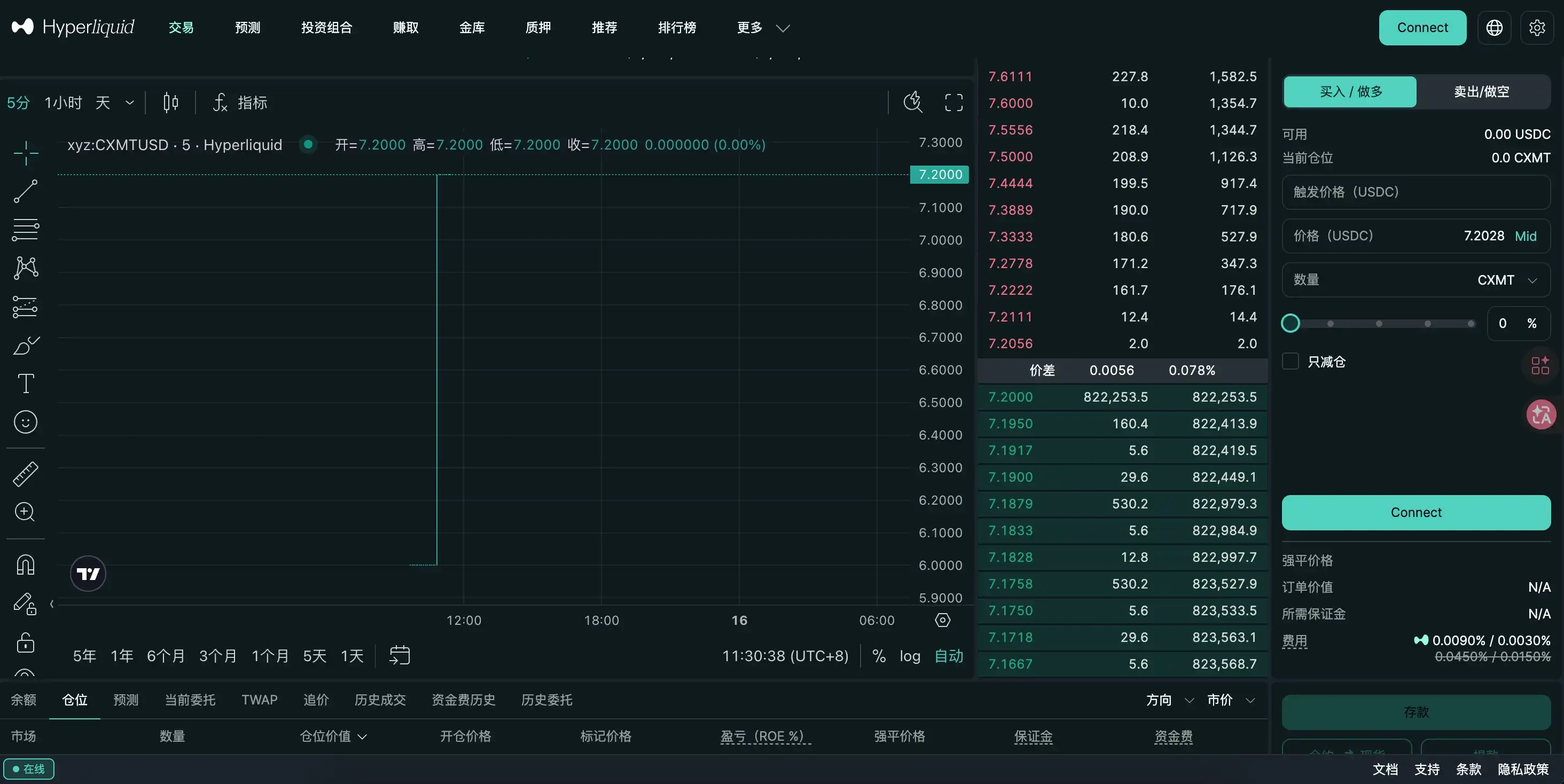
According to a July 15 Bloomberg report, Trade.xyz deployed a ChangXin Memory Technologies (CXMT) perpetual contract on the Hyperliquid blockchain under the symbol xyz:CXMTUSD. As of publication, the contract's 24-hour trading volume is approximately $1.32 million, with an open interest of about $2.41 million and a funding rate of 0.0014%. The price has risen from an initial marking price of around $6 to $7.2, a 24-hour gain of 20%.
This is not the first time Hyperliquid has facilitated pre-IPO pricing. In May this year, just before AI chip company Cerebras went public, the difference between Hyperliquid's pre-IPO contract price and the Nasdaq opening price was only 1.3%; in June, on the day of SpaceX's IPO, on-chain contracts saw a daily trading volume of $1.38 billion. However, targeting a STAR Market A-share company is a first.
$7.2 Equates to ~52 Yuan per Share, Implied Market Cap ~3.5 Trillion Yuan
The contract tracks the per-share price in USDC, employing the same logic used for SpaceX and Cerebras pre-IPO contracts.
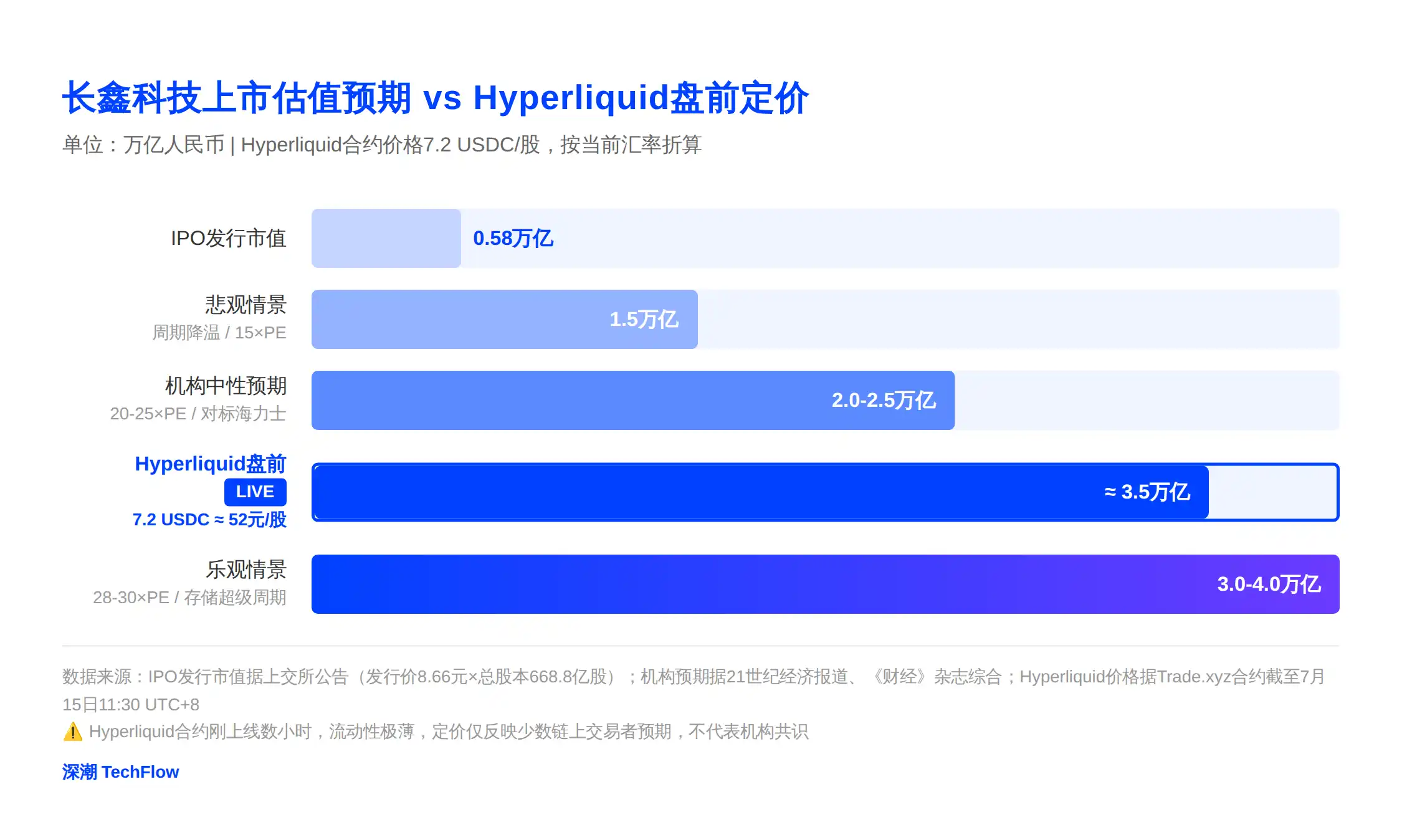
Converted at the current exchange rate, $7.2 equates to approximately 52 yuan per share. Multiplying this by the post-issuance total shares of 66.88 billion yields an implied total market capitalization of about 3.5 trillion yuan, roughly 6 times the IPO's issuance market cap of 579.2 billion yuan.
This pricing falls within the optimistic range of sell-side institution expectations. The 21st Century Business Herald cited investment bankers predicting an estimated post-listing valuation of 2 to 2.5 trillion yuan for CXMT; Caijing magazine, synthesizing estimates from multiple institutions, suggested an optimistic scenario of 3 to over 4 trillion yuan. Hyperliquid's pre-market pricing of 3.5 trillion yuan sits between the upper end of the neutral range and the lower end of the optimistic range.
Another interpretation: if these on-chain traders' judgment is accurate, ChangXin's stock might open around 50 yuan per share on its first trading day, approximately 6 times the 8.66 yuan IPO price. The average first-day gain for A-share STAR Market IPOs in the first half of this year was 489%, making a 6-fold opening not outlandish.
With the contract live for less than 24 hours, the $1.32 million trading volume and $2.41 million open interest represent initial liquidity for the on-chain market, but there remains an order-of-magnitude gap compared to the $1.38 billion single-day volume during SpaceX's listing. This price reflects the directional bets of early participants, not an institutional-grade valuation.
A-Shares: Can't Sell or Short on Day One – Perpetual Contracts Naturally Fill the Gap
Why would crypto traders pay attention to a Chinese A-share? Perspectives from some investors on overseas social media platforms might explain. The structural limitations of A-shares are precisely the opportunity for perpetual contracts.
A-shares have two key structural limitations. T+1 settlement means you cannot sell shares on the same day you buy them, and short selling is not available for individual STAR Market stocks. For a stock like ChangXin, which could experience extreme volatility on its debut, A-share holders face an awkward situation: even if they profit from a limit-up move, they cannot lock in those gains that day, fully exposed to the risk of a gap-down opening the next day.
The perpetual contracts on Hyperliquid have none of these restrictions. Trading is 24/7, long or short positions are possible, and leverage is adjustable. Theoretically, investors holding A-share positions in ChangXin could open short positions on Hyperliquid to hedge overnight risk.
However, the lack of an arbitrage path is a reality that must be acknowledged. Cerebras and SpaceX listed on Nasdaq, allowing global investors to arbitrage freely between the underlying stock and the contract, leading to rapid price convergence. ChangXin is listing on the Shanghai Stock Exchange's STAR Market, where a 500,000 yuan asset threshold and QFII quota restrictions prevent the vast majority of overseas retail investors from directly buying the underlying shares.
A price gap may persist for a long time between the contract price and the actual A-share trading price, for which investors will need to assign a premium.
Foreign Investors Can't Buy A-Shares, DeFi Becomes the Entry Point for the 'China Storage Substitution' Theme
Blockchain.News explicitly pointed out in its coverage: the CXMT contract provides overseas traders a channel to bypass the STAR Market's 500,000 yuan threshold.
This demand isn't fabricated. ChangXin Memory Technologies is the world's fourth-largest DRAM supplier, with a 7.7% global market share in Q1. SemiAnalysis predicts it may surpass Micron to become the world's third-largest by year-end. Apple has reportedly begun testing ChangXin's DRAM chips for devices in the Chinese market (according to a July 8 Financial Times report). Forecasted net profit for the first half of 2026 is 50-57 billion yuan, with profit margins around 70%, comparable to SK Hynix's 73% and Samsung's 81%.
Global storage industry investors are watching the IPO of such a company, but most cannot buy its shares. The crypto research firm Citrini has repeatedly recommended Hyperliquid's perpetual contract scenario in paid research reports while also expressing a bullish view on ChangXin.
With foreign capital unable to directly participate in A-shares, Hyperliquid's contracts may become the most convenient channel for them to engage with the 'China storage substitution' theme.
From a broader perspective, this is the first time DeFi infrastructure is being used to create a parallel pricing market for a Chinese STAR Market target. Hyperliquid's HIP-3 framework allows any entity staking 500,000 HYPE tokens (approximately $28 million) to deploy perpetual contracts. Utilizing this mechanism, Trade.xyz has successively launched pre-IPO contracts for companies like SpaceX, Cerebras, OpenAI, and Anthropic, generating over $1.46 billion in cumulative trading volume. Following TradingView's integration of Hyperliquid and Trade.xyz data sources on July 2, the price movements of these on-chain perpetual contracts have entered mainstream trading terminals.
It's worth noting that Hyperliquid's policy center and TradeXYZ recently met with the SEC's Cryptocurrency Working Group to discuss crypto regulation. From the current regulatory trajectory, US regulation appears to be the primary compliance focus for the platform, with potential Chinese regulatory risks associated with A-share targets not yet a major consideration.
(Note: Hyperliquid is not accessible to users in China.)
57.9 Billion Yuan IPO, H1 Net Profit of ~66 Billion Yuan: ChangXin's IPO is the Event Itself
Returning to the A-share context, even without the Hyperliquid contract, ChangXin's IPO is already a landmark event for China's capital markets in 2026.
Priced at 8.66 yuan per share, based on an initial issuance of 6.688 billion shares, the IPO is expected to raise 57.9 billion yuan, nearly double the original plan of 29.5 billion yuan. If the overallotment option is fully exercised, the total could reach 66.6 billion yuan, making it Asia's largest IPO this year and the largest semiconductor IPO in A-share history. The P/E ratio is 308.92 times, far exceeding the industry average of 76.32 times, but the market seems unconcerned as Q1 net profit of 33 billion yuan is rapidly digesting the valuation. The company expects H1 2026 revenue of 110-120 billion yuan and net profit attributable to shareholders of 50-57 billion yuan, representing year-on-year growth exceeding 2244%.
More crucially, timing. The global DRAM market is in a rare super-cycle boom. Samsung, SK Hynix, and Micron are shifting significant capacity towards HBM (High Bandwidth Memory) for AI servers, creating a shortage in consumer DRAM supply. Q1 DRAM contract prices surged 90%-95% quarter-on-quarter, the largest single-quarter increase in history. ChangXin focuses on consumer-grade DDR5 and LPDDR5X products, with a monthly capacity of 200,000-300,000 wafers. It is one of the few global manufacturers expanding production of consumer DRAM against the trend, capturing the capacity gap strategically vacated by the three giants.
On the A-share subscription side, all 71 new listings in the first half of this year rose on their debut, with STAR Market IPOs averaging a 489% first-day gain. Retail investors can participate in the online subscription on July 16 using subscription code 787825, with listing expected on July 27.
For A-share investors, the July 16 subscription is the main gate. For overseas investors, Hyperliquid's CXMT contract has opened a side door. Whether the contract price can rapidly converge to the actual trading price after the July 27 listing, as it did with Cerebras, will be a key test of whether this model can be replicated for A-shares. But even if the prices don't converge, the very existence of this parallel market demonstrates that global capital's interest in China's storage substitution narrative is more than just talk.



![How high can MemeCore [M] rally as it leads top 100 with 16% gains?](https://d1x7dwosqaosdj.cloudfront.net/images/2026-07/3d45ef1ea56e45f6a19ae78972d369b7.jpg)

