Hyperliquid Infringement Dispute: Technological Rights Protection or Opportunistic Marketing?

marsbitPublicado em 2026-02-04Última atualização em 2026-02-04

Resumo

Hyperliquid, a high-performance decentralized exchange (DEX), faces patent infringement allegations from Cypherium, a competing RWA blockchain project. The dispute centers on US Patent 11,411,721 B2, held by Cypherium, which covers systems for dynamically selecting and reconfiguring validator committees using mechanisms like aggregated signatures and two-phase reconfiguration in a Proof-of-Stake (PoS) environment. Cypherium’s founder, Sky Guo, claims Hyperliquid’s core consensus engine, HyperCore—a custom variant of the HotStuff algorithm—illegally uses this patented technology to achieve its high throughput and sub-second finality. The controversy arises as Hyperliquid’s native token, HYPE, surged over 40% amid a broader market downturn and the launch of its new prediction market proposal, HIP-4. Critics question the timing of the allegations, noting coinciding promotions for Cypherium’s upcoming project, "G-Exchange," suggesting potential "clickbait marketing." Hyperliquid has not yet publicly responded to the legal claims. With Hyperliquid’s code remaining closed-source, external verification of the infringement is challenging. The situation highlights tensions between protecting proprietary tech and maintaining decentralization trust. Additionally, HYPE is set to unlock 9.92 million tokens (2.79% of supply) on February 6, worth approximately $357 million at current prices.

Original Author: Sanqing, Foresight News

On February 2, Hyperliquid announced that the HIP-4 proposal had gone live on the testnet on February 2. This proposal aims to build a prediction market infrastructure by introducing "Outcome Trading." Additionally, from late January to early February 2026, the cryptocurrency market showed weakness, with Bitcoin's price falling below the $75,000 mark, leading to a broad market correction. However, Hyperliquid's native token HYPE bucked the trend, rising over 40% in the past week.
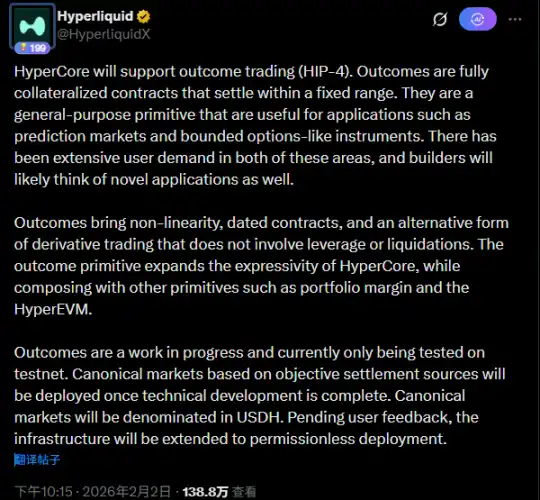
Image Source: Hyperliquid Tweet

However, as Hyperliquid expands its business, it has encountered allegations of technological infringement from a peer. On February 2, Sky Guo, founder of the RWA public chain project Cypherium, publicly accused Hyperliquid of infringing on its patented technology on social media. Sky Guo claimed that Hyperliquid's underlying consensus engine, HyperCore, uses a patented optimized version of the PoS-based HotStuff algorithm and demanded that Hyperliquid cease the infringement.
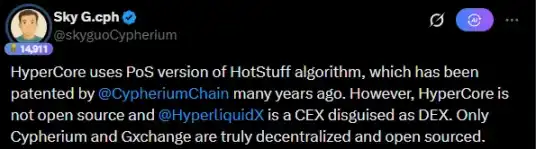
Image Source: Sky Guo Tweet


Core Dispute: The Technical Boundaries of Patent US 11,411,721 B2

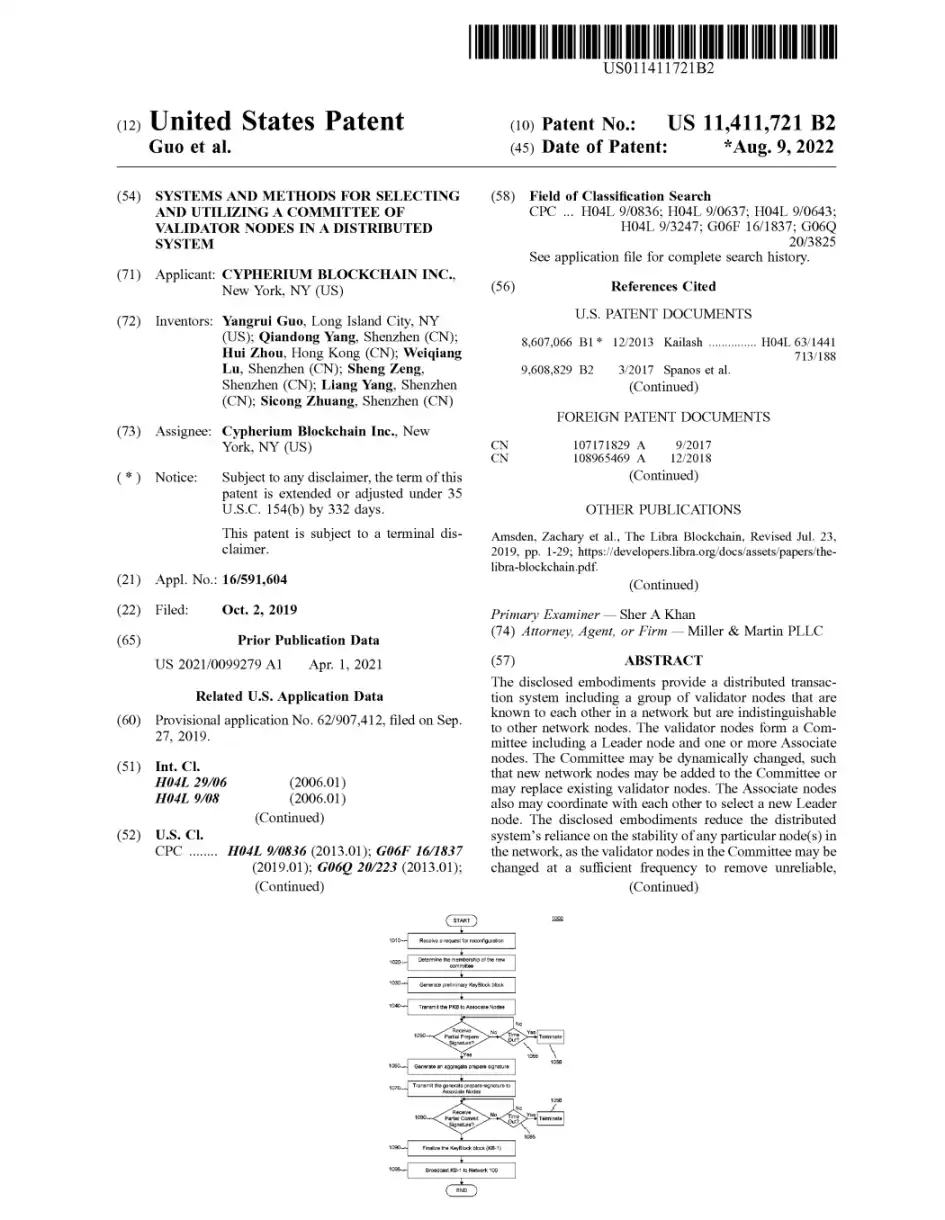
The core of this dispute revolves around a formal patent issued by the United States Patent and Trademark Office (USPTO) on August 9, 2022, with the number US 11,411,721 B2. The assignee of this patent is Cypherium Blockchain Inc., and its title is "Systems and methods for selecting and utilizing a committee of validator nodes in a distributed system."

The patent details a mechanism for dynamically selecting and reconfiguring a validator committee, supporting node election through PoW, PoS, or PoA, and emphasizes the use of Aggregate Signatures to enhance consensus efficiency and fault tolerance. The patent also proposes specific implementation paths such as Two-phase Reconfiguration and Tree-structured Hierarchy.

Cypherium believes that these technologies are key to implementing HotStuff in large-scale, high-performance networks (such as Hyperliquid's 200,000 TPS), and this constitutes the core barrier of the patent rights.
First Page of Cypherium Patent US 11,411,721 B2 | Image Source: Google Patents

The technical dispute centers on both parties' improvements and applications of the consensus algorithm HotStuff, but HotStuff itself is an open-source consensus protocol published in academia between 2018 and 2019.

Cypherium's CypherBFT combines HotStuff with PoW to achieve permissionless operation, while Hyperliquid's HyperBFT is a custom variant optimized for low-latency transactions.

However, Cypherium claims that its patent covers specific enhancement logic for HotStuff in a PoS environment. Hyperliquid has not yet responded regarding whether HyperBFT uses the unique claims covered by the patent.

Escalation of Accusations: From Questioning Transparency to Alleging Infringement

Prior to this infringement allegation, Sky Guo's criticism of Hyperliquid primarily focused on code transparency.

Image Source: Sky Guo Tweet

This lack of transparency, on one hand, protects Hyperliquid's commercial advantage in high-concurrency processing; on the other hand, it makes it difficult for the project to prove its innocence through public audits when facing external technical质疑 (questioning/doubt).

Sky Guo believes that it is precisely because HyperCore borrowed the dynamic committee selection logic described in his patent that it achieved its sub-second finality.

Sky Guo claims to have sent a legal letter to the Hyperliquid team and relevant responsible persons, accusing them of using the patented technology without permission. He stated that the Hyperliquid side is currently avoiding the issue and has not responded to the legal correspondence.

Solid Evidence or Ambush Marketing?

From a superficial legal and technical logic perspective, the US patent US 11,411,721 B2 held by Cypherium is indeed a formally issued legal document. Its scope of protection确实涵盖 (does indeed cover) key aspects of consensus mechanisms such as dynamic committee selection, signature aggregation, and two-phase reconfiguration.

According to Hyperliquid's publicly available technical documentation, the underlying HyperCore engine确实运行 (does indeed run) on a custom variant of the HotStuff algorithm called HyperBFT. HotStuff is precisely the technology改良对象 (improvement target) heavily involved in the claims of this patent.
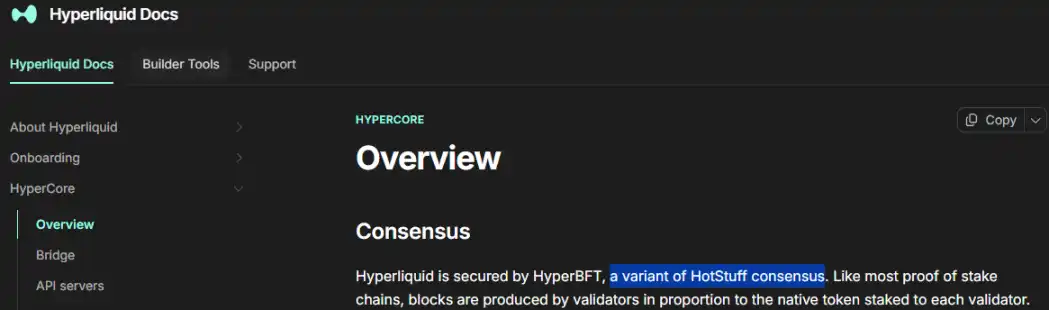
Image Source:Hyperliquid Docs

Furthermore, since Hyperliquid's core codebase is currently closed-source, this black-box属性 (attribute) makes it difficult for the outside world to determine whether its specific implementation path avoids the relevant patent through public code audits.

However, in reality, HotStuff and its variants are hardly new in the high-performance Layer 1 race. From Meta's (formerly Facebook) aborted Libra/Diem, to the currently prominent Aptos (AptosBFT), Monad (MonadBFT), and even early research iterations of Sui's core consensus, all have been significantly influenced by HotStuff's linear communication complexity and responsive design.

Additionally, the timing and context of the accusation are thought-provoking. Sky Guo published the infringement allegation at 12:00 on February 3, coinciding with strong market performance of the HYPE token and the热度 (heat/buzz) surrounding the HIP-4 proposal for the prediction market.

On social platforms, some KOLs expressed support for this rights protection action, but the comment sections of related posts featured疑似推广内容 (suspected promotional content) about "G-Exchange." "G-Exchange" is an upcoming new project within the Cypherium ecosystem. The coincidence in the timeline between this technical accusation and the预热 (pre-launch warm-up) of a new project makes this series of维权动作 (rights protection actions)疑似 (suspected of being) ambush marketing to generate buzz for the new business.

Image Source: Sky Guo and other X account tweets

Whether the accusation is a "real hammer" (solid evidence) or "ambush marketing," Hyperliquid seems to have reached a crossroads. As its business expands, community calls for increased transparency are growing. Faced with infringement质疑 (doubts/questions), will Hyperliquid insist on its black-box advantage, or will it prove its innocence through partial open-sourcing or third-party audits? This concerns the trust foundation of its decentralization narrative.

Note: 9.92 million HYPE tokens are scheduled to be unlocked on February 6, accounting for 2.79% of the circulating supply, with a value of approximately $357 million (based on a price of $36).


Perguntas relacionadas

QWhat is the core patent technology that Cypherium accuses Hyperliquid of infringing upon?

ACypherium accuses Hyperliquid of infringing upon US Patent No. 11,411,721 B2, which covers systems and methods for dynamically selecting and reconfiguring a committee of validator nodes in a distributed system, utilizing mechanisms like aggregate signatures and two-phase reconfiguration to enhance consensus efficiency and fault tolerance.

QHow did Hyperliquid's native token HYPE perform in the market amidst the broader cryptocurrency downturn mentioned?

ADespite a broader market correction where Bitcoin fell below $75,000, Hyperliquid's native token HYPE experienced significant growth, rising over 40% in the past week.

QWhat specific technical feature does Sky Guo claim Hyperliquid's HyperCore engine borrowed from Cypherium's patent?

ASky Guo claims that Hyperliquid's HyperCore engine borrowed the dynamic committee selection logic from Cypherium's patent, which is key to achieving its sub-second finality.

QWhy is it difficult to verify the patent infringement claims against Hyperliquid through public code audit?

AIt is difficult to verify the infringement claims because Hyperliquid's core codebase is currently closed-source and non-transparent, making it impossible for external parties to conduct a public code audit to determine if the implementation avoids the patented technology.

QWhat coincidental timing suggests that Cypherium's infringement accusation might be a form of 'clickbait marketing'?

AThe accusation was made just as HYPE token was performing strongly and the HIP-4 proposal was generating prediction market hype. Additionally, promotional content for Cypherium's new project 'G-Exchange' appeared in related social media discussions, suggesting the timing may be strategic for marketing purposes.

Leituras Relacionadas

After Three Consecutive Quarters of Decline, Can the Crypto Market Find a Window for Stabilization in Q3?

The cryptocurrency market has just concluded its worst-performing quarter since 2022, with total capitalization dropping 12.6% to $2.1 trillion. All core metrics indicate capital is leaving the sector, not just rotating within it. Bitcoin fell 14.2% and Ethereum dropped 25.4% in Q2, breaking their previous correlation with US tech stocks. A key driver is the reversal in US spot Bitcoin ETF flows, which saw a net outflow of approximately $4.67 billion in Q2, including a record monthly outflow near $4.5 billion in June. While recent data suggests long-term holders are accumulating again, sustained ETF outflows mean continued selling pressure. Market focus is now singularly on the Federal Reserve. The upcoming July FOMC meeting is seen as the most critical event for Q3. A dovish signal could support Bitcoin reclaiming a $68,000-$84,000 range, while a hawkish stance might establish a new trading band around $50,000-$56,000. Additionally, regulatory uncertainty persists, with the progress of the crucial *CLARITY Act* stalling in the Senate, reducing its perceived 2026 passage probability to 40-45%. Despite the broad downturn, a few sectors showed growth. Prediction markets saw nominal volume surge 48.7% year-over-year to $113.8 billion, and tokenized collectibles transaction volume rose 143% quarterly to $1.4 billion. The Real-World Asset (RWA) tokenization sector also continued steady growth, now representing ~$28.1 billion in on-chain value. The market's foundation for an extreme crash appears limited, with Bitcoin price hovering near its 200-week moving average. However, the trading paradigm has shifted from narrative-driven speculation to decisions based on price action, policy developments, and interest rate expectations, making a broad sentiment-driven rally unlikely in the near term.

marsbitHá 9h

After Three Consecutive Quarters of Decline, Can the Crypto Market Find a Window for Stabilization in Q3?

marsbitHá 9h

BIT Trading Moment: BTC Still Suppressed by Weekly 200 EMA, Rejection May Restart Decline; Storage and Semiconductors that Surged Last Night Begin Falling in Evening Trading

**Crypto & Stock Market Wrap: Bitcoin Tests Resistance, Stocks Retreat After AI Surge** Bitcoin consolidates around $66,000, facing key resistance near $68,000—an area seen as a major psychological and technical hurdle where previous rallies have failed. Analysts note the cryptocurrency is caught between its 200-week moving average (~$63,333) and 200-week EMA (~$68,328). A clear break above $68k is needed to signal a stronger bullish trend, while a rejection could lead to a retest of $63k support. Market sentiment remains cautious, with low futures open interest pointing to a low-liquidity rebound rather than a full bull market. Bitcoin spot ETFs saw another $203 million inflow. US stock futures pointed lower after a strong Tuesday session led by a massive rebound in semiconductors and memory stocks. The rally was fueled by renewed optimism about AI-driven hardware demand, with Micron, SanDisk, and SK Hynix surging. However, those gains reversed in pre-market trading. Super Micro Computer (SMCI) soared over 20% after hours on strong guidance and a record backlog. Other standouts included Rocket Lab and nuclear energy plays Oklo and X-Energy. Rising oil prices (Brent above $91) and climbing Treasury yields (10-year near 4.64%), however, are reigniting inflation concerns and acting as a headwind for equities. In Asia, markets were mixed. South Korea's KOSPI pared early gains to close slightly higher as semiconductor stocks like SK Hynix gave back initial surges. Japan's Nikkei edged lower as the yen hit a fresh 38-year low against the dollar, raising fears of potential market intervention. Key events to watch include the Samsung Galaxy launch, AMD's AI event, and a slew of major tech earnings from Alphabet, Tesla, and IBM after the close on Wednesday, followed by the ECB meeting and Intel's earnings on Thursday.

marsbitHá 9h

BIT Trading Moment: BTC Still Suppressed by Weekly 200 EMA, Rejection May Restart Decline; Storage and Semiconductors that Surged Last Night Begin Falling in Evening Trading

marsbitHá 9h

Former CFTC Chairman, Circle President Tarbert: Preaching Long-Termism While Cashing Out $30 Million Himself

Former CFTC Chairman and Circle President Heath Tarbert has consistently advocated for a long-term vision in public, urging patience from investors as Circle’s stock price has fallen significantly from its peak. However, it has been revealed that since Circle’s IPO, Tarbert has continuously sold his CRCL shares through pre-arranged trading plans, cashing out approximately $30 million, without making any public market purchases. This contrast between his public messaging and personal actions has drawn criticism. Tarbert joined Circle in July 2023 as Chief Legal Officer, leveraging his regulatory experience to help guide the company through its IPO and expansion. Despite promoting stablecoins as long-term infrastructure, he established a 10b5-1 trading plan just before Circle went public, leading to substantial stock sales over the following year. In March 2026, he initiated another plan to sell more shares. His career trajectory highlights a pattern of moving between high-level regulatory roles and influential positions in the financial sector. After resigning as CFTC Chairman in early 2021, he joined Citadel Securities as Chief Legal Officer just 27 days later, during a period of intense regulatory scrutiny for the firm. He later joined Circle, aiding its efforts to navigate regulatory challenges for its public listing. While Tarbert's expertise in policy and compliance is valuable to companies like Circle, his actions—advocating long-term confidence while personally divesting—raise questions about the alignment between his public statements and his private financial decisions, leaving investors who followed his advice to bear the market risks.

marsbitHá 9h

Former CFTC Chairman, Circle President Tarbert: Preaching Long-Termism While Cashing Out $30 Million Himself

marsbitHá 9h

Gate Research Institute: The 'Wall Street-ization' Wave of Crypto Financial Products – Competition or Integration?

The article titled "Gate Research Institute: Are Crypto Financial Products Sparking a 'Wall Street' Wave—Competition or Convergence?" explores the evolving relationship between the crypto ecosystem and traditional finance (TradFi). The piece begins by reflecting on Bitcoin's original 2009 vision of decentralization, disintermediation, and moving away from banks. It then contrasts this with the 2024 landscape, where key crypto assets like Bitcoin are increasingly held through Wall Street products like ETFs issued by giants like BlackRock. The article questions whether this signifies that TradFi is systematically taking over the rights to issue, price, custody, and distribute crypto financial assets. The core argument is that this is not a zero-sum takeover but rather a bidirectional convergence where each side addresses the other's weaknesses. Crypto offers 24/7 global markets, programmable settlement, and open access but lacks compliant channels, institutional-grade custody, deep fiat liquidity, and mainstream distribution. TradFi possesses these but is constrained by legacy systems, limited operating hours, and slow settlement. Two primary convergence paths are highlighted: * **Path A (CEX to TradFi):** Exemplified by Gate, which has progressed from offering tokenized stocks and CFDs to providing direct, real stock trading (US, Hong Kong, South Korea) within its platform, using USDT. * **Path B (TradFi to Crypto):** Exemplified by Robinhood, which has integrated crypto trading, acquired exchanges like Bitstamp, and is moving traditional assets like stocks onto the blockchain via tokenization and its own Layer 2. Both paths are ultimately competing to become the next-generation, unified financial account—a "super account" where users can seamlessly trade cryptocurrencies, stocks, ETFs, RWA (Real World Assets), and tokenized treasury products in one interface. The growth of RWA and tokenized treasuries (e.g., BlackRock's BUIDL) is presented as the asset-layer fusion, providing stable, yield-bearing assets on-chain and acting as a bridge between the two worlds. In conclusion, the "Wall Street-ization" of crypto is framed as a mutual transformation. Decentralized ideals persist in the protocol layer, while at the application layer, a more efficient, global, and accessible unified capital market is emerging from this convergence. The future competition lies not between crypto exchanges and stockbrokers, but between platforms vying to offer the most comprehensive asset coverage, liquidity, and user experience within a single account.

marsbitHá 9h

Gate Research Institute: The 'Wall Street-ization' Wave of Crypto Financial Products – Competition or Integration?

marsbitHá 9h

Trading

Spot
活动图片




