Hyperliquid Infringement Dispute: Technological Rights Protection or Opportunistic Marketing?

marsbitPublicado em 2026-02-04Última atualização em 2026-02-04

Resumo

Hyperliquid, a high-performance decentralized exchange (DEX), faces patent infringement allegations from Cypherium, a competing RWA blockchain project. The dispute centers on US Patent 11,411,721 B2, held by Cypherium, which covers systems for dynamically selecting and reconfiguring validator committees using mechanisms like aggregated signatures and two-phase reconfiguration in a Proof-of-Stake (PoS) environment. Cypherium’s founder, Sky Guo, claims Hyperliquid’s core consensus engine, HyperCore—a custom variant of the HotStuff algorithm—illegally uses this patented technology to achieve its high throughput and sub-second finality. The controversy arises as Hyperliquid’s native token, HYPE, surged over 40% amid a broader market downturn and the launch of its new prediction market proposal, HIP-4. Critics question the timing of the allegations, noting coinciding promotions for Cypherium’s upcoming project, "G-Exchange," suggesting potential "clickbait marketing." Hyperliquid has not yet publicly responded to the legal claims. With Hyperliquid’s code remaining closed-source, external verification of the infringement is challenging. The situation highlights tensions between protecting proprietary tech and maintaining decentralization trust. Additionally, HYPE is set to unlock 9.92 million tokens (2.79% of supply) on February 6, worth approximately $357 million at current prices.

Original Author: Sanqing, Foresight News

On February 2, Hyperliquid announced that the HIP-4 proposal had gone live on the testnet on February 2. This proposal aims to build a prediction market infrastructure by introducing "Outcome Trading." Additionally, from late January to early February 2026, the cryptocurrency market showed weakness, with Bitcoin's price falling below the $75,000 mark, leading to a broad market correction. However, Hyperliquid's native token HYPE bucked the trend, rising over 40% in the past week.
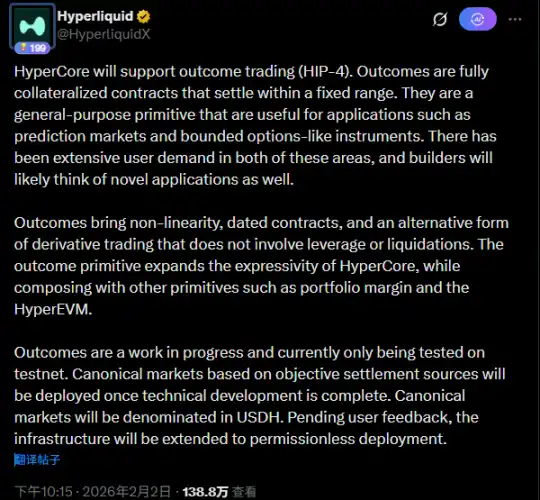
Image Source: Hyperliquid Tweet

However, as Hyperliquid expands its business, it has encountered allegations of technological infringement from a peer. On February 2, Sky Guo, founder of the RWA public chain project Cypherium, publicly accused Hyperliquid of infringing on its patented technology on social media. Sky Guo claimed that Hyperliquid's underlying consensus engine, HyperCore, uses a patented optimized version of the PoS-based HotStuff algorithm and demanded that Hyperliquid cease the infringement.
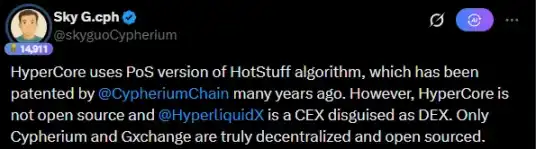
Image Source: Sky Guo Tweet


Core Dispute: The Technical Boundaries of Patent US 11,411,721 B2

The core of this dispute revolves around a formal patent issued by the United States Patent and Trademark Office (USPTO) on August 9, 2022, with the number US 11,411,721 B2. The assignee of this patent is Cypherium Blockchain Inc., and its title is "Systems and methods for selecting and utilizing a committee of validator nodes in a distributed system."

The patent details a mechanism for dynamically selecting and reconfiguring a validator committee, supporting node election through PoW, PoS, or PoA, and emphasizes the use of Aggregate Signatures to enhance consensus efficiency and fault tolerance. The patent also proposes specific implementation paths such as Two-phase Reconfiguration and Tree-structured Hierarchy.

Cypherium believes that these technologies are key to implementing HotStuff in large-scale, high-performance networks (such as Hyperliquid's 200,000 TPS), and this constitutes the core barrier of the patent rights.
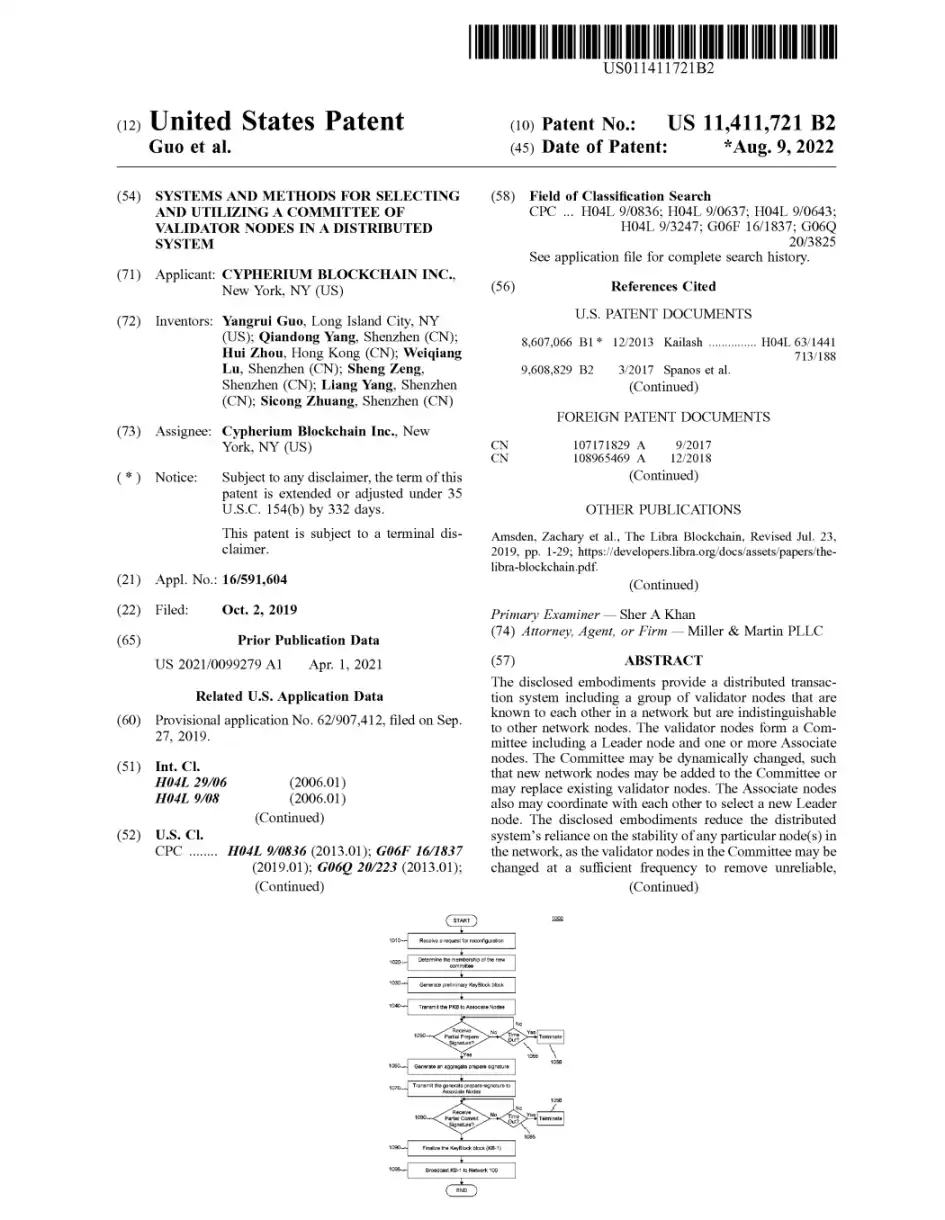
First Page of Cypherium Patent US 11,411,721 B2 | Image Source: Google Patents

The technical dispute centers on both parties' improvements and applications of the consensus algorithm HotStuff, but HotStuff itself is an open-source consensus protocol published in academia between 2018 and 2019.

Cypherium's CypherBFT combines HotStuff with PoW to achieve permissionless operation, while Hyperliquid's HyperBFT is a custom variant optimized for low-latency transactions.

However, Cypherium claims that its patent covers specific enhancement logic for HotStuff in a PoS environment. Hyperliquid has not yet responded regarding whether HyperBFT uses the unique claims covered by the patent.

Escalation of Accusations: From Questioning Transparency to Alleging Infringement

Prior to this infringement allegation, Sky Guo's criticism of Hyperliquid primarily focused on code transparency.
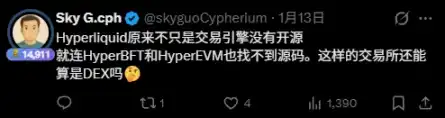
Image Source: Sky Guo Tweet

This lack of transparency, on one hand, protects Hyperliquid's commercial advantage in high-concurrency processing; on the other hand, it makes it difficult for the project to prove its innocence through public audits when facing external technical质疑 (questioning/doubt).

Sky Guo believes that it is precisely because HyperCore borrowed the dynamic committee selection logic described in his patent that it achieved its sub-second finality.

Sky Guo claims to have sent a legal letter to the Hyperliquid team and relevant responsible persons, accusing them of using the patented technology without permission. He stated that the Hyperliquid side is currently avoiding the issue and has not responded to the legal correspondence.

Solid Evidence or Ambush Marketing?

From a superficial legal and technical logic perspective, the US patent US 11,411,721 B2 held by Cypherium is indeed a formally issued legal document. Its scope of protection确实涵盖 (does indeed cover) key aspects of consensus mechanisms such as dynamic committee selection, signature aggregation, and two-phase reconfiguration.

According to Hyperliquid's publicly available technical documentation, the underlying HyperCore engine确实运行 (does indeed run) on a custom variant of the HotStuff algorithm called HyperBFT. HotStuff is precisely the technology改良对象 (improvement target) heavily involved in the claims of this patent.
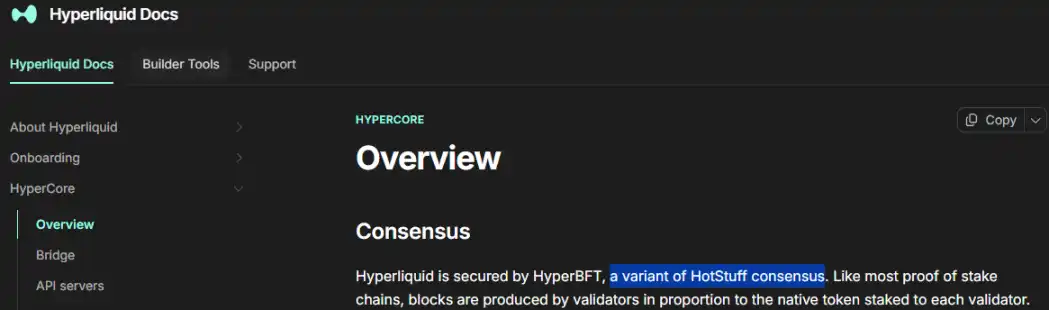
Image Source:Hyperliquid Docs

Furthermore, since Hyperliquid's core codebase is currently closed-source, this black-box属性 (attribute) makes it difficult for the outside world to determine whether its specific implementation path avoids the relevant patent through public code audits.

However, in reality, HotStuff and its variants are hardly new in the high-performance Layer 1 race. From Meta's (formerly Facebook) aborted Libra/Diem, to the currently prominent Aptos (AptosBFT), Monad (MonadBFT), and even early research iterations of Sui's core consensus, all have been significantly influenced by HotStuff's linear communication complexity and responsive design.

Additionally, the timing and context of the accusation are thought-provoking. Sky Guo published the infringement allegation at 12:00 on February 3, coinciding with strong market performance of the HYPE token and the热度 (heat/buzz) surrounding the HIP-4 proposal for the prediction market.

On social platforms, some KOLs expressed support for this rights protection action, but the comment sections of related posts featured疑似推广内容 (suspected promotional content) about "G-Exchange." "G-Exchange" is an upcoming new project within the Cypherium ecosystem. The coincidence in the timeline between this technical accusation and the预热 (pre-launch warm-up) of a new project makes this series of维权动作 (rights protection actions)疑似 (suspected of being) ambush marketing to generate buzz for the new business.
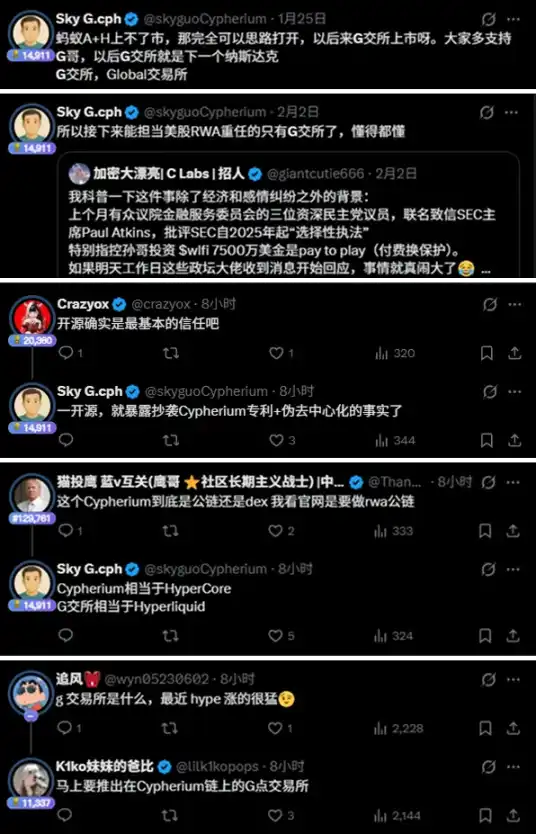
Image Source: Sky Guo and other X account tweets

Whether the accusation is a "real hammer" (solid evidence) or "ambush marketing," Hyperliquid seems to have reached a crossroads. As its business expands, community calls for increased transparency are growing. Faced with infringement质疑 (doubts/questions), will Hyperliquid insist on its black-box advantage, or will it prove its innocence through partial open-sourcing or third-party audits? This concerns the trust foundation of its decentralization narrative.

Note: 9.92 million HYPE tokens are scheduled to be unlocked on February 6, accounting for 2.79% of the circulating supply, with a value of approximately $357 million (based on a price of $36).


Perguntas relacionadas

QWhat is the core patent technology that Cypherium accuses Hyperliquid of infringing upon?

ACypherium accuses Hyperliquid of infringing upon US Patent No. 11,411,721 B2, which covers systems and methods for dynamically selecting and reconfiguring a committee of validator nodes in a distributed system, utilizing mechanisms like aggregate signatures and two-phase reconfiguration to enhance consensus efficiency and fault tolerance.

QHow did Hyperliquid's native token HYPE perform in the market amidst the broader cryptocurrency downturn mentioned?

ADespite a broader market correction where Bitcoin fell below $75,000, Hyperliquid's native token HYPE experienced significant growth, rising over 40% in the past week.

QWhat specific technical feature does Sky Guo claim Hyperliquid's HyperCore engine borrowed from Cypherium's patent?

ASky Guo claims that Hyperliquid's HyperCore engine borrowed the dynamic committee selection logic from Cypherium's patent, which is key to achieving its sub-second finality.

QWhy is it difficult to verify the patent infringement claims against Hyperliquid through public code audit?

AIt is difficult to verify the infringement claims because Hyperliquid's core codebase is currently closed-source and non-transparent, making it impossible for external parties to conduct a public code audit to determine if the implementation avoids the patented technology.

QWhat coincidental timing suggests that Cypherium's infringement accusation might be a form of 'clickbait marketing'?

AThe accusation was made just as HYPE token was performing strongly and the HIP-4 proposal was generating prediction market hype. Additionally, promotional content for Cypherium's new project 'G-Exchange' appeared in related social media discussions, suggesting the timing may be strategic for marketing purposes.

Leituras Relacionadas

In-depth: The Foreign Guest Genspark

The article "The Foreign Guest: Genspark" investigates the identity and business practices of AI startup Genspark, which presents itself as a Palo Alto-based "AI Costco" offering a subscription bundle of over 70 models and numerous AI agent tools. Despite its official Silicon Valley narrative, Genspark's founding team has deep roots in Chinese tech giant Baidu, a history systematically downplayed in its branding. The company actively cultivates an image as an elite US firm, heavily publicizing partnerships and endorsements from OpenAI, Anthropic, and Microsoft, while distancing itself from the Chinese AI community and obscuring its connections to Chinese investors and open-weight models (like those from DeepSeek, Moonshot AI, and MiniMax) that power its services. Genspark's core strategy involves rapidly cloning and integrating successful AI product concepts (e.g., from Perplexity, Manus, Plaud) into its unified platform, supported by aggressive marketing, including Super Bowl ads and paid native content in publications like The Wall Street Journal. Critically, the article suggests a significant portion of its engineering and product development is conducted by a team in Beijing, operating outside its official US corporate structure. This duality allows Genspark to leverage Chinese talent and models for efficiency and cost reduction while constructing a public facade as a purely American success story. The piece concludes that Genspark's most effective agent is its own corporate identity, meticulously engineered to obscure its Chinese underpinnings and be perceived solely as a Silicon Valley company.

marsbitHá 40m

In-depth: The Foreign Guest Genspark

marsbitHá 40m

Debate: Korean Workers Fear Unemployment, While Musk Envisions a Society 'Without Work'?

While South Korean auto workers fear job losses from robotics, Elon Musk envisions a future where AI and robots render most work optional. This article explores the growing tension between immediate anxieties over automation and long-term visions of a post-work society. The piece begins with recent strikes at Hyundai's Korean plants, where unions, amid standard wage negotiations, also sought job guarantees against advancing robotics—specifically mentioning Boston Dynamics' Atlas. This reflects how anxiety about technological displacement is emerging even before robots are fully capable of replacing skilled labor on assembly lines. The author argues that while current robotics still struggle with the nuanced, experiential knowledge of veteran workers, the *perception* of imminent replacement is fueling social conflict prematurely. This modern "Luddite" sentiment is compared to the 19th-century English textile workers who smashed machines. Historically, Luddites weren't simply anti-technology; they were protesting the rapid devaluation of their skills and the unequal distribution of productivity gains. Similarly, today's workers ask who will bear the cost of transition and share in the new wealth created by machines. In contrast, figures like Elon Musk propose an optimistic endpoint: with AI and robotics driving extreme abundance, the link between work and survival could break. He suggests concepts like "Universal High Income" could allow society to share the technological bounty, transforming work from a necessity into a choice. The core challenge, however, lies in the transition. The author notes that technology's benefits diffuse slowly, while its disruptive costs—job losses, skill obsolescence—can be concentrated and immediate. The risk is a painful interim period where productivity gains are captured by a few before new social contracts, safety nets, and retraining systems are established. The conclusion calls for proactive governance. Just as past industrial revolutions gave rise to labor standards and social safety nets, the robotics era needs its own frameworks. These should address job transition support, distribution of productivity gains, safety liability, and ethical deployment. Embracing such "constraints" is not opposition to progress but a necessary step to ensure technology benefits society broadly. The discussion sparked by Hyundai's workers, therefore, is not premature but essential.

marsbitHá 53m

Debate: Korean Workers Fear Unemployment, While Musk Envisions a Society 'Without Work'?

marsbitHá 53m

Trading

Spot
活动图片