Hyperbeat: Launching a 'Bank' on Hyperliquid

marsbitPublicado em 2026-04-09Última atualização em 2026-04-09

Resumo

Hyperbeat, a protocol built on Hyperliquid, has launched "Liquid Banking," a self-custodial banking solution deployed on HyperEVM. It integrates stablecoin deposits, VISA card spending, perpetual trading, and multi-currency fiat on/off ramps into a single on-chain smart wallet. The core feature is "Credit Mode," powered by Morpho's lending engine. Users deposit assets like BTC or ETH as collateral. When spending with the VISA card, the system instantly borrows stablecoins via Morpho to complete payments, while the collateral remains on-chain earning yield. There is no grace period—interest accrues immediately upon spending. Hyperbeat uses its native stablecoin, beatUSD, issued in partnership with Paxos. Deposit yields come from real borrowing interest generated by consumer spending. Fiat services are provided by Noah, supporting multiple currencies, and the VISA card is issued by Third National via infrastructure from Rain. As a self-custodial system, user assets stay in their smart wallet. To prevent fraud, withdrawals require a cooling period and operator approval for collateral removal. The system emphasizes transparency and on-chain security but places responsibility on users to manage their account health, with no customer support to reverse errors.

On April 8, Hyperliquid's native protocol Hyperbeat launched Liquid Banking, a self-custodied 'bank' deployed on HyperEVM, integrating stablecoin deposits, VISA card spending, perpetual contract trading, and multi-currency fiat on/off ramps into a single on-chain smart wallet.
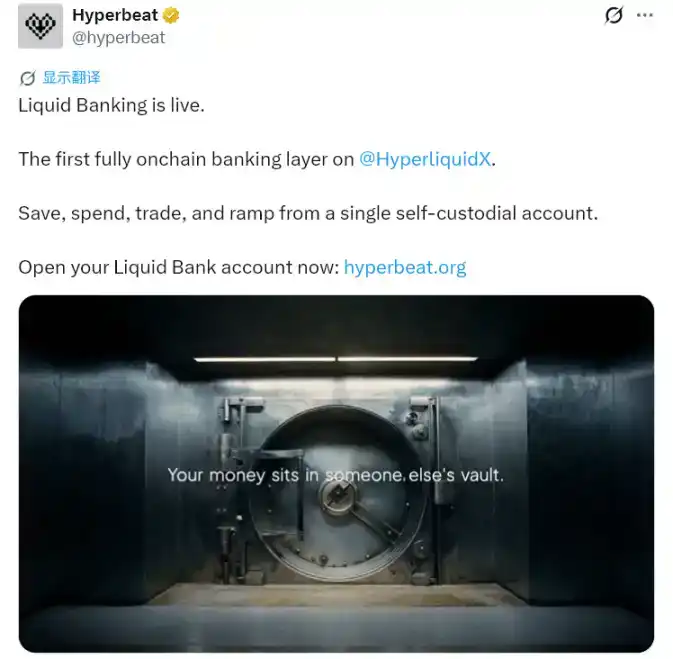
The Hyperbeat team transitioned from being among the first validators on the Hyperliquid testnet. Initially just 5 people, they self-funded a start with approximately $200,000. The two co-founders, Kilian Boshoff(@Fundi_Crypto) and 800.HL(@degennQuant), maintain a low profile; the former has a background from Stellenbosch University in South Africa. The company is registered in the Cayman Islands.

In August 2025, it completed a $5.2 million seed round co-led by ether.fi Ventures and Electric Capital, with participation from Coinbase Ventures, Maelstrom, Anchorage Digital, and others, valuing the company at approximately $40 million.

Morpho Provides the Engine, Building a 'Bank' in Ten Months

The core selling point of Liquid Banking is Credit Mode.
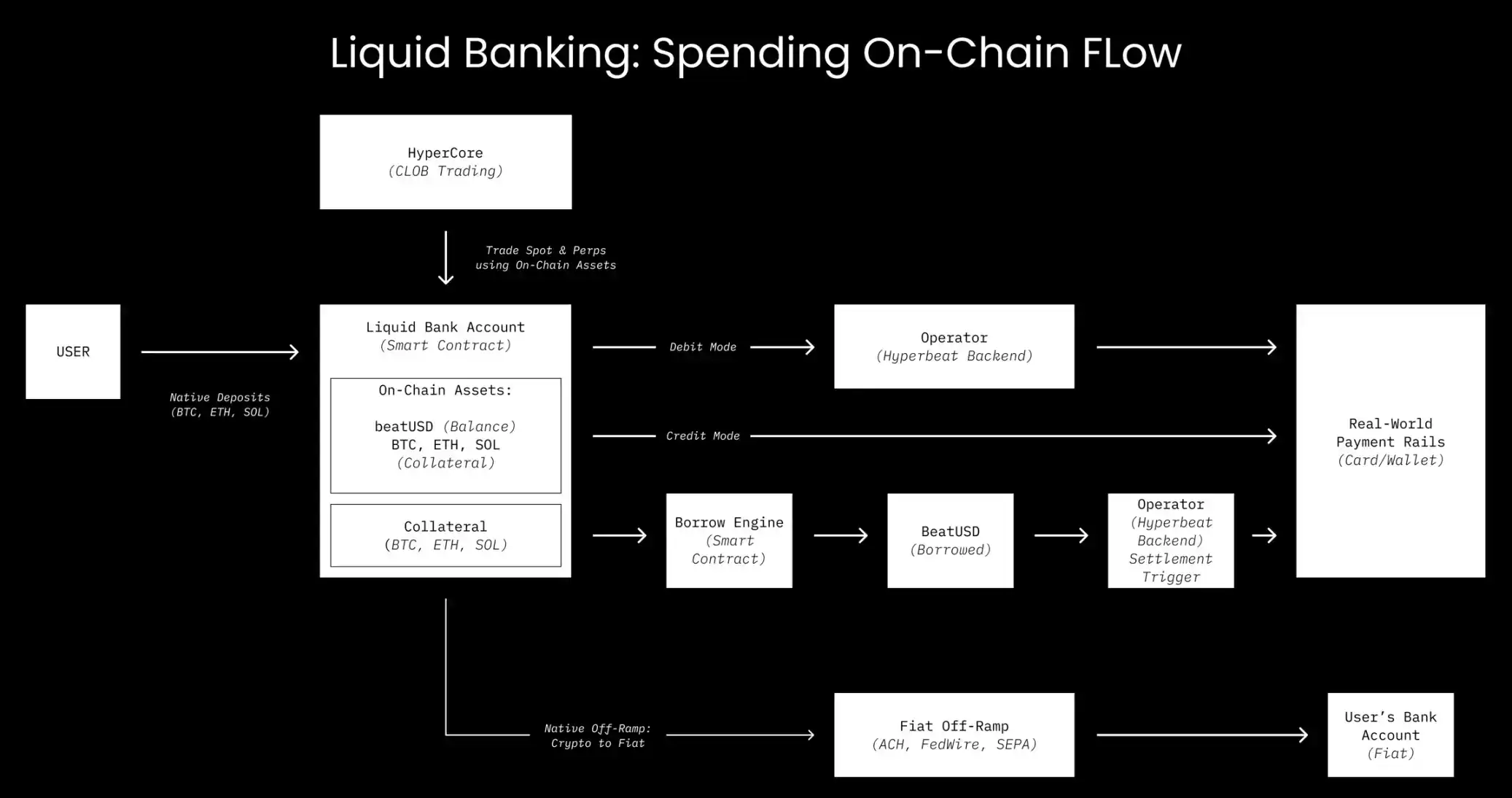
Users deposit assets like BTC, ETH, HYPE, etc., as collateral. When swiping the VISA card, the system instantly borrows stablecoins through the Morpho Blue market to complete the payment, while the collateral remains on-chain, continuing to generate yield. The user never interacts with a borrowing interface; the act of swiping the card is itself an on-chain loan.

The underlying lending engine comes from Morpho. Hyperbeat integrates Morpho into the user's smart wallet through an on-chain whitelist mechanism. Currently, Credit Mode operates on six isolated markets, with collateral covering HYPE, UBTC, UETH, USOL, and even the gold token XAUT.

Hyperbeat does not touch the core lending logic; Morpho does not touch the user interface. The former builds the 'bank frontend,' the latter supplies the 'credit engine.'

Stablecoin deposits for Liquid Banking center around beatUSD, a native stablecoin issued in partnership with Paxos Labs. Paxos provides the stablecoin infrastructure (underpinned by USDG0). The yield from the reserves flows directly back into Hyperbeat's rewards program and is ultimately distributed to users, rather than remaining with the issuer.

The deposit-side USD+ vault automatically allocates user funds to protocols like Morpho, Hypuur, Hyperlend, Felix, etc., offering 3%-8% APY.

The yield comes from the real borrowing interest paid by Credit Mode consumers. The more spending, the higher the deposit yield. But the sustainability of this cycle depends on the volume of real consumption.

Spend Without Selling Crypto, But Interest Accrues Immediately on Swipe

Fiat on/off ramps for Liquid Banking are provided by Noah, supporting USD (ACH, FedWire) and EUR (SEPA) deposits, with a unique IBAN bound to each account.
In March 2026, direct top-ups and withdrawals for Vietnamese Dong and Malaysian Ringgit were added. Withdrawals also cover over ten currencies including British Pounds, Dirhams, and Thai Baht.

The VISA card is issued by Third National, with underlying infrastructure from Rain, a Visa Principal Member. By early January 2026, Rain's financing round valued it at $1.95 billion, with an annualized processing volume exceeding $3 billion, covering over a hundred countries.

The card tier is Visa Signature,附带机场贵宾厅等权益 (includes benefits like airport lounge access). Foreign currency transactions incur a 1% FX fee (based on Visa's official exchange rate), with no annual fee and no transaction fees; ATM withdrawals cost $1 + 0.65%; the default monthly spending limit is $100,000.

The borrowing利率 (interest rate) for Credit Mode fluctuates with the utilization rate of the Morpho market, but there is no grace period. Every instance of 'spending without selling crypto' starts accruing interest the second the card is swiped.

Hyperbeat's official 'no hidden fees' refers to the transparency of the yield strategy, not the card's fee pricing. The Credit Mode borrowing rate is dynamically determined by the Morpho market. The lack of a grace period means the real-time cost of the convenience of 'spending without selling crypto' exists and is not low.

The Cost of Self-Custody is a One-Day Cooling Period

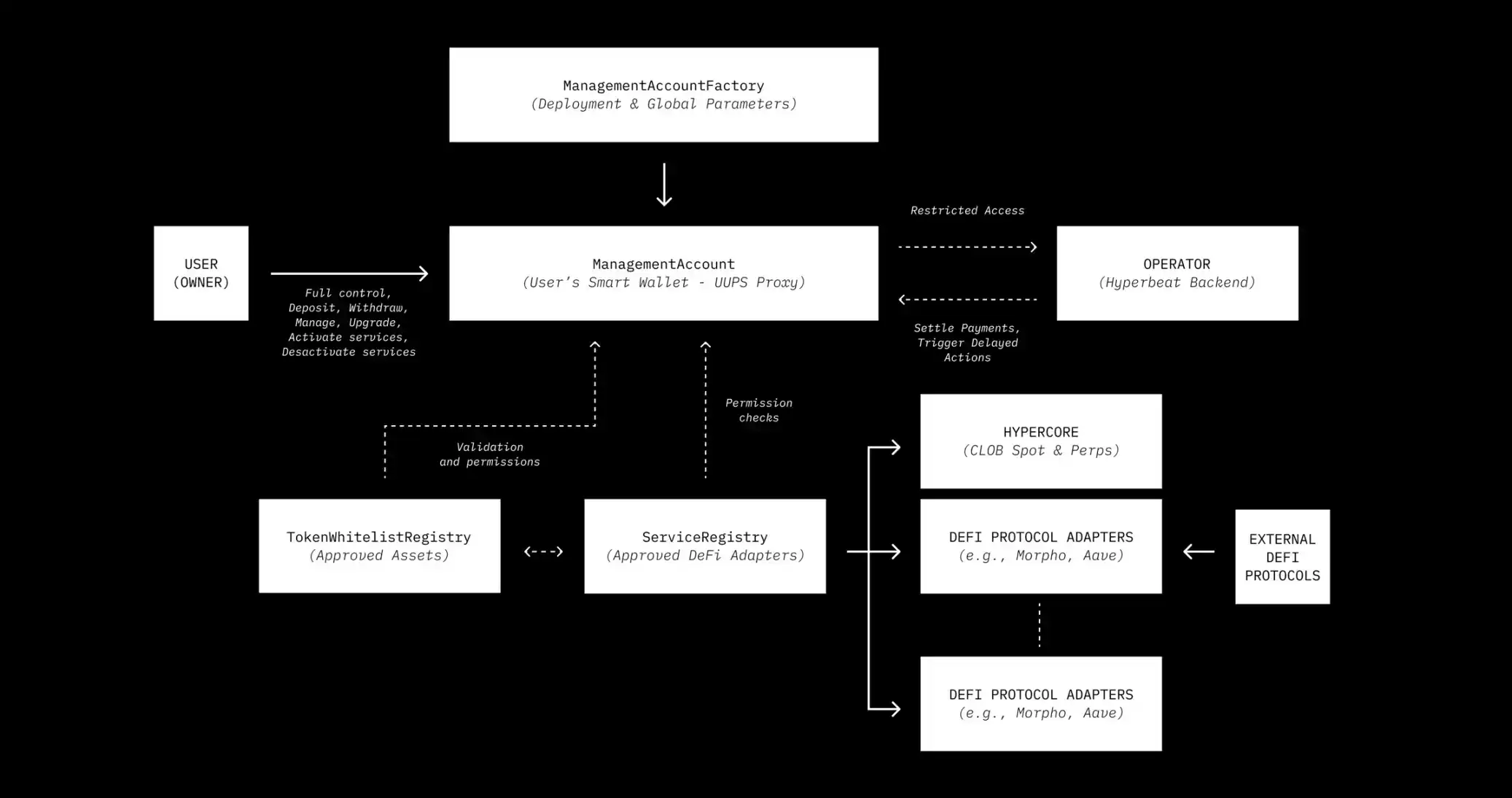
Unlike all centralized crypto cards, user assets always remain in their self-controlled ManagementAccount smart wallet. The Hyperbeat backend only has a restricted Operator role, able to execute settlements only within user-set limits and unable to transfer assets to unauthorized addresses.

But self-custody must solve one problem: what if a user withdraws funds right after swiping the card? Hyperbeat introduces an on-chain timelock mechanism.

Withdrawing settlement tokens requires a cooling period and a confirmation process. Withdrawing collateral requires Operator approval to prevent bad debt. Switching modes also has a delay. The contracts were audited by Zellic and Nethermind, with key management provided by Turnkey.

These frictions are not a bug; they are a feature. They acknowledge the speed difference between on-chain settlement and offline consumption, filling the gap with contract rules rather than 'please believe us.' But users must monitor their health factor themselves; there is no customer service to undo operational mistakes.


Perguntas relacionadas

QWhat is the core feature of Hyperbeat's Liquid Banking product launched on Hyperliquid?

AThe core feature is Credit Mode, which allows users to spend stablecoins borrowed instantly via Morpho Blue markets using their crypto assets as collateral, all within a single on-chain smart wallet without manually interacting with a lending interface.

QWhich companies were the lead investors in Hyperbeat's $5.2 million seed round and what was the valuation?

AThe seed round was co-led by ether.fi Ventures and Electric Capital, with participation from CoinBase Ventures, Maelstrom, and Anchorage Digital, valuing the company at approximately $40 million.

QHow does Hyperbeat's Credit Mode generate yield for stablecoin depositors?

AYield is generated from the real borrowing interest paid by consumers using Credit Mode. User deposits are automatically allocated to protocols like Morpho, Hypuur, Hyperlend, and Felix, with the interest from spending/borrowing flowing back to the reward program and ultimately to depositors.

QWhat is a key operational difference and potential cost for users of the Hyperbeat VISA card compared to traditional credit cards?

AA key difference is that there is no interest-free grace period. Borrowing interest starts accruing from the very second a transaction is made, and the rate is dynamically determined by the Morpho market's utilization.

QWhat is a key security feature and its associated user trade-off in Hyperbeat's self-custody model?

AA key security feature is the on-chain timelock and cooldown period for withdrawing settled tokens or collateral, which prevents bad debt but introduces a delay (e.g., a one-day cooldown) and requires users to actively manage their health factor without the ability for customer support to reverse mistakes.

Leituras Relacionadas

SpaceX, OpenAI, Anthropic: The Three AI Giants Racing for IPO, Which One Is Worth Betting On?

SpaceX, OpenAI, and Anthropic are poised for historic IPOs within weeks, potentially raising a combined $180 billion—a sum exceeding the entire internet bubble's fundraising. The hosts of the Limitless Podcast argue this isn't just individual company financing but an unprecedented capital concentration for AI infrastructure, driven by an insatiable need for compute, data centers, power, and chips. SpaceX's IPO is notable for reportedly changing market index rules to allow faster inclusion, potentially funneling trillions in passive retirement funds into its stock, despite its unproven space-based data center business model. In contrast, Anthropic demonstrates explosive growth, with ARR reportedly hitting $45 billion and approaching profitability, fueled by strong enterprise adoption of products like Claude Code. Google's separate $80 billion raise highlights the immense capital pressure, even for giants. The discussion acknowledges bubble risks but leans optimistic. The hosts contend the massive spending is building essential physical infrastructure for the next technological era. A key bottleneck isn't capital but the real-world limits of chip manufacturing and construction speed. As long as demand for AI compute outstrips supply, this investment cycle represents a foundational build-out rather than a purely financial bubble. All three companies are seen as foundational bets on the future, with Anthropic often cited as the most immediately compelling due to its proven revenue trajectory.

marsbitHá 28m

SpaceX, OpenAI, Anthropic: The Three AI Giants Racing for IPO, Which One Is Worth Betting On?

marsbitHá 28m

From 'Old Guys' to 'New Favorites': How AI Is Revaluing Old Infrastructure from Dell to Nokia?

From "Vintage Tech" to "New AI Darlings": How AI Revalues Old Infrastructure One year ago, tech giants like Dell, Nokia, Cisco, and Western Data were seen as slow-growth, low-valuation stories, far from the AI spotlight dominated by players like Nvidia. Now, these legacy tech stocks are gaining market attention, sparking debate on whether this is genuine industry revaluation or a temporary narrative. As AI moves from model parameters to real-world data centers, the market is recognizing companies with proven delivery and infrastructure capabilities. This shift marks a change in the AI investment thesis: from pure model and GPU focus to the complex systems engineering required for deployment. Companies like Dell, HPE, and Corning are being revalued not for being "sexy" AI innovators, but for their decades of accumulated expertise in supply chains, enterprise delivery, and infrastructure—assets that have become critical in the AI buildout phase. The revaluation is unfolding across three key infrastructure lines: 1. **Servers & System Integration:** Dell and HPE are emerging as crucial system integrators or "general contractors" for AI data centers, translating GPU orders into complete, deployable server racks integrated with power, cooling, and networking. 2. **Networking & Connectivity:** AI's scale demands robust high-speed connections. Corning (fiber optics), Nokia (AI-RAN, 6G), and Cisco (data center switches) are gaining importance for enabling efficient data transfer within and between AI clusters. 3. **Storage:** Beyond high-speed memory (HBM/DRAM), the AI data explosion is driving demand for high-capacity hard drives (HDDs) from companies like Western Digital and Seagate to handle training data, logs, and cold storage cost-effectively. For this revaluation to be substantive and not just a narrative, three criteria are key: 1) Concrete AI-related order and revenue growth (e.g., Dell's AI server sales), 2) Upward revisions to company financial guidance, and 3) Sustainable improvements in profit quality, not just top-line revenue spikes. In essence, AI's transition to a real construction phase is re-pricing "old assets" against "new demand." The opportunity, however, is selective. Only those legacy firms that are demonstrably integrated into the capital expenditure chains of data center and enterprise AI deployment are likely to experience a true "logic re-rating" rather than just a temporary valuation bounce.

marsbitHá 34m

From 'Old Guys' to 'New Favorites': How AI Is Revaluing Old Infrastructure from Dell to Nokia?

marsbitHá 34m

The Merger of Codex and ChatGPT Marks the Beginning of a Major Reshuffle in Programming Tools

OpenAI is shifting its strategic focus from ChatGPT to Codex, merging them along with the browser tool Atlas into a unified desktop super-app. This move signals an internal belief that Codex, originally a programming tool, represents the next evolution of AI more than conversational models like ChatGPT. Over the past year, Codex's weekly active users have surged past 5 million. The key distinction is that while ChatGPT answers questions, Codex executes tasks. Enterprises increasingly value this ability to get work done over simply receiving advice. Consequently, Codex is attracting professionals beyond developers, including analysts, bankers, marketers, and product managers. OpenAI's reorganization and increased investment in Codex stem from recognizing that the future of AI competition lies in execution capabilities, not just conversation. The company is launching role-specific plugins (e.g., for data analysis, sales, design) to transform Codex into a broad knowledge work platform that automates and redefines white-collar workflows. Beyond being a tool, Codex reflects OpenAI's ambition to redefine software. New features like "Sites"—which generates interactive websites from documents—and collaborative "Annotations" aim to create a paradigm where the AI understands the goal and handles the tools and steps, functioning more like a digital colleague than traditional software. The ultimate goal is a unified experience where the user cares only about the completed task.

marsbitHá 44m

The Merger of Codex and ChatGPT Marks the Beginning of a Major Reshuffle in Programming Tools

marsbitHá 44m

Interpreting Investment Opportunities in the Age of Great Navigation, Invesco Great Wall Fund Releases '2026 Report on Chinese Enterprises Going Global'

Invesco Great Wall Fund has released its "2026 China Corporate Globalization Report," titled "The 'Great Navigation Era' of Chinese Enterprises." The report analyzes the new trends and investment opportunities as Chinese companies expand globally, moving from simple product exports to comprehensive overseas operations involving services, branding, and local production. Driven by factors like trade friction, the pursuit of higher profit margins abroad, and policy support, globalization is becoming essential for Chinese companies. The report outlines an evolution: from early product export ("Globalization 1.0") to the current "Globalization 2.0," characterized by overseas capacity, capital goods investment, consumer brand expansion, and service exports. Chinese firms' competitive advantages are highlighted, including a vast engineer talent pool, low-cost and robust infrastructure, and complete industrial clusters. Specific sectors with significant出海 potential are identified: * **Capital Goods** (e.g., engineering machinery, power equipment): Benefiting from global demand, especially in Belt & Road markets and the AI-driven power grid upgrade cycle. * **Consumer Brands**: Transitioning from cost to brand advantage, leveraging供应链 efficiency. * **Technology & Innovation**: Including AI applications, optical modules within global tech supply chains, and new energy vehicles focusing on local production. * **Pharmaceuticals**: Chinese biotech firms are becoming preferred partners for global pharma, with potential for breakthrough drugs in areas like oncology and weight loss. The report concludes that corporate globalization represents a sustained, core theme for China's capital markets, though companies must navigate challenges like geopolitics and localization.

marsbitHá 56m

Interpreting Investment Opportunities in the Age of Great Navigation, Invesco Great Wall Fund Releases '2026 Report on Chinese Enterprises Going Global'

marsbitHá 56m

Trading

Spot
Futuros

Artigos em Destaque

O que é $BANK

Bank AI: Um Passo Revolucionário no Futuro da Banca Introdução Em uma era marcada por avanços rápidos na tecnologia, o Bank AI está na interseção da inteligência artificial (IA) e dos serviços bancários. Este projeto inovador visa redefinir o panorama financeiro, melhorando a eficiência operacional, as medidas de segurança e as experiências dos clientes através do poder da IA. Ao embarcarmos nesta exploração do Bank AI, iremos aprofundar no que o projeto implica, suas dinâmicas operacionais, seu contexto histórico e marcos significativos. O que é o Bank AI? No seu cerne, o Bank AI representa uma iniciativa transformadora com o objetivo de integrar a inteligência artificial em várias operações bancárias. Este projeto aproveita as capacidades da IA para automatizar processos, melhorar os protocolos de gestão de risco e melhorar a interação com os clientes através de serviços personalizados. Os principais objetivos do Bank AI incluem: Automatização das Funções Bancárias: Ao aproveitar as tecnologias de IA, o Bank AI visa automatizar tarefas rotineiras, reduzindo o peso sobre os recursos humanos e aumentando a eficiência. Gestão de Risco Melhorada: O projeto utiliza algoritmos de IA para prever e identificar riscos, fortalecendo assim as medidas de segurança contra fraudes e outras ameaças. Personalização dos Serviços Bancários: O Bank AI foca em oferecer produtos e serviços financeiros ajustados, analisando dados e comportamentos dos clientes. Melhoria da Experiência do Cliente: A implementação de soluções impulsionadas por IA, como chatbots e assistentes virtuais, visa proporcionar aos usuários interações mais humanizadas, revolucionando a forma como os clientes se envolvem com os bancos. Com esses objetivos, o Bank AI posiciona-se como um ator crucial para tornar a banca mais eficiente, segura e centrada no usuário. Quem é o Criador do Bank AI? Os detalhes sobre o criador do Bank AI permanecem desconhecidos. Assim, nenhuma pessoa ou organização específica foi identificada nas informações disponíveis. O anonimato que cerca a origem do projeto levanta questões, mas não diminui a sua ambiciosa visão e objetivos. Quem são os Investidores do Bank AI? Semelhante ao criador do projeto, informações específicas sobre os investidores ou organizações que apoiam o Bank AI não foram divulgadas. Sem essas informações, é difícil delinear o apoio financeiro e institucional que pode estar impulsionando o projeto para frente. No entanto, a importância de ter uma sólida base de investimento é fundamental para sustentar o desenvolvimento em um campo tão inovador. Como Funciona o Bank AI? O Bank AI opera em várias frentes inovadoras, focando em fatores únicos que o diferenciam das estruturas bancárias tradicionais. Abaixo estão as principais características operacionais: Automatização: Ao aplicar algoritmos de aprendizado de máquina, o Bank AI automatiza vários processos manuais dentro dos bancos. Isso resulta na redução dos custos operacionais e permite que os trabalhadores humanos redirecionem os seus esforços para atividades mais estratégicas. Gestão de Risco Avançada: A integração da IA nas práticas de gestão de risco equipa os bancos com ferramentas para prever com precisão potenciais ameaças, como fraudes, garantindo que as informações e ativos dos clientes permaneçam seguros. Recomendações Financeiras Personalizadas: Através do aprendizado contínuo a partir das interações com os clientes, os sistemas de IA desenvolvem uma compreensão sutil das necessidades dos usuários, permitindo oferecer conselhos adaptados sobre decisões financeiras. Interações Melhoradas com os Clientes: Utilizando chatbots e assistentes virtuais alimentados por IA, o Bank AI permite uma experiência de cliente mais envolvente, permitindo que os usuários tenham suas dúvidas resolvidas rapidamente, reduzindo assim os tempos de espera e melhorando os níveis de satisfação. Juntas, estas características operacionais posicionam o Bank AI como um pioneiro no setor bancário, estabelecendo novos padrões para a prestação de serviços e a excelência operacional. Cronologia do Bank AI Compreender a trajetória do Bank AI requer uma análise do seu contexto histórico. Abaixo está uma cronologia que destaca marcos e desenvolvimentos importantes: Início de 2010: A conceituação da integração da IA nos serviços bancários começou a ganhar atenção à medida que instituições bancárias reconheciam os potenciais benefícios. 2018: Ocorreu um aumento significativo na implementação de tecnologias de IA, quando os bancos começaram a usar ferramentas de IA como chatbots para atendimento ao cliente básico e sistemas de gestão de risco para melhorar o tratamento de segurança. 2023: A sofisticação da IA continuou a avançar, com a introdução de IA generativa para tarefas mais complexas, como processamento de documentos e análise de investimentos em tempo real. Este ano marcou um salto significativo nas capacidades proporcionadas aos bancos pela tecnologia de IA. 2024-Estado Atual: Neste ano, o Bank AI está em uma trajetória ascendente, com pesquisas e desenvolvimentos em andamento prontos para aprimorar ainda mais as capacidades nas operações bancárias. A exploração contínua das aplicações de IA sugere desenvolvimentos emocionantes por vir. Pontos Chave Sobre o Bank AI Integração da IA na Banca: O Bank AI foca na adoção da inteligência artificial para simplificar os processos bancários e melhorar as experiências dos usuários. Automatização e Foco em Gestão de Risco: O projeto enfatiza fortemente essas áreas, visando transferir o peso das tarefas rotineiras enquanto melhora as estruturas de segurança através de análises preditivas. Soluções Bancárias Personalizadas: Ao aproveitar os dados dos clientes, o Bank AI possibilita serviços bancários ajustados que atendem às necessidades individuais dos usuários. Compromisso com o Desenvolvimento: O Bank AI permanece comprometido com contínuas pesquisas e esforços de desenvolvimento, garantindo a sua adaptabilidade e relevância contínua à medida que a tecnologia continua a evoluir. Conclusão Em resumo, o Bank AI exemplifica um passo crucial em frente na indústria bancária, aproveitando a inteligência artificial para remodelar paradigmas operacionais, melhorar a segurança e promover a satisfação do cliente. Apesar das lacunas de informação em torno do criador e dos investidores, os objetivos claros e os mecanismos funcionais do Bank AI fornecem uma base sólida para sua evolução contínua. À medida que a tecnologia de IA continua a avançar e se fundir com o setor bancário, o Bank AI está bem posicionado para impactar significativamente o futuro dos serviços financeiros, aprimorando a maneira como entendemos e interagimos com a banca.

40 Visualizações TotaisPublicado em {updateTime}Atualizado em 2024.12.03

O que é $BANK

Como comprar BANK

Bem-vindo à HTX.com!Tornámos a compra de Lorenzo Protocol (BANK) simples e conveniente.Segue o nosso guia passo a passo para iniciar a tua jornada no mundo das criptos.Passo 1: cria a tua conta HTXUtiliza o teu e-mail ou número de telefone para te inscreveres numa conta gratuita na HTX.Desfruta de um processo de inscrição sem complicações e desbloqueia todas as funcionalidades.Obter a minha contaPasso 2: vai para Comprar Cripto e escolhe o teu método de pagamentoCartão de crédito/débito: usa o teu visa ou mastercard para comprar Lorenzo Protocol (BANK) instantaneamente.Saldo: usa os fundos da tua conta HTX para transacionar sem problemas.Terceiros: adicionamos métodos de pagamento populares, como Google Pay e Apple Pay, para aumentar a conveniência.P2P: transaciona diretamente com outros utilizadores na HTX.Mercado de balcão (OTC): oferecemos serviços personalizados e taxas de câmbio competitivas para os traders.Passo 3: armazena teu Lorenzo Protocol (BANK)Depois de comprar o teu Lorenzo Protocol (BANK), armazena-o na tua conta HTX.Alternativamente, podes enviá-lo para outro lugar através de transferência blockchain ou usá-lo para transacionar outras criptomoedas.Passo 4: transaciona Lorenzo Protocol (BANK)Transaciona facilmente Lorenzo Protocol (BANK) no mercado à vista da HTX.Acede simplesmente à tua conta, seleciona o teu par de trading, executa as tuas transações e monitoriza em tempo real.Oferecemos uma experiência de fácil utilização tanto para principiantes como para traders experientes.

392 Visualizações TotaisPublicado em {updateTime}Atualizado em 2026.06.02

Como comprar BANK

Discussões

Bem-vindo à Comunidade HTX. Aqui, pode manter-se informado sobre os mais recentes desenvolvimentos da plataforma e obter acesso a análises profissionais de mercado. As opiniões dos utilizadores sobre o preço de BANK (BANK) são apresentadas abaixo.

活动图片













