Hurun Report Interview with Justin Sun: New Paradigms of Value Circulation under the Web3 Transformation Cycle

marsbitPublicado em 2026-05-29Última atualização em 2026-05-29

Resumo

In a deep-dive interview with *Hurun Report*, Justin Sun, founder of TRON, outlines his vision for Web3's evolution from proof-of-concept to global adoption, emphasizing stablecoins as the cornerstone for building a new paradigm of value transfer. Sun defines the core mission as enabling low-cost, efficient global fund movement for anyone, anywhere, regardless of bank access. He argues that sustainable blockchain projects must be driven by genuine demand and usage, with stablecoin payments currently representing the most mature and scalable application. Citing TRON's position as a leading stablecoin network with over $86.3 billion in USDT circulation, he attributes this growth to real-world use in cross-border transfers, savings, and payments, viewing it as a "natural replacement" for traditional financial infrastructure's inefficiencies. On strategy, Sun advocates for a methodology combining data-driven iteration, rapid execution, and user-centricity. He highlights the pivotal decision to partner with Tether on TRC-20 USDT as a calculated move that capitalized on stablecoins' long-term trend and network effects. While Web3 is inherently global, Sun stresses the critical importance of local compliance and cultural adaptation for successful market entry. Looking ahead, Sun identifies the convergence of AI and blockchain as a key frontier. He sees AI as fundamentally reshaping thinking and decision-making, with blockchain providing decentralized infrastructure for AI, while ...

Against the backdrop of the Web3 industry entering deep waters and the accelerated restructuring of global financial infrastructure, blockchain is transitioning from early exploration to large-scale application. As an authoritative institution with extensive influence in the business and investment fields, an in-depth interview by the renowned magazine Hurun Report is regarded as a significant industry bellwether. Recently, in an exclusive interview with Hurun Report, Justin Sun, founder of TRON, systematically elaborated his judgments on industry evolution and long-term value around core issues such as stablecoin payments, globalization paths, and the AI integration trend. His perspectives also reflect the crucial phase where Web3 infrastructure is moving from "feasibility validation" to "global adoption."
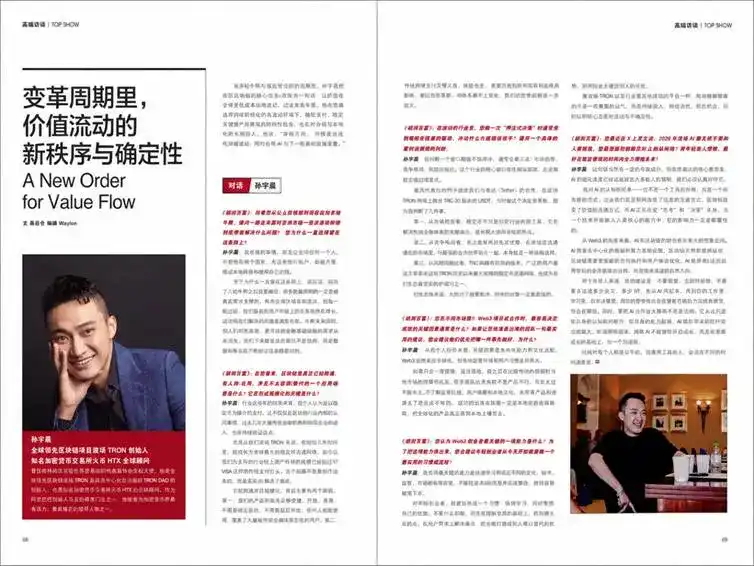
Stablecoins Build a Global Value Circulation Network, Web3 Infrastructure Enters Scaling Phase

In the Hurun Report interview, Justin Sun succinctly summarized his long-term core objective: "To enable anyone in the world, regardless of location or bank account access, to transfer and use their funds with low cost and high efficiency." This statement fundamentally reveals the value essence of blockchain technology — building an open and inclusive Internet of Value.

He further pointed out that after experiencing multiple bull and bear cycles, projects capable of enduring cycles must be built on real demand and practical usage. The sustained growth in on-chain user scale and transaction volume is an important basis for his judgment on industry direction. Against this backdrop, the on-chain payment system with stablecoins at its core has become the most mature and scalable application scenario.

In the Hurun Report interview, Justin Sun mentioned that TRON has rapidly developed into one of the world's largest stablecoin circulation networks, with its on-chain asset transfer volume even surpassing that of some traditional payment networks. This growth is not driven by short-term market sentiment but by continuous usage from real users in scenarios like cross-border transfers, value storage, and daily payments. Official data shows that the circulating supply of USDT on the TRON network currently exceeds $86.3 billion, reflecting robust network effects driven by genuine user demand.

In terms of structural advantages, the scalability of stablecoin payments benefits from two factors: on one hand, blockchain networks possess openness and permissionless characteristics, enabling them to reach user groups inaccessible to traditional financial systems; on the other hand, limitations in efficiency, cost, and user experience within traditional cross-border payment systems provide significant substitution space for new-generation infrastructure. Sun believes this trend is essentially a "natural substitution" of existing financial systems by technological advancement, rather than short-term competition.

Globalization Strategy and Technological Integration Advance in Tandem, Building Long-Term Competitive Advantage for Web3

When discussing enterprise growth and strategic decision-making, Sun presented a highly systematic methodology in the Hurun Report interview. He summarized the success factors as the combination of "data-driven iteration, rapid execution, and user-centric orientation," emphasizing that in a rapidly changing technological environment, single-dimensional capabilities can hardly sustain long-term competitiveness; instead, efficient trial-and-error and precise decision-making must be achieved through the synergy of these three.

At the organizational level, he proposed a management framework of "clear direction, layered support, and a sense of ownership among all members" to prevent deviation and loss of control during rapid expansion. This organizational structure emphasizing flatness and agility is seen as an important foundation for Web3 enterprises to maintain competitiveness in a highly uncertain environment.

Regarding specific key strategic decisions, Sun reflected on the case of TRON's collaboration with Tether to launch TRC-20 USDT in the Hurun Report interview. He stated that this decision was based on a comprehensive judgment of market trends, competitive landscape, and risk-reward ratio: stablecoins represent a long-term trend in financial system evolution, leading assets exhibit significant network effects, and the upside potential in this field far outweighs potential risks. This partnership has proven to be a major growth engine for the TRON ecosystem and has constructed its core competitive moat in the stablecoin domain.

Regarding global expansion, Sun emphasized that while Web3 has inherent cross-border attributes, its actual implementation still heavily depends on local compliance and cultural adaptation. In the Hurun Report interview, he noted that different markets have significant differences in regulatory frameworks, user habits, and business environments, and a project's success often hinges on the depth of understanding these differences and the ability to build local partnership networks.

Furthermore, Sun expressed clear judgment regarding AI technology development. He stated in the interview that AI is not merely a tool upgrade but a reconstruction of "thinking and decision-making capabilities." Its integration with blockchain in areas like data, computing power, and intelligent execution will be an important direction for the next phase of technological evolution. Blockchain provides decentralized infrastructure for AI, while AI enhances the intelligence and user experience of blockchain systems; the fusion of the two possesses long-term strategic value.

Addressing industry participants and young entrepreneurs, the core advice Sun offered in the Hurun Report interview is: in a highly uncertain environment, continuous learning and rapid adaptation are the most crucial capabilities. Simultaneously, one should focus investments and build irreplaceable core strengths based on an understanding of the industry's overall picture, rather than dispersing resources across multiple tracks.

Transitioning from early-stage technical validation and market exploration, to the large-scale application phase represented by stablecoins, and extending towards AI integration and global compliant implementation. In this process, TRON is continuously advancing the realization and evolution of the Internet of Value through infrastructure capabilities, globalization strategy, and technological foresight.


Leituras Relacionadas

SpaceX, OpenAI, Anthropic: The Three AI Giants Racing for IPO, Which One Is Worth Betting On?

SpaceX, OpenAI, and Anthropic are poised for historic IPOs within weeks, potentially raising a combined $180 billion—a sum exceeding the entire internet bubble's fundraising. The hosts of the Limitless Podcast argue this isn't just individual company financing but an unprecedented capital concentration for AI infrastructure, driven by an insatiable need for compute, data centers, power, and chips. SpaceX's IPO is notable for reportedly changing market index rules to allow faster inclusion, potentially funneling trillions in passive retirement funds into its stock, despite its unproven space-based data center business model. In contrast, Anthropic demonstrates explosive growth, with ARR reportedly hitting $45 billion and approaching profitability, fueled by strong enterprise adoption of products like Claude Code. Google's separate $80 billion raise highlights the immense capital pressure, even for giants. The discussion acknowledges bubble risks but leans optimistic. The hosts contend the massive spending is building essential physical infrastructure for the next technological era. A key bottleneck isn't capital but the real-world limits of chip manufacturing and construction speed. As long as demand for AI compute outstrips supply, this investment cycle represents a foundational build-out rather than a purely financial bubble. All three companies are seen as foundational bets on the future, with Anthropic often cited as the most immediately compelling due to its proven revenue trajectory.

marsbitHá 37m

SpaceX, OpenAI, Anthropic: The Three AI Giants Racing for IPO, Which One Is Worth Betting On?

marsbitHá 37m

From 'Old Guys' to 'New Favorites': How AI Is Revaluing Old Infrastructure from Dell to Nokia?

From "Vintage Tech" to "New AI Darlings": How AI Revalues Old Infrastructure One year ago, tech giants like Dell, Nokia, Cisco, and Western Data were seen as slow-growth, low-valuation stories, far from the AI spotlight dominated by players like Nvidia. Now, these legacy tech stocks are gaining market attention, sparking debate on whether this is genuine industry revaluation or a temporary narrative. As AI moves from model parameters to real-world data centers, the market is recognizing companies with proven delivery and infrastructure capabilities. This shift marks a change in the AI investment thesis: from pure model and GPU focus to the complex systems engineering required for deployment. Companies like Dell, HPE, and Corning are being revalued not for being "sexy" AI innovators, but for their decades of accumulated expertise in supply chains, enterprise delivery, and infrastructure—assets that have become critical in the AI buildout phase. The revaluation is unfolding across three key infrastructure lines: 1. **Servers & System Integration:** Dell and HPE are emerging as crucial system integrators or "general contractors" for AI data centers, translating GPU orders into complete, deployable server racks integrated with power, cooling, and networking. 2. **Networking & Connectivity:** AI's scale demands robust high-speed connections. Corning (fiber optics), Nokia (AI-RAN, 6G), and Cisco (data center switches) are gaining importance for enabling efficient data transfer within and between AI clusters. 3. **Storage:** Beyond high-speed memory (HBM/DRAM), the AI data explosion is driving demand for high-capacity hard drives (HDDs) from companies like Western Digital and Seagate to handle training data, logs, and cold storage cost-effectively. For this revaluation to be substantive and not just a narrative, three criteria are key: 1) Concrete AI-related order and revenue growth (e.g., Dell's AI server sales), 2) Upward revisions to company financial guidance, and 3) Sustainable improvements in profit quality, not just top-line revenue spikes. In essence, AI's transition to a real construction phase is re-pricing "old assets" against "new demand." The opportunity, however, is selective. Only those legacy firms that are demonstrably integrated into the capital expenditure chains of data center and enterprise AI deployment are likely to experience a true "logic re-rating" rather than just a temporary valuation bounce.

marsbitHá 44m

From 'Old Guys' to 'New Favorites': How AI Is Revaluing Old Infrastructure from Dell to Nokia?

marsbitHá 44m

The Merger of Codex and ChatGPT Marks the Beginning of a Major Reshuffle in Programming Tools

OpenAI is shifting its strategic focus from ChatGPT to Codex, merging them along with the browser tool Atlas into a unified desktop super-app. This move signals an internal belief that Codex, originally a programming tool, represents the next evolution of AI more than conversational models like ChatGPT. Over the past year, Codex's weekly active users have surged past 5 million. The key distinction is that while ChatGPT answers questions, Codex executes tasks. Enterprises increasingly value this ability to get work done over simply receiving advice. Consequently, Codex is attracting professionals beyond developers, including analysts, bankers, marketers, and product managers. OpenAI's reorganization and increased investment in Codex stem from recognizing that the future of AI competition lies in execution capabilities, not just conversation. The company is launching role-specific plugins (e.g., for data analysis, sales, design) to transform Codex into a broad knowledge work platform that automates and redefines white-collar workflows. Beyond being a tool, Codex reflects OpenAI's ambition to redefine software. New features like "Sites"—which generates interactive websites from documents—and collaborative "Annotations" aim to create a paradigm where the AI understands the goal and handles the tools and steps, functioning more like a digital colleague than traditional software. The ultimate goal is a unified experience where the user cares only about the completed task.

marsbitHá 53m

The Merger of Codex and ChatGPT Marks the Beginning of a Major Reshuffle in Programming Tools

marsbitHá 53m

Interpreting Investment Opportunities in the Age of Great Navigation, Invesco Great Wall Fund Releases '2026 Report on Chinese Enterprises Going Global'

Invesco Great Wall Fund has released its "2026 China Corporate Globalization Report," titled "The 'Great Navigation Era' of Chinese Enterprises." The report analyzes the new trends and investment opportunities as Chinese companies expand globally, moving from simple product exports to comprehensive overseas operations involving services, branding, and local production. Driven by factors like trade friction, the pursuit of higher profit margins abroad, and policy support, globalization is becoming essential for Chinese companies. The report outlines an evolution: from early product export ("Globalization 1.0") to the current "Globalization 2.0," characterized by overseas capacity, capital goods investment, consumer brand expansion, and service exports. Chinese firms' competitive advantages are highlighted, including a vast engineer talent pool, low-cost and robust infrastructure, and complete industrial clusters. Specific sectors with significant出海 potential are identified: * **Capital Goods** (e.g., engineering machinery, power equipment): Benefiting from global demand, especially in Belt & Road markets and the AI-driven power grid upgrade cycle. * **Consumer Brands**: Transitioning from cost to brand advantage, leveraging供应链 efficiency. * **Technology & Innovation**: Including AI applications, optical modules within global tech supply chains, and new energy vehicles focusing on local production. * **Pharmaceuticals**: Chinese biotech firms are becoming preferred partners for global pharma, with potential for breakthrough drugs in areas like oncology and weight loss. The report concludes that corporate globalization represents a sustained, core theme for China's capital markets, though companies must navigate challenges like geopolitics and localization.

marsbitHá 1h

Interpreting Investment Opportunities in the Age of Great Navigation, Invesco Great Wall Fund Releases '2026 Report on Chinese Enterprises Going Global'

marsbitHá 1h

Trading

Spot
Futuros

Artigos em Destaque

Como comprar SUN

Bem-vindo à HTX.com!Tornámos a compra de SUN (SUN) simples e conveniente.Segue o nosso guia passo a passo para iniciar a tua jornada no mundo das criptos.Passo 1: cria a tua conta HTXUtiliza o teu e-mail ou número de telefone para te inscreveres numa conta gratuita na HTX.Desfruta de um processo de inscrição sem complicações e desbloqueia todas as funcionalidades.Obter a minha contaPasso 2: vai para Comprar Cripto e escolhe o teu método de pagamentoCartão de crédito/débito: usa o teu visa ou mastercard para comprar SUN (SUN) instantaneamente.Saldo: usa os fundos da tua conta HTX para transacionar sem problemas.Terceiros: adicionamos métodos de pagamento populares, como Google Pay e Apple Pay, para aumentar a conveniência.P2P: transaciona diretamente com outros utilizadores na HTX.Mercado de balcão (OTC): oferecemos serviços personalizados e taxas de câmbio competitivas para os traders.Passo 3: armazena teu SUN (SUN)Depois de comprar o teu SUN (SUN), armazena-o na tua conta HTX.Alternativamente, podes enviá-lo para outro lugar através de transferência blockchain ou usá-lo para transacionar outras criptomoedas.Passo 4: transaciona SUN (SUN)Transaciona facilmente SUN (SUN) no mercado à vista da HTX.Acede simplesmente à tua conta, seleciona o teu par de trading, executa as tuas transações e monitoriza em tempo real.Oferecemos uma experiência de fácil utilização tanto para principiantes como para traders experientes.

541 Visualizações TotaisPublicado em {updateTime}Atualizado em 2025.03.21

Como comprar SUN

Discussões

Bem-vindo à Comunidade HTX. Aqui, pode manter-se informado sobre os mais recentes desenvolvimentos da plataforma e obter acesso a análises profissionais de mercado. As opiniões dos utilizadores sobre o preço de SUN (SUN) são apresentadas abaixo.

活动图片












