Hong Kong is expected to grant the first batch of stablecoin issuer licenses within two weeks, reportedly choosing HSBC and Standard Chartered as the first companies to obtain the long-awaited approval.
HSBC, Standard Chartered Lead Hong Kong’s Stablecoin Race
On Friday, Bloomberg reported that HSBC, Hong Kong’s largest bank by assets, and a joint venture led by Standard Chartered are set to be among the first companies to receive the Hong Kong Monetary Authority’s (HKMA) stablecoin licenses this month.
Authorities are reportedly prioritizing institutions already authorized to issue banknotes and will approve the two banks in the first batch, according to people familiar with the matter. Notably, the HKMA favors bank-led stablecoin issuers due to their robust capital base and ability to ensure greater safety while facilitating wider adoption, the sources affirmed.
Last month, the financial authority’s Chief Executive, Eddie Yue, announced it would grant the first, limited batch of stablecoin provider licenses in March as the review of 36 applications was nearly completed.
The HKMA enacted the Stablecoins Ordinance last August, which directs any individual or entity seeking to issue any fiat-referenced stablecoin (FRS) in Hong Kong, or any Hong Kong Dollar (HKD)-denominated token, to obtain a license from the financial regulator.
The number of licenses and the timetable had not yet been finalized and were subject to change. However, sources suggested March 24 as a possible date, as revealed by the South China Morning Post (SCMP), which first broke the news.
Industry sources suggested that Hong Kong’s licensing regime will initially prioritize the local currency. Standard Chartered has already announced plans to issue a Hong Kong dollar-pegged token.
The London-based bank, alongside Animoca Brands and Hong Kong Telecommunications (HKT), formed a joint venture last year to apply for a license to issue a HKD-denominated stablecoin.
Since 2024, the trio has been part of the financial authority’s stablecoin issuer sandbox program, which enabled limited-scale tests of these tokens across various scenarios, including e-commerce payments, cross-border trade settlements, and tokenized asset trading.
RD Technologies, a Hong Kong-based fintech firm founded by former HKMA CEO Norman Chan Tak-lam, and JD Coinlink, the fintech arm of Chinese e-commerce giant JD.com, also started testing HKD-pegged tokens under the regulator’s sandbox program last year.
Meanwhile, HSBC’s potential approval has reportedly surprised the industry, given the bank’s absence from the HKMA-led sandbox. HSBC has focused on tokenization projects, including tokenized deposits.
However, the bank had reportedly been actively engaged with local and global players in the digital-asset space and is committed to playing a central role in Hong Kong’s evolving financial ecosystem.
A ‘Testing Ground’ For Mainland Financial Innovation
Hong Kong’s expected approvals come amid China’s recent decision to explicitly prohibit onshore tokenization of real-world assets (RWAs), intensify scrutiny of related offshore activities, and prohibit the issuance of yuan-pegged offshore stablecoins without authorization.
Last month, Chinese authorities reaffirmed their long‐standing ban on virtual assets, saying that domestic companies and overseas entities under their control are prohibited from issuing virtual currencies abroad without official approval.
As reported by Bitcoinist, legal experts have suggested that Hong Kong’s ambitions to establish itself as a leading regulated hub for stablecoins were at risk of being hindered by the People’s Bank of China’s explicit crackdown on the sector.
Nonetheless, experts also believe Hong Kong could serve as a testing ground for financial innovations, given competition with the US and favorable conditions for the internationalization of the yuan, the SCMP noted.
“Hong Kong is a testing field for Chinese assets and money to go abroad on the blockchain,” Raymond Chan, chairman of the Greater Bay Area FinTech League, told the news outlet. “We are the firewall defending against challenges that may disrupt the market in China, thanks to our full set of regulations.”
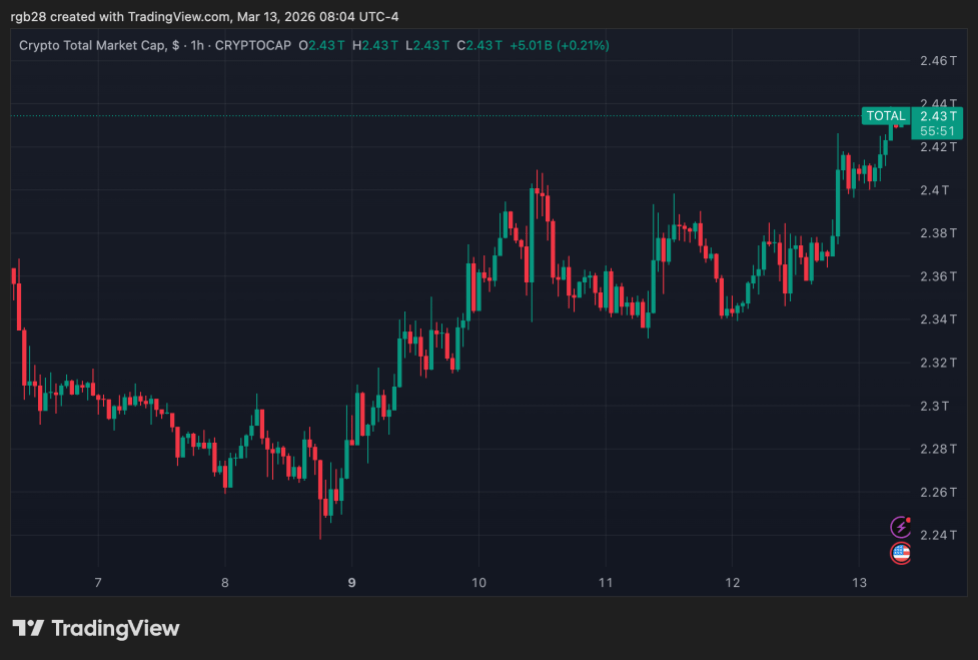
The total crypto market capitalization is at $2.43 trillion in the one-week chart. Source: TOTAL on TradingView