HSBC Bank and Anchorpoint Financial win Hong Kong’s first stablecoin licenses – Details

ambcryptoPublicado em 2026-04-10Última atualização em 2026-04-10

Resumo

Hong Kong has issued its first stablecoin licenses to institutional, bank-backed entities HSBC Bank and Anchorpoint Financial (backed by Standard Chartered, Animoca Brands, and HKT). This marks the formal launch of the city's strict stablecoin regulatory framework, which prioritizes established players with strong compliance, capital reserves, and regulatory respect. The cautious, limited approval process may slow broader market participation and innovation in the near term but is designed to ensure user protection, risk management, and overall trust. The regime, which came into effect in August 2025, includes stringent rules on reserves, governance, and anti-money laundering controls.

Hong Kong has granted its first stablecoin issuer licenses. The initial batch is small and institutional, which sets a cautious tone.

Here’s what you need to know.

Bank-backed issuers dominate first approvals

The first stablecoin licenses went to Anchorpoint Financial and HSBC’s Hong Kong banking arm, both well-known TradFi players. Anchorpoint itself is backed by Standard Chartered, Animoca Brands, and HKT.

The initiative is happening under a new framework, led by the Hong Kong Monetary Authority (HKMA). Both entities are set to begin operations in the coming months.

These approvals are the formal launchpad for the city’s stablecoin regime, which took effect in August 2025.
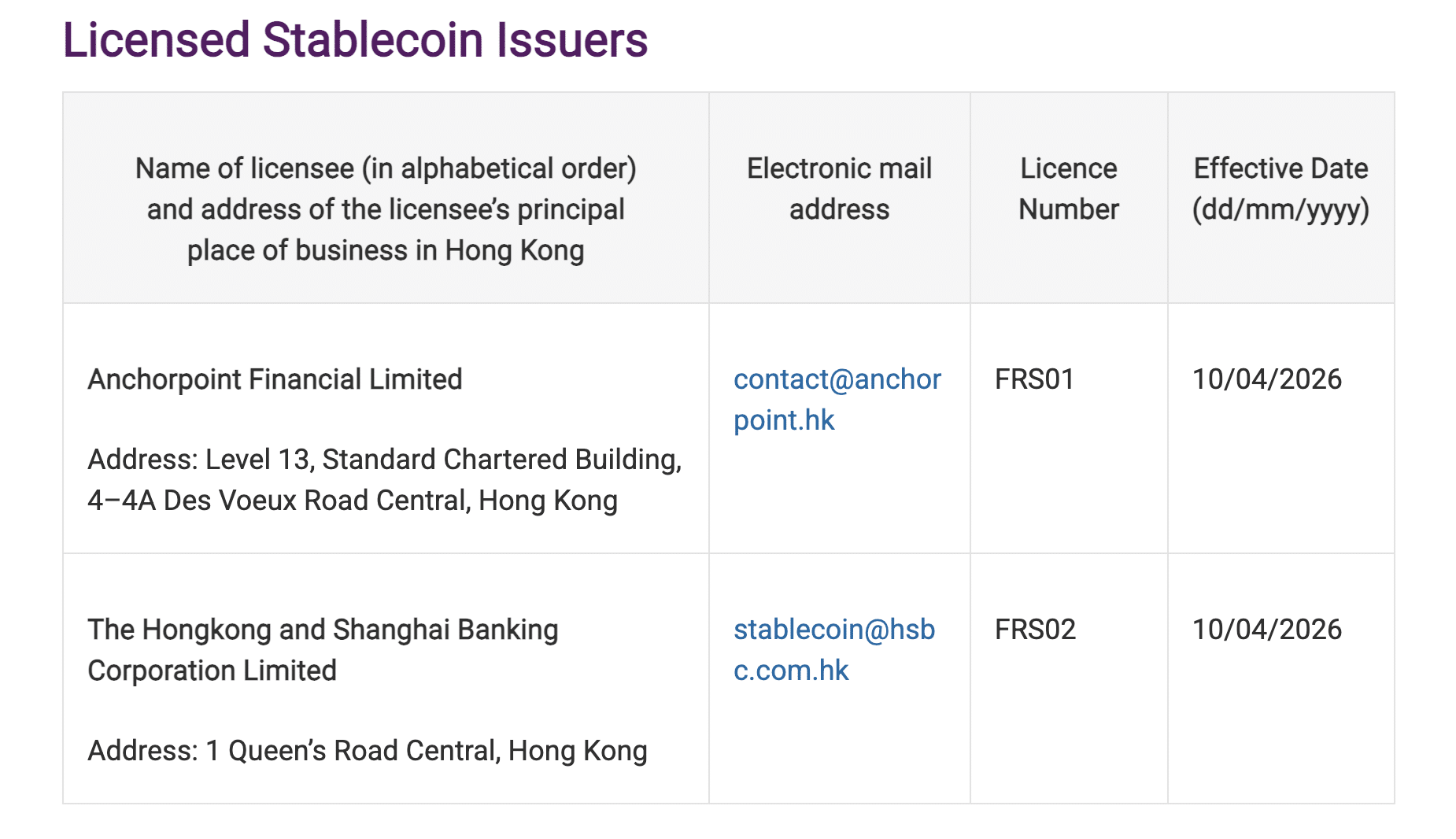
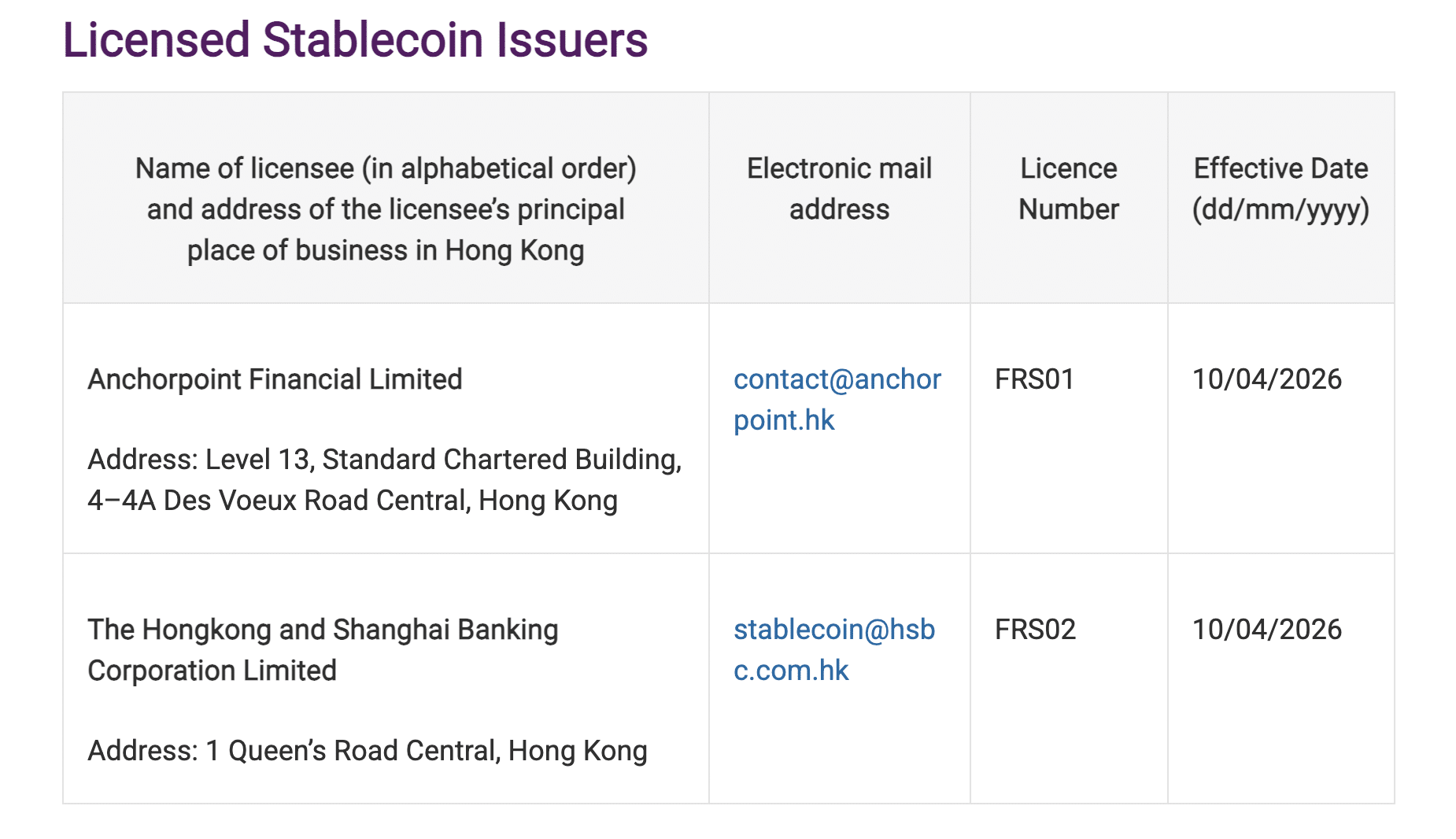
Source: HKMA

They’re prioritizing entities with established compliance systems, capital backing, and regulatory respect.

HKMA Chief Executive Eddie Yue stated that the regime would provide –

An orderly operating environment... while ensuring robust user protection and effective risk management.

AMBCrypto previously reported that Hong Kong expanded its licensing regime to cover crypto dealers and custodians. This brought trading and asset storage under the same regulatory perimeter.

The announcement came after a delayed timeline

The HKMA had earlier stated that initial licenses could be issued as early as March. However, approvals only materialized in April.

This is in line with the regime itself, with its strict requirements on reserve backing, redemption mechanisms, governance, and AML controls. The framework also lays out enforcement powers, including fines and license revocations.

Institutions first, broader access later?

In the near term, Hong Kong’s stablecoin market is likely to remain held by institutional players. Limited licenses and stringent compliance thresholds will slow participation from crypto-native firms.

It will certainly increase trust and stability among the masses, but early innovation impediment is a concern. The key question in time, will be whether the HKMA expands access or maintains a bank-led model.


Final Summary

  • Hong Kong’s first stablecoin licenses go to bank-backed players.
  • Strict rules and limited approvals could slow innovation but increase trust.

Perguntas relacionadas

QWhich two companies received Hong Kong's first stablecoin licenses?

AHSBC's Hong Kong banking arm and Anchorpoint Financial received the first stablecoin licenses.

QWhich regulatory authority is leading the new stablecoin framework in Hong Kong?

AThe Hong Kong Monetary Authority (HKMA) is leading the new stablecoin framework.

QWhat are some of the key requirements of Hong Kong's stablecoin regime?

AThe regime has strict requirements on reserve backing, redemption mechanisms, governance, and Anti-Money Laundering (AML) controls.

QWhat is a potential concern regarding the new licensing approach according to the article?

AA potential concern is that limited licenses and stringent compliance could slow participation from crypto-native firms and create an early innovation impediment.

QWhen did Hong Kong's stablecoin regulatory regime officially take effect?

AThe stablecoin regulatory regime took effect in August 2025.

Leituras Relacionadas

Anthropic's IPO Launch: Commercial Miracle or Valuation Bubble?

Anthropic has confidentially filed for an IPO, led by Morgan Stanley and Goldman Sachs, potentially going public by October. Following its latest $650 billion funding round, its pre-IPO valuation stands at $965 billion, with projections reaching up to $2 trillion at listing, which would make it the highest-valued private company ever. The article, written by Fu Sheng, addresses skepticism that this represents an AI bubble akin to the 2000 dot-com crash. It argues the current situation differs fundamentally. Unlike the internet bubble era, which relied on speculative narratives with little revenue, Anthropic's valuation is backed by unprecedented, measurable financial performance. Key data points include: * **Revenue Growth:** ARR skyrocketed from $10 billion in early 2025 to $470 billion by May 2026, targeting $100 billion by year-end—a growth curve unmatched in business history. * **Profitability:** It achieved operating profitability in Q2 2026 with an estimated $5.6 billion profit. * **Efficiency:** With ~3,000 employees and ~$470 billion ARR, its revenue per employee exceeds $10 million. Products like Claude Code, launched less than a year ago, already generate $25 billion in annualized revenue. * **Enterprise Adoption:** It boasts a strong enterprise client base, with 8 of the Fortune 10 and over 1,000 large firms spending over $1 million annually on Claude. The valuation is framed using a traditional SaaS model (e.g., a 10x Price-to-Sales multiple on $100 billion revenue). The author contends the core question for analysts has shifted from "How big could this be?" to "How much is it earning and will earn next quarter?" The discussion extends beyond Anthropic to a broader paradigm shift: the transition from a "carbon-based" to a "silicon-based" economy. Companies are increasingly prioritizing investment in compute and AI capabilities over human resources, as these directly scale productivity and competitive advantage. Anthropic's IPO is thus positioned not just as a corporate milestone, but as a price anchor for this new economic era.

链捕手Há 41m

Anthropic's IPO Launch: Commercial Miracle or Valuation Bubble?

链捕手Há 41m

Near Returns to the AI Stage: Transformation into a Public Chain Due to 'Payroll Difficulties,' Agent and Privacy Emerge as New Growth Narratives

NEAR Returns to AI Origins: From Payroll Struggles to Blockchain, Now Focusing on AI Agents and Privacy NEAR Protocol's journey began not with grand blockchain ambitions, but from a practical hurdle: its AI startup founders, including Transformer paper co-author Illia Polosukhin, couldn't efficiently pay international developers in 2017. This led them to pivot and build a high-performance, scalable blockchain. After years navigating various crypto narratives like sharding and cross-chain interoperability, NEAR is now leveraging its AI roots to re-enter the AI arena. A key driver is its "NEAR Intents" layer, which abstracts complex cross-chain transactions. Users simply state their goal (e.g., swap BTC for ETH), and a solver network finds the optimal route. This system has processed over $20B in cross-chain volume, generating significant fee revenue. A major growth area is private transactions via "Confidential Intents/Swaps," which hide trade details until settlement to protect against MEV and front-running. Remarkably, private swaps recently accounted for over 40% of NEAR's transaction volume, highlighting strong demand but also potential regulatory scrutiny. With its AI-founder pedigree, NEAR is positioning itself at the intersection of blockchain, AI agents, and privacy, aiming to become infrastructure for the emerging agent economy while navigating the challenges of its rapid adoption.

marsbitHá 3h

Near Returns to the AI Stage: Transformation into a Public Chain Due to 'Payroll Difficulties,' Agent and Privacy Emerge as New Growth Narratives

marsbitHá 3h

From Ethereum to AI's 'CROPS': What Exactly is This Set of 'Slow Variables' That Vitalik Repeatedly Emphasizes?

In recent discussions, Vitalik Buterin has frequently emphasized the concept of "CROPS," a framework defining core values for Ethereum's development. CROPS stands for Censorship Resistance, Capture Resistance, Open Source, Privacy, and Security. Initially outlined in the Ethereum Foundation's "EF Mandate," it represents a commitment to user sovereignty, ensuring that the network resists external control, remains open, protects privacy, and prioritizes security. The relevance of CROPS extends beyond Ethereum's foundational principles, becoming crucial in the context of AI integration. As AI agents begin handling wallet operations and automated transactions, the risk increases that users may cede control over their digital assets, privacy, and intentions to centralized AI service providers. A "CROPS AI" would therefore emphasize local execution where possible, privacy-preserving remote model calls (e.g., using zero-knowledge proofs), and transparent, verifiable processes to maintain user agency. Vitalik highlights a significant convergence between "CROPS Ethereum access layer" and "CROPS AI." Both address the same fundamental challenge: how users can access powerful services—be it blockchain data via RPCs or AI models—without exposing sensitive information or relinquishing ultimate control. This intersection points toward a future digital entry point that is more private, secure, and user-controlled. Ultimately, CROPS is not merely an abstract ideal but a practical guidepost. It steers development—from protocol resilience and wallet design to AI agent safety—towards a future where users retain self-sovereignty even as digital systems grow more complex and powerful. In an era of accelerating AI adoption, these "slow variables" of censorship resistance, openness, privacy, and security may define Ethereum's enduring value.

marsbitHá 3h

From Ethereum to AI's 'CROPS': What Exactly is This Set of 'Slow Variables' That Vitalik Repeatedly Emphasizes?

marsbitHá 3h

Trading

Spot
Futuros

Artigos em Destaque

Como comprar WIN

Bem-vindo à HTX.com!Tornámos a compra de WINkLink (WIN) simples e conveniente.Segue o nosso guia passo a passo para iniciar a tua jornada no mundo das criptos.Passo 1: cria a tua conta HTXUtiliza o teu e-mail ou número de telefone para te inscreveres numa conta gratuita na HTX.Desfruta de um processo de inscrição sem complicações e desbloqueia todas as funcionalidades.Obter a minha contaPasso 2: vai para Comprar Cripto e escolhe o teu método de pagamentoCartão de crédito/débito: usa o teu visa ou mastercard para comprar WINkLink (WIN) instantaneamente.Saldo: usa os fundos da tua conta HTX para transacionar sem problemas.Terceiros: adicionamos métodos de pagamento populares, como Google Pay e Apple Pay, para aumentar a conveniência.P2P: transaciona diretamente com outros utilizadores na HTX.Mercado de balcão (OTC): oferecemos serviços personalizados e taxas de câmbio competitivas para os traders.Passo 3: armazena teu WINkLink (WIN)Depois de comprar o teu WINkLink (WIN), armazena-o na tua conta HTX.Alternativamente, podes enviá-lo para outro lugar através de transferência blockchain ou usá-lo para transacionar outras criptomoedas.Passo 4: transaciona WINkLink (WIN)Transaciona facilmente WINkLink (WIN) no mercado à vista da HTX.Acede simplesmente à tua conta, seleciona o teu par de trading, executa as tuas transações e monitoriza em tempo real.Oferecemos uma experiência de fácil utilização tanto para principiantes como para traders experientes.

364 Visualizações TotaisPublicado em {updateTime}Atualizado em 2025.03.21

Como comprar WIN

Discussões

Bem-vindo à Comunidade HTX. Aqui, pode manter-se informado sobre os mais recentes desenvolvimentos da plataforma e obter acesso a análises profissionais de mercado. As opiniões dos utilizadores sobre o preço de WIN (WIN) são apresentadas abaixo.

活动图片