How Weakening US Labor Data Could Impact Bitcoin Market — Report

bitcoinistPublicado em 2026-03-29Última atualização em 2026-03-29

Resumo

A report analyzes how weakening US labor data could negatively impact Bitcoin and broader financial markets. Citing analysis from Alphractal CEO Wedson, the article highlights a steep decline in the US labor force participation rate (LFP), an underrated macroeconomic signal. Historically, a falling LFP—indicating fewer people working, less consumption, and weaker economic output—has preceded downturns in the S&P 500. Similarly, Bitcoin has shown vulnerability to such macro stress, as seen during the 2008 crisis and the 2020 COVID lockdowns. The key risk for Bitcoin is a potential macro shock that triggers a risk-off sentiment, causing investors to flee to safety. Unlike in 2020, there is currently no massive liquidity injection to cushion this blow and propel prices higher. This bearish outlook is further supported by a steadily declining Coinbase Premium, indicating waning demand from US investors. At the time of writing, Bitcoin's price is approximately $66,750, down over 5% for the week despite a minor 24-hour gain.

The global macro environment has been one of the major defining factors in Bitcoin and the broader crypto market so far this year. From the brewing geopolitical tensions in the Middle East to the rising inflation expectations in the United States, the global financial markets have barely caught a break in 2026. A prominent market expert has come forward with interesting US labor data, breaking down how the rising macroeconomic pressure could impact Bitcoin and the broader financial markets.

Macro Shock Could Trigger Risk-Off Behavior Among BTC Investors

In a March 28th post on the X platform, Alphractal founder and CEO shared that the participation of the United States labor force has been in a steep decline over the past few weeks. According to the crypto pundit, the Labor Force Participation is one of the most underrated macroeconomic signals in the current market landscape.

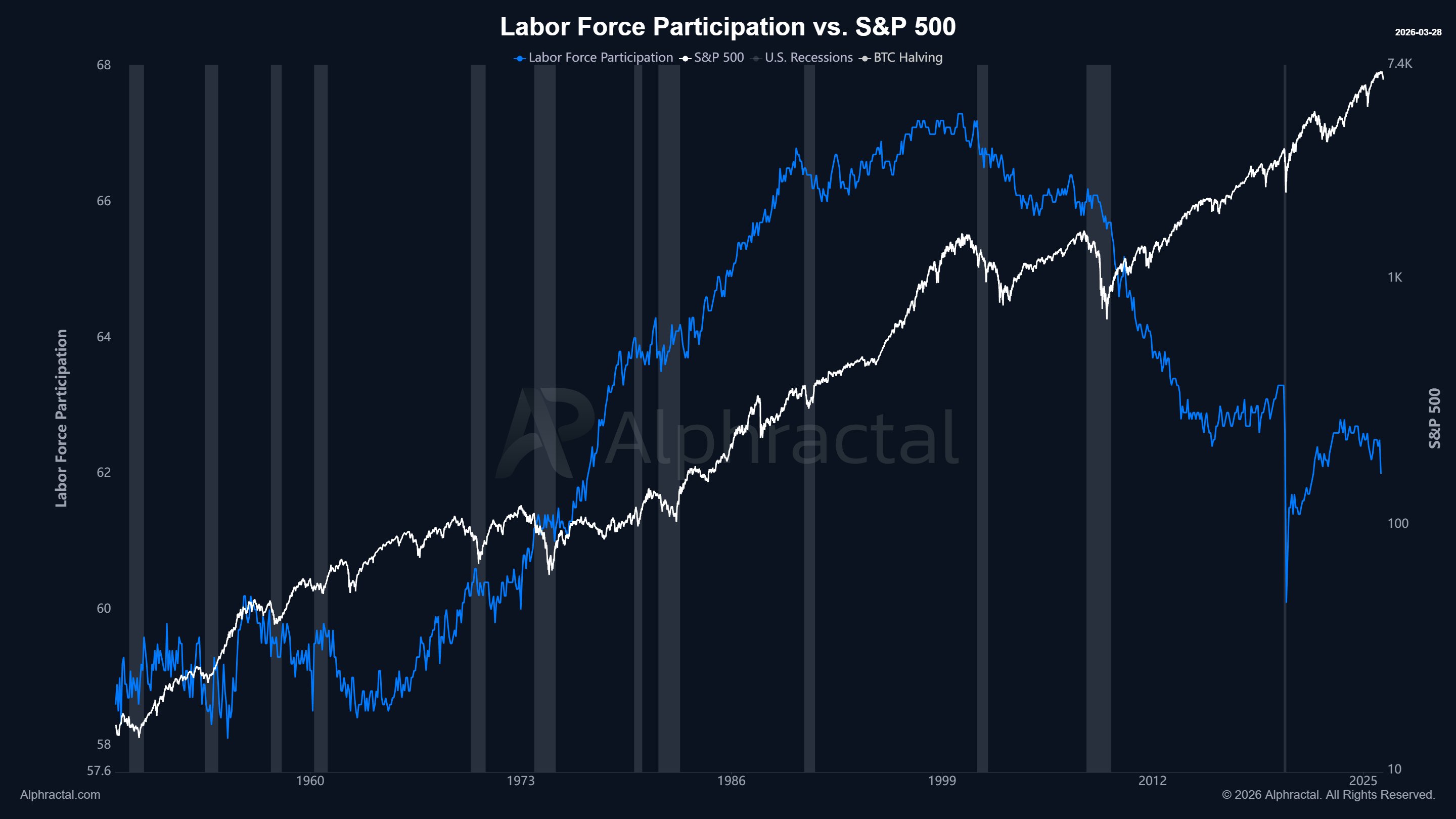
Wedson highlighted the major trends of the Labor Force Participation over the last two decades and its impact on the S&P 500 index. According to the highlighted data, participation reached its peak around 2000, before collapsing during 2008 financial crisis, briefly recovering, and then falling to historic lows during the COVID-19 pandemic.
Source: @joao_wedson on X

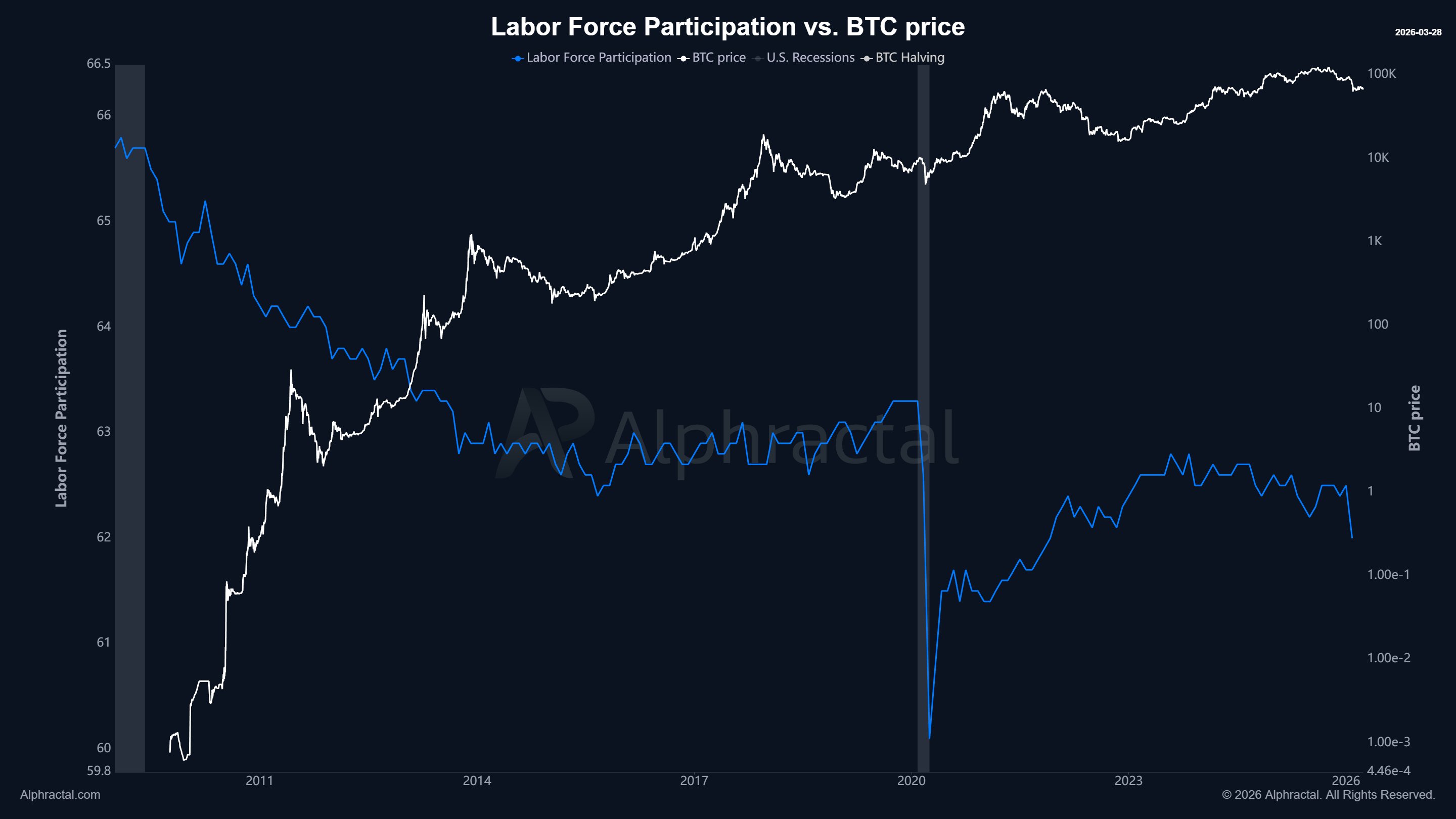
As the labor force participation rate dwindled, the S&P 500 soon followed despite its initial show of resilience. The same can be seen for Bitcoin in the chart below, which seemed to succumb to the macro stress each time the LFP suffered a nosedive.
Source: @joao_wedson on X

Wedson noted that, before the “liquidity” flood sent the Bitcoin price to new highs, the market leader initially fell to cycle lows as the labor participation crashed during the COVID lockdown in 2020. What’s different now is that there’s no obvious liquidity fuel to take advantage in the current labor participation plunge.

Wedson wrote in his post:

A falling participation rate means fewer people working, less consumption, weaker real economic output. The stock market can diverge from that reality for a while but not forever.

According to the Alphractal founder, the specific risk for Bitcoin is a macro shock that triggers a risk-off behavior among investors, with most market participants fleeing to safety before the next accumulation phase begins. And, as rightly baked in the steadily-declining Coinbase Premium, the demand for BTC among US investors seems to be in a steady downturn.

Bitcoin Price Overview

As of this writing, the flagship cryptocurrency is valued at around $66,750, reflecting a roughly 1% jump in the past 24 hours. The single-day action has not been enough to wipe out losses from the past week, which still stand at more than 5%.

The price of BTC on the daily timeframe | Source: BTCUSDT chart on TradingView


Criptomoedas em alta

Perguntas relacionadas

QWhat is the main macroeconomic factor discussed in the article that could impact the Bitcoin market?

AThe weakening US labor data, specifically the decline in Labor Force Participation, is highlighted as a major macroeconomic factor that could impact the Bitcoin market.

QAccording to the expert, what does a falling labor force participation rate indicate for the economy?

AA falling labor force participation rate means fewer people working, less consumption, and weaker real economic output.

QWhat specific risk does the Alphractal founder identify for Bitcoin in the current market environment?

AThe specific risk for Bitcoin is a macro shock that triggers a risk-off behavior among investors, causing them to flee to safety.

QHow did the article describe the current demand for Bitcoin among US investors?

AThe demand for BTC among US investors is in a steady downturn, as indicated by the steadily declining Coinbase Premium.

QWhat was the price of Bitcoin at the time of writing, and what was its weekly performance?

AAt the time of writing, Bitcoin was valued at around $66,750, reflecting a weekly loss of more than 5% despite a 1% gain in the last 24 hours.

Leituras Relacionadas

Conversation with Investor Zheng Di: MicroStrategy's Coin Sale Experiment, AI Economy, and Opportunities in US Stocks

Frontier tech investor Zheng "Didier" Di discusses the recent Bitcoin price drop, the financial strategy shift at MicroStrategy, the AI-driven surge in U.S. stocks, and the evolving role of crypto exchanges. Didier posits that the recent BTC decline stems less from macro factors or ETF outflows, and more from market repricing due to MicroStrategy's new financial structure. Following a wave of preferred stock and debt issuance (STRC, STRZ, etc.), MicroStrategy must now manage cash flow to pay dividends, potentially leading to a market expectation of sustained, small-scale BTC sales to maintain its "per-share bitcoin neutral" principle. Didier views this as a financial "experiment" testing market capacity for such recurring sell pressure, which, while creating near-term structural headwinds, likely avoids a true "death spiral" absent major new external shocks. Shifting to AI, Didier argues that tokens are becoming the new form of labor, with AI models and compute (tokenized inputs) increasingly replacing human roles in execution and middle-management. This drives enterprise efficiency and higher margins, fueling the sustained rally in U.S. semiconductor, data center, and infrastructure stocks. He foresees an emerging "machine economy" where automated agents transact and collaborate on-chain. Regarding crypto exchanges offering U.S. equities, Didier sees this as a natural evolution. With few crypto-native assets generating lasting value, exchanges are pivoting towards real-world assets (RWAs) like stocks and bonds. This doesn't necessarily cannibalize crypto but reflects a maturing industry focusing on blockchain's core utilities: decentralized choice and efficient settlement. He notes that trading logic for crypto natives doesn't need to drastically change, as meme-driven and fundamentalist strategies find analogs in U.S. markets. The "1011 event" (likely referring to a major market crash) severely damaged crypto market liquidity, marking a probable end to the altcoin speculative cycle, with capital flowing towards the deeper liquidity of U.S. markets. For the macro outlook, Didier is cautious about near-term market pressure from potential mega-IPOs (e.g., SpaceX) and the U.S. midterm elections, which could bring more regulatory scrutiny. Long-term, he remains bullish on AI's productivity gains and its convergence with blockchain/Web3, predicting a shift from speculative frenzy to a more institutionalized, industrial phase for the crypto sector.

marsbitHá 15m

Conversation with Investor Zheng Di: MicroStrategy's Coin Sale Experiment, AI Economy, and Opportunities in US Stocks

marsbitHá 15m

Playnance’s $GCOIN Lists on KoinBX Amid Rapid Growth in India

Playnance's native token, $GCOIN, has been listed on the cryptocurrency exchange KoinBX as of June 18. This move aims to enhance accessibility for its rapidly growing community, particularly in India, where the blockchain-powered Web3 iGaming ecosystem has gained significant traction. Over 130 partners in Playnance's "Be the Boss" program have built communities engaging thousands of active players in the region. The "Be the Boss" model allows participants to create and manage their own gaming communities, earning rewards tied to community activity. CEO Pini Peter noted India's high engagement, with community leaders successfully building player networks. One partner, Dr. Nicolas, reported earning over $57,000 through the program in recent months, highlighting both the financial rewards and the opportunity to grow an engaged community. $GCOIN serves as the ecosystem's core utility token, incentivizing participation and aligning the interests of players and community leaders ("Bosses"). The listing on KoinBX is part of Playnance's strategy to expand globally, increasing the token's utility and accessibility by combining community ownership, gamified engagement, and blockchain-based incentives. Founded in 2020, Playnance is a Web3 iGaming infrastructure company focused on creating live, non-custodial, on-chain products to onboard mainstream users. It currently processes approximately one million transactions daily, aiming to simplify the user experience while maintaining full on-chain transparency.

TheNewsCryptoHá 55m

Playnance’s $GCOIN Lists on KoinBX Amid Rapid Growth in India

TheNewsCryptoHá 55m

STRC Hits Historic Low, Saylor's Perpetual Motion Machine Grinds to a Halt

STRC, the perpetual preferred stock issued by MicroStrategy to fund its Bitcoin purchases, hit a historic low of $85.32, a 17% discount to its $100 par value. Designed as a "digital credit engine" to trade stably near par and enable continuous share issuance for buying Bitcoin, its plunge signals a breakdown in this model. Three key factors drove the decline: 1. Bitcoin's price fell over 50% from its peak, trading around $63,000 amid hawkish Fed signals. 2. MicroStrategy's cash reserves were depleted after a $1.5 billion convertible note repayment, slashing the dividend coverage for STRC's 11.5% yield to ~7 months. The company then sold 32 BTC to cover dividends—Michael Saylor's first Bitcoin sale since 2022—damaging the "never sell" narrative. 3. A competing Bitcoin-backed preferred stock, Strive's SATA, offers a higher yield (~13%) and daily dividends, drawing investors away from STRC. The drop triggers a negative cycle: STRC below par halts ATM share issuances, cutting off a key funding source for Bitcoin buys and potentially forcing more BTC sales for dividends, further eroding confidence. While Saylor argues the model is mathematically sound—needing only 2.3% annual Bitcoin growth to sustain itself—the market is testing the resilience of the leveraged Bitcoin treasury strategy in a bear market. The STRC price now reflects rising skepticism about this financial machinery's durability during downturns.

marsbitHá 1h

STRC Hits Historic Low, Saylor's Perpetual Motion Machine Grinds to a Halt

marsbitHá 1h

A Guide to Grayscale’s ‘Bottom Fishing’: Using Cash Flow to Assess Cryptocurrency Value

**Title:** Grayscale's Guide to Bottom-Fishing: Valuing Cryptoassets Using Cash Flows **Summary:** This report by Grayscale Research presents a fundamental valuation framework for cryptocurrency assets, moving beyond pure speculation to analyze those with underlying cash flows. It distinguishes between "commodity-like" assets (e.g., Bitcoin) and "cash-flow" assets, primarily within DeFi. Using the leading decentralized lending protocol Aave as a case study, the analysis applies traditional financial methodologies like Discounted Cash Flow (DCF) and Price-to-Earnings (P/E) multiples. Key findings indicate that AAVE tokens are currently undervalued. Despite recent challenges, the protocol's strong revenue growth, ~50% net profit margin, and diversified treasury support a fundamental valuation range of $80-$100 per token (compared to a ~$75 market price at the time of writing). In a base-case scenario driven by stablecoin adoption and regulatory clarity, the fair value could rise to around $175 within a year. The report emphasizes that protocol success does not automatically translate to token value. It critically examines the "value capture" mechanisms—such as buybacks, burns, and staking rewards—that channel protocol profits to token holders. Furthermore, it addresses the legal and governance complexities of Decentralized Autonomous Organizations (DAOs), noting their difference from traditional corporate equity but highlighting how robust, transparent governance can align protocol economics with holder interests. The conclusion is that the crypto market is maturing, with capital increasingly flowing towards projects with demonstrable fundamentals, real adoption, and disciplined capital allocation, creating opportunities for value-based investors.

marsbitHá 2h

A Guide to Grayscale’s ‘Bottom Fishing’: Using Cash Flow to Assess Cryptocurrency Value

marsbitHá 2h

Trading

Spot
Futuros

Artigos em Destaque

Como comprar ONE

Bem-vindo à HTX.com!Tornámos a compra de Harmony (ONE) simples e conveniente.Segue o nosso guia passo a passo para iniciar a tua jornada no mundo das criptos.Passo 1: cria a tua conta HTXUtiliza o teu e-mail ou número de telefone para te inscreveres numa conta gratuita na HTX.Desfruta de um processo de inscrição sem complicações e desbloqueia todas as funcionalidades.Obter a minha contaPasso 2: vai para Comprar Cripto e escolhe o teu método de pagamentoCartão de crédito/débito: usa o teu visa ou mastercard para comprar Harmony (ONE) instantaneamente.Saldo: usa os fundos da tua conta HTX para transacionar sem problemas.Terceiros: adicionamos métodos de pagamento populares, como Google Pay e Apple Pay, para aumentar a conveniência.P2P: transaciona diretamente com outros utilizadores na HTX.Mercado de balcão (OTC): oferecemos serviços personalizados e taxas de câmbio competitivas para os traders.Passo 3: armazena teu Harmony (ONE)Depois de comprar o teu Harmony (ONE), armazena-o na tua conta HTX.Alternativamente, podes enviá-lo para outro lugar através de transferência blockchain ou usá-lo para transacionar outras criptomoedas.Passo 4: transaciona Harmony (ONE)Transaciona facilmente Harmony (ONE) no mercado à vista da HTX.Acede simplesmente à tua conta, seleciona o teu par de trading, executa as tuas transações e monitoriza em tempo real.Oferecemos uma experiência de fácil utilização tanto para principiantes como para traders experientes.

314 Visualizações TotaisPublicado em {updateTime}Atualizado em 2026.06.02

Como comprar ONE

Discussões

Bem-vindo à Comunidade HTX. Aqui, pode manter-se informado sobre os mais recentes desenvolvimentos da plataforma e obter acesso a análises profissionais de mercado. As opiniões dos utilizadores sobre o preço de ONE (ONE) são apresentadas abaixo.

活动图片