How to Withdraw USDT to a Card Without P2P and Exchangers Using OneSix

cryptonews.ruPublicado em 2026-08-14Última atualização em 2026-08-14

Resumo

Many users store funds in USDT, but eventually need to convert it to rubles and withdraw to a bank card. Traditionally, this required using P2P platforms or online exchangers, involving counterparty search, rate comparison, and risks like fraud or opaque processes. OneSix offers an alternative approach. It's a crypto wallet (accessible via Telegram MiniApp and web) that supports USDT on multiple networks, as well as BTC, ETH, and others. Users can convert cryptocurrency to rubles directly within the service and withdraw funds to a bank card or via Russia's SBP system, typically within about five minutes, eliminating the need for external P2P or exchange services. Beyond withdrawals, OneSix allows users to pay directly with crypto. By scanning a Russian SBP QR code, the service automatically converts the crypto to rubles and sends the payment, enabling payments for utilities, online shopping, and more. It also supports creating crypto invoices for freelancers and businesses. A key differentiator is OneSix's compliance approach. If an incoming transaction fails its AML check, it is automatically returned to the sender instead of being credited and later frozen. This reduces user risk of having to prove fund origins or facing account restrictions due to tainted assets. In summary, OneSix provides a streamlined, integrated solution for converting crypto to fiat and making payments, aiming to offer greater convenience and reduced risk compared to traditional P2P and exchange m...

Many users prefer to store a portion of their funds in $USDT. But sooner or later, a very everyday task arises: exchanging cryptocurrency for rubles and transferring the money to a bank card. Until recently, one almost always had to use P2P platforms or online exchangers for this. This meant searching for a counterparty or a suitable service, comparing exchange rates, and facing additional risks associated with the exchange.

The main drawback of P2P and many exchangers is the lack of transparency. The user does not always understand who the other party to the transaction is, by what rules the service verifies the origin of funds, and how settlements are organized. There is always a chance of encountering fraudulent schemes like the "triangle," where a cryptocurrency seller is used to launder criminally obtained funds.

OneSix offers a different approach: the conversion of cryptocurrency and withdrawal of rubles happen inside the cryptocurrency wallet, without the need to search for counterparties or use third-party services.

Withdraw $USDT to a Card Without Fear

OneSix is a cryptocurrency wallet that works through Telegram MiniApp and a web interface. It supports $USDT on the TRC20, ERC20, and BEP20 networks, as well as BTC, ETH, BNB, TRX, and LTC.

If a user needs to exchange some of their crypto assets for rubles, it's enough to select the amount and arrange a withdrawal to a bank card or via SBP (Faster Payments System). According to OneSix, order execution usually takes about five minutes.

The conversion of cryptocurrency to rubles happens inside the service, so there is no need to search for a buyer on a P2P platform or use a third-party exchanger.

This is especially convenient for those living abroad who regularly receive transfers in $USDT. For example, if part of the savings is stored in $USDT, the necessary amount can be exchanged within the wallet and rubles can be immediately transferred to one's own card or the card of relatives in Russia.

Not Only Withdrawal, But Also Payment

OneSix allows users not to think about withdrawing funds to a card at all. Through the OneSix wallet, one can easily pay for Russian SBP QR codes directly from the cryptocurrency balance. The user opens the wallet, scans the QR code, confirms the operation, and the service automatically calculates the amount in cryptocurrency, converts it to rubles, and sends the payment to the recipient. The payment is made in rubles, although for the user it all looks as if they are paying in cryptocurrency.

This way, one can pay for utility bills, online store purchases, grocery delivery, and any other services that accept payment via SBP.

Furthermore, through OneSix, one can create crypto invoices and payment links for receiving payments in digital assets. This is convenient for freelancers, consultants, developers, and small companies working with foreign clients.

Compliance Instead of Random Counterparties

Another difference of OneSix is its approach to AML transaction checks. In practice, any user of a non-custodial wallet can encounter cryptocurrency with a questionable history: it's enough to receive a transfer from a third party or accidentally buy assets that were previously involved in suspicious operations.

When these coins are later transferred to centralized services, such as wallets and exchanges, the assets are first credited to the wallet and then can be frozen on the balance until the circumstances are clarified, and the user has to prove the origin of the assets and undergo additional checks.

OneSix acts differently: if an incoming transaction does not pass the AML check, it is simply not credited to the wallet and is automatically returned to the sender. This approach reduces the risk that the user will later have to confirm the origin of funds or face restrictions due to the questionable history of the received assets.

P2P and exchangers solve only one problem—helping to exchange cryptocurrency for rubles—but they do not relieve the user of the associated risks. OneSix offers a different approach: here, the conversion happens inside the service, so the user simply withdraws rubles to a card or pays for a purchase via QR code, without thinking about the exchange process itself.


This is promotional material. Hash Telegraph is not responsible for the accuracy of the information provided. The opinion of the editorial staff may not coincide with the assessment presented in the material.


Perguntas relacionadas

QWhat is the main advantage of using OneSix to withdraw USDT to a card compared to P2P platforms and exchangers?

AThe main advantage is that the cryptocurrency conversion to rubles happens internally within the OneSix wallet service. This eliminates the need to search for a counterparty on a P2P platform or use a third-party exchanger, reducing risks associated with lack of transparency and potential fraud.

QHow can users make payments in Russia using their cryptocurrency balance via OneSix?

AUsers can pay for Russian SBP QR codes directly from their cryptocurrency balance in the OneSix wallet. They scan the QR code, confirm the transaction, and the service automatically calculates the amount in cryptocurrency, converts it to rubles, and sends the payment to the recipient.

QWhat is the key difference in how OneSix handles incoming transactions that fail AML checks?

AUnlike some services that credit the funds first and then potentially freeze them, OneSix does not credit incoming transactions that fail its AML (Anti-Money Laundering) checks. Instead, such transactions are automatically returned to the sender, reducing the user's risk of dealing with funds of questionable origin.

QFor which group of users is the internal conversion feature of OneSix particularly convenient, according to the article?

AIt is particularly convenient for users living abroad who regularly receive transfers in USDT. They can exchange the needed amount inside the wallet and immediately transfer rubles to their own card or a relative's card in Russia.

QWhat additional business feature does OneSix offer beyond withdrawals and payments?

AOneSix allows users to create crypto invoices and payment links for receiving payments in digital assets. This is useful for freelancers, consultants, developers, and small companies working with foreign clients.

Leituras Relacionadas

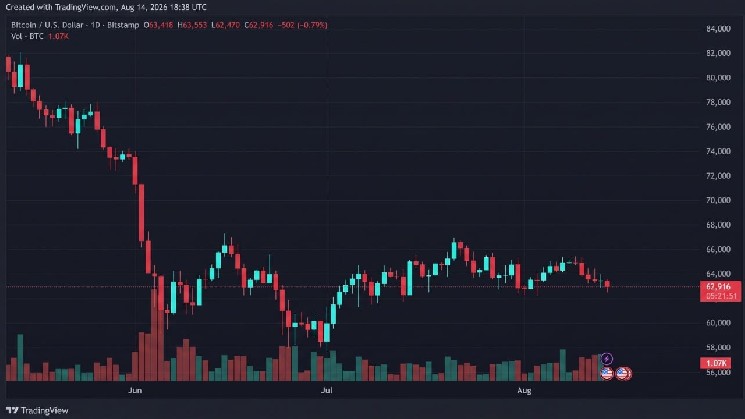
Bitcoin Price Drops to $62,470 as Sellers Retest $63,000 Support Level

Bitcoin's price fell below $63,000 for a second consecutive day on Friday, hitting an intraday low of $62,470. The cryptocurrency later recovered to trade just above $63,000, leaving it nearly flat for the past 24 hours and for August overall, with a weekly loss of 2.6%. The volatility triggered significant liquidations, with $26 million of leveraged long Bitcoin positions liquidated over 24 hours. Market sentiment was further dampened by data showing over $131 million in outflows from spot Bitcoin ETFs for a second straight day, signaling a potential pullback by institutional investors. Adding to the negative pressure, index provider MSCI has proposed new criteria for "non-operating companies" in its global indexes, which could lead to the exclusion of firms holding significant digital assets like Bitcoin on their balance sheets. Companies such as Strategy and Metaplanet could be affected, potentially forcing index-tracking funds to sell their shares. Strategy publicly criticized the proposal, arguing digital assets are legitimate assets and index providers should not dictate what companies can own. Public consultations on MSCI's proposal end September 30, with a final decision expected by October 16. If approved, exclusions could begin in November, potentially triggering sustained institutional selling and damaging a key bridge for Bitcoin adoption in the corporate sector.

cryptonews.ruHá 2h

Bitcoin Price Drops to $62,470 as Sellers Retest $63,000 Support Level

cryptonews.ruHá 2h

Trading

Spot
活动图片