How to Systematically Track High-Win-Rate Addresses on Polymarket?

marsbitPublicado em 2026-03-02Última atualização em 2026-03-02

Resumo

This article explores methods to systematically identify and track high-success-rate addresses on Polymarket, a blockchain-based prediction market where all transactions are publicly recorded on-chain. It highlights that while data is transparent, the key challenge lies in extracting meaningful signals from vast datasets to detect addresses with potential informational advantages. The piece outlines common characteristics of such addresses: new wallets making large, concentrated bets; specialization in specific verticals; abnormal changes in position size; and exceptionally precise timing, repeatedly entering positions hours before major news breaks. A three-step systematic approach is recommended: First, filter addresses based on sustained profitability (e.g., 30-day positive returns, >55% win rate) using leaderboards like Polymarket Analytics. Second, analyze their holdings in specific event markets, focusing on addresses that are consistently among the top holders before full market pricing. Third, scrutinize their on-chain behavior: entry timing relative to news, position-building patterns (e.g., rapid, concentrated entries), holding periods, and trading focus. Advanced strategies include monitoring exit behavior (e.g., large, unexplained sell-offs), conducting wallet clustering analysis to find linked addresses, tracking unusual volume spikes in low-liquidity markets, and cross-referencing on-chain activity with external real-world data for validation. The goal is to ...

An address on Polymarket turned $35,000 into $442,000, achieving a 12.6x return. Notably, the position was established hours before a major market movement, and the trades were largely settled before the news spread to mainstream channels. This is not an isolated incident. Before the news of the "Venezuela Raid" political event became public, three addresses made moves in advance and collectively profited $630,000 from the same event.

If such trading occurred in traditional financial markets, one might easily think of information asymmetry. However, in prediction markets, all fund flows and position changes are recorded on the public blockchain; there are no hidden accounts or private transactions.

Being public does not mean there is no gap. The key is not whether you can see the trades, but whether you can discern the truly informative signals from the massive amount of data.
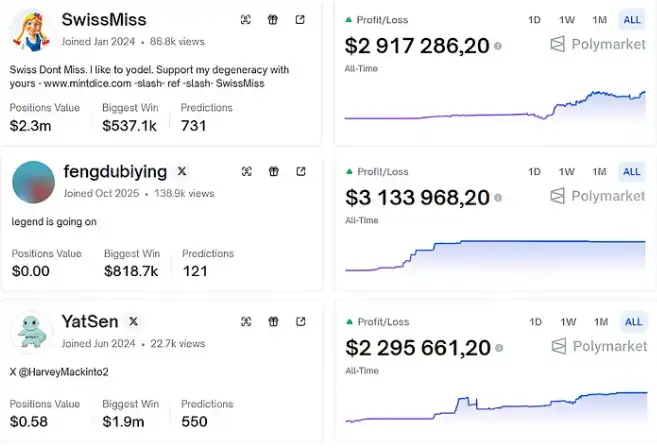
Every Trade on Polymarket is Public Data

Many prediction market participants still view Polymarket as a traditional betting platform: watch the odds, pick a direction, and bet on the outcome. But Polymarket's underlying structure is completely different from DraftKings or ordinary sports betting. All transactions occur on-chain; fund flows, position sizes, and entry/exit timings are all publicly viewable. The operational paths of the most accurate and timely addresses are not post-hoc speculation but real-time on-chain records.
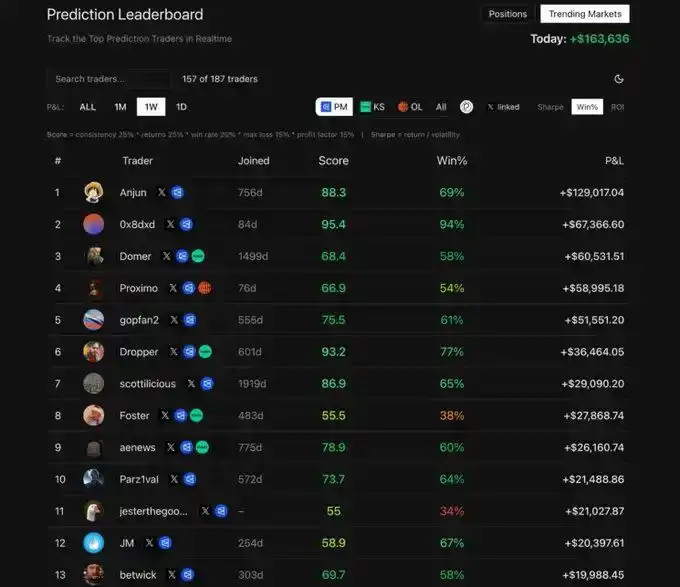
Polymarket's API is also open. Transaction records, market data, and historical trades can be directly called by anyone; there is no permission barrier.

Therefore, the gap is not about who can see the data, but about who can extract meaning from it. On-chain information is public, but what is truly valuable is the ability to identify wallets worth tracking continuously and to recognize behavioral changes before prices fully reflect them.

What Characteristics Do True "Informed Addresses" Typically Have?

It is important to emphasize that not all profitable wallets imply insider information. Some traders have solid research capabilities, while others rely on quantitative models and algorithmic advantages. However, when profitability is repeatedly coupled with specific behavioral patterns, one can observe structural features that distinguish them from mere "luck."

· Type 1: New Addresses Combined with Unusually Large Bets

A wallet created just days ago, with very few transactions, suddenly invests a large amount of capital in a low-liquidity niche market. This behavior is uncommon. Especially in the absence of public catalysts, large, concentrated positions often carry stronger informational significance.

· Type 2: Highly Vertical Trading Focus

Some addresses do not operate across markets but focus long-term on a specific niche, maintaining a stable and significant win rate in that area. They do not diversify across crypto prices, elections, sports, etc., but concentrate their firepower on a single theme, with more decisive position decisions.

· Type 3: Abnormal Changes in Position Size

When an address that has been betting with medium size for a long time suddenly significantly increases its position size in a particular market, this behavior often indicates a change in the strength of conviction. Position size itself is an attitude; a sudden change in scale usually reflects an upgrade in information or belief.

· Type 4: Overly Precise Timing

Occasional early positioning can be attributed to coincidence, but if an address repeatedly completes its positions hours before major news announcements, with highly consistent direction, this temporal lead is difficult to explain simply as luck. Once is random; repeated occurrences are more likely to reflect an information advantage.

How to Systematically Screen for Potential "Information-Advantaged Addresses"

· Step 1: Analyze Performance on Polymarket Leaderboards

Start with the leaderboard on Polymarket Analytics (link: https://polymarketanalytics.com/traders), sorted by 30-day P&L, using recent stable profitability as the first filter. Focus on wallet addresses with an overall positive return over 30 consecutive days, a win rate above 55%, and total profit significantly higher than total loss. Also, confirm that their trading is concentrated in markets with real liquidity, not low-volume prediction events with little participation.
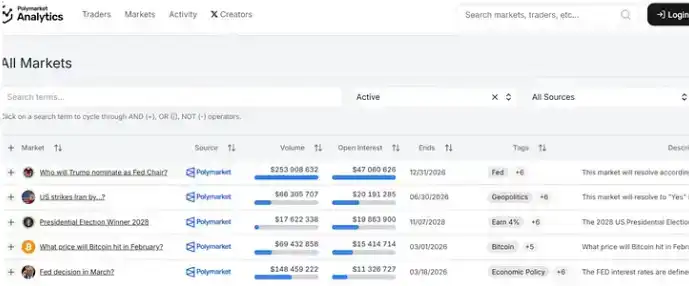
The goal at this stage is not to directly judge whether they have an information advantage, but to build a watchlist of addresses with sustained profitability. A consistent profit record is the foundation for subsequent behavioral analysis.

· Step 2: Analyze Position Structure in Specific Events

After the initial screening, drill down into specific trading events. Enter active prediction markets and check the Top Holders list for that event. Polymarket publicly displays the addresses with the largest current positions; these large positions often represent stronger conviction.
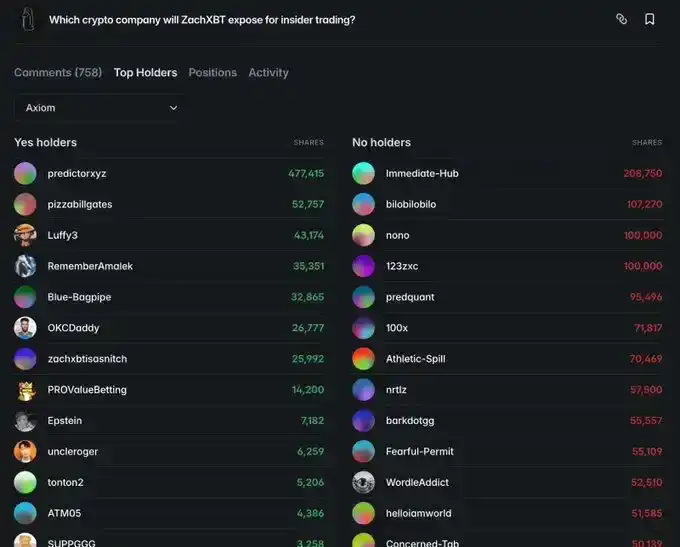
The key is not whether an address hits a single large bet, but whether its behavior is persistent. If a wallet repeatedly appears in the top holder lists for multiple significant events, and these positions were established before the market was fully priced, this repetition itself constitutes a signal.

Hitting once might be chance, but repeatedly making large, early-stage positions with consistent direction and validated outcomes often indicates a judgment system with a stable advantage.

· Step 3: Analyze Trading Behavior and Position Timing

After identifying candidate addresses, further analyze their on-chain transaction history, focusing on entry timing, position structure, and holding rhythm.
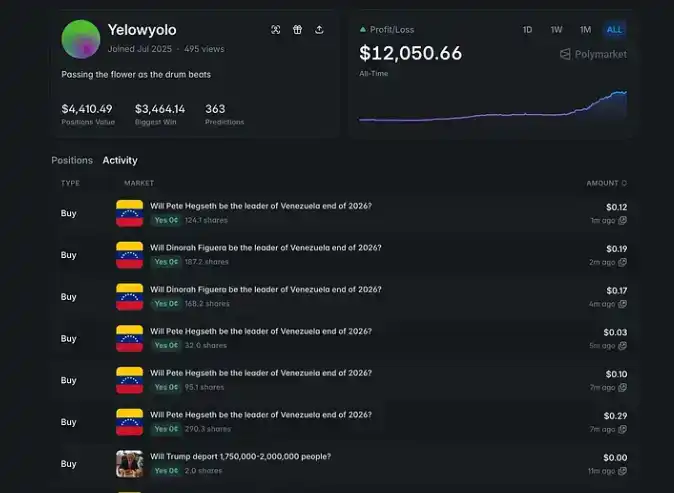
First, observe the entry time. If the purchase occurs hours before the official news release and repeats multiple times, the timing advantage itself becomes an important variable; entering after media reports is more likely to be just information following.

Second, analyze the method of position building. Mature traders typically build positions in batches and add gradually, while wallets with strong information judgment often complete concentrated layouts quickly within a short time window because their opportunity is limited.

Furthermore, pay attention to the holding period. Some high-quality addresses choose to exit during the middle of the trend发酵, rather than waiting for the tail end of extreme volatility, indicating their goal is to capture the main trend rather than marginal profits.

Finally, observe their trading scope. Addresses that are highly vertical and long-term focused on a single niche are more likely to form stable information advantages; addresses that frequently operate across sectors are more likely to rely on market sentiment rather than specific domain judgment.

Advanced Address Tracking Strategies

After mastering the basic screening methods, what truly makes the difference is the further dissection of the details of fund behavior.

First, focus on exit behavior, not just entry timing. Addresses with information advantages often not only position early but also actively reduce positions before potential negative news emerges. When a large address with a long, stable holding history suddenly significantly reduces its position without obvious catalysts, the informational content of this action is often higher than the initial buy. Especially when the reduction reaches a significant proportion, this change itself is a signal.

Second, perform wallet clustering analysis using on-chain data. Connections between addresses are not completely untraceable. Identical funding sources, similar Gas usage patterns, and transactions occurring consecutively within a very short time may reveal relationships between addresses. Many seemingly "new" accounts can often be traced back to a long-active old address through 2 or 3 fund transfers. Tracking along the fund flow path helps identify new potential high-quality accounts before the market notices.

Additionally, pay attention to abnormal volume changes in niche markets. If a market with usually small daily trading volume suddenly experiences a large influx of funds without public news, this structural increase in volume often means some participants have acted early. Analyzing the specific addresses driving the volume change can help build a new watchlist.

Finally, cross-validate on-chain behavior with external public information. The so-called "Pizza Index" once inferred potential military action from abnormal order volumes at pizzerias near the Pentagon. Similarly, flight tracking data, social media activity of key figures, adjustments to public calendars, and other information can provide corroboration or counter-verification for on-chain position behavior. The linkage between on-chain capital flows and real-world signals can often strengthen the reliability of judgment.


Criptomoedas em alta

Perguntas relacionadas

QWhat are the key characteristics of potentially high-performing addresses on Polymarket?

AKey characteristics include: 1) New addresses making unusually large bets, 2) High specialization in a narrow trading domain, 3) Abnormal changes in position size indicating conviction shifts, and 4) Exceptionally precise timing of trades before major news breaks.

QHow can one systematically identify addresses with potential information advantages on Polymarket?

AA systematic approach involves: 1) Analyzing the Polymarket Analytics leaderboard for consistently profitable addresses, 2) Examining specific event holders lists for large, early positions, and 3) Conducting deep analysis of transaction timing, position structure, and holding patterns.

QWhy is transaction timing particularly important when analyzing Polymarket addresses?

ATransaction timing is crucial because addresses that consistently establish positions hours before major news becomes public, rather than after media coverage begins, demonstrate a potential information advantage that cannot be easily explained by luck alone.

QWhat advanced strategies can be used for tracking high-performance addresses beyond basic screening?

AAdvanced strategies include: analyzing exit behaviors and sudden position reductions, conducting wallet clustering through on-chain data analysis, monitoring unusual volume spikes in niche markets, and cross-referencing on-chain activity with external real-world signals.

QHow does Polymarket's structure differ from traditional betting platforms in terms of data transparency?

AUnlike traditional platforms, all Polymarket transactions occur on-chain, making fund flows, position sizes, and entry/exit timestamps publicly visible and accessible through open APIs, creating a transparent environment where performance is verifiable through public blockchain data.

Leituras Relacionadas

The Truth Behind Digital Banking: The Fragile Ecosystem Supporting 1.46 Billion Users

The article "The Truth About Digital Banks: The Fragile Ecosystem Behind 1.46 Billion Users" provides a data-driven analysis of the digital banking sector based on a verified list of 368 active neobanks as of July 2026. While these platforms collectively serve 1.46 billion users, with Asia (817 million users) and institutions like WeBank and Nubank dominating the landscape, the sector faces significant structural vulnerabilities. A key finding is that only 127 of the 368 neobanks hold full banking licenses. The majority operate atop third-party infrastructure providers like Banking-as-a-Service (BaaS) platforms, creating systemic risk where the failure of a single provider, as seen in past cases like Wirecard and Synapse, can jeopardize multiple consumer brands. Furthermore, the industry experiences a steady, quiet stream of failures, mergers, and shutdowns that often go unreported. The analysis also examines the adoption of artificial intelligence (AI), finding only 67 platforms (18%) have deployed AI at scale, with many innovators based in emerging markets like Nigeria and the Philippines. The infrastructure layer is highly concentrated, with 106 providers supporting the entire ecosystem of 368 consumer-facing brands. The article concludes with three predictions: the unlicensed gap will close through acquisitions or exits; an AI credit model is likely to fail in the next economic downturn; and a nascent but significant trend is the emergence of financial services designed for AI agents rather than humans.

marsbitHá 3m

The Truth Behind Digital Banking: The Fragile Ecosystem Supporting 1.46 Billion Users

marsbitHá 3m

Digital Asset Trading Platform Uphold Cuts 17% of Global Workforce Amid 'Crypto Winter'

Cryptocurrency trading platform Uphold has laid off approximately 17% of its global workforce, affecting 85 full-time employees and contractors. The cuts are part of a strategic shift to reallocate resources towards its rapidly growing corporate services business, as retail cryptocurrency trading activity has declined amid the ongoing market downturn. CEO Simon McLaughlin stated the company is restructuring after years of significant growth and remains confident in the long-term prospects of digital assets and blockchain technology. Founded in 2015, Uphold offers trading and custody services for cryptocurrencies, fiat, stocks, and precious metals. It has recently expanded to provide infrastructure for banks, fintech firms, and broker-dealers to integrate crypto services. The layoffs occur against a backdrop of a prolonged crypto market slump, with total market capitalization falling to around $2.1 trillion by Q2 2024. Factors include weakened trading volumes, reduced retail participation, interest rate hikes, geopolitical uncertainty, and net outflows from U.S. spot Bitcoin ETFs. Uphold clarified it is not shutting down its UK operations or any international offices. The company highlighted strong growth in its corporate platform and announced plans to evolve its consumer app into a broader blockchain-based financial assistant by 2026, offering U.S. stocks, tokenized securities, lending, credit cards, and DeFi yield opportunities.

cryptonews.ruHá 3m

Digital Asset Trading Platform Uphold Cuts 17% of Global Workforce Amid 'Crypto Winter'

cryptonews.ruHá 3m

Has the Crypto Utopia Collapsed? The Industry Reaches an Inflection Point After the Frenzy Subsides

Has the crypto utopia collapsed? The industry is at an inflection point as the hype fades. The prevailing view is that crypto has become an outlet for excess liquidity, with many participants leaving as financial returns have fallen short of past-decade expectations. The 2021 boom has been revealed as an illusion, placing the industry in the "trough of disillusionment" on Gartner's Hype Cycle. This forces a return to first principles: re-evaluating token value, securing DeFi protocols, and finding real-world applications. The core failure is a repetitive cycle of reflexive speculation, driven by the premature liquidity of tokens. The industry's incentives prioritized short-term gains over genuine innovation. While curiosity drives invention, recent DeFi hacks signal a need for engineering and iteration, including token models. The culture is shifting; the industry is no longer in its early stages. Positioned at a turning point on the technology adoption curve, crypto faces the immense challenge of rebuilding finance from scratch, a process of inevitable iteration and failure. Regarding crypto VC, claims of its death are overstated. The exceptional returns of 2016-2021 were an anomaly. The initial crypto-anarchist ethos has largely been co-opted by Wall Street and regulators. The utopian vision is over; the industry is being assimilated into the existing system, becoming a business. Current viable project categories include stablecoins, prediction markets, tokenized assets/RWA, perpetual contracts, and AI/agent integration. Crypto is converging with fintech, far from the envisioned DeFi revolution, and must find killer apps within regulatory boundaries. A reconciliation is possible: cryptocurrency may change value storage and transfer in subtle, imperceptible ways that integrate into existing systems, rather than through revolutionary fanfare. True creativity often emerges from adversity. There remains much to build for those driven by genuine curiosity.

marsbitHá 18m

Has the Crypto Utopia Collapsed? The Industry Reaches an Inflection Point After the Frenzy Subsides

marsbitHá 18m

Lei Jun Earns 7 Billion in One Day from CXMT's IPO? Xiaomi Executive Responds

On July 28th, Changxin Technology's stock price on the Sci-Tech Innovation Board experienced minor fluctuations. The company had made a historic market debut the previous day, becoming the first A-share stock to record a single-day trading volume exceeding 1 trillion yuan. This led to significant paper gains for its strategic investors. Among them, Xiaomi's wholly-owned subsidiary was allocated 18.24 million shares with an initial investment of approximately 158 million yuan. Reports estimated a paper profit of 717 million yuan for Xiaomi founder Lei Jun based on his shareholding structure. However, a Xiaomi executive clarified that this was a corporate investment and should not be conflated with personal wealth. Other major beneficiaries included Alibaba and Nio. Alibaba, an early investor, held nearly a 5% stake through two entities, with an estimated paper gain exceeding 160 billion yuan. Nio, participating in the strategic placement, also saw substantial paper returns. Additionally, state-owned banks and insurance institutions that invested in Changxin recorded potential gains in the hundreds of billions. Conversely, companies like Country Garden reportedly missed out on nearly 50 billion yuan in potential gains after divesting their stakes before the IPO due to liquidity pressures. The article notes that these are paper profits based on the listing price, as the allocated shares are subject to lock-up periods, and final realized gains will depend on future stock performance. An employee from Changxin Technology commented that ordinary staff remain focused on their salaries and benefits rather than the market hype.

marsbitHá 27m

Lei Jun Earns 7 Billion in One Day from CXMT's IPO? Xiaomi Executive Responds

marsbitHá 27m

Trading

Spot

Artigos em Destaque

Como comprar WIN

Bem-vindo à HTX.com!Tornámos a compra de WINkLink (WIN) simples e conveniente.Segue o nosso guia passo a passo para iniciar a tua jornada no mundo das criptos.Passo 1: cria a tua conta HTXUtiliza o teu e-mail ou número de telefone para te inscreveres numa conta gratuita na HTX.Desfruta de um processo de inscrição sem complicações e desbloqueia todas as funcionalidades.Obter a minha contaPasso 2: vai para Comprar Cripto e escolhe o teu método de pagamentoCartão de crédito/débito: usa o teu visa ou mastercard para comprar WINkLink (WIN) instantaneamente.Saldo: usa os fundos da tua conta HTX para transacionar sem problemas.Terceiros: adicionamos métodos de pagamento populares, como Google Pay e Apple Pay, para aumentar a conveniência.P2P: transaciona diretamente com outros utilizadores na HTX.Mercado de balcão (OTC): oferecemos serviços personalizados e taxas de câmbio competitivas para os traders.Passo 3: armazena teu WINkLink (WIN)Depois de comprar o teu WINkLink (WIN), armazena-o na tua conta HTX.Alternativamente, podes enviá-lo para outro lugar através de transferência blockchain ou usá-lo para transacionar outras criptomoedas.Passo 4: transaciona WINkLink (WIN)Transaciona facilmente WINkLink (WIN) no mercado à vista da HTX.Acede simplesmente à tua conta, seleciona o teu par de trading, executa as tuas transações e monitoriza em tempo real.Oferecemos uma experiência de fácil utilização tanto para principiantes como para traders experientes.

409 Visualizações TotaisPublicado em {updateTime}Atualizado em 2025.03.21

Como comprar WIN

Discussões

Bem-vindo à Comunidade HTX. Aqui, pode manter-se informado sobre os mais recentes desenvolvimentos da plataforma e obter acesso a análises profissionais de mercado. As opiniões dos utilizadores sobre o preço de WIN (WIN) são apresentadas abaixo.

活动图片