How To Play The Bitcoin 4-Year Cycle For The Most Gains In The Bull Market

bitcoinistPublicado em 2026-05-25Última atualização em 2026-05-25

Resumo

A crypto analyst argues that Bitcoin's four-year cycle is still active, despite recent market debates suggesting it may be over. By examining past cycles from 2011-2014, 2015-2018, and 2019-2022, the analyst identifies a consistent pattern: a "Buy" year with declining prices, a "Hold" year of rising prices, a "Sell" year near the peak, and a final "Bear" year of market crash. The analyst applies this model to the current cycle, positioning 2023 as the Buy phase, 2024 as Hold, 2025 as Sell, and 2026 as the ongoing Bear phase, explaining Bitcoin's recent sideways and declining price action. Looking ahead, the analyst predicts the 2027-2030 cycle will follow the same pattern, with the next major accumulation opportunity potentially arriving in 2027. The conclusion is that the four-year cycle structure remains intact and is playing out as expected.

A crypto analyst is raising questions over whether the famous four-year cycle theory that has governed Bitcoin’s (BTC) market trajectory in the past is now dead. The expert has shared BTC’s price movements and investor trends to prove that the cycle theory is still very much alive and playing out in the current market cycle.

Analyst Says Bitcoin’s 4-Year Cycle Is Still Active

In an X post on May 23, Mags, a crypto analyst, has raised concerns about whether “the 4-year cycle is over” for Bitcoin. This debate has been spreading across the market for months now, with some experts, such as Strategy CEO Michael Saylor, stating that the four-year cycle has ended, while others believe it is still active.

Many crypto community members, in response to Mags’ post, also compared this cycle to past ones. They noted that the current BTC market is markedly different from previous cycles, due to the emergence of Spot ETFs, increased institutional flows, and broader adoption.

However, after examining and comparing these cycles himself, Mags noted that each one corresponds almost perfectly to the next. The analyst pointed to the 2011-2014 four-year cycle on his accompanying chart, highlighting how the market moved through distinct stages of investor activity and price movement during that period.
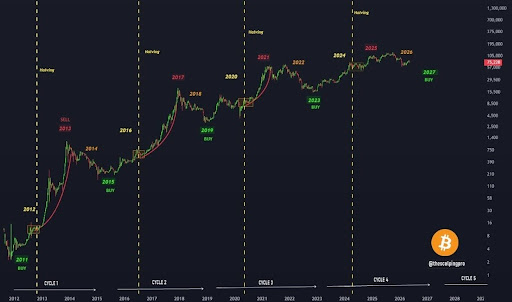
Source: Chart from Mags on X

In 2011, Bitcoin prices were declining, presenting a buying opportunity for investors. In the second year, Bitcoin began to rise, and investors simply held onto their tokens to allow them to grow. By 2013, prices had climbed to near peak levels, which the analyst noted was when most investors began selling their BTC. The fourth and final year of that cycle saw the market crash, and prices fall sharply. Mags described this as the bear market stage, marking the final stage before a fresh bull cycle began.

Notably, the same four-stage yearly trend was observed during the 2015-2018 and 2019-2022 cycles. Mags also stated that the cyclical theory is actively running in the current cycle, noting that Bitcoin has already moved through its Buy stage in 2023, Hold in 2024, and Sell phase in 2025. Based on this, Mags said that BTC is now in its bear market phase, coinciding with the cryptocurrency’s recent sideways movements and ongoing price declines.

What The Theory Says About The 2027-2030 Cycle

In his analysis, Mags went further to predict what the next cycle could look like after the current one ends. He suggested that the 2027-2030 cycle could follow a similar pattern, with Bitcoin potentially experiencing the same Buy, Hold, Sell, Bear market phases across each year.

He noted that if this structure holds, the next major accumulation window for investors and traders would arrive in 2027, a year ahead of the next anticipated bull run. Mags has pushed back against the speculation that the four-year cycle is dead, declaring that the structure “is still on track and everything is playing out perfectly.”


BTC trading at $77,435 on the 1D chart | Source: BTCUSDT on Tradingview.com

Criptomoedas em alta

Perguntas relacionadas

QIs Bitcoin's 4-year cycle theory still active according to the crypto analyst Mags?

AYes, Mags states that the 4-year cycle theory is still active and is playing out perfectly in the current market cycle.

QWhat are the four distinct yearly stages described in the analyst's interpretation of the Bitcoin cycle?

AThe four distinct yearly stages are: Buy (Year 1 - price decline/buying opportunity), Hold (Year 2 - price rise/accumulation), Sell (Year 3 - near peak levels/most investors sell), and Bear Market (Year 4 - market crash/price decline).

QAccording to Mags' analysis, what phase is Bitcoin currently in within the 2023-2026 cycle?

AAccording to Mags, Bitcoin is currently in its Bear Market phase for the 2023-2026 cycle, coinciding with recent sideways movements and price declines.

QWhen does Mags predict the next major accumulation window for Bitcoin investors will occur?

AMags predicts the next major accumulation window for investors and traders will arrive in 2027.

QWhy are some in the crypto community debating if the 4-year cycle is over for Bitcoin?

ASome believe the current Bitcoin market is markedly different from past cycles due to factors like the emergence of Spot ETFs, increased institutional flows, and broader adoption, leading to the debate about the cycle's validity.

Leituras Relacionadas

Bitcoin Withdrawals Continue: 8 Years of Storage in a Coldcard Cold Wallet Ended in Zero

Coldcard Hardware Wallet Hacked: Losses Mount Due to Vulnerable Seed Generation A critical vulnerability in Coldcard hardware wallets has led to a continued wave of fund thefts. According to Galaxy Research, the total stolen has reached 1,367.05 BTC (approx. $88.6 million) from 4,585 addresses, a significant increase from the initial 594.5 BTC reported on July 30, 2026. Most of the stolen funds remain on the attackers' addresses. The issue is not with the current firmware, which Coinkite has updated, but with seed phrases generated on vulnerable devices between March 2021 and the release of fixed firmware versions. Due to a programmer error, devices switched from using a hardware random number generator to the software-based Yasmarang generator, which was initialized with publicly accessible data like the chip's serial number. This made the seed phrases predictable through offline brute-force attacks, meaning wallets remain at risk until funds are moved to a new wallet generated with the patched firmware. Affected devices include Mk2/Mk3 with firmware 4.0.1–4.1.9 (and up to 5.0.3), Mk4/Mk5 up to version 5.6.0, and Q models up to 1.5.0Q. The only exceptions are seeds created with a high-entropy method like at least 50 independent dice rolls or a strong unique BIP-39 passphrase. All other owners must generate a new seed on the fixed firmware and transfer their assets. A case highlighting the human impact involves a 39-year-old long-term investor who lost 2 BTC (approx. $130,000) in minutes. He had accumulated the Bitcoin over eight years through physical labor, viewing it as a financial lifeline and a retirement plan in a country suffering from hyperinflation. His story underscores that even conservative "buy and hold in cold storage" strategies can be compromised by such underlying technical flaws. From a technical perspective, this incident echoes historical failures where weak random number generators undermined cryptographic security, challenging the assumption that offline storage is automatically foolproof.

cryptonews.ruHá 5h

Bitcoin Withdrawals Continue: 8 Years of Storage in a Coldcard Cold Wallet Ended in Zero

cryptonews.ruHá 5h

Trading

Spot

Artigos em Destaque

Como comprar 4

Bem-vindo à HTX.com!Tornámos a compra de 4 (4) simples e conveniente.Segue o nosso guia passo a passo para iniciar a tua jornada no mundo das criptos.Passo 1: cria a tua conta HTXUtiliza o teu e-mail ou número de telefone para te inscreveres numa conta gratuita na HTX.Desfruta de um processo de inscrição sem complicações e desbloqueia todas as funcionalidades.Obter a minha contaPasso 2: vai para Comprar Cripto e escolhe o teu método de pagamentoCartão de crédito/débito: usa o teu visa ou mastercard para comprar 4 (4) instantaneamente.Saldo: usa os fundos da tua conta HTX para transacionar sem problemas.Terceiros: adicionamos métodos de pagamento populares, como Google Pay e Apple Pay, para aumentar a conveniência.P2P: transaciona diretamente com outros utilizadores na HTX.Mercado de balcão (OTC): oferecemos serviços personalizados e taxas de câmbio competitivas para os traders.Passo 3: armazena teu 4 (4)Depois de comprar o teu 4 (4), armazena-o na tua conta HTX.Alternativamente, podes enviá-lo para outro lugar através de transferência blockchain ou usá-lo para transacionar outras criptomoedas.Passo 4: transaciona 4 (4)Transaciona facilmente 4 (4) no mercado à vista da HTX.Acede simplesmente à tua conta, seleciona o teu par de trading, executa as tuas transações e monitoriza em tempo real.Oferecemos uma experiência de fácil utilização tanto para principiantes como para traders experientes.

703 Visualizações TotaisPublicado em {updateTime}Atualizado em 2026.06.02

Como comprar 4

Discussões

Bem-vindo à Comunidade HTX. Aqui, pode manter-se informado sobre os mais recentes desenvolvimentos da plataforma e obter acesso a análises profissionais de mercado. As opiniões dos utilizadores sobre o preço de 4 (4) são apresentadas abaixo.

活动图片