How the $900 Billion Anthropic Was Built?

链捕手Publicado em 2026-05-13Última atualização em 2026-05-13

Resumo

Anthropic, the AI startup behind Claude, is reportedly in early talks to raise at least $30 billion in new funding, targeting a valuation exceeding $900 billion. This would propel it past OpenAI's recent $852 billion valuation. The funding round is expected to close by late May 2026. The company's valuation surge is driven by extraordinary revenue growth, reportedly reaching an annualized $30 billion by March 2026 from $1 billion in December 2024. However, OpenAI questions this figure, suggesting a net revenue closer to $22 billion after cloud platform fees. Despite high revenue, Anthropic's gross margin is reportedly around 40%, and it is not yet profitable, with breakeven projected for 2028. A significant portion of the new capital would fund massive, pre-committed computing infrastructure with partners like Amazon, Google, and Microsoft. This highlights a new AI financing model where high valuations fuel compute spending, which in turn requires even higher future valuations to sustain. Notably, many early-stage investors are reportedly sitting out this round. Bankers privately estimate a potential IPO valuation between $400-500 billion, creating a rare scenario where the final private funding round valuation ($900B+) could far exceed the expected public market debut. Anthropic is targeting an IPO between October 2026 and the first half of 2027. Its public listing is poised to be a critical test for the entire AI sector's valuation logic, potentially validating or chall...

By Su Yang

Edited by Xu Qingyang

Bloomberg, citing informed sources, revealed that AI startup Anthropic is in early-stage talks with investors, aiming to raise at least $30 billion in new funding at a valuation exceeding $900 billion.

Informed sources disclosed that this round of financing is expected to be completed as early as the end of May 2026, although the deal is not yet finalized, and no term sheet has been signed.

If the financing succeeds, Anthropic will not only surpass OpenAI (valued at $852 billion in March) but also challenge the market capitalizations of tech giants like Apple and Microsoft. It is noteworthy that early investors who backed the company have largely chosen to sit on the sidelines for this round.

Anthropic CEO Dario Amodei. This image was generated by AI.

01 $30 Billion in Annual Revenue and 40% Gross Margin

Why can a company's valuation skyrocket 15-fold in 14 months? The answer seems obvious: growth rate.

According to publicly reported data, Anthropic's annualized revenue surged from $1 billion in December 2024 to $30 billion by the end of March 2026. This means that over consecutive years, it has maintained a growth rate exceeding 10x.

This growth curve may be unprecedented in enterprise software history.

Eight of the top ten companies on the Fortune Global 500 list are already Anthropic's clients. Over 1,000 enterprise accounts spend more than $1 million annually on Claude. In particular, its developer-facing coding product, Claude Code, launched in May 2025, reached an annualized revenue of $2.5 billion by February 2026, with enterprise subscriptions quadrupling within the first six weeks of the year.

Calculated with a $900 billion valuation and $30 billion in annualized revenue, the price-to-sales ratio is approximately 30x. This multiple sounds extreme, but supporters' calculations bet on the future. They believe a company growing 10x annually cannot be valued conventionally. Its pricing logic assumes it can maintain a similar compound growth rate until 2028, making the current valuation reasonable in hindsight.

Regarding Anthropic's revenue, competitor OpenAI has raised its own doubts, suggesting that the $30 billion annualized revenue reported by Anthropic uses gross revenue accounting. That is, when customers use its models through platforms like Amazon Web Services or Google Cloud, it records the total end consumption as revenue and then lists the fees paid to the cloud platforms as expenses.

OpenAI estimates that after deducting these intermediary fees, Anthropic's true annual revenue is closer to $22 billion. This $8 billion gap is purely a methodological choice, but it will become a focal point for market and regulatory scrutiny during an IPO.

More noteworthy than revenue accounting are the costs.

Documents show that Anthropic plans to spend approximately $19 billion in 2026 on training and inference computing, a figure almost equivalent to its annual revenue. More critically, due to inference costs exceeding expectations by 23%, its business gross margin has been compressed to about 40%, a level far below that of most mature enterprise software companies.

Anthropic is not yet profitable and is expected to break even only by 2028. For a company nearing a trillion-dollar valuation, this combination of financial metrics is indeed unusual.

02 Valuation-Driven Computing Arms Race

Why does Anthropic need to raise so much money?

Nominally, it's for development and expansion, but in essence, this $30 billion financing is primarily to pay for the computing infrastructure it has already committed to but has not yet built. This appears to be a model completely different from traditional tech finance.

In the past, startups raised funds to refine products, expand markets, and then gradually match valuations with growth. But in the AI era, startups need to first raise funds at an extremely high valuation, use that money to lock in massive future computing power, and then hope this computing power drives a leap in model capabilities, leading to revenue growth that ultimately justifies the high valuation.

It's like the chicken-and-egg debate.

Now, valuations drive computing commitments, and these commitments require the next, even higher valuation to fund them. This cycle is constantly accelerating. Anthropic is the ultimate embodiment of this model.

Once this cycle starts, it's hard to stop. It can propel a company to the clouds or plunge it into an abyss in an instant.
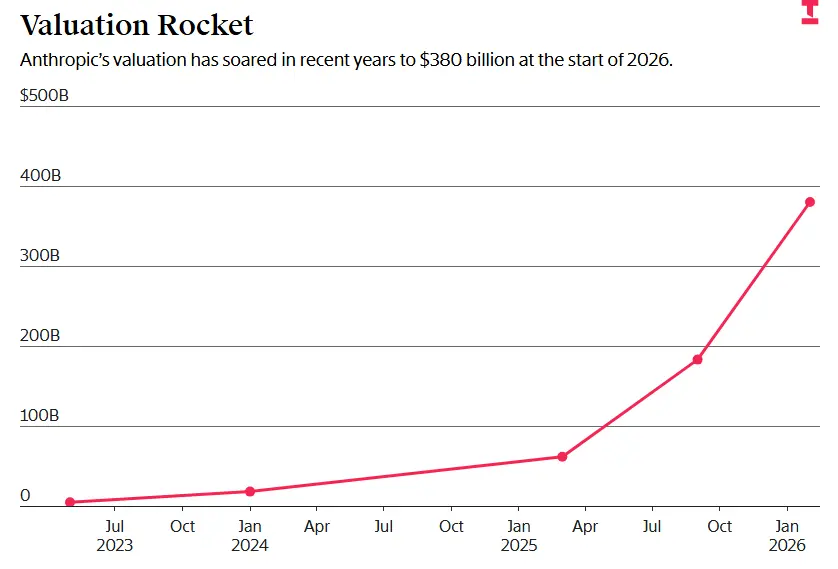
Anthropic's valuation surged to $380 billion in early 2026.

Shortly after the company completed its last $30 billion funding round, Anthropic CEO Dario Amodei told Fortune magazine that if AI progress were delayed by 12 months, Anthropic would go bankrupt.

For a company valued at $900 billion, the distance between "extraordinary success" and "operational bankruptcy" might be just a few bad quarters.

This precarious balance may be why sensitive early investors have largely refrained from participating in this round.

03 Early Investors Collectively Wait-and-See

According to Forbes, some of Anthropic's early backers—those who invested at a $4.1 billion valuation in 2023 or a $61.5 billion valuation in March 2025—have almost no willingness to participate in this round.

The reason is simple. Bankers privately estimate that if Anthropic goes public as early as October 2026, its public market valuation might land between $400 billion and $500 billion. This means that if someone invests at a $900 billion valuation in the final private round, theoretically, before the shares even unlock and become tradable, that investment would already be underwater on paper.

Such an inversion, where late-stage private valuations are significantly higher than expected IPO valuations, is extremely rare in the history of tech financing.

It's a signal, indicating either that this company is severely overvalued in the private market, or that the public market will offer a completely different pricing. Either possibility is fraught with uncertainty.

And that decisive event on the horizon is the IPO itself.

We previously mentioned the key figure behind Anthropic's IPO and financing—the company's financial helmsman, Krishna Rao.

The Information reported that at the time, Anthropic's computing lifeline was essentially tied to Google alone. Rao felt this was untenable—you can't put all your eggs in one basket. He championed a new strategy internally and among investors: computing suppliers must be diversified.

According to The Information citing informed sources, Rao discussed this strategy in depth with investor Byron Deeter of Bessemer Venture Partners. Deeter later commented that it was Rao who made the company realize that having multiple partners would allow for faster development.

Looking back now, Anthropic moved faster than OpenAI. They have already signed deep agreements with all three cloud computing giants: Amazon, Google, and Microsoft. At the chip level, they have also incorporated NVIDIA GPUs, Google's self-developed TPUs, and Amazon's chips, forming a diversified supply network.

But signing agreements is not enough; the core is ensuring suppliers actually deliver the computing resources. In late 2025, Rao spearheaded two major deals: one committing $30 billion to use Microsoft's cloud servers running NVIDIA chips, and another securing up to 1 million Google TPUs.

By early April 2026, Anthropic went further, signing new agreements with Broadcom and Google, locking in several gigawatts of data center power supply capacity. These moves are no longer simply "buying" computing power but are large-scale "reservations" of future infrastructure.

Since joining, Rao has helped the company complete multiple funding rounds totaling $60 billion. By January of this year, the company's valuation had risen to $380 billion.

It can be said that under Rao's forceful drive, Anthropic's computing infrastructure and financial firepower have reached unprecedented scale.

04 Is There a Bubble? The Answer in Six Months

Following the current pace, if this round of financing proceeds as intended, Anthropic is expected to seek an IPO between October 2026 and the first half of 2027. Goldman Sachs, JPMorgan Chase, and Morgan Stanley are reportedly in discussions about the matter.

At that time, the market's core focus will no longer be "Can Anthropic sustain growth?" but will turn into a public referendum on the entire AI industry's valuation logic over the past three years: Was the private market's pricing of AI correct?

Ultra-large-scale corporate capital expenditure commitments, multi-year computing reservation contracts, 40% gross margins, the debate between gross and net revenue accounting, and that accelerating "valuation-computing-revaluation" cycle—all these complex issues that could be ambiguously handled in the private market will, at the IPO, be placed under the public market's microscope.

If the public market is willing to give Anthropic a valuation of $1 trillion or even higher, then the entry price at a $900 billion valuation might look like a generous early bet. But if the market only offers $500 billion, the situation for the last batch of private investors would be very awkward.

A third possibility, perhaps with more profound implications, is that Anthropic's IPO will serve as a key data point to validate or disprove the entire AI finance structural hypothesis.

Remember Michael Burry, the inspiration behind *The Big Short*, who recently warned about "tech stocks" and "chip stocks" bubbles in his paid newsletter again. Once the AI finance hypothesis is disproven during Anthropic's listing, it could be the moment the bubble bursts.

So, whether for Anthropic itself or for the entire AI industry accustomed to soaring valuations over the past three years, the stress test has just begun, and will soon be given the most real, most ruthless pricing by a stock trend curve.

Special contributor Jin Lu also contributed to this article.

Perguntas relacionadas

QAccording to the article, what is Anthropic's current annualized revenue and how does it compare to OpenAI's reported revenue?

AAccording to the article, Anthropic's annualized revenue has surged to $30 billion as of March 2026. OpenAI estimates that Anthropic's real net revenue, after deducting payments to cloud platforms, is closer to $22 billion, questioning the $30 billion figure which uses gross revenue accounting.

QWhat is the primary purpose of Anthropic's new $30 billion funding round as described in the text?

AThe primary purpose of the $30 billion funding round is to pay for the massive computing infrastructure that Anthropic has already committed to but has not yet built. This is part of a 'valuation-computing-valuation' cycle where high valuations fund future compute resources.

QWhy are many of Anthropic's early-stage investors reportedly not participating in the new $30 billion funding round?

AEarly-stage investors are hesitant because bankers privately estimate that Anthropic's public market valuation upon an IPO could be between $400 and $500 billion. Investing at a $900 billion valuation in the final private round could mean immediate paper losses once the company goes public at a lower valuation.

QWhat key financial challenge regarding costs does Anthropic face, according to the article?

AAnthropic plans to spend about $19 billion on training and inference compute in 2026, which is almost equivalent to its full-year revenue. Due to inference costs exceeding expectations by 23%, its gross margin is compressed to around 40%, which is lower than most mature enterprise software companies. The company is not yet profitable.

QWho is identified as a key figure behind Anthropic's financing and compute strategy, and what was his major contribution?

AKrishna Rao, Anthropic's financial leader, is identified as the key figure. He advocated for and executed a strategy of diversifying compute suppliers beyond just Google, securing deals with Amazon, Google, and Microsoft, and locking in large-scale, long-term compute and power infrastructure commitments.

Leituras Relacionadas

Should You Buy SpaceX Stock at $1.7 Trillion? Here's What the Market Is Worried About

SpaceX is preparing for a massive IPO aiming to raise around $75 billion at a valuation of approximately $1.75 trillion. While its achievements in reusable rockets and the profitable Starlink satellite internet service are clear, the market is concerned about the aggressive valuation. Key issues include: the current $1.75 trillion valuation, which is about 94 times 2025 revenue, seems to price in not just existing businesses but also unproven future ventures like AI infrastructure and orbital data centers. Financially, while Starlink is profitable, the AI division, bolstered by the acquisition of xAI, is incurring massive losses and consuming the majority of capital expenditures. This acquisition also introduced complex related-party financing arrangements and debt onto SpaceX's balance sheet. Furthermore, corporate governance poses a challenge. SpaceX's dual-class share structure ensures founder Elon Musk retains absolute control, limiting ordinary shareholders' influence over high-risk, long-term strategic decisions. The future success of ambitious projects like the Starship rocket—critical for lowering costs and enabling new services—remains a significant variable for the valuation. In summary, the market's apprehension (FUD) centers not on doubting SpaceX's past technological triumphs but on questioning how much premium public investors should pay for a future that combines proven profits with highly speculative and capital-intensive new ventures, all under a governance structure that offers limited shareholder oversight.

marsbitHá 22m

Should You Buy SpaceX Stock at $1.7 Trillion? Here's What the Market Is Worried About

marsbitHá 22m

Breaking the DeFi Cascading Liquidation Curse: Vitalik Proposes a New Solution

Vitalik Buterin has proposed a new DeFi design to eliminate the automatic liquidation mechanism that causes market instability during sharp downturns. The current system, used by protocols like Aave, triggers forced sales when collateral value falls below a threshold, often exacerbating price drops and creating systemic selling pressure. Buterin's alternative model is based on splitting an asset like ETH into two synthetic option-like tokens, P and N, pegged to a price index. Their combined value always equals one ETH. Instead of sudden liquidation, a position's value gradually drifts from its target peg if the market moves. Users must proactively rebalance their holdings to maintain their desired exposure, transferring the management burden from the protocol to the user or automated tools. A key advantage is the reduced reliance on real-time oracles. Pricing decisions are deferred until contract expiry, allowing for more robust, fault-tolerant oracle designs. This removes a clear liquidation threshold that speculators can target for manipulation or MEV extraction. However, significant challenges remain. Frequent rebalancing could incur high slippage and transaction costs, necessitating new liquidity provider models. The design is better suited for hedging instruments than for stablecoins requiring a rigid 1:1 peg. While not an immediate replacement for existing systems, the proposal challenges the foundational assumption that instantaneous forced liquidation is an unavoidable necessity in DeFi, opening the door for fundamentally different risk management architectures.

marsbitHá 27m

Breaking the DeFi Cascading Liquidation Curse: Vitalik Proposes a New Solution

marsbitHá 27m

The End of Single-Factor Cryptography

The article "The End of Single-Factor Crypto" posits a fundamental shift in the cryptocurrency ecosystem. It argues the era where crypto asset valuations were predominantly driven by, and correlated with, Bitcoin's price is ending. The space is bifurcating into two distinct economies: endogenous and exogenous. The endogenous economy represents traditional crypto, where token and project values are directly tied to crypto market prices. The emerging exogenous economy comprises projects and businesses that may utilize blockchain technology or tokens but derive their fundamental value from external, non-crypto factors like consumer demand, subscription revenue, or real-world utility. Examples include AI inference platforms like Venice, fintech lenders using blockchain for efficiency, and stablecoin/payment infrastructure companies acquired by giants like Mastercard and Stripe. This shift means investment analysis must change. For exogenous assets, evaluating traditional business fundamentals—such as revenue streams, unit economics, and competitive moats—becomes more critical than tracking Bitcoin charts. While endogenous assets like Bitcoin remain relevant, the growth of the exogenous category is driven by measurable demand independent of crypto price cycles, paving the way for a new, more diversified market phase. Consequently, crypto is evolving from a single-factor, reflexive asset class into a multifaceted ecosystem with varied drivers and investment theses.

marsbitHá 27m

The End of Single-Factor Cryptography

marsbitHá 27m

Morning Post | Bitmine Plans to Raise $300 Million Through Preferred Stock Issuance; Polymarket Accuses Kalshi of Commercial Espionage

ChainCatcher's Daily Crypto Brief: Key developments from the past 24 hours include significant funding moves, regulatory actions, and market predictions. Bitmine announced a $300 million preferred stock fundraising. Polymarket accused rival prediction platform Kalshi of corporate espionage, citing numerous suspicious coincidences in product launches, a claim Kalshi strongly denied. The U.S. Department of Justice, in a joint "Disruption Week" anti-fraud operation with companies like Coinbase and Meta, froze over $3.8 million in cryptocurrency linked to scams. In infrastructure news, Macau completed its integration with the multi-central bank digital currency bridge, mBridge, aiming to build efficient cross-border payment channels. Cosmos Labs acquired the block explorer Mintscan. Market-wise, Geoffrey Kendrick, Standard Chartered's Head of Digital Assets Research, stated Bitcoin is nearing a bottom around $63,000, maintaining a year-end target of $100,000. He noted stability in U.S. spot Bitcoin ETF holdings. Ahead of SpaceX's anticipated IPO, internal insiders at Rocket Lab (RKLB) sold over $18.41 million in stock. In tokenization, Goldman Sachs partnered with Apex and Archax to launch a tokenized real estate fund. The meme token tracker GMGN reported the top trending tokens: on Ethereum, HEX, SHIB, LINK, PEPE, mUSD; on Solana, TROLL, swarms, WORLDCUP, neet, Buttcoin; and on Base, PEPE, toby, ODDS, ELSA, SKI.

链捕手Há 41m

Morning Post | Bitmine Plans to Raise $300 Million Through Preferred Stock Issuance; Polymarket Accuses Kalshi of Commercial Espionage

链捕手Há 41m

Trading

Spot
Futuros
活动图片