How prediction markets raise insider trading and credit risks

cointelegraphPublicado em 2025-12-09Última atualização em 2025-12-09

Resumo

Prediction markets like Kalshi and Polymarket are experiencing significant growth, with billions in trading volume, but face scrutiny over ethical and financial risks. Concerns include insider trading, as seen in a manipulated map edit during the Russo-Ukrainian War that influenced a Polymarket bet resolution, and wash trading, which comprised up to 60% of volume on Polymarket. Regulators, including the CFTC, have granted some approvals, but states are challenging these platforms over gambling classifications. Analysts warn that easy access and gamified interfaces could lead to credit overextension and loan defaults, introducing new risks for lenders and consumers.

Prediction markets like Kalshi and Polymarket are growing, generating billions of dollars in volume. But some observers are concerned about the ethical problems and potential credit risks posed by major prediction betting platforms.

Last week, Polymarket saw a notional volume of over $1.2 billion, according to Dune Analytics. Media giant CNBC has entered into a partnership with prediction market Kalshi to integrate prediction data in its TV, digital and subscription platforms.

On the back of this success, Kalshi co-founder Tarek Mansour has mentioned creating “a tradable asset out of any difference in opinion,” stating that prediction markets could soon surpass the stock market in size.

Regulators in some jurisdictions are taking efforts to curb their activities. Concerns over wash and insider trading have surfaced in recent weeks, and some analysts believe it’s making credit risks worse.
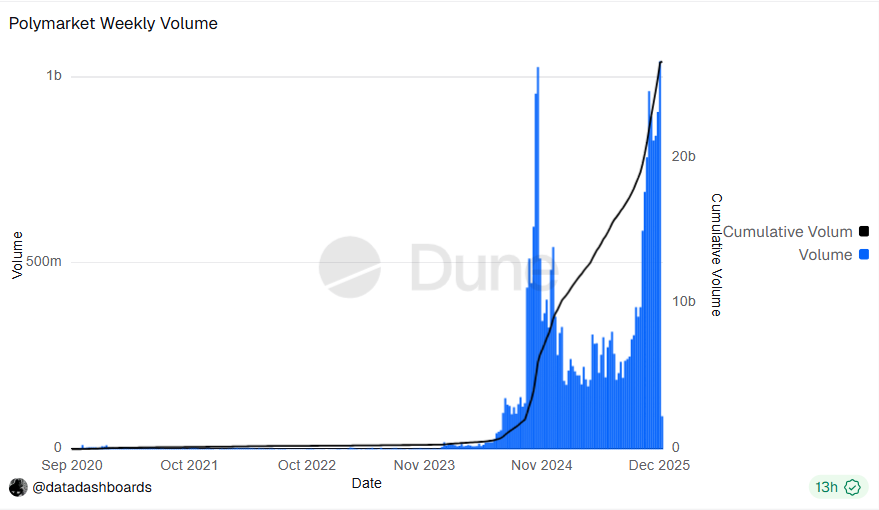
Weekly volumes on Polymarket are frequently over $1 billion. Source: Dune

Russo-Ukrainian War map altered, prediction market bet resolved

Prediction markets have opened up a range of possibilities for setting wagers on events. These can range from a specific element of a sports match to the outcome of a war. In some instances, this has led to insider manipulation to resolve a market in a certain way.

This is what may have happened in November, when the Institute for the Study of War (ISW) announced an unauthorized edit to its map of the Russo-Ukrainian War. The map is used by media organizations worldwide to track changes to frontline positions.

The edit concerned the ISW’s map of Myrnohrad, where Ukrainian troops have been defending the city against the Russian Pokrovsk offensive since July 2024. The unauthorized change to the map of the city coincided with the resolution of a bet on Polymarket, “Will Russia capture Myrnohrad by...” and then a series of dates.

The market resolution was triggered if Russia held an intersection between two streets, Vatutina Vulytsya and Puhachova Vulytsya. According to 404 Media, on Nov. 15, someone edited the map to show Russian troops had taken the intersection. Just minutes after the market resolved, the edit disappeared.
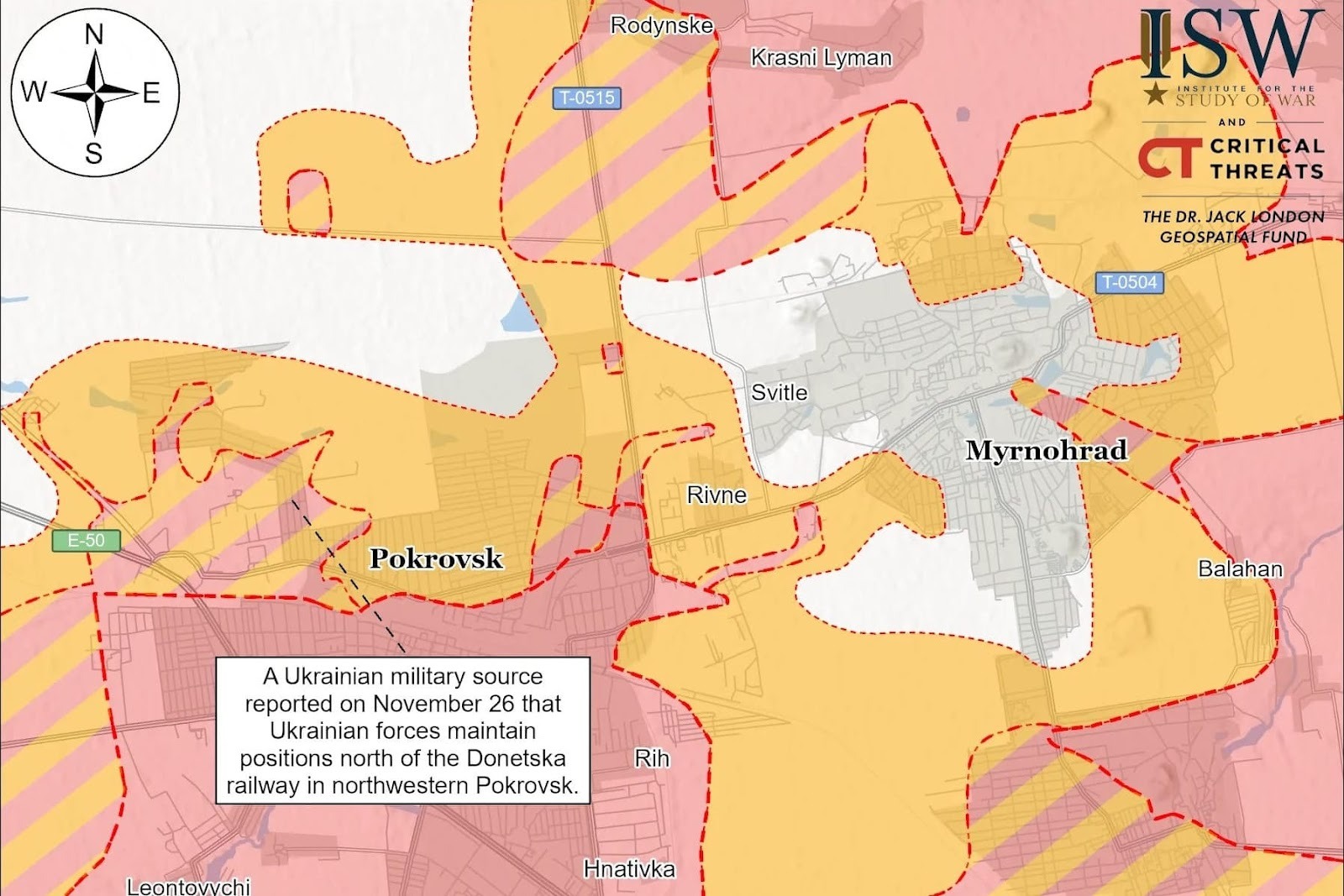

The updated Nov. 17 ISW map did not show that Russian forces controlled the intersection. Source: ISW, 404

The ISW announced the unapproved edit on Nov. 17. It noted that, “The map does not represent battlefield changes in real-time, and all adjustments made during our workday are subject to review and change over the course of the day.”

In this instance, not only was insider knowledge allegedly used to manipulate data, but that manipulation could have affected the public perception of an ongoing violent conflict.

Other examples have also surfaced. Pseudonymous trader AlphaRaccoo netted over $1 million in bets relating to Google search result rankings. He also reportedly made $150,000 by predicting the exact day Google would launch a new version of its Gemini AI model.

Jeong Haeju, a senior software engineer at Meta, said, “He’s a Google insider milking Polymarket for quick money. It’s one of the wildest things I’ve seen on the platform.”
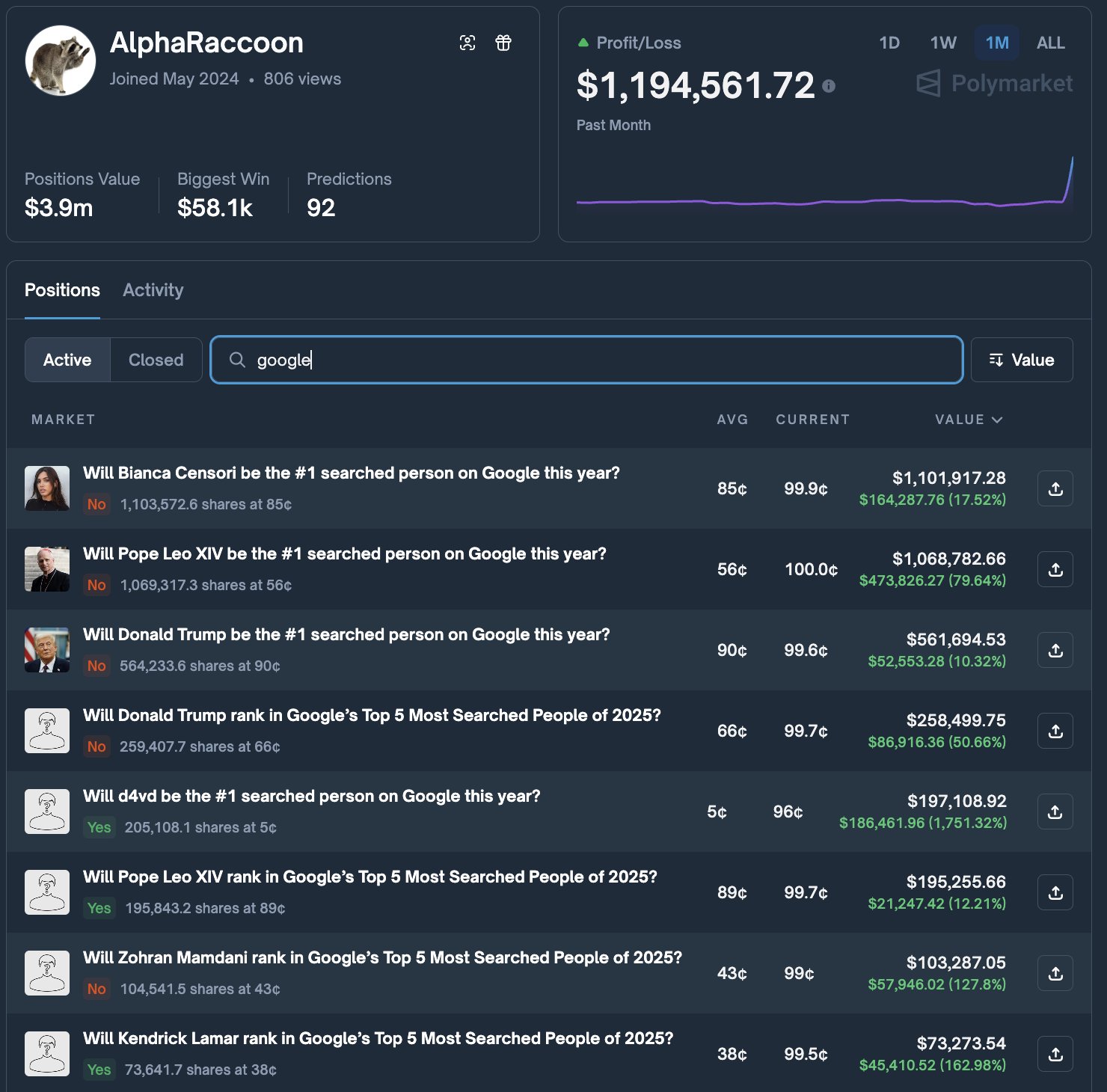
AlphaRaccoon’s betting history. Source: Jeong Haeju

Allegations of manipulation aren’t limited to insider trading. A November report from researchers at the Columbia Business School found that wash trading — i.e., “buying and selling securities without taking a net position, for the purpose of artificially inflating recorded volume” — accounted for 60% of volume on Polymarket in December 2024.

Related: Polymarket rife with ‘artificial trading,’ Columbia University researchers find

This fell substantially but rose to nearly 20% of total volume by October 2025 and has comprised an average of 25% of all trading on Polymarket.

Wash trading “doesn’t add liquidity or information to the market,” said Yash Kanoria, a professor at Columbia University’s business school. This is especially important, given claims that prediction markets provide more accurate and dynamic analyses of a situation.

Jason Wingard, a distinguished visiting professor at Harvard University and executive chairman of the Education Board, wrote that prediction markets create a “‘truth signal’ that moves faster than polls, pundits, or official reports. When thousands of people are willing to lose money on what they think will happen, the result is a dynamic forecast of political outcomes, corporate decisions, economic trends, and cultural shifts.”

Regulation battles as prediction markets ponder new assets

Prediction platforms have won important regulatory approvals this year. In November, Polymarket secured regulatory approval from the US Commodity Futures Trading Commission (CFTC) to operate an intermediated trading platform.

Polymarket founder and CEO Shayne Coplan said, “This approval allows us to operate in a way that reflects the maturity and transparency that the US regulatory framework demands.”

Kalshi is also regulated by the CFTC, meaning that, on paper, it should be allowed to operate in all 50 states.

However, state regulators have taken issue with these platforms. Kalshi is currently facing legal battles with gaming regulators in Nevada, New Jersey, New York, Massachusetts, Maryland and Ohio over whether its platform constitutes a gambling enterprise.

Others see the potential for risks to the financial and credit systems. Bank of America analysts wrote, “Easy access and gamified interfaces encourage frequent and impulsive wagers, which can lead to overextension of credit and rising loan defaults.”

“For investors this convergence of entertainment and speculative finance signals heightened behavioral risk that could pressure credit quality, increase delinquencies, and impact earnings for issuers and subprime lenders.”

They said these risks could pressure credit quality and that online betting markets “introduce a new risk for lenders, one that they have not had to deal with historically and underwriting models may need to be adapted.”

The Connecticut Department of Consumer Protection has served cease-and-desist orders to Robinhood, Kalshi and Crypto.com. It stated that, in addition to lacking proper gambling licenses, the platforms pose “a serious risk to consumers who may not realize that wagers placed on these illegal platforms offer no protections for their money or information.”

Mansour’s plan to turn “any difference in opinion” into a tradable asset may sound novel, but betting platforms will first have to face regulatory scrutiny and a host of ethical issues.

Magazine: 6 reasons Jack Dorsey is definitely Satoshi... and 5 reasons he’s not


Leituras Relacionadas

From South Korea to the United States: Blue-Collar Jobs Are Becoming Increasingly Popular, Thanks to AI

AI is reshaping the labor market's value proposition. The traditional four-year college degree is losing its appeal as a guaranteed career path, while skilled blue-collar trades like electricians, welders, and plumbers are experiencing historic demand and wage premiums. This shift is driven by dual pressures: AI's displacement of certain white-collar roles and a booming need for physical infrastructure and data center construction. Data confirms the trend. In the U.S., vocational school revenue surged, and a significant portion of recent layoffs are AI-related. Surveys show a majority of Gen Z adults plan to pursue blue-collar work, citing better job security against AI automation. Vocational education interest has exploded recently. Experts cite a psychological shift as younger generations seek tangible, AI-resistant careers and avoid high student debt. In many cases, salaries for skilled trades now match or exceed those requiring a bachelor's degree. In South Korea, semiconductor vocational high schools boast near-total employment, with graduates securing high-paying roles at companies like Samsung. The shortage is structural, exacerbated by a retiring baby boomer workforce and massive infrastructure projects. Companies like JPMorgan Chase, Meta, and Lowe's are investing heavily in training programs. However, overcoming historical stigma and a "perception gap" around trade careers remains a key challenge to closing the talent gap.

marsbitHá 25m

From South Korea to the United States: Blue-Collar Jobs Are Becoming Increasingly Popular, Thanks to AI

marsbitHá 25m

Qualcomm: AI Hype Subsides, When Will Smartphones Emerge from the Gloom?

Qualcomm reported its Q3 FY2026 results (ending June 2026), with revenue of $9.95B, down 4% YoY but above expectations. Gross margin declined to 53.1%, pressured by rising costs across manufacturing and memory. Key business segments showed mixed performance: Handset revenue fell 19.6% YoY to $5.09B, dragged by an 11% decline in non-Apple Android shipments and weaker high-end mix. Conversely, Automotive revenue surged 61% to $1.59B, and IoT grew 9% to $1.83B. Core operating profit dropped 41% YoY due to margin compression and higher expenses. Management's Q4 FY2026 guidance projects revenue of $9.7B-$10.5B, in line with consensus, but Non-GAAP EPS guidance of $2.05-$2.25 fell short of expectations. Amidst persistent weakness in its core handset market, Qualcomm is pursuing growth in AI, focusing on Edge AI (smartphones, PCs, automotive) and Data Center AI. Its data center strategy includes four pillars: AI accelerators (e.g., AI200), commercial CPUs (Dragonfly C1000), custom silicon, and connectivity solutions. While these initiatives initially boosted its stock, concerns over AI capital expenditure sustainability have since erased those gains. The company targets $5B in data center revenue for FY2027 and $15B for FY2029. The report concludes that with the traditional handset business still under pressure, the data center opportunity is currently viewed as a longer-term option, and a more conservative valuation based on core operations may be warranted until AI contributions materialize.

marsbitHá 29m

Qualcomm: AI Hype Subsides, When Will Smartphones Emerge from the Gloom?

marsbitHá 29m

From TPU to Self-Evolving Agents: How Jeff Dean Predicts the Next Step in AI

At the 2026 YC Startup School, Jeff Dean outlined his vision for AI's next phase, shifting focus from simply scaling models to building intelligent, autonomous systems. He believes AI's progress is no longer just about creating smarter models, but about integrating them into systems capable of long-term, iterative work, automated experimentation, and continuous learning. This evolution moves the competition from "who has the bigger model" to "who can best organize intelligence." Dean suggests AI capabilities are now comparable to a junior engineer, enabling the automation of complex workflows. However, the true challenge and opportunity lie in managing these AI "workers" at scale. He emphasizes the importance of **context engineering**—structuring tools, memory, and feedback loops—over raw model power. For startups, this means building deep expertise in niche domains where general models currently fail (near 0-1% success rates), leveraging proprietary data, specialized tools, and domain-specific evaluators. A recurring theme is re-examining fundamental constraints. Dean's past work, like moving Google's search index to memory or creating the TPU, stemmed from questioning outdated assumptions about hardware and cost. He sees similar inflection points today, particularly in **specialized inference hardware** to drastically reduce latency and energy consumption for real-time Agent operation. Notably, he points out that in modern AI systems, the dominant cost is often not computation but **data movement**. Reliable, long-running Agents require robust system design, borrowing concepts from distributed computing like checkpointing, state management, and parallel exploration to handle failures and maintain progress over days or weeks. As AI automates execution, the scarcest human skills will shift to **defining clear specifications**, **judging what problems are worth solving** (taste), and designing effective feedback loops. Ultimately, Dean's framework prioritizes understanding the problem deeply, identifying the true bottlenecks, and systematically building closed-loop systems where AI can not only perform tasks but also improve AI itself.

marsbitHá 30m

From TPU to Self-Evolving Agents: How Jeff Dean Predicts the Next Step in AI

marsbitHá 30m

Trading

Spot
活动图片




