How Likely Is a 5x Surge for HYPE?

marsbitPublicado em 2026-03-12Última atualização em 2026-03-12

Resumo

Despite a backdrop of "extreme fear" in the broader market, Hyperliquid (HYPE) has drawn significant attention, particularly from BitMEX co-founder Arthur Hayes, who has set a $150 price target—a fivefold increase from its current ~$36 price. Hayes argues that as trading activity shifts on-chain, HYPE's value capture mechanism, which uses ~97% of platform revenue to buy back and burn tokens, provides strong long-term price support. Key growth drivers include the HIP-3 proposal, enabling permissionless perpetual markets for traditional assets like indices and commodities, which already contributes ~10% of revenue. Community sentiment is bullish, citing HYPE's low ADV/OI ratio as a sign of genuine trading volume. However, achieving the $150 target is contingent on annualized revenue growing from ~$843 million to ~$1.4 billion. While on-chain data shows developer activity remains high, market sentiment has only recently begun to align with the platform's fundamentals.

Editor's Note: Against a backdrop of heightened macroeconomic uncertainty and persistently bearish sentiment in the crypto market, a fascinating divergence is emerging: investor sentiment remains in the "extreme fear" zone, while the prices of some assets have begun to slowly climb.

Recently, the decentralized derivatives trading platform Hyperliquid (HYPE) has become a focal point of community discussion. BitMEX co-founder Arthur Hayes publicly set a target price of $150 (approximately 5 times the current price), drawing significant market attention. As of March 12, 2026, HYPE was trading around $36, with a 24-hour gain of about 5% and a cumulative increase of over 11% in the past 7 days.
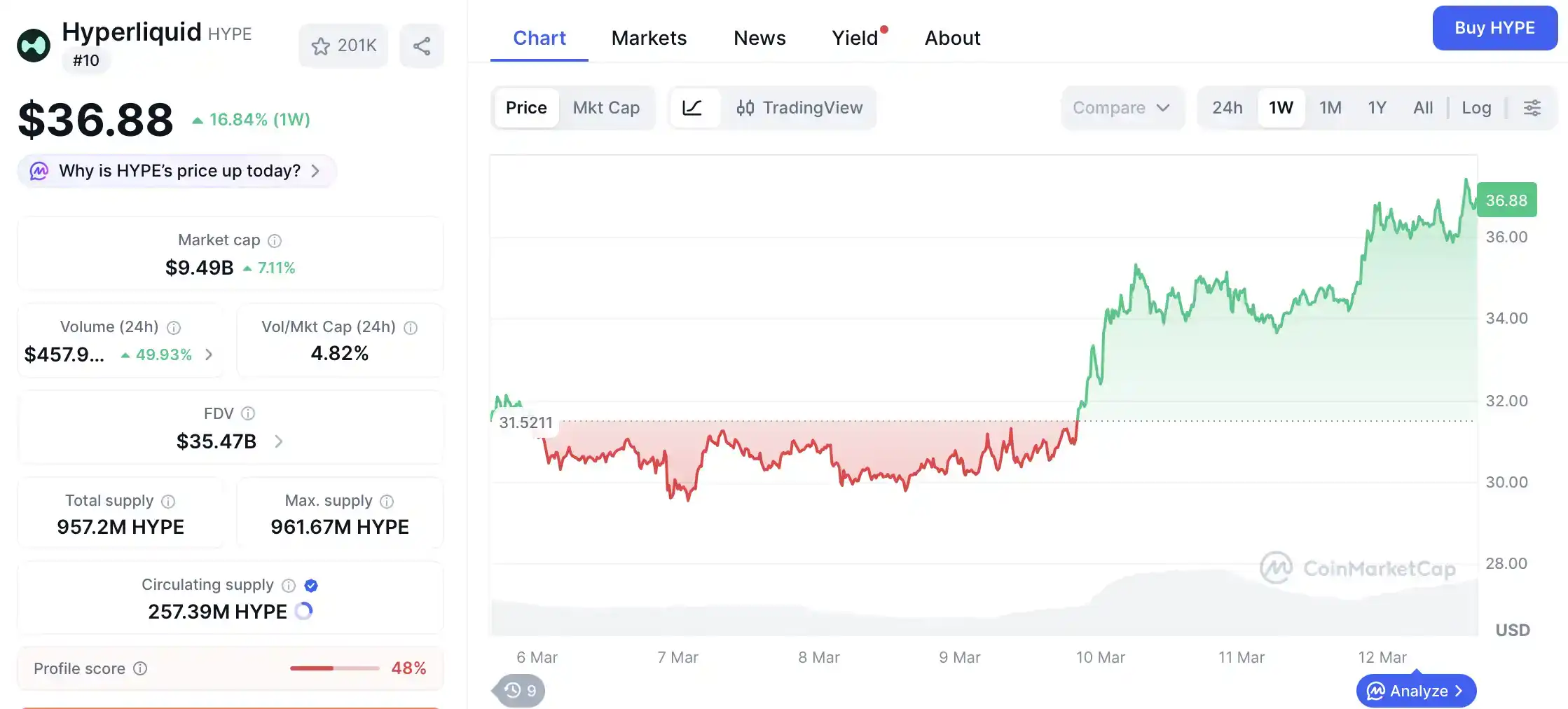
The community has offered various explanations for its upward momentum: for instance, the platform allocates approximately 97% of its revenue to buy back and burn tokens, creating a value capture mechanism directly linked to trading activity; the HIP-3 mechanism enables users to create more types of perpetual markets on-chain, expanding potential trading demand; simultaneously, a low ADV/OI ratio is seen by some market participants as a signal of more "authentic" trading volume.

This article synthesizes the views of Arthur Hayes and several community participants, attempting to understand the structural reasons behind HYPE's recent strength in a market environment where sentiment remains cautious.

Below is the original text:

The crypto market is currently in a rather delicate state: prices are slowly rising, but investor sentiment remains extremely pessimistic.

The Crypto Fear and Greed Index is still in the "Extreme Fear" range. However, for seasoned market participants like BitMEX co-founder Arthur Hayes, this divergence between price and sentiment sends a different signal.

Arthur Hayes: HYPE Target Price $150

Hayes believes that instead of focusing solely on short-term price fluctuations or hastily shorting the market, attention should be turned to decentralized exchanges (DEXs).

Reflecting on past market cycles, he pointed out that during the sideways trend in 2023, although traders overall had a tough time, platforms like GMX still achieved sustained growth through trading fees.

In his view, as more trading activity moves on-chain, Hyperliquid (HYPE) could follow a similar development path.

By comparison, institutions like Tether or Circle typically retain profits within the company; Hyperliquid, however, employs a different mechanism—roughly 97% of revenue is used to buy back and burn HYPE tokens, thereby reducing the circulating supply and providing long-term support for the price.

Based on this business model, Arthur Hayes believes HYPE's price has the potential to rise to $150.

"My target price for HYPE by August 2026 is $150. Based on the price of around $30 when I wrote this article, this implies an approximately 5x upside."

Related reading: Arthur Hayes: Why Is HYPE a Potential 5x Asset?

What Conditions Does Hyperliquid Need to Break Out?

However, for this target price to have a realistic foundation, Hyperliquid still needs to achieve stronger growth. Currently, the platform's annualized revenue is approximately $843 million, but to support such a valuation, the revenue scale would need to increase to roughly $1.4 billion.

One key growth driver could come from HIP-3.

HIP-3 allows users to create permissionless perpetual contract markets on-chain, with the underlying assets directly pegged to traditional assets—for example, the Nasdaq 100 index or precious metals. To launch such a market, users need to stake 500,000 HYPE tokens.

Although this mechanism was introduced relatively recently, HIP-3 already contributes about 10% of Hyperliquid's revenue. If more traders begin hedging traditional asset risks on-chain in the future, this business segment could see significant expansion.

Community Broadly Bullish on HYPE

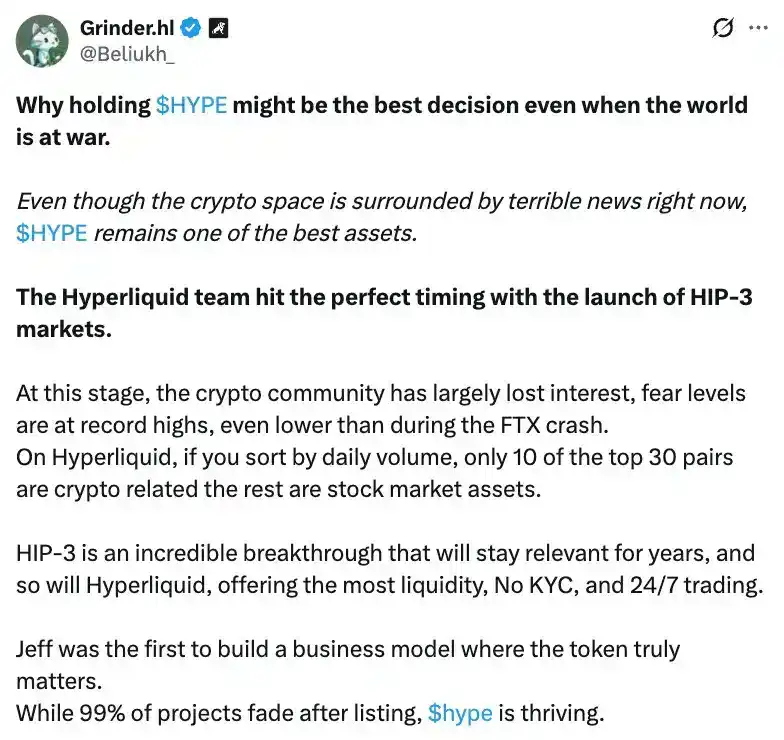
Echoing Hayes's view, one X user stated, "Even if the world is at war, holding HYPE might be the best decision."
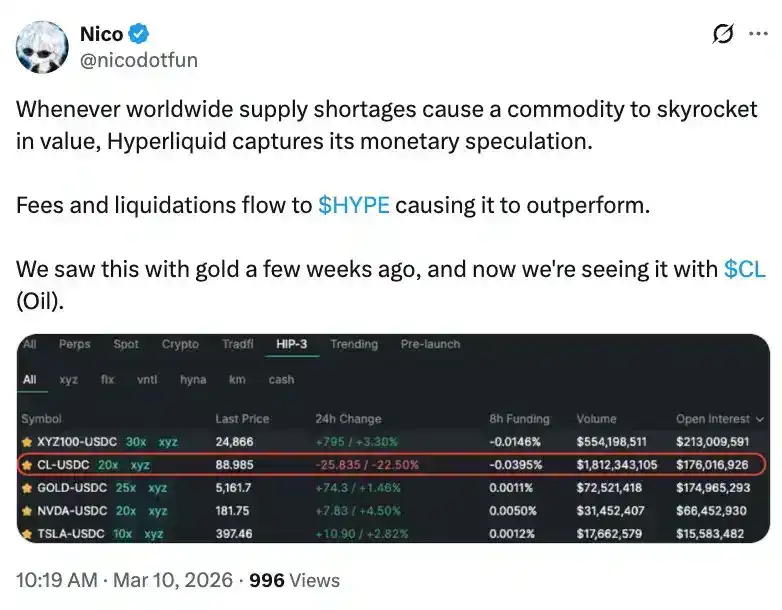
Additionally, another user commented, "Whenever a global supply shortage causes a spike in the price of a certain commodity, Hyperliquid will capture the resulting speculative demand for it. The trading fees and profits from liquidations will flow to HYPE, allowing it to outperform the market. We saw this happen with gold a few weeks ago, and now we're seeing the same phenomenon with CL (crude oil)."
Another important metric supporting the bullish outlook is the ADV/OI Ratio (Average Daily Volume / Open Interest).

Arthur Hayes cited this metric, stating: "Among the top five perpetual DEXs, Hyperliquid has the most authentic trading volume because it has the lowest ADV/OI ratio."
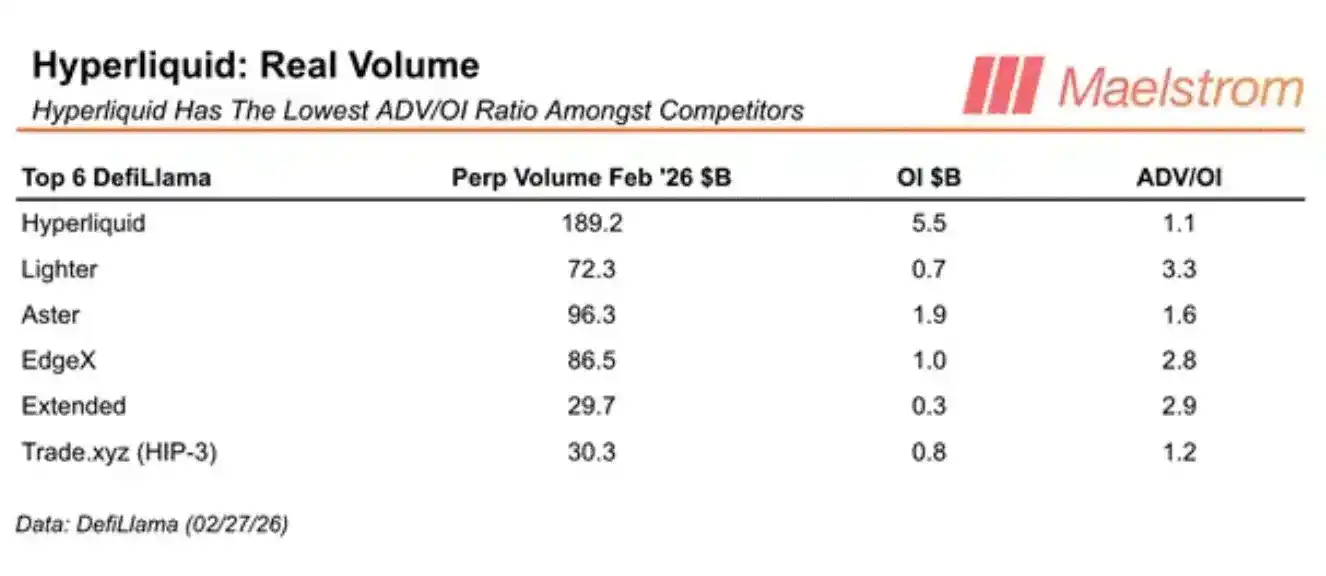
However, Hayes also believes that over time and as market conditions change, Hyperliquid's visible share of the overall Average Daily Volume (ADV) will continue to grow.

&HYPE: Price and On-Chain Metrics

Meanwhile, at the time of writing, HYPE is trading at approximately $34.98, up 13.37% in the past 24 hours. However, despite the strong price performance, on-chain data suggests market sentiment remains relatively cautious.

Data from Santiment shows a clear divergence between developer building progress and market sentiment between mid-January and mid-February: project development activity continued to advance, but market sentiment towards the project did not warm up simultaneously.
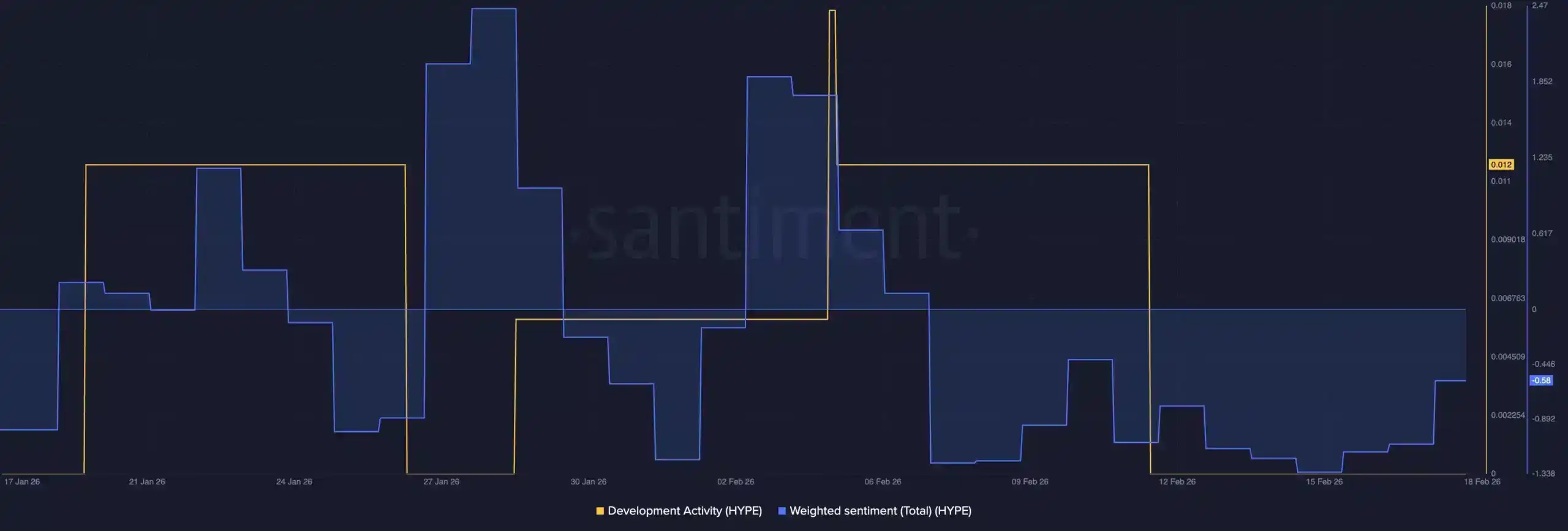
Nonetheless, investor sentiment remained skewed negative, primarily because traders were more focused on short-term price movements. It's only recently that market sentiment has begun to recover, suggesting the market may finally be starting to recognize the platform's growing utility and revenue model.

It's worth noting that this is not the first time Hayes has expressed strong confidence in HYPE. As early as February 21, the BitMEX co-founder stated on X that he was continuously accumulating HYPE and had set a target price of $150.

In his previous assessment, this target price could be achieved by July 2026; in the latest prediction, the timeline has been pushed back to around August 2026. However, this is contingent on the protocol achieving approximately $1.4 billion in annualized revenue.

Final Summary

Metrics like Hyperliquid's low ADV/OI ratio indicate that its trading activity comes more from real users rather than artificially manufactured wash trading.

Simultaneously, market sentiment remains cautious, suggesting investors are still waiting for clearer signals to confirm the platform can achieve sustainable growth.


Criptomoedas em alta

Perguntas relacionadas

QWhat is Arthur Hayes' price target for HYPE and by when does he expect it to be reached?

AArthur Hayes has set a price target of $150 for HYPE, which he expects to be achieved around August 2026.

QWhat is the key mechanism Hyperliquid uses to capture value and support its token price?

AHyperliquid uses a mechanism where approximately 97% of its revenue is used to buy back and burn HYPE tokens, reducing the circulating supply and providing long-term support for the price.

QWhat is HIP-3 and how does it contribute to Hyperliquid's growth potential?

AHIP-3 is a mechanism that allows users to create permissionless perpetual markets on-chain, with assets pegged to traditional markets like the Nasdaq 100 index or precious metals. It already contributes about 10% of Hyperliquid's revenue and is seen as a key driver for future growth.

QAccording to the article, why is Hyperliquid's ADV/OI ratio considered a sign of 'real' trading volume?

AA low ADV/OI (Average Daily Volume to Open Interest) ratio suggests that the trading volume is more likely to be genuine and from real users, rather than artificially inflated by wash trading. Hayes cited this as a reason Hyperliquid's volume is the 'most real' among the top five perpetual DEXs.

QWhat was the state of market sentiment towards HYPE according to on-chain data from Santiment?

ASantiment data showed a divergence between developer activity and market sentiment from mid-January to mid-February. Development continued to progress, but market sentiment remained negative and cautious, only recently beginning to recover as the platform's revenue model gained recognition.

Leituras Relacionadas

Agent Race Ends, Super Workbench Takes Over

The era of fragmented AI agents is ending. Over the past month, China's tech giants—Tencent, Alibaba, and ByteDance—have simultaneously shifted strategy: instead of launching new, standalone AI agents, they are consolidating their various agent projects into unified "super workbenches." Tencent integrated its QClaw teams into WorkBuddy, a strategic product hailed as a potential third flagship after QQ and WeChat. Alibaba is merging its QoderWork, Wukong, and MuleRun agents into a new "Qianwen Office" platform under DingTalk's leadership. ByteDance rebranded its TRAE SOLO coding agent to TRAE Work, signaling a broader focus on workflow collaboration. This convergence marks a pivotal industry consensus. The initial exploration phase, where companies rapidly built numerous overlapping agents for different scenarios, proved costly and inefficient. With open-source tools eroding technical barriers, competition has shifted from agent creation to resource consolidation and cost control. Historically, platform wars are won not by creating more products, but by simplifying them—as seen with browsers unifying web access and super-apps consolidating services. Now, the "super workbench" aims to become the unified AI entry point for work. This reflects a deeper market realization: the primary audience for AI is no longer just programmers (a market in the tens of millions) but all knowledge workers (a market of billions). The real opportunity lies in augmenting everyday tasks—managing emails, documents, data, and meetings—across the entire workday. The core battleground is becoming control over the primary AI entry point that employees use daily. Tencent's WorkBuddy leverages WeChat and Tencent Docs; Alibaba's Qianwen Office taps into DingTalk's organizational data; ByteDance's TRAE Work integrates with Feishu's workflows. Whoever owns this "super workbench" gains strategic control over orchestrating enterprise data and APIs. This shift is redefining enterprise software. Traditional SaaS applications, valued for their user interfaces, will recede into the background. Their core functionalities will be exposed as standardized "Skills" or APIs for the super workbench's agents to invoke. Software value will shift from selling user seats to charging based on API calls and outcomes delivered. The evolution of agents is moving through clear stages: first as novel standalone products, then as consolidated primary work entry points, and finally as pervasive, invisible capabilities embedded into the digital fabric. The recent moves by major tech firms signal the transition from the first stage into the second, accelerating toward the third. In the end, the most successful agent technology may become invisible—like electricity or the HTTP protocol—a fundamental, unnamed infrastructure powering work itself.

marsbitHá 13m

Agent Race Ends, Super Workbench Takes Over

marsbitHá 13m

Michael Saylor: 110 Reasons to Oppose BIP-110

Michael Saylor presents 110 arguments against Bitcoin Improvement Proposal (BIP) 110, a soft fork aimed at restricting certain non-monetary data storage uses (like inscriptions) on the Bitcoin blockchain. He acknowledges the proponents' valid concerns—such as node costs, fee pressure, and preserving Bitcoin's monetary focus—but fundamentally disagrees with the proposed solution. Saylor argues that BIP 110 represents a dangerous precedent of using consensus rules to enforce value judgments on transaction validity, moving away from Bitcoin's core principles of neutrality and permissionless innovation. His key objections are organized into eleven categories: 1) It violates neutrality and hard consensus by banning currently valid transactions. 2) It fails to meet the high burden of proof required for a consensus change, lacking concrete data on the alleged crisis. 3) Its seven bundled technical restrictions are overly broad, targeting generic script functionalities and blocking future upgrade paths. 4) It sacrifices compatibility and future optionality by closing off designed upgrade hooks. 5) Its temporary rules add significant complexity (grandfathering, expiry states) without sufficient justification. 6) The economic and security impacts, particularly on miner revenue and fee markets, are uncertain and unmodeled. 7) Superior, market-based tools (fee markets, relay/mining policies) already exist to manage blockchain load. 8) It stifles innovation by creating a chilling effect for developers. 9) Its modified activation mechanism (55% threshold, forced signaling) is aggressive and risks network splits. 10) The precedent it sets—using consensus to suppress disliked but legal uses—is more dangerous than the problem it aims to solve. 11) A better path exists: improving measurements, refining resource-based policies, and allowing market forces to work. Saylor concludes that Bitcoin's strength lies in its neutral rules, open markets, and hard consensus. Changing these foundational elements to target specific use cases is an unnecessary and risky "iatrogenic" intervention. He advocates for guarding Bitcoin's neutrality rather than acting as its redeemer.

marsbitHá 28m

Michael Saylor: 110 Reasons to Oppose BIP-110

marsbitHá 28m

Trading

Spot

Artigos em Destaque

Como comprar HYPE

Bem-vindo à HTX.com!Tornámos a compra de Hyperliquid (HYPE) simples e conveniente.Segue o nosso guia passo a passo para iniciar a tua jornada no mundo das criptos.Passo 1: cria a tua conta HTXUtiliza o teu e-mail ou número de telefone para te inscreveres numa conta gratuita na HTX.Desfruta de um processo de inscrição sem complicações e desbloqueia todas as funcionalidades.Obter a minha contaPasso 2: vai para Comprar Cripto e escolhe o teu método de pagamentoCartão de crédito/débito: usa o teu visa ou mastercard para comprar Hyperliquid (HYPE) instantaneamente.Saldo: usa os fundos da tua conta HTX para transacionar sem problemas.Terceiros: adicionamos métodos de pagamento populares, como Google Pay e Apple Pay, para aumentar a conveniência.P2P: transaciona diretamente com outros utilizadores na HTX.Mercado de balcão (OTC): oferecemos serviços personalizados e taxas de câmbio competitivas para os traders.Passo 3: armazena teu Hyperliquid (HYPE)Depois de comprar o teu Hyperliquid (HYPE), armazena-o na tua conta HTX.Alternativamente, podes enviá-lo para outro lugar através de transferência blockchain ou usá-lo para transacionar outras criptomoedas.Passo 4: transaciona Hyperliquid (HYPE)Transaciona facilmente Hyperliquid (HYPE) no mercado à vista da HTX.Acede simplesmente à tua conta, seleciona o teu par de trading, executa as tuas transações e monitoriza em tempo real.Oferecemos uma experiência de fácil utilização tanto para principiantes como para traders experientes.

332 Visualizações TotaisPublicado em {updateTime}Atualizado em 2026.06.02

Como comprar HYPE

Discussões

Bem-vindo à Comunidade HTX. Aqui, pode manter-se informado sobre os mais recentes desenvolvimentos da plataforma e obter acesso a análises profissionais de mercado. As opiniões dos utilizadores sobre o preço de HYPE (HYPE) são apresentadas abaixo.

活动图片









