How Does Backpack's Staking Token-to-Equity Conversion Work?

marsbitPublicado em 2026-02-25Última atualização em 2026-02-25

Resumo

Backpack, a Solana-based wallet and exchange platform founded by ex-FTX members, has announced a novel staking-to-equity conversion plan. Users who stake its native token for at least one year can convert those tokens into real company equity at a fixed ratio, with 20% of equity reserved for this purpose. The platform emerged after FTX’s collapse, having lost 80% of its operational funds, and gradually built its user base through its Mad Lads NFT community and a compliant exchange. It recently acquired FTX Europe and secured regulatory licenses. Backpack’s tokenomics include a 1 billion total supply, with 62.5% pre-IPO allocation. The TGE will release 25% of tokens, entirely to users. The model ties token distribution to IPO milestones—a rare hybrid approach in crypto. This move aims to transform users from token holders into legal company owners. However, it faces significant regulatory challenges, particularly from the SEC, which may view the token as a security. The dual-structure of token and equity could also complicate IPO investor relations. While innovative, the plan operates in a regulatory grey area—attempting to bridge decentralized tokenomics with traditional equity financing.

Original | Odaily Planet Daily (@OdailyChina)

Author | DingDang (@XiaMiPP)
On February 24, Backpack CEO Armani Ferrante announced a staking-to-equity conversion plan, allowing users who stake Backpack's native token for at least one year to exchange these tokens for real company equity at a fixed ratio. The company has reserved 20% of its equity for this plan.

This brief statement conveys far more information than a conventional TGE narrative.

In traditional TGE narratives, users are seen as traffic and community token holders; in this design, Backpack attempts to elevate users from product users to legal company owners.

The question is: Can it really work? Is this a financial innovation or a high-risk experiment dancing on the edge of regulation? Does it change the power structure, or is it just a more advanced form of chip management? To understand this, we must look back at Backpack's own history.

Backpack: A Company Rising from the Ruins

Backpack is a "wallet + exchange" integrated platform centered on the Solana ecosystem, founded by Armani Ferrante, a former member of FTX and Alameda Research. It was established after the collapse of FTX, emphasizing compliance and user custody.

However, unlike the "trading first, ecosystem later" development path of centralized exchanges like Binance, Backpack's path is the reverse. It started with a wallet and NFTs, gradually accumulating users, community, and technical foundations, and eventually launched an exchange.

Looking back at Backpack's history. In 2022, the collapse of FTX not only tore apart the credit structure of the entire crypto industry but also directly impacted projects associated with it. Backpack had just completed a $20 million funding round led by FTX Ventures and Jump Crypto before FTX's collapse. But as the empire crumbled, about 80% of Backpack's operating funds evaporated. At that time, Backpack was positioned as a "wallet + xNFT operating system," aiming to provide Solana users with a safer, integrated entry point, avoiding reliance on centralized platforms.

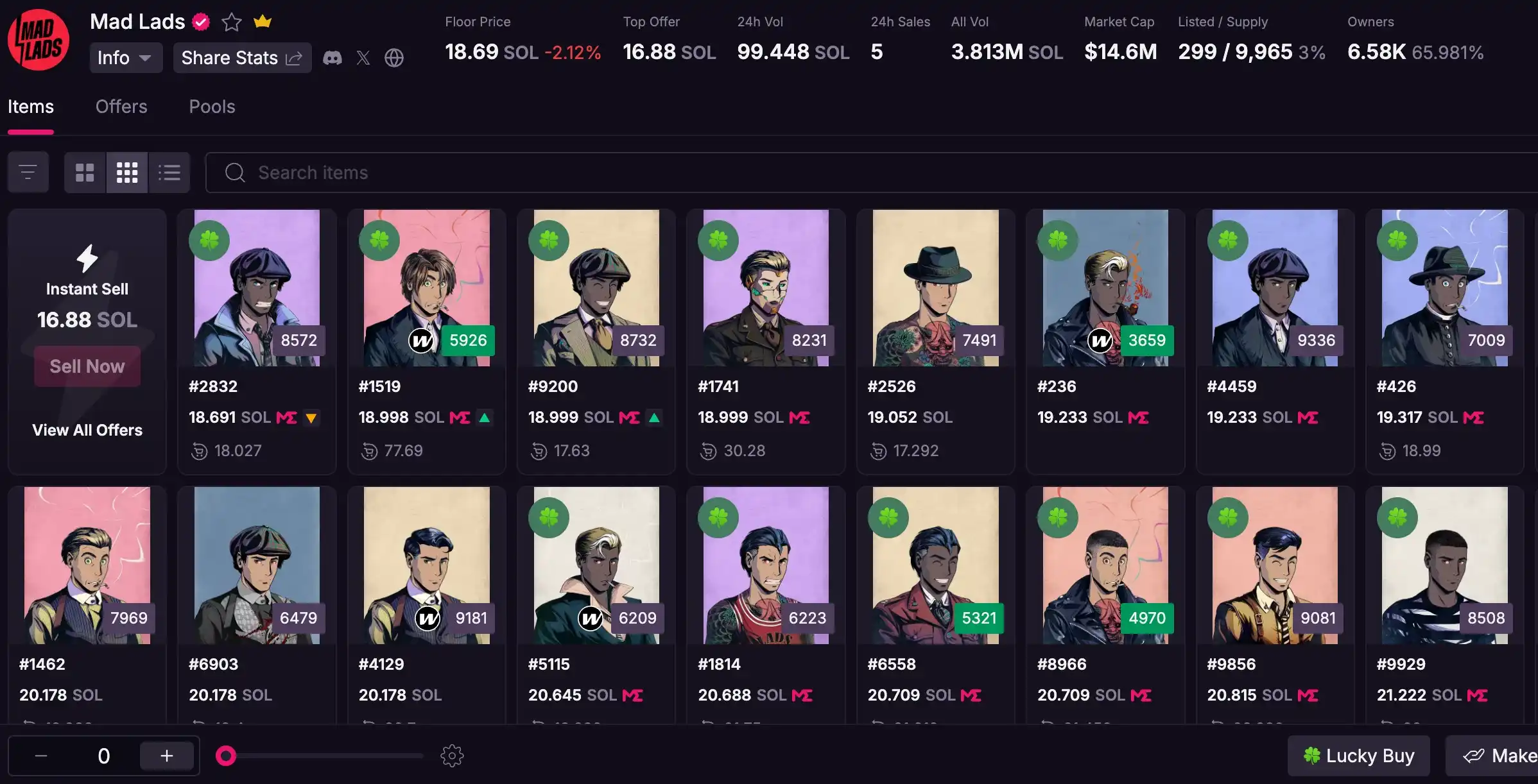
In April 2023, during the bear market trough, Backpack quietly launched the Mad Lads NFT series, with a minting price of 6.9 SOL. It quickly became one of the top NFT communities on Solana, with the floor price once reaching 229.4 SOL. Today, despite the overall decline of NFTs, the Mad Lads floor price remains at 18.8 SOL, more than double the original minting price.
In November of the same year, Backpack obtained a Dubai VARA license and launched Backpack Exchange, though it was only in a limited testing phase at the time. By then, it had accumulated user trust through its wallet and NFTs, leveraging the exchange to monetize traffic. In February 2024, Backpack completed a $17 million Series A funding round, valuing the company at $120 million. In January 2025, it acquired FTX Europe's assets for $32.7 million, obtaining a European MiFID II license, further strengthening its compliance foundation and committing to handle FTX EU customer claims.

Backpack was born with a silver spoon but rebuilt from the ruins. After nearly three years, Backpack has accumulated a trading volume of over $400 billion and user assets exceeding $350 million.

Now, it is poised for a greater leap.

Token Issuance Plan and Equity Linkage

On February 17, Backpack announced the start of identity verification before TGE, the first step for users to claim tokens.

According to Backpack's token economic model, the total token supply is 1 billion. The pre-IPO total supply is 625 million tokens (62.5%), released in three phases:

  • Phase 1 (TGE): Releases 25% of the total supply, or 250 million tokens. Of these, 240 million (24%) are allocated to points holders, and 10 million (1%) to Mad Lads holders. This phase is 100% allocated to users, with no internal team share.
  • Phase 2 (Pre-IPO): Accounts for 37.5%, or 375 million tokens, as "growth-triggered unlocks," released gradually based on key milestones (such as regulatory approvals, new product launches, and geographic expansion).
  • Phase 3 (Post-IPO): Also accounts for 37.5%, or 375 million tokens, deposited into company treasury, locked for one year after IPO, for the team and investors.

From its token distribution plan, we can already see that token issuance is closely tied to an IPO. Backpack is currently negotiating terms for a new $50 million funding round at a valuation of $1 billion. At this valuation, the 20% equity reserved is worth $200 million.

In the short history of the cryptocurrency industry, token issuance has quietly evolved from an optional financing tool to an almost "instinctive choice" and default path for nearly all projects. As users, we are familiar with this method, but Backpack's approach goes beyond what we know.

From an industry perspective, this model fills a gap. Coinbase successfully IPOed in 2021 but never issued a native token; DeFi projects like Uniswap issued governance tokens but did not pursue an equity listing. Backpack is attempting a "dual-track" system: tokens for community incentives and equity for long-term ownership, which is unprecedented in the crypto industry.

Is Token Issuance + IPO Feasible?

Although this plan is bold and innovative, it faces regulatory challenges.

Under U.S. regulatory context, most tokens could be considered securities by the SEC. If so, companies must comply with registration, disclosure, and anti-fraud rules. If an IPO is pursued in the future, the SEC will review the history of token issuance, structural design, and potential compliance violations.

More complex is the potential "ownership conflict" between equity and tokens: IPO investors worry about dilution of rights (such as voting rights and dividends), while token holders expect value capture, which could be seen as "dual financing" or misleading behavior. Especially during the Gensler era (2022-2024), enforcement tightened, and many projects abandoned IPOs altogether.

In short, token issuance takes the "decentralized/on-chain financing" fast lane, while an IPO takes the "centralized/compliant/equity financing" slow lane. Backpack is trying to drive both vehicles simultaneously, which requires极强的 structural design and regulatory communication skills. Otherwise, it could face delays in listing or regulatory fines.

While there is no complete precedent in the crypto industry, there are partial ones. Coinbase, also a centralized exchange, completed its IPO in 2021, but it had considered issuing a token. Backpack co-founder Can Sun revealed in a podcast two years ago that he participated in Coinbase's上市 work, helping design its token economic model. Although Coinbase ultimately chose a pure equity listing, this experience provided valuable reference for Backpack. At that time, he already planned to realize this unfulfilled ambition at Backpack.

Can It Change the Industry?

Today, the reality of the crypto industry is that many tokens lose over 80% of their value within a year of listing. "Peak at issuance" has almost become a curse. Backpack seems to be寻找 another path: giving tokens the possibility of converting to equity,推动 incentive methods to change.

In the past, the familiar model was "earn tokens with product," where projects first build a good product, and users earn token rewards through usage, such as fee sharing, liquidity mining, airdrops, etc. Token value comes from the product's actual performance. Backpack's approach更像 using token expectations to feed company valuation, i.e., equity binding, IPO narrative, using the expected value of tokens to quickly gather funds, community, and attention, thereby raising the company's valuation and accelerating financing and product iteration. Tokens are no longer just reward tools but valuation engines.

Of course, this transformation is full of uncertainty. How will regulators define it? How to balance rights between equity and tokens? Will the market really buy into the narrative of future shareholders? These questions have no ready answers. But in a pessimistic moment for the crypto industry, Backpack is at least trying to provide a new tension.

Backpack once rebuilt from the ruins; this time, it is building a bridge in the cracks of the system.


Criptomoedas em alta

Perguntas relacionadas

QWhat is the core mechanism of Backpack's staking-to-equity conversion plan?

AUsers who stake Backpack's native token for at least one year have the opportunity to convert these tokens into real company equity at a fixed ratio, with 20% of the company's equity reserved for this plan.

QHow did Backpack's development path differ from traditional centralized exchanges like Binance?

ABackpack started with a wallet and NFT ecosystem (e.g., Mad Lads NFT) to build user trust and community, then launched its exchange, whereas traditional exchanges like Binance typically prioritize trading services first before expanding into ecosystems.

QWhat are the three phases of Backpack's token economic model?

APhase 1 (TGE): 25% of total supply allocated to users; Phase 2 (Pre-IPO): 37.5% unlocked based on milestones like regulatory approvals; Phase 3 (Post-IPO): 37.5% reserved for team and investors, locked for one year after IPO.

QWhat regulatory challenges does Backpack face with its dual-token and equity model?

AThe SEC may classify the token as a security, requiring compliance with registration and disclosure rules. The dual structure could also create ownership conflicts between equity investors and token holders, potentially leading to regulatory scrutiny or delays in IPO.

QHow does Backpack's approach aim to change the typical 'peak at launch' token trend?

ABy linking token staking to real equity ownership and an IPO narrative, Backpack uses token expectations to boost company valuation, attract funding, and shift incentives from short-term rewards to long-term ownership, potentially breaking the cycle of post-launch token depreciation.

Leituras Relacionadas

Agent Race Ends, Super Workbench Takes Over

The era of fragmented AI agents is ending. Over the past month, China's tech giants—Tencent, Alibaba, and ByteDance—have simultaneously shifted strategy: instead of launching new, standalone AI agents, they are consolidating their various agent projects into unified "super workbenches." Tencent integrated its QClaw teams into WorkBuddy, a strategic product hailed as a potential third flagship after QQ and WeChat. Alibaba is merging its QoderWork, Wukong, and MuleRun agents into a new "Qianwen Office" platform under DingTalk's leadership. ByteDance rebranded its TRAE SOLO coding agent to TRAE Work, signaling a broader focus on workflow collaboration. This convergence marks a pivotal industry consensus. The initial exploration phase, where companies rapidly built numerous overlapping agents for different scenarios, proved costly and inefficient. With open-source tools eroding technical barriers, competition has shifted from agent creation to resource consolidation and cost control. Historically, platform wars are won not by creating more products, but by simplifying them—as seen with browsers unifying web access and super-apps consolidating services. Now, the "super workbench" aims to become the unified AI entry point for work. This reflects a deeper market realization: the primary audience for AI is no longer just programmers (a market in the tens of millions) but all knowledge workers (a market of billions). The real opportunity lies in augmenting everyday tasks—managing emails, documents, data, and meetings—across the entire workday. The core battleground is becoming control over the primary AI entry point that employees use daily. Tencent's WorkBuddy leverages WeChat and Tencent Docs; Alibaba's Qianwen Office taps into DingTalk's organizational data; ByteDance's TRAE Work integrates with Feishu's workflows. Whoever owns this "super workbench" gains strategic control over orchestrating enterprise data and APIs. This shift is redefining enterprise software. Traditional SaaS applications, valued for their user interfaces, will recede into the background. Their core functionalities will be exposed as standardized "Skills" or APIs for the super workbench's agents to invoke. Software value will shift from selling user seats to charging based on API calls and outcomes delivered. The evolution of agents is moving through clear stages: first as novel standalone products, then as consolidated primary work entry points, and finally as pervasive, invisible capabilities embedded into the digital fabric. The recent moves by major tech firms signal the transition from the first stage into the second, accelerating toward the third. In the end, the most successful agent technology may become invisible—like electricity or the HTTP protocol—a fundamental, unnamed infrastructure powering work itself.

marsbitHá 12m

Agent Race Ends, Super Workbench Takes Over

marsbitHá 12m

Michael Saylor: 110 Reasons to Oppose BIP-110

Michael Saylor presents 110 arguments against Bitcoin Improvement Proposal (BIP) 110, a soft fork aimed at restricting certain non-monetary data storage uses (like inscriptions) on the Bitcoin blockchain. He acknowledges the proponents' valid concerns—such as node costs, fee pressure, and preserving Bitcoin's monetary focus—but fundamentally disagrees with the proposed solution. Saylor argues that BIP 110 represents a dangerous precedent of using consensus rules to enforce value judgments on transaction validity, moving away from Bitcoin's core principles of neutrality and permissionless innovation. His key objections are organized into eleven categories: 1) It violates neutrality and hard consensus by banning currently valid transactions. 2) It fails to meet the high burden of proof required for a consensus change, lacking concrete data on the alleged crisis. 3) Its seven bundled technical restrictions are overly broad, targeting generic script functionalities and blocking future upgrade paths. 4) It sacrifices compatibility and future optionality by closing off designed upgrade hooks. 5) Its temporary rules add significant complexity (grandfathering, expiry states) without sufficient justification. 6) The economic and security impacts, particularly on miner revenue and fee markets, are uncertain and unmodeled. 7) Superior, market-based tools (fee markets, relay/mining policies) already exist to manage blockchain load. 8) It stifles innovation by creating a chilling effect for developers. 9) Its modified activation mechanism (55% threshold, forced signaling) is aggressive and risks network splits. 10) The precedent it sets—using consensus to suppress disliked but legal uses—is more dangerous than the problem it aims to solve. 11) A better path exists: improving measurements, refining resource-based policies, and allowing market forces to work. Saylor concludes that Bitcoin's strength lies in its neutral rules, open markets, and hard consensus. Changing these foundational elements to target specific use cases is an unnecessary and risky "iatrogenic" intervention. He advocates for guarding Bitcoin's neutrality rather than acting as its redeemer.

marsbitHá 27m

Michael Saylor: 110 Reasons to Oppose BIP-110

marsbitHá 27m

Trading

Spot

Artigos em Destaque

Como comprar F

Bem-vindo à HTX.com!Tornámos a compra de Synfutures (F) simples e conveniente.Segue o nosso guia passo a passo para iniciar a tua jornada no mundo das criptos.Passo 1: cria a tua conta HTXUtiliza o teu e-mail ou número de telefone para te inscreveres numa conta gratuita na HTX.Desfruta de um processo de inscrição sem complicações e desbloqueia todas as funcionalidades.Obter a minha contaPasso 2: vai para Comprar Cripto e escolhe o teu método de pagamentoCartão de crédito/débito: usa o teu visa ou mastercard para comprar Synfutures (F) instantaneamente.Saldo: usa os fundos da tua conta HTX para transacionar sem problemas.Terceiros: adicionamos métodos de pagamento populares, como Google Pay e Apple Pay, para aumentar a conveniência.P2P: transaciona diretamente com outros utilizadores na HTX.Mercado de balcão (OTC): oferecemos serviços personalizados e taxas de câmbio competitivas para os traders.Passo 3: armazena teu Synfutures (F)Depois de comprar o teu Synfutures (F), armazena-o na tua conta HTX.Alternativamente, podes enviá-lo para outro lugar através de transferência blockchain ou usá-lo para transacionar outras criptomoedas.Passo 4: transaciona Synfutures (F)Transaciona facilmente Synfutures (F) no mercado à vista da HTX.Acede simplesmente à tua conta, seleciona o teu par de trading, executa as tuas transações e monitoriza em tempo real.Oferecemos uma experiência de fácil utilização tanto para principiantes como para traders experientes.

287 Visualizações TotaisPublicado em {updateTime}Atualizado em 2026.06.02

Como comprar F

Discussões

Bem-vindo à Comunidade HTX. Aqui, pode manter-se informado sobre os mais recentes desenvolvimentos da plataforma e obter acesso a análises profissionais de mercado. As opiniões dos utilizadores sobre o preço de F (F) são apresentadas abaixo.

活动图片