How Did Cardano Token NIGHT Ignite Nearly $10 Billion in Daily Trading Volume?

比推Publicado em 2025-12-24Última atualização em 2025-12-24

Resumo

The Cardano-based privacy token NIGHT, associated with the Midnight sidechain, recently recorded nearly $10 billion in daily trading volume across major exchanges like Binance, OKX, and Bybit. Its price surged over 300% in less than two weeks after launch, reaching a fully diluted valuation of over $2.5 billion before settling around $0.08. Midnight, developed by Cardano’s parent company IOG, focuses on programmable data protection using zero-knowledge proofs (ZKPs) packaged into developer-friendly TypeScript APIs. It employs a dual-token model: NIGHT for governance and generating DUST, the utility token used for transaction and privacy fees. This design aims to meet regulatory requirements by separating governance from transactional assets. The token’s rapid growth is attributed to a massive airdrop campaign targeting 37 million addresses across multiple blockchains, alongside distribution partnerships with top exchanges. With Cardano planning major upgrades in 2025—including scaling solutions, Midnight’s mainnet launch, native stablecoin integration, and enhanced interoperability—NIGHT’s rise may signal renewed momentum for the ecosystem.

Author: Eric, Foresight News

Original Title: A Token with Nearly $10 Billion in Daily Trading Volume, Actually from Cardano?


Recently, a token named NIGHT, which was listed for spot or contract trading on Bitget, Binance, OKX, and Bybit earlier this month, saw its 24-hour global trading volume exceed $9 billion, approaching $10 billion. Bybit even surpassed Binance in 24-hour spot trading volume thanks to NIGHT.

NIGHT was officially launched on December 9. According to CoinGecko data, the token's price rose from around $0.025 to nearly $0.114 in less than two weeks, a increase of over 3 times. Its FDV once exceeded $2.5 billion, which would place it within the top 50 by market capitalization. At the time of writing, NIGHT price has retraced to around $0.08.
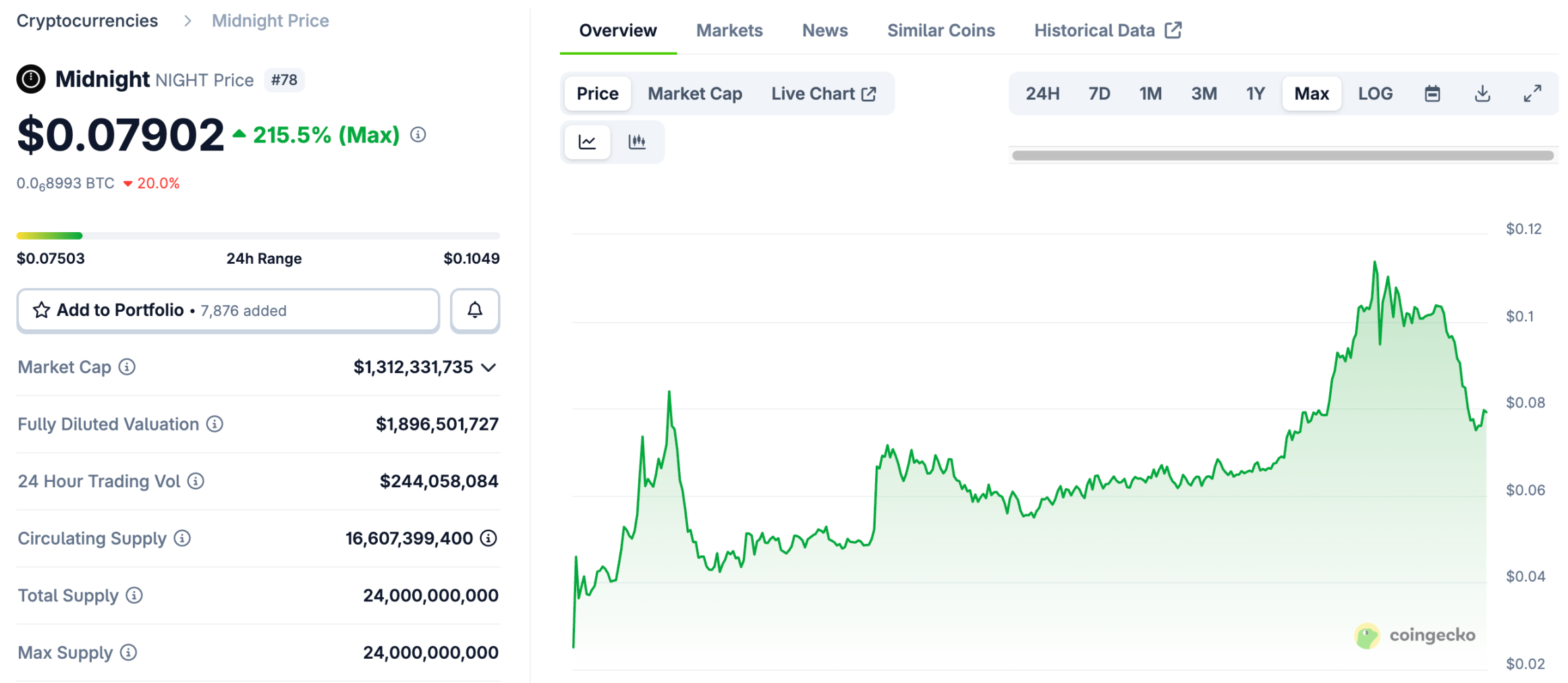
Such performance from a token listed on several major exchanges simultaneously is not entirely unexpected. However, the interesting part is that NIGHT is the token of Midnight, a privacy-focused sidechain of Cardano. The explosive power of a project bearing both the "Cardano" and "privacy" labels truly surprised most people.

What Makes Midnight "Valuable"?

Midnight is a sidechain developed by Input Output Global (IOG, the parent company of Cardano) with "programmable data protection" as its core selling point. It packages zero-knowledge proofs (ZKP) into a ready-to-use TypeScript API, allowing Web2 developers to implement "selective disclosure" on-chain without needing to learn cryptography. The entire network uses Cardano as its consensus layer and Halo2 as its ZK backend, employing a dual-token model (NIGHT+DUST). The goal is first to land the "data availability without visibility" that enterprises care about most, and then gradually expand to scenarios like DeFi, RWA, and on-chain compliant identity.

Overall, it doesn't seem particularly unique. It adopts ZKP privacy technology but doesn't natively protect privacy; instead, it makes privacy features optional to address practical needs.

IOG first publicly announced the plan to develop Midnight in November 2022, but the testnet wasn't launched until nearly two years later, in October 2024. This is indeed IOG's style—it took almost 5 years from announcing smart contracts for Cardano to actual implementation, which wasn't achieved until September 2021, long after the bull market had passed.

In May of this year, Midnight established a foundation, with Fahmi Syed, former CFO of Polkadot development team Parity, as chairman, signaling the first step towards TGE (Token Generation Event). Just two days after announcing the foundation's establishment, Cardano founder Charles Hoskinson revealed plans to airdrop tokens to 37 million addresses on 8 major blockchains, stating that the airdrop would target only retail users, with no VC participation in the project.

Perhaps what truly ignited market sentiment was Midnight's "massive airdrop." In addition to the airdrop, Midnight also distributed nearly 3 billion NIGHT tokens in collaboration with Binance, OKX, and Bybit. This large-scale approach, which contrasts sharply with the recent popular ICO models, garnered a positive market response.
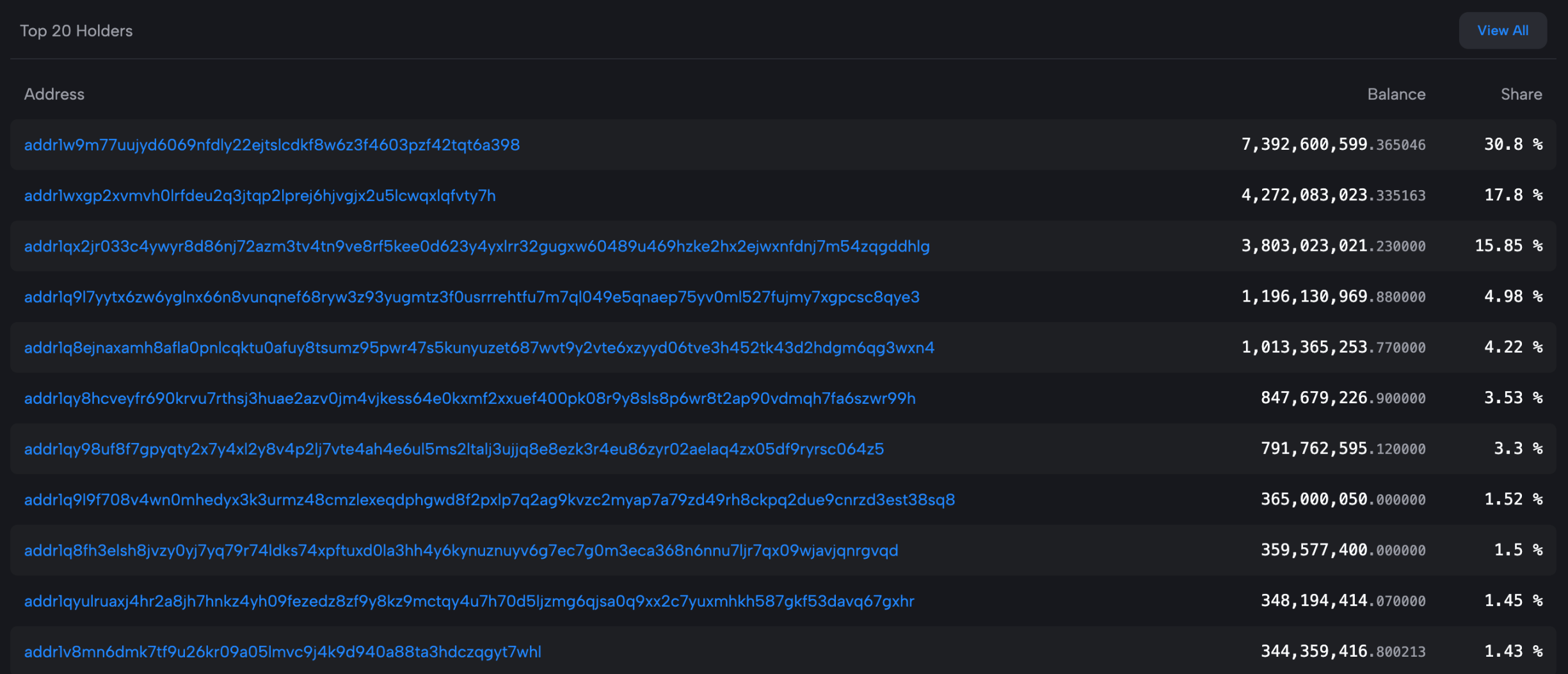
Looking at the block explorer, aside from the top three addresses which likely belong to IOG or the Midnight Foundation, the holdings of the remaining addresses are relatively decentralized. According to data provided on the official website, the author estimates that the airdrop itself, combined with exchange collaboration events, distributed nearly one-third of the total supply (24 billion tokens), which indeed qualifies as a massive effort.

Midnight's tokenomics feature not just NIGHT, but a "NIGHT+DUST" dual-token model. This rare design isn't based on some "whimsical idea" but rather aims to ensure regulatory compliance. NIGHT can be used for network governance, incentives, and generating the other token, DUST. NIGHT itself is not related to privacy and supports on-chain auditing.

DUST, generated by holding NIGHT, is used to pay for transaction fees, similar to Gas. Additionally, DUST will be used to pay for privacy fees—if one wants to add optional privacy features to on-chain transactions, they must pay DUST. DUST is automatically distributed to NIGHT holders' accounts with each block produced and "decays" over time to prevent malicious hoarding and network attacks.

Thus, Midnight's "equity" token, NIGHT, does not participate in paying on-chain transaction fees but exists solely as a governance token and a generator for the actual on-chain fuel, DUST. DUST itself, as a "renewable resource" generated by NIGHT and constantly decreasing over time, would be considered a resource rather than an asset from a regulatory perspective, potentially satisfying regulatory requirements in various jurisdictions.

Cardano to Heavily Invest in On-Chain Ecosystem Next Year

According to Cardano's roadmap, next year will be focused on comprehensively boosting on-chain activity.

First and foremost, Cardano will undergo a network upgrade to increase throughput to 1000-10,000 TPS through parallel block processing and a layered structure for vertical scaling, while maintaining security and decentralization. Following this will be the mainnet launch of the protagonist of this article, Midnight. Cardano believes Midnight's launch will bring more DeFi activity and TVL through its optional privacy features. Additionally, the Cardano Treasury will allocate funds to support the native issuance of major stablecoins like USDT and USDC on Cardano.

The last point, which the author finds most important, is Cardano's plan to focus on interoperability—not simple cross-chain functionality, but enabling users from other chains to interact directly with DApps on Cardano by paying gas fees on their source chain.

Last week, Cardano achieved atomic swaps between BTC and ADA through Fluid, not via cross-chain bridges, wrapped tokens, or centralized custody, but directly through underlying script-to-script transactions, which is somewhat facilitated by Cardano's own UTXO ledger model. Two days ago, interactions between Cardano stake pool operators and Solana's co-founder on X also confirmed this development direction.

Accompanying the strategic and product plans is capital investment. The Cardano Foundation plans to increase its marketing budget by 12% and "make an appearance" at events like TOKEN2049 and Consensus. Venture Hub will also invest 2 million ADA to support startups and ecosystem projects. Furthermore, the Cardano Foundation plans to inject tens of millions of ADA into on-chain DeFi to improve liquidity and attract institutional participation.

From this perspective, driving up the price of NIGHT might just be the appetizer Cardano is serving for a series of plans. Perhaps 2026 is really the year to keep an eye on this project, which launched its mainnet back in 2017 and has been almost forgotten by the mainstream Web3 market.


Twitter:https://twitter.com/BitpushNewsCN

Bitpush TG Discussion Group:https://t.me/BitPushCommunity

Bitpush TG Subscription: https://t.me/bitpush

Original link:https://www.bitpush.news/articles/7598128

Perguntas relacionadas

QWhat is NIGHT and which blockchain is it from?

ANIGHT is the native token of Midnight, a privacy-focused sidechain developed by Input Output Global (IOG), the parent company of Cardano.

QWhat was the 24-hour trading volume of NIGHT that sparked significant attention?

ANIGHT achieved a 24-hour trading volume of nearly $9 billion, approaching $10 billion, which was a major point of discussion.

QWhat is the core technological feature of the Midnight blockchain?

AMidnight's core feature is 'programmable data protection,' offering TypeScript APIs for zero-knowledge proofs (ZKPs) to enable 'selective disclosure' without requiring developers to learn cryptography.

QHow does Midnight's dual-token model (NIGHT and DUST) work and why was it designed this way?

ANIGHT is used for governance and generating DUST, while DUST acts as gas for transaction fees and privacy features. This design helps comply with regulatory requirements by separating the governance token from the transactional resource.

QWhat are some of Cardano's key plans for its ecosystem in the coming year as mentioned in the article?

ACardano plans to upgrade network throughput to 1000-10,000 TPS, launch the Midnight mainnet, support native issuance of stablecoins like USDT and USDC, focus on interoperability allowing users to interact with DApps using their native chain's gas tokens, and invest in marketing and liquidity.

Leituras Relacionadas

AI Trading Cools, South Korean Stocks Plunge 1.8%, Spot Gold Rises 1%, Bitcoin Dives

A sell-off in AI-related stocks, triggered by Broadcom's disappointing earnings forecast, sent shockwaves through global markets. South Korea's KOSPI led Asia's decline, plunging 1.8% as the risks from concentrated chip stock gains and surging leveraged investments came to the fore. The tech-heavy Nasdaq 100 futures fell 0.5% following Broadcom's 14% after-hours plunge, which signaled a slower-than-expected transition to AI clients. This pullback extended Wall Street's weakness, halting the S&P 500's nine-day rally amid hawkish Fed signals and renewed Middle East tensions. South Korean authorities convened an emergency meeting, pledging "immediate measures" against market volatility and warning of record-high stock margin debt. The adjustment rippled across assets: Bitcoin fell to around $64,000, its lowest since February, while safe-haven gold rose 1% on bargain hunting. Oil prices dipped on Middle East ceasefire news. Market analysts noted the sell-off was driven by profit-taking after massive gains, particularly in chip stocks like Samsung and SK Hynix, which now dominate the KOSPI. Wall Street banks are divided on Korea's outlook, with Goldman Sachs raising its target while Citigroup and others warn of overvaluation and a potential bubble. Bridgewater's Ray Dalio noted that great technological shifts often create bubbles. Meanwhile, Fed officials' hints at potential future rate hikes added to the cautious mood ahead of key U.S. jobs data.

华尔街日报Há 4m

AI Trading Cools, South Korean Stocks Plunge 1.8%, Spot Gold Rises 1%, Bitcoin Dives

华尔街日报Há 4m

Seeking Alpha's Hot Article: Why Might the U.S. Stock Market Crash in June?

In a recent Seeking Alpha article, financial professor and analyst Damir Tokic argues that the US stock market may be poised for a significant crash in June 2026. The core thesis centers on a "mega-bubble" in equities, particularly within the technology sector, which has driven the S&P 500 to near-record valuations, with a Shiller P/E ratio exceeding 40—a level comparable to the 2000 dot-com bubble. Tokic identifies two primary catalysts for a potential collapse. First, he points to unsustainable market exuberance fueled by what he terms the "Trump Stimulus"—massive AI capital expenditure by tech giants, which he believes is politically driven and cannot last. Second, and more urgently, he highlights the escalating Iran war as a critical threat. The ongoing closure of the Strait of Hormuz has created a severe global energy supply crunch. Strategic petroleum reserves are projected to hit critically low operational levels by June, potentially causing oil prices to spike above $200 per barrel and triggering a severe, supply-driven inflationary shock. This scenario, Tokic warns, would force the Federal Reserve's hand. Despite currently maintaining a dovish bias, the Fed would likely be compelled to officially pivot to a hawkish stance at its June FOMC meeting to combat soaring inflation and bond yields. He contends that such a shift—or even a failure to act, which would destroy Fed credibility—could be the trigger that punctures the market bubble. The resulting downturn, he concludes, could rival the bear markets of 2000 and 2008, advising investors to prepare for a major correction.

marsbitHá 27m

Seeking Alpha's Hot Article: Why Might the U.S. Stock Market Crash in June?

marsbitHá 27m

AI PC Battle: Bet on the Toll Booth, Not the Camp

**Title:** The AI PC Battle: Don't Bet on Sides, Bet on the Tollbooth **Summary:** The AI PC competition is moving beyond simple "x86 vs. Arm" narratives. The core investment thesis should focus on identifying which players can sustain margins, cash flow, and pricing power throughout the upgrade cycle, rather than backing a particular architecture. The opportunity is analyzed in three layers: 1. **The Advanced Foundry Tollbooth:** TSMC is positioned to collect "tolls" regardless of which chip designer wins, due to its dominant ~70% share in advanced semiconductor manufacturing, which is essential for high-end AI PC chips. 2. **Compute & Platform Spillover:** AMD represents an offensive in the x86 CPU+GPU space, while NVIDIA leverages its GPU and CUDA software stack dominance. Both benefit from the demand for increased local AI compute. 3. **Architecture Diffusion & Turnaround Plays:** ARM and Intel offer potential for significant upside (elasticity), but investments here require stricter discipline due to higher execution risks and competitive challenges. The industry is transitioning from concept to shipment validation. While short-term forecasts for AI PC adoption have been revised down slightly due to tariffs and procurement delays, the long-term trend towards AI becoming a standard PC feature remains intact. The key driver for upgrade cycles will be whether compelling enterprise applications (e.g., privacy-sensitive computing, low-latency inference) emerge beyond consumer-focused features like meeting summarization. Investment strategy should prioritize companies with platform-level advantages and recurring revenue streams. TSMC offers high certainty as the foundational tollbooth. AMD presents a strong offensive play within the established ecosystem. ARM and Intel are higher-risk, higher-potential-reward turnaround bets. The report cautions against chasing short-term hype and emphasizes a disciplined, long-term approach focused on buying ecosystem strength and cash-flow certainty after market enthusiasm subsides. **Key Risks:** Underwhelming AI PC applications slowing upgrade cycles; slow improvement in Windows on Arm compatibility; macro/tariff impacts on PC demand; potential advanced node supply-demand mismatches affecting TSMC; high overall AI sector valuations making stocks vulnerable to a risk-off shift in markets.

marsbitHá 41m

AI PC Battle: Bet on the Toll Booth, Not the Camp

marsbitHá 41m

Ten-Thousand-Word Analysis: From $10 to $290, MRVL Wins the Entire AI Era by 'Not Making GPUs'

Marvell Technology's stock price surged from under $10 in 2016 to a record $290 in June 2026, fueled not by making GPUs, but by dominating AI infrastructure connectivity. This analysis argues the market misvalues MRVL as merely a smaller Broadcom in custom AI chips, overlooking its true, unique position. Marvell's core strength lies in enabling high-speed data flow for AI clusters through three interconnected businesses. First, it holds a commanding ~70% market share in high-speed optical DSPs (essential for data center light modules), a deep-moat business with accelerating growth. Second, its custom AI chip design business serves hyperscalers like AWS, Microsoft, and Google, with a significant revenue pipeline despite lower margins. Third, stable cash flows come from Ethernet switch chips and enterprise storage controllers. Together, they form a full-stack "AI data movement" platform. CEO Matt Murphy's transformative leadership since 2016, involving strategic divestments, key acquisitions (like Inphi for optical DSPs), and securing long-term agreements with major cloud providers, repositioned the company. A pivotal $2 billion strategic investment from NVIDIA in 2026 underscored Marvell's critical role in the AI ecosystem, particularly through collaborations like NVLink Fusion. While Marvell faces risks—including client concentration (losing the Amazon Trainium3 design), lower-margin business mix, competitive threats, insider selling, and complex supply chains—its fundamentals remain strong. The optical interconnect moat is widening with the acquisition of Celestial AI (photonics fabric), and financial metrics show accelerating revenue growth and operating leverage. With a PEG ratio suggesting undervaluation relative to its growth, the thesis is that the market undervalues Marvell's monopolistic position in AI "plumbing" while overemphasizing its competitive custom chip segment. The story transcends investing, symbolizing how in any complex system—from the internet to AI—the value of "connection" ultimately surpasses that of individual "nodes."

marsbitHá 1h

Ten-Thousand-Word Analysis: From $10 to $290, MRVL Wins the Entire AI Era by 'Not Making GPUs'

marsbitHá 1h

Trading

Spot
Futuros

Artigos em Destaque

Como comprar ADA

Bem-vindo à HTX.com!Tornámos a compra de Cardano (ADA) simples e conveniente.Segue o nosso guia passo a passo para iniciar a tua jornada no mundo das criptos.Passo 1: cria a tua conta HTXUtiliza o teu e-mail ou número de telefone para te inscreveres numa conta gratuita na HTX.Desfruta de um processo de inscrição sem complicações e desbloqueia todas as funcionalidades.Obter a minha contaPasso 2: vai para Comprar Cripto e escolhe o teu método de pagamentoCartão de crédito/débito: usa o teu visa ou mastercard para comprar Cardano (ADA) instantaneamente.Saldo: usa os fundos da tua conta HTX para transacionar sem problemas.Terceiros: adicionamos métodos de pagamento populares, como Google Pay e Apple Pay, para aumentar a conveniência.P2P: transaciona diretamente com outros utilizadores na HTX.Mercado de balcão (OTC): oferecemos serviços personalizados e taxas de câmbio competitivas para os traders.Passo 3: armazena teu Cardano (ADA)Depois de comprar o teu Cardano (ADA), armazena-o na tua conta HTX.Alternativamente, podes enviá-lo para outro lugar através de transferência blockchain ou usá-lo para transacionar outras criptomoedas.Passo 4: transaciona Cardano (ADA)Transaciona facilmente Cardano (ADA) no mercado à vista da HTX.Acede simplesmente à tua conta, seleciona o teu par de trading, executa as tuas transações e monitoriza em tempo real.Oferecemos uma experiência de fácil utilização tanto para principiantes como para traders experientes.

1.2k Visualizações TotaisPublicado em {updateTime}Atualizado em 2026.06.02

Como comprar ADA

Discussões

Bem-vindo à Comunidade HTX. Aqui, pode manter-se informado sobre os mais recentes desenvolvimentos da plataforma e obter acesso a análises profissionais de mercado. As opiniões dos utilizadores sobre o preço de ADA (ADA) são apresentadas abaixo.

活动图片










