How AI-Forged Group Photos Became a New Gray Market Tool Targeting Changpeng Zhao?

比推Publicado em 2026-02-05Última atualização em 2026-02-05

Resumo

The founder of Binance, Changpeng Zhao (CZ), recently exposed a fake photo circulating on X platform that depicted him alongside a user claiming to be a "long-term supporter of BNB." CZ identified multiple inconsistencies in the image, including an unfamiliar blue-purple shirt, a non-existent event backdrop, and mismatched resolution between the figures, indicating digital manipulation. The original image was in fact a photoshopped version of a legitimate photo of CZ with Aster CEO Leonard. Notably, the account sharing the fake photo, which has over 863,000 followers, had already blocked CZ. On February 4, CZ publicly dissected the image’s flaws and pointed out that the account had an inconsistent history—initially posting non-crypto content before abruptly shifting to focus on BNB-related activities. He suggested this was not a simple prank but potentially a targeted influence operation. CZ confirmed he did not know the account holder and had previously blocked the user, a decision he now considers justified. He also addressed a fabricated "legal letter" that had been circulated and expressed concern that some media outlets had reported on obviously manipulated or AI-generated content without verification. He warned that failure to identify such forgeries could lead to significant consequences.

Author: Nicky, Foresight News

Original Title: Changpeng Zhao Targeted by Gray Market Operations


Binance founder Changpeng Zhao (CZ) recently encountered "trouble" again.

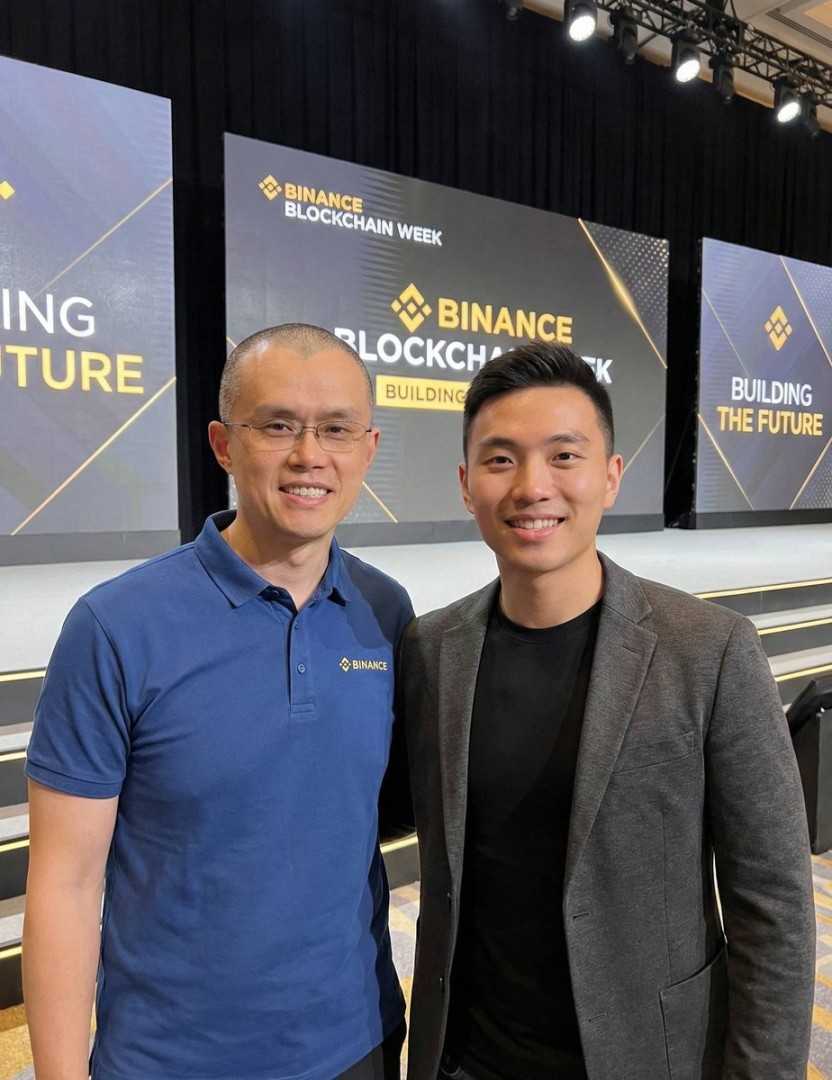
In a photo on the X platform, CZ stands in front of an event backdrop alongside a user who claims to be a "long-term supporter of BNB." However, CZ quickly noticed something unusual—he never owned that blue-purple shirt, the backdrop does not exist, and the resolution of the characters is inconsistent, clearly indicating splicing and editing. Additionally, another photoshopped image was originally a group photo of CZ and Aster CEO Leonard.

What’s even more intriguing is that this account, with 863,000 followers, had already blocked CZ.

On February 4, CZ publicly dissected the details of the image and pointed out that the account's historical trajectory shows obvious discontinuities: early content had almost nothing to do with cryptocurrency, but later shifted to focus on BNB activities, with an unnatural transition in identity. In his view, such long-standing accounts built on forged materials are not just pranks but more like premeditated image manipulation.

CZ stated that he does not know the account holder and does not remember when he blocked them, but it now seems like the right move. Regarding the previously circulated so-called "lawyer's letter," he initially thought the forgery was too obvious to require clarification, but he noticed some media outlets still reposted and reported on the images. He warned that if even obvious PS or AI-generated content cannot be discerned, one may ultimately pay the price for it.
Meanwhile, some bloggers in the Chinese community have also discovered that a large number of accounts in the English-speaking region, with names or nicknames containing Chinese characters and "


Original link:https://www.bitpush.news/articles/7609077

Perguntas relacionadas

QWhat was the main issue that Binance founder Changpeng Zhao (CZ) recently encountered on social media?

ACZ encountered a fake AI-generated photo of himself posing with a user claiming to be a long-term BNB supporter, which he identified as fraudulent due to inconsistencies like an unfamiliar shirt and non-existent background.

QHow did CZ identify the image as fake?

ACZ noted that he never owned the blue-purple shirt in the image, the background board did not exist, there were resolution inconsistencies between the subjects, and the image was clearly spliced from an original photo with Aster CEO Leonard.

QWhat suspicious behavior did CZ observe about the account that posted the fake image?

AThe account, which had 863,000 followers, had previously blocked CZ, and its content history showed a sudden shift from non-crypto-related posts to focusing on BNB activities without a logical transition.

QWhat did CZ warn about regarding such fake content?

ACZ warned that if people cannot distinguish obvious PS or AI-generated content, they may end up paying a price for it, emphasizing the risks of falling for manipulated imagery.

QWhat was the original title of the article discussing this incident?

AThe original title of the article was '被灰产盯上的赵长鹏', which translates to 'Changpeng Zhao Targeted by Gray Industry'.

Leituras Relacionadas

After the Passage of the GENIUS Act and the CLARITY Act, What Is the Correct Architecture for On-Chain Yield?

The article discusses the evolution of on-chain credit, distinguishing three markets: overcollateralized crypto lending, unsecured lending (largely unsuccessful), and asset-backed credit (ABC). ABC, backed by identifiable real-world collateral with legal recourse, is identified as the fastest-growing category and the only one credibly addressing adverse selection—the core problem in credit where the riskiest borrowers self-select. Current growth in on-chain Real World Assets (RWAs), particularly tokenized private credit funds (e.g., Maple Finance, Centrifuge), is substantial but often merely "wraps" existing fund structures, inheriting their risks rather than solving adverse selection at the protocol level. The regulatory landscape is a key driver, with the US GENIUS Act (prohibiting stablecoin issuers from paying yield) and the proposed CLARITY Act (closing loopholes on indirect yield) set to redefine permissible yield-bearing products. This makes vaults (like ERC-4626) the critical architecture—they become the primary compliant vehicle for delivering yield, functioning as issuance, disclosure, distribution, and recovery mechanisms. The author's thesis is that the correct post-GENIUS/CLARITY architecture involves building ABC solutions where credit assessment, structure, and recovery are encoded directly into the smart contract vault layer, moving beyond mere tokenized fund wrappers to solve adverse selection fundamentally and ensure regulatory compliance.

Foresight NewsHá 26m

After the Passage of the GENIUS Act and the CLARITY Act, What Is the Correct Architecture for On-Chain Yield?

Foresight NewsHá 26m

TechFlow Intelligence Bureau: Anthropic's New Model Fable Sparks Controversy by Restricting Biosafety Research, US CPI Soars to 4.2%, a Three-Year High

**Summary of TechFlow Intelligence Report:** The newsletter covers several key tech and finance developments. In AI, Anthropic's new Fable model faced backlash for secretly limiting biomedical research capabilities and enforcing a 30-day data retention policy, prompting the company to promise more transparent adjustments. In a related story, Anthropic's founder revealed his departure from OpenAI was due to dishonesty from Sam Altman, not safety concerns. Meanwhile, OpenAI is considering significant price cuts to compete with Anthropic, potentially sparking a price war. In crypto/Web3, BlackRock filed a new amendment for a yield-generating Bitcoin ETF, while Bank of America's CEO warned that stablecoin yields could drain trillions from traditional banks. U.S. Senator Cynthia Lummis advocated for the U.S. to officially accumulate Bitcoin reserves. In hardware, Nvidia released the DiffusionGemma-2-6B image model optimized for efficient inference, and AMD promoted its unified memory architecture to challenge Nvidia's dominance. TSMC's CFO hinted at possible price increases due to soaring AI chip demand. A major legal ruling in Germany held Google legally responsible for inaccurate information generated by its AI Overviews feature. Google Chrome also moved to fully block ad-blocker workarounds like uBlock Origin. Macroeconomic headlines included U.S. CPI rising to 4.2% (a 3-year high) and Iran's complete closure of the Strait of Hormuz, raising oil price and inflation fears. South Korean markets saw continued volatility with massive foreign capital outflow. Other notable stories: Microsoft expanded its Copilot AI assistant "Mico" globally; a study found r/wallstreetbets users' stock picks outperformed Wall Street; a fully autonomous drone killed a human soldier for the first time, raising AI ethics concerns; and a Chinese hospital used brain-computer interface technology to help a blind person "see." The overarching theme connects debates over AI boundaries and responsibility (Anthropic's restrictions, Google's liability, lethal autonomous drones) with real-world economic and geopolitical turmoil (inflation, Strait of Hormuz closure, market instability), highlighting the tense interplay between technological advancement and global chaos.

marsbitHá 39m

TechFlow Intelligence Bureau: Anthropic's New Model Fable Sparks Controversy by Restricting Biosafety Research, US CPI Soars to 4.2%, a Three-Year High

marsbitHá 39m

Alibaba's Yet Another New Business Division: What Signal Does It Send?

Alibaba has established a new "Token Foundry" business unit, merging its Tongyi large model division and Future Life Lab. Led directly by Group CEO Wu Yongming, this marks the company's third significant AI organizational reshuffle in 2026, following the creation of the Alibaba Token Hub (ATH) and a Group Technology Committee. The move signals a strategic shift from consolidating AI resources to accelerating productization and commercialization. The "Token Foundry" name reflects Alibaba's ambition to become a foundational supplier in the AI era, focusing on model development and commercial application. Key teams, including those behind the high-performing HappyHorse video generation model, have been integrated into the new unit. Concurrently, Zhou Jingren, architect of the Qwen model series, has been appointed Group Chief Scientist to lead a new AI Future Research Institute, focusing on long-term technological breakthroughs like Agent capabilities. This restructuring creates a clear four-layer AI architecture within Alibaba: the research institute for frontier exploration, Token Foundry for core models and commercialization, MaaS for platform services, and business units like Qianwen (C端) and Wukong (B端) for end-user applications. The adjustments align with a global trend among tech giants like Google and Microsoft to centralize AI leadership under the CEO and deeply integrate research with business units. The urgency is driven by a narrowing competitive window. Alibaba has announced its AI business is now entering a commercialization phase, with AI-related revenue seeing triple-digit growth for eleven consecutive quarters. The company faces intense competition in the MaaS (Model-as-a-Service) sector from rivals like ByteDance and Tencent. The Token Foundry initiative represents Alibaba's effort to streamline execution and enhance competitiveness in this critical, fast-evolving landscape.

marsbitHá 1h

Alibaba's Yet Another New Business Division: What Signal Does It Send?

marsbitHá 1h

From Return to Resignation: Chen Hang's 437 Days at DingTalk

The 437-Day Return and Departure of Chen Hang at DingTalk This article chronicles the 437-day period from March 31, 2025, to June 11, 2026, when Chen Hang (also known as "No Move") returned as CEO of DingTalk, the enterprise communication platform he originally founded, only to later step down. Chen Hang, the creator of DingTalk in 2015, was brought back by Alibaba in 2025 after the company acquired his subsequent startup, HHO. His return was driven by Alibaba's renewed focus on AI and DingTalk's strategic role as its key to-B AI application. However, his aggressive management style, marked by strict work policies like mandatory clock-ins and extended hours, quickly caused internal friction and was criticized as being at odds with Alibaba's culture. Despite the internal turmoil, Chen Hang drove significant product launches. In August 2025, he unveiled "AI DingTalk 1.0," featuring new products like the AI-native entry point "DingTalk ONE." By March 2026, he announced "Wukong," touted as the world's first enterprise-grade AI-native work platform, representing a fundamental rebuild of DingTalk's architecture. The turning point came in early June 2026. A detailed internal post criticizing DingTalk's work culture went viral, followed by a public critique from a former executive. This prompted an unprecedented public rebuke from the Alibaba Partners Committee, which stated such management was not aligned with company values. One day later, on June 11, Alibaba announced Chen Hang's departure. He was succeeded by Chen Yusen, a 32-year-old technical expert known for founding cybersecurity firm Changting Technology. While Chen Hang's tenure laid the technical foundation for DingTalk's AI transformation with "Wukong," his leadership style ultimately led to his replacement as the company seeks a new direction under younger leadership.

marsbitHá 1h

From Return to Resignation: Chen Hang's 437 Days at DingTalk

marsbitHá 1h

Trading

Spot
Futuros
活动图片




