How a single copy-paste mistake cost a user $50M in USDt

cointelegraphPublicado em 2025-12-20Última atualização em 2025-12-20

Resumo

A user lost nearly $50 million in USDt in an address poisoning scam after mistakenly copying a malicious look-alike address from their transaction history. The scam works by attackers sending small transactions to a victim's wallet using addresses that closely resemble those of the victim's trusted contacts. In this case, the victim first sent a small test transaction to the correct address but then copied a fraudulent, similar-looking address for the full $50 million transfer. Onchain investigators noted the addresses shared the same first three and last four characters, a subtle similarity that can deceive even experienced users. The stolen funds were subsequently swapped for Ether and partially laundered through Tornado Cash. This incident highlights how such attacks exploit human error rather than technical vulnerabilities. The loss occurred amid a broader surge in crypto hacks, which reached $3.4 billion in losses in 2025.

A single transaction error led to one of the largest onchain losses seen this year, after a user mistakenly sent nearly $50 million in USDt to a scam address in a classic address poisoning attack.

According to onchain investigator Web3 Antivirus, the victim lost 49,999,950 USDt (USDT) after copying a malicious wallet address from their transaction history.

Address poisoning scams rely on look-alike wallet addresses being inserted into a victim’s transaction history via small transfers. When victims later copy an address from their transaction history, they may unknowingly select the scammer’s lookalike address instead of the intended recipient.

Onchain data shows the victim initially sent a small test transaction to the correct address. Minutes later, however, the full $50 million transfer was sent to the poisoned address.
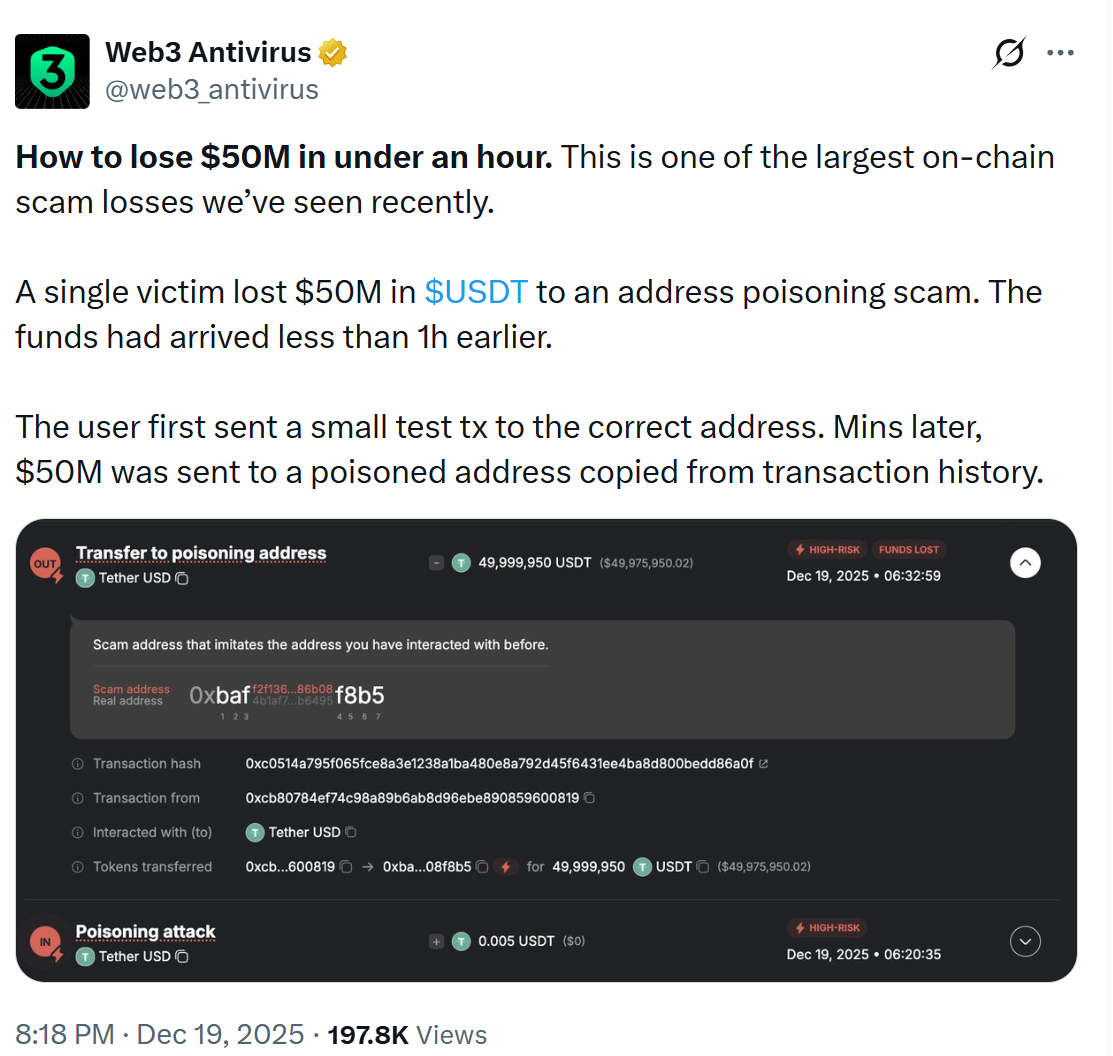
User falls victim to address poisoning scam. Source: Web3 Antivirus

Related: Attacker takes over multisig minutes after creation, drains up to $40M slowly

Subtle address similarity enough to fool experienced users

Security researcher Cos, founder of SlowMist, noted the similarity between the addresses was subtle but enough to deceive even experienced users. “You can see the first 3 characters and last 4 characters are the same,” he wrote.

The victim’s wallet had been active for roughly two years and was primarily used for USDt transfers, according to onchain analysis. Shortly before the loss, the funds were withdrawn from Binance, suggesting the wallet was being actively managed at the time of the incident.

“This is the brutal reality of address poisoning, an attack that doesn’t rely on breaking systems, but on exploiting human habits,” another onchain analyst wrote.

The attacker has since swapped the stolen USDt for Ether (ETH), splitting it into multiple wallets, and partially moved it into Tornado Cash.

Related: Binance denies reports of delayed action over funds linked to Upbit hack

Crypto hacks hit $3.4 billion in 2025

As Cointelegraph reported, crypto-related hacks resulted in $3.4 billion in losses in 2025, marking the highest annual total since 2022. The surge was largely driven by a handful of massive breaches targeting major crypto entities rather than a broad rise in average attack size.

Just three incidents accounted for 69% of total losses this year, led by the $1.4 billion hack of crypto exchange Bybit, which alone made up nearly half of all stolen funds.

Magazine: 2026 is the year of pragmatic privacy in crypto — Canton, Zcash and more

Perguntas relacionadas

QWhat is an address poisoning scam and how did it lead to a $50 million loss?

AAn address poisoning scam is a type of attack where a scammer sends a small transaction to a victim's wallet using a look-alike address. The victim, when later copying an address from their transaction history, may accidentally select the scammer's fraudulent address instead of the legitimate one. In this case, the user mistakenly sent $50 million in USDt to the poisoned address.

QWhat detail did the security researcher from SlowMist point out about the fraudulent address?

AThe security researcher, Cos from SlowMist, noted that the similarity between the legitimate and the fraudulent address was very subtle. He pointed out that the first 3 characters and the last 4 characters of the two addresses were identical, which was enough to deceive even experienced users.

QWhat did the attacker do with the stolen USDt funds after the scam was successful?

AAfter successfully stealing the USDt, the attacker swapped the funds for Ether (ETH). They then split the ETH into multiple wallets and partially moved it into the privacy-focused mixing service, Tornado Cash.

QHow much was lost to crypto hacks in 2025 according to the article, and what was a major contributing factor?

AAccording to the article, crypto-related hacks resulted in $3.4 billion in losses in 2025. The surge was largely driven by a handful of massive breaches targeting major crypto entities, with just three incidents accounting for 69% of the total losses.

QWhat preliminary step did the victim take before sending the full $50 million, and why was it ineffective in preventing the loss?

AThe victim initially sent a small test transaction to the correct address. However, this was ineffective because the scammer's look-alike address was already in their transaction history from a previous, small 'poisoning' transfer. When the victim went to copy the address for the large transfer, they mistakenly selected the fraudulent one.

Leituras Relacionadas

Huang Renxun Dramatically 'Saves' South Korean Stock Market

In early June, South Korea's stock market experienced a sharp decline, with the KOSPI index dropping over 5% and triggering a trading halt. Amid this volatility, NVIDIA CEO Jensen Huang's visit to Seoul provided a dramatic boost to market sentiment. During his trip, Huang held a dinner meeting with SK Group Chairman Chey Tae-won and SK Hynix CEO Kwak Noh-Jung. He announced that NVIDIA's new Vera CPU would utilize SK Hynix DRAM and confirmed a multi-year technical collaboration between the two companies. This partnership aims to co-develop next-generation memory for NVIDIA's AI infrastructure roadmap, covering products from data center supercomputers to personal AI devices. Huang also publicly commented that AI company stocks were attractively priced. A key announcement was that NVIDIA's upcoming Vera Rubin AI supercomputer systems will use HBM4 memory, with supply qualifications granted to all three major suppliers: SK Hynix, Samsung Electronics, and Micron Technology. Despite this multi-sourcing strategy, Huang warned that the industry-wide chip shortage, affecting everything from wafers to packaging, is expected to persist for several years due to relentless demand from global AI factory construction. The collaboration extends beyond memory supply. SK Hynix will employ NVIDIA's AI platforms and Omniverse digital twin technology to enhance its own semiconductor design, simulation, and manufacturing processes, aiming for more autonomous factory operations. This visit builds upon a prior October 2025 agreement for SK Group to build a large-scale AI data center using over 50,000 NVIDIA GPUs. Huang's itinerary also included meetings with other Korean giants like Hyundai, LG, and Samsung, indicating NVIDIA's broader strategy to deepen ties with South Korea's tech industry.

链捕手Há 3h

Huang Renxun Dramatically 'Saves' South Korean Stock Market

链捕手Há 3h

When Inference Becomes a Scarce Resource, Who Captures the Value?

When Inference Becomes the Scarce Resource, Who Captures the Value? The core AI bottleneck has shifted from model training to inference (runtime execution). While concerns persisted about an "AI compute gap"—initially a $200B, now a $600B problem—the market is now recognizing that the solution and value lie in the inference layer. Nvidia's financial restructuring around "serving tokens" and Cerebras's successful IPO highlight this shift. Inference is a recurring, usage-based cost, estimated to be 10-50x larger than the one-time training market, especially with the rise of agentic AI. The inference stack spans six layers: silicon (e.g., Nvidia), bare metal (e.g., CoreWeave), GPU rental/aggregation, deployment/optimization, model APIs, and end applications. Most companies operate in one layer. However, Hyperbolic uniquely spans three layers (GPU rental, deployment, and model APIs) without owning any hardware. It aggregates fragmented GPU supply from multiple cloud providers into a standardized pool, offering developers the cheapest available compute through intelligent routing. Its multi-cloud aggregation creates a data moat and a flywheel: more supply leads to better pricing data and liquidity, attracting more developers and providers. In contrast, applications like Venice operate at the top of the stack, reselling privacy-wrapped inference but remaining dependent on and constrained by the underlying compute costs they purchase. As inference demand explodes, value accrues not just to consumer applications but increasingly to the aggregation and routing layer that captures their cost of revenue. The coming potential GPU oversupply reinforces this dynamic. While hardware owners may suffer from depreciation, asset-light aggregators like Hyperbolic benefit from price arbitrage, routing workloads to the cheapest available capacity. The ultimate winner in the inference economy may not be the entity with the most GPUs, but the one that can most efficiently discover, aggregate, and route the world's fragmented compute.

链捕手Há 3h

When Inference Becomes a Scarce Resource, Who Captures the Value?

链捕手Há 3h

Trading

Spot
Futuros

Artigos em Destaque

Como comprar BILL

Bem-vindo à HTX.com!Tornámos a compra de Billions Network (BILL) simples e conveniente.Segue o nosso guia passo a passo para iniciar a tua jornada no mundo das criptos.Passo 1: cria a tua conta HTXUtiliza o teu e-mail ou número de telefone para te inscreveres numa conta gratuita na HTX.Desfruta de um processo de inscrição sem complicações e desbloqueia todas as funcionalidades.Obter a minha contaPasso 2: vai para Comprar Cripto e escolhe o teu método de pagamentoCartão de crédito/débito: usa o teu visa ou mastercard para comprar Billions Network (BILL) instantaneamente.Saldo: usa os fundos da tua conta HTX para transacionar sem problemas.Terceiros: adicionamos métodos de pagamento populares, como Google Pay e Apple Pay, para aumentar a conveniência.P2P: transaciona diretamente com outros utilizadores na HTX.Mercado de balcão (OTC): oferecemos serviços personalizados e taxas de câmbio competitivas para os traders.Passo 3: armazena teu Billions Network (BILL)Depois de comprar o teu Billions Network (BILL), armazena-o na tua conta HTX.Alternativamente, podes enviá-lo para outro lugar através de transferência blockchain ou usá-lo para transacionar outras criptomoedas.Passo 4: transaciona Billions Network (BILL)Transaciona facilmente Billions Network (BILL) no mercado à vista da HTX.Acede simplesmente à tua conta, seleciona o teu par de trading, executa as tuas transações e monitoriza em tempo real.Oferecemos uma experiência de fácil utilização tanto para principiantes como para traders experientes.

247 Visualizações TotaisPublicado em {updateTime}Atualizado em 2026.06.02

Como comprar BILL

O que é ATWO

I. Introdução ao ProjetoArena Two é uma plataforma interativa descentralizada que permite aos fãs desempenhar um papel ativo e tokenizado nos resultados de eventos em tempo real. Ao contrário dos modelos tradicionais de transmissão que reduzem os fãs a espectadores passivos, a Arena Two utiliza a tecnologia blockchain para permitir que os fãs votem diretamente em tempo real e influenciem os resultados em campo.II. Informação sobre o TokenNome do token: ATWO(Arena Two)III. Links RelacionadosWebsite:https://arenatwo.com/Exploradores:https://basescan.org/token/0x499D35eBE6cEe9B2Ac35Fd003fcBbeeB9CFc7B32Twitter:https://x.com/arenatwoXNota: A introdução ao projeto provém dos materiais publicados ou fornecidos pela equipa oficial do projeto, que é apenas para referência e não constitui aconselhamento de investimento. A HTX não se responsabiliza por quaisquer perdas diretas ou indiretas resultantes.

218 Visualizações TotaisPublicado em {updateTime}Atualizado em 2026.06.02

O que é ATWO

Como comprar ATWO

Bem-vindo à HTX.com!Tornámos a compra de Arena Two (ATWO) simples e conveniente.Segue o nosso guia passo a passo para iniciar a tua jornada no mundo das criptos.Passo 1: cria a tua conta HTXUtiliza o teu e-mail ou número de telefone para te inscreveres numa conta gratuita na HTX.Desfruta de um processo de inscrição sem complicações e desbloqueia todas as funcionalidades.Obter a minha contaPasso 2: vai para Comprar Cripto e escolhe o teu método de pagamentoCartão de crédito/débito: usa o teu visa ou mastercard para comprar Arena Two (ATWO) instantaneamente.Saldo: usa os fundos da tua conta HTX para transacionar sem problemas.Terceiros: adicionamos métodos de pagamento populares, como Google Pay e Apple Pay, para aumentar a conveniência.P2P: transaciona diretamente com outros utilizadores na HTX.Mercado de balcão (OTC): oferecemos serviços personalizados e taxas de câmbio competitivas para os traders.Passo 3: armazena teu Arena Two (ATWO)Depois de comprar o teu Arena Two (ATWO), armazena-o na tua conta HTX.Alternativamente, podes enviá-lo para outro lugar através de transferência blockchain ou usá-lo para transacionar outras criptomoedas.Passo 4: transaciona Arena Two (ATWO)Transaciona facilmente Arena Two (ATWO) no mercado à vista da HTX.Acede simplesmente à tua conta, seleciona o teu par de trading, executa as tuas transações e monitoriza em tempo real.Oferecemos uma experiência de fácil utilização tanto para principiantes como para traders experientes.

130 Visualizações TotaisPublicado em {updateTime}Atualizado em 2026.06.02

Como comprar ATWO

Discussões

Bem-vindo à Comunidade HTX. Aqui, pode manter-se informado sobre os mais recentes desenvolvimentos da plataforma e obter acesso a análises profissionais de mercado. As opiniões dos utilizadores sobre o preço de A (A) são apresentadas abaixo.

活动图片