Hot Perp DEX Recent Updates: Find the Best Way to Participate

Odaily星球日报Publicado em 2025-12-18Última atualização em 2025-12-18

Resumo

Despite a generally cool market, Perp DEX platforms remain highly active due to airdrop incentives and stable trading volumes. Here are key updates from three popular Perp DEXs: **StandX** launched its mainnet trading points program, with daily volume exceeding $100 million. Users earn points by depositing DUSD, providing liquidity, trading, or inviting friends. A trading competition is planned, along with more trading pairs. **Aster**, currently leading in daily trading volume among Perp DEXs, continues its monthly airdrop campaigns. Phase 4 is ongoing until Dec 22, and Phase 5 will run from Dec 22 to Feb 1, 2026, distributing 1.2% of total supply. Aster has also increased its daily buyback and burn rate to ~$4 million and launched a human vs. AI trading competition. **Lighter** has been added to Coinbase's listing roadmap, but its TGE may be delayed until late December or early January. Its points system for traders remains opaque ("a blind box"), considering factors like volume and PnL. The team emphasizes a long-term approach to token value rather than a pump at launch.

Original | Odaily Planet Daily (@OdailyChina)

Author | Asher (@Asher_ 0210)
Although the overall market has been relatively cold recently, driven by incentives such as token airdrops, the community discussion around the Perp DEX sector remains highly active, and daily trading volume has remained stable without significant decline. Next, Odaily Planet Daily will summarize the recent key updates from 3 highly discussed Perp DEX platforms to see what offers the best value at this stage.

StandX: Trading Points Activity Now Live on Mainnet, Trading Competition Coming Soon

On December 10, StandX announced on platform X that the trading points activity is now live on the mainnet, with the first day's trading volume exceeding $81 million, and reaching over $100 million on December 16. Users can earn points by depositing DUSD into the Perps Wallet, Vaults, or actively participating in trading (Interaction link: https://standx.com/).

This event is in cooperation with Binance Wallet. Users using Binance Wallet's keyless extension wallet will receive a 10% points bonus, which lasts for 4 weeks until January 7, 2026. Points will be retroactively awarded for all past transactions since the mainnet launch.

Furthermore, core team member Justin participated in a Chinese AMA in early December. Odaily Planet Daily summarizes the key points below:

Q1: Is there a depegging risk for the built-in stablecoin (DUSD)? How secure is it?

A1: The DUSD mechanism is secure and fully collateralized, with underlying assets like BTC and ETH; it uses a "spot long + perpetual short" basis trading strategy to maintain "market neutrality." This means the total asset value remains stable in U terms regardless of price fluctuations, only earning funding rates without bearing the risk of price volatility.

Q2: What's the difference between the Mainnet and the previous Alpha testnet?

A2: The Alpha phase used test coins, primarily for testing product features and distributing "testnet points"; the Mainnet phase uses real funds, requiring users to deposit actual USDT for trading. The current points are "mainnet points," whose value and weight differ from the testnet.

Q3: What are the project's future plans?

A3: StandX is about to launch a trading competition and plans to list more altcoin perpetual pairs. Simultaneously, the team will continue optimizing the product experience, aiming for a CEX-like (centralized Exchange) experience on the DEX.

Q4: What is the proportion of trading points vs. deposit points for the airdrop?

A4: This hasn't been finalized yet because we are currently separating points from each phase and each type, meaning rewards are earned separately. We will comprehensively evaluate the contribution of each user type and point type to the overall StandX product and ecosystem before the airdrop to decide the reward proportions.

Complete Guide to Earning StandX Points

Method 1: Deposit DUSD to get tDUSD (1.2x points), specific steps:

  • Mint DUSD with USDT/USDC;
  • Deposit DUSD into the Perps wallet to convert it to tDUSD;
  • Every 1000 tDUSD / day = 1200 points;
  • Lossless participation, suitable for newcomers and users who don't trade.

Method 2: Provide LP, points rules:

  • DUSD: Each DUSD earns 1 point per day;
  • USDT/USDC: Each USDT/USDC earns 1.2 points per day.

For example, 1000 DUSD + 1000 USDT → 2200 points/day.

Method 3: SWAP trading to earn points (specified trading pairs), every 100 DUSD trading volume = 5 points.

This method has significant slippage; "point farmers" should participate cautiously.

Method 4: Invite friends, both parties get an additional 5% points bonus.

Method 5: Trade on the StandX mainnet to earn points.

  • If profitable: More profit means more tDUSD, leading to higher points;
  • If loss: If the loss exceeds 50% of the initial capital, points are still given based on 50% of the initial capital.

Additionally, the daily trading check-in event is worth participating in. Complete two trades over $100 daily to earn 10 points.

The StandX trade-to-earn points for token airdrop is still in its early stages. Judging by the daily trading volume, it's not "very competitive" currently, making it relatively easy to earn points. It's worth participating in; even if you don't farm trading volume for points, you can deposit stablecoins to "freeload" points daily.

Aster: Monthly Airdrops + Regular Buyback & Burn; Launches Human vs. AI Trading Duel

According to the latest data from DeFiLlama, Aster's daily trading volume has recently surpassed that of Lighter (which has the highest token launch expectations), ranking first among Perp DEX projects.

Perp DEX Data

Although Aster has completed its TGE, its airdrop activities continue to progress, operating on a monthly cycle with short interaction periods and clear rewards.

Phase 4 Token Airdrop Ongoing

Currently, Phase 4 Aster Harvest officially started at 8:00 AM UTC on November 10 and will last until 7:59 AM UTC on December 22, 2025. This phase will distribute 1.5% of the total ASTER token supply, allocated equally across six epoch cycles, with 0.25% allocated per epoch.

Phase 5 Token Airdrop Starts December 22, Lasts 6 Weeks

Phase 5 Aster Crystal will begin after Phase 4 Aster Harvest concludes. Specific details are as follows:

  • Duration: 6 weeks (December 22, 2025, to February 1, 2026);
  • Allocation: 1.2% of the total supply (approx. 96 million ASTER) for Phase 5, with 0.6% claimable immediately after the event ends and the other 0.6% subject to a 3-month lock-up.

Additionally, Aster will launch the Aster chain testnet by the end of this year, the mainnet in Q1 next year, and token staking and governance functions in Q2.

Accelerates Phase 4 Buyback Execution, Daily Buyback Scale Increased to ~$4 Million

According to the latest announcement from the ASTER team, the buyback speed for Phase 4 will be increased under the existing mechanism. The accelerated buyback scale increased from approximately $3 million/day to about $4 million/day starting December 8.

The official statement said this move allows faster on-chain deployment of the fees accumulated since November 10 for Phase 4 buybacks and strengthens support during market volatility. Based on current fee levels, it's estimated that stable execution of the buyback will be reached within 8 to 10 days, after which the daily buyback scale will continue to be maintained between 60% and 90% of the previous day's revenue as per Phase 4 rules.

The team emphasized that all operations remain transparently executed on-chain, with no changes to the relevant execution wallet address (Address link: https://bscscan.com/address/0x573ca9ff6b7f164dff513077850d5cd796006ff4).

Additionally, Aster burned 77.86 million ASTER repurchased in Season 3 on December 5, worth nearly $80 million.
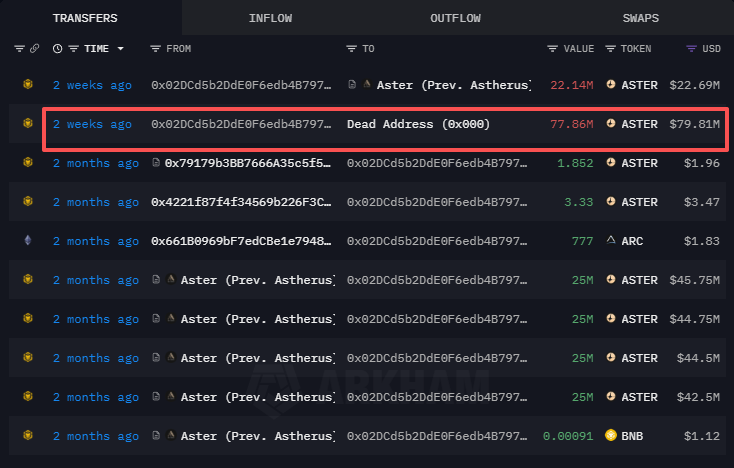
Aster Buyback Address

Launches Human vs. AI Trading Duel

On December 9, Aster announced on platform X that the Human vs. AI trading duel is live. 70 funded human traders are competing against 30 AI agents run by @nofA_ai (initial capital $10,000 each). The trading duel runs from December 9 to December 23.

As of now, only 29 out of the 100 traders (human and AI) are profitable. Among them, only 9 have profits exceeding $5,000—8 are human traders, and 1 is AI. The top performer is human trader Tippy, with profits as high as $47,000, far ahead.
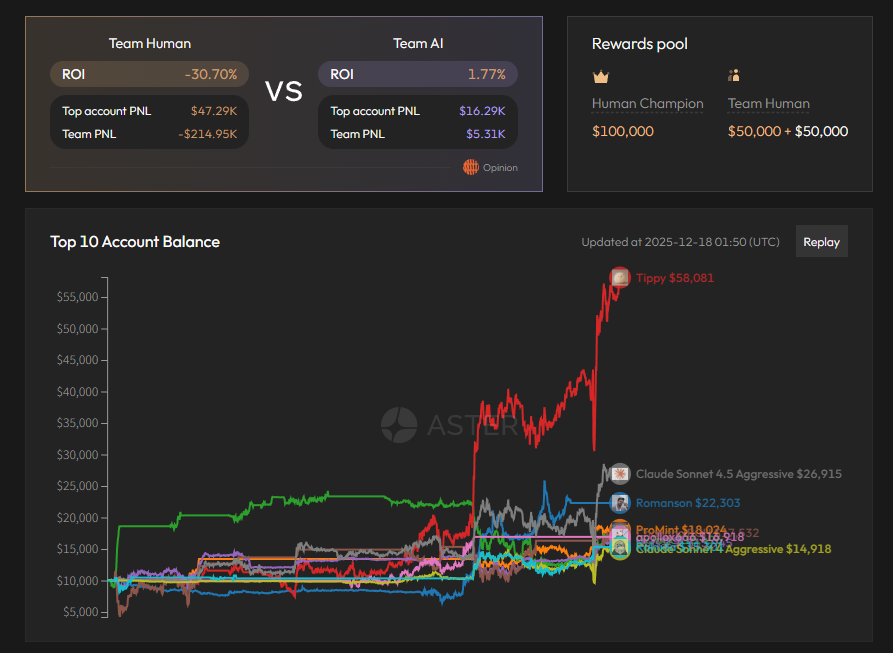
Human vs. AI Trading Profit Chart

Lighter: To List on Coinbase, but TGE Might Be Delayed

Since Lighter announced the completion of a $68 million funding round on November 11, valuing the company at $1.5 billion post-funding, its daily trading volume has consistently remained at the forefront of Perp DEXs, often ranking first. Regarding Q2 points, the official distribution is scheduled for every Friday. Market makers are allocated 50,000 points weekly (only advanced accounts are eligible to earn points through market making). Regular trading users are allocated 200,000 points weekly. Factors influencing points include: trading volume, open interest, account equity, leverage, profit/loss amount, and trading categories, but the specific weights have not been disclosed, making it a "blind box."

On December 13, Coinbase Markets announced on platform X that Lighter had been added to its listing roadmap, leading community members to believe Lighter's TGE is imminent.
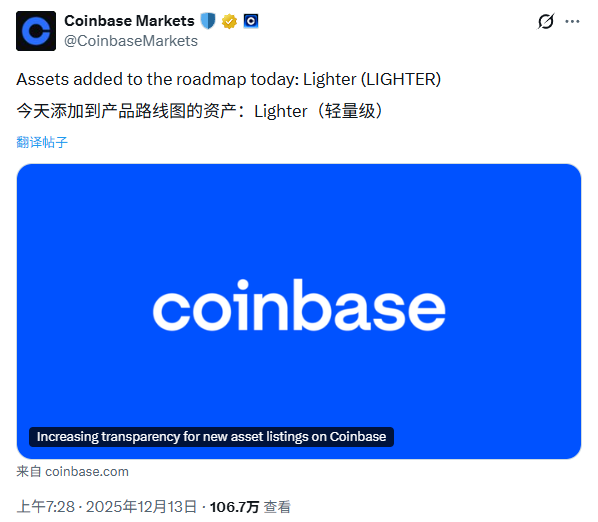
Coinbase Adds Lighter to Listing Roadmap

However, based on feedback from participants in Lighter's Japanese AMA, the TGE might be delayed to between December 24 and January 1 next year. Influenced by this news, the probability of "No" in the Polymarket event "Will Lighter airdrop tokens this year?" increased from just 8% on December 16 to 33%.
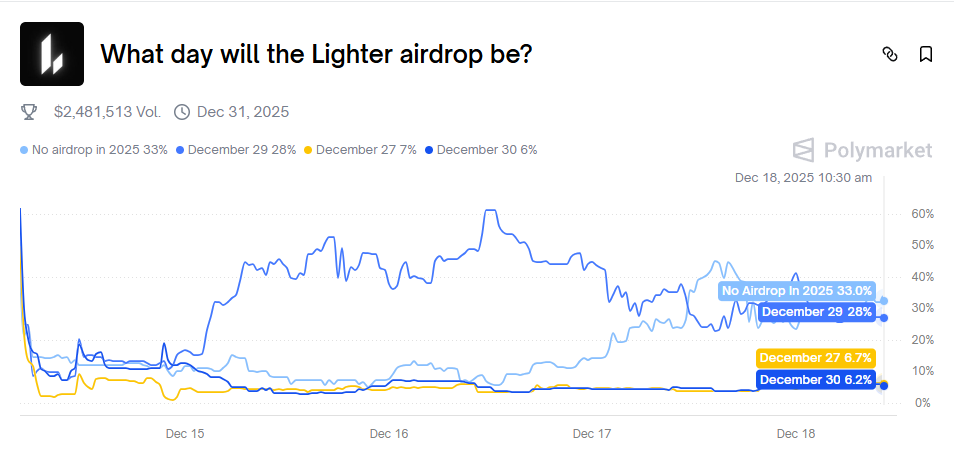
Polymarket Event: "Will Lighter Airdrop Tokens This Year?"

Furthermore, in a recent podcast interview on The Chopping Block, Lighter founder and CEO Vladimir Novakovski, when asked about the token, stated: "From an expectation management perspective, this is a marathon, not a sprint. The team and early community don't really anticipate a 'day one moonshot.' A more realistic expectation is starting from a relatively healthy position, with the overall trend gradually improving as we continue building the product. Our goal is clearly not to maximize value on day one, but to have it in a healthy state in the current market environment, and then iterate from there. We've seen too many tokens pump hard on day one and then trend downwards."

Related Content

2025 Airdrop Farming Survival Rules: Past Gold Rushes, Now Relying on These Two Trump Cards

Criptomoedas em alta

Perguntas relacionadas

QWhat are the main ways to earn points on StandX and which method is recommended for new users?

AThe main ways to earn points on StandX are: 1) Depositing DUSD to get tDUSD (1.2x points), 2) Providing liquidity (LP), 3) SWAP trading on specified pairs, 4) Inviting friends for a 5% bonus, and 5) Trading on the mainnet. The method recommended for new users or those who don't want to trade is depositing stablecoins to 'farm' points with minimal risk.

QWhat is the current status of Aster's token airdrop and what are the key details of its upcoming Phase 5?

AAster's Phase 4 airdrop (Aster Harvest) is currently ongoing until December 22, 2025, distributing 1.5% of the total ASTER supply. Phase 5 (Aster Crystal) will begin on December 22, 2025, and last for 6 weeks until February 1, 2026. It will distribute 1.2% of the total supply (approx. 96 million ASTER), with half (0.6%) claimable immediately and the other half (0.6%) subject to a 3-month lockup.

QHow has Aster modified its token buyback mechanism in Stage 4 and what was the recent major burn event?

AAster has accelerated its Stage 4 buyback, increasing the daily buyback volume from approximately $3 million to about $4 million starting December 8th. This is executed transparently on-chain. Additionally, Aster recently burned 77.86 million ASTER tokens from the S3 season回购, valued at nearly $80 million.

QWhat was the outcome of the 'Human vs. AI Trading Duel' event hosted on Aster, and who was the top performer?

AIn the Human vs. AI Trading Duel on Aster, 70 human traders competed against 30 AI agents. As of the report, only 29 of the 100 participants were profitable. The top performer was a human trader named 'Tippy', who achieved a profit of $47,000. Only 9 traders had profits exceeding $5,000, 8 of whom were human and 1 was an AI.

QWhat is the current expectation for Lighter's TGE (Token Generation Event) according to community speculation, and what evidence suggests a potential delay?

ACommunity speculation, based on a Japanese AMA, suggests Lighter's TGE might be delayed to between December 24th and January 1st. This is further supported by the probability of 'No' on the Polymarket prediction market for 'Will Lighter airdrop its token this year?' rising from 8% to 33%.

Leituras Relacionadas

Optical Chips: Collective Capacity Expansion

The global optical chip industry is experiencing a massive wave of expansion driven by surging AI data center demand. Major players across the US, Japan, Europe, and China are aggressively investing to ramp up production capacity. In the US, Coherent is expanding its 6-inch Indium Phosphide (InP) semiconductor fab in Texas, supported by CHIPS Act funding and a $2 billion strategic investment from NVIDIA. Lumentum is building a new factory for InP optical devices, and Nokia is scaling its advanced photonic chip packaging and testing capabilities. NVIDIA's investments aim to secure future supply of critical lasers and optical interconnect products for AI infrastructure. Japan's JX Advanced Metals, a leading InP substrate supplier, plans a multi-billion yen investment to increase its capacity 7-10 times, strengthening its grip on the crucial upstream materials market. In Europe, IQE and Tower Semiconductor settled a patent dispute and signed a multi-year InP epitaxial wafer supply agreement, highlighting that next-generation silicon photonics platforms will integrate high-performance InP components. STMicroelectronics and Sivers Semiconductors are also expanding silicon photonics production and partnerships. China is rapidly building out its domestic supply chain. Dongshan Precision's subsidiary, Source Photonics, announced a $12 billion project to expand optical chip and module production. Companies like Sanan Optoelectronics and Yunnan Germanium are scaling up InP chip manufacturing and substrate production, moving towards vertical integration from materials to modules. While debate continues around the exact future architecture—whether CPO (Co-Packaged Optics), NPO, or pluggables will dominate—analysts like Morgan Stanley argue the underlying driver is unchangeable: the explosive growth in bandwidth demand. This will inevitably increase the volume of optical engines, lasers, and related content per GPU, regardless of the final technical path. The competition for "more light" in the AI era has intensified into a global, full-chain capacity race.

marsbitHá 42m

Optical Chips: Collective Capacity Expansion

marsbitHá 42m

Stablecoins Finally Find Real Yield: An In-Depth Look at On-Chain Reinsurance Re | A Conversation with Re Founder Karan Saroya

Stablecoin Real Yield Found: A Deep Dive into On-Chain Reinsurance with Re's Karan Saroya As stablecoin supply exceeds $170 billion, the search for sustainable, non-speculative yield intensifies. Re, an on-chain reinsurance platform, provides an answer: connecting stablecoin capital to the trillion-dollar traditional reinsurance market. Re operates as a regulated reinsurer, accepting stablecoin deposits as collateral to back US insurance companies. These insurers pay premiums, generating yield that flows back to on-chain depositors. Currently supporting 35 insurers and underwriting $500 million, Re projects scaling to over $1 billion soon. Key insights from a Bankless podcast with founder Karan Saroya and investor Avichal of Electric Capital: 1. **Uncorrelated, Real-World Yield:** Re offers stablecoin holders access to reinsurance returns (targeting 12-14%+), an asset class entirely separate from crypto or equity markets. 2. **Operational Efficiency via Smart Contracts:** Re replaces traditional, labor-intensive capital fundraising with smart contracts, allowing a ~12-person team to compete with industry giants. 3. **Regulatory Leverage:** For every $1 of collateral, regulations allow backing $5-7 in written premiums. This leverage amplifies returns from the underlying risk-free rate. 4. **DeFi Integration:** Depositors receive receipt tokens, which can be used in protocols like Morpho for "looping," potentially pushing yields to 18-20%+. 5. **The "DeFi Mullet" Model:** A compliant front-end (regulated reinsurer) paired with a decentralized back-end (smart contracts, DeFi capital markets). 6. **RE Governance Token:** Modeled on Lloyd's of London, the token governs the central capital pool's allocation, counterparty acceptance, and parameters. 7. **Real Economic Impact:** Capital funds real-world productivity (factories, clinics, businesses) via insurance, moving beyond crypto's internal loops. The discussion highlights a pivotal moment: DeFi's supply-side infrastructure is now met by real demand for productive yield, potentially kickstarting a flywheel where vast on-chain stablecoin capital seeks these real-world returns.

链捕手Há 2h

Stablecoins Finally Find Real Yield: An In-Depth Look at On-Chain Reinsurance Re | A Conversation with Re Founder Karan Saroya

链捕手Há 2h

1996 or 1999? Walsh's First Test is 'How to View AI'

"1996 or 1999? Wall's First Big Test Is 'How to View AI'" Federal Reserve Chairman Wall's initial challenge is not whether to raise or cut rates, but a more fundamental judgment: what kind of boom is the current AI boom? This will determine the Fed's policy path and define his legacy. Economics is split between two opposing views, according to reporter Nick Timiraos. One sees imminent productivity gains that will increase supply and cool inflation, allowing the Fed to hold steady. The other argues that while productivity benefits are distant, demand shocks are here now, and waiting for data confirmation risks missing the intervention window, forcing sharper rate hikes later. Wall has signaled a leaning toward the first view, echoing 1996-era Alan Greenspan, who embraced strong, productivity-driven growth without fear of inflation. However, Wall faces a different macro environment than Greenspan did, with tariff pressures, expanding fiscal deficits, and diminishing globalization benefits, which could force more significant inflation pressures even if AI benefits materialize. Wall's logic, expressed before taking office, is that AI-driven productivity gains won't show in official data for years. If the Fed waits for confirmation, it might mistakenly tighten policy and choke off the very growth that could suppress inflation. This argues for using forward-looking narratives over lagging data. Chicago Fed President Austan Goolsbee presents a key counter-argument. He distinguishes between expected and unexpected productivity booms. A widely anticipated boom, like the current AI wave, can cause people to spend future wealth gains in advance, overheating the economy before productivity actually rises, thus requiring preemptive rate hikes. He cites rising costs for AI data centers as evidence of such overheating. Fed Governor Christopher Waller offers a rebuttal to Goolsbee, noting the "expected spending" mechanism only works if people can borrow against future income, which many households cannot do due to borrowing constraints. Wall also faces a paradox related to his desire to reduce the Fed's use of "forward guidance" (pre-announcing policy moves). This practice was established in 1999 when Greenspan began signaling hikes to avoid market shocks. If the economy follows a less optimistic path, Wall may be forced to choose between using the guidance he wants to abolish or risking market volatility by staying silent. The ultimate question defining Wall's first major test remains: Is this 1996 or 1999?

marsbitHá 3h

1996 or 1999? Walsh's First Test is 'How to View AI'

marsbitHá 3h

Ethereum Q1 2026 Report: Fees Decline, Users and Transaction Volume Hit New Highs

Ethereum Q1 2026 Report: Fees Down, Users & Transactions Hit New Highs Token Terminal's Q1 2026 report on Ethereum presents a pivotal development: the network achieved record highs in monthly active users (13.2M, +85.9% YoY), total transactions (200.4M, +81.5% YoY), and throughput (25.78 TPS), while transaction fees on the mainnet plummeted by 47.9% quarter-over-quarter. This shift is attributed to the network's strategic move into a "low fees for scale" phase, exemplified by the Fusaka upgrade which increased data capacity and lowered block space costs, releasing pent-up demand (a manifestation of Jevons's Paradox). The report highlights a core narrative shift for Ethereum: from a DeFi-centric blockchain to a global financial settlement layer. It maintains a dominant position in tokenized assets, holding majority market shares among top chains in stablecoins (61.8%), tokenized funds (73.0%), and tokenized commodities (84.0%). Growth in tokenized funds (+73.1% YoY) and commodities (+325.9% YoY) was particularly strong, driven by institutions like BlackRock and JPMorgan entering the space. Contrasting these usage gains, several USD-denominated value metrics declined in Q1: fully diluted market cap fell 30.3% QoQ, total value locked (TVL) dropped 11.0%, and ecosystem transaction volume decreased 24.0%. The report interprets this as Ethereum prioritizing long-term network expansion and cementing its role as the default settlement layer for finance over short-term fee capture. The commentary from Etherealize argues that, much like the early internet, Ethereum's open, permissionless model is poised to win over closed alternatives as institutional tokenization accelerates.

marsbitHá 4h

Ethereum Q1 2026 Report: Fees Decline, Users and Transaction Volume Hit New Highs

marsbitHá 4h

Trading

Spot
Futuros

Artigos em Destaque

Como comprar HOT

Bem-vindo à HTX.com!Tornámos a compra de Holo (HOT) simples e conveniente.Segue o nosso guia passo a passo para iniciar a tua jornada no mundo das criptos.Passo 1: cria a tua conta HTXUtiliza o teu e-mail ou número de telefone para te inscreveres numa conta gratuita na HTX.Desfruta de um processo de inscrição sem complicações e desbloqueia todas as funcionalidades.Obter a minha contaPasso 2: vai para Comprar Cripto e escolhe o teu método de pagamentoCartão de crédito/débito: usa o teu visa ou mastercard para comprar Holo (HOT) instantaneamente.Saldo: usa os fundos da tua conta HTX para transacionar sem problemas.Terceiros: adicionamos métodos de pagamento populares, como Google Pay e Apple Pay, para aumentar a conveniência.P2P: transaciona diretamente com outros utilizadores na HTX.Mercado de balcão (OTC): oferecemos serviços personalizados e taxas de câmbio competitivas para os traders.Passo 3: armazena teu Holo (HOT)Depois de comprar o teu Holo (HOT), armazena-o na tua conta HTX.Alternativamente, podes enviá-lo para outro lugar através de transferência blockchain ou usá-lo para transacionar outras criptomoedas.Passo 4: transaciona Holo (HOT)Transaciona facilmente Holo (HOT) no mercado à vista da HTX.Acede simplesmente à tua conta, seleciona o teu par de trading, executa as tuas transações e monitoriza em tempo real.Oferecemos uma experiência de fácil utilização tanto para principiantes como para traders experientes.

105 Visualizações TotaisPublicado em {updateTime}Atualizado em 2026.06.02

Como comprar HOT

O que é HOLO

Compreender o HOLO: O Futuro das Aplicações Descentralizadas Introdução ao HOLO, $holo No panorama em rápida evolução das criptomoedas e tecnologias descentralizadas, o HOLO, também conhecido como Holo, emergiu como um jogador notável. Este projeto inovador facilita o desenvolvimento de aplicações descentralizadas (DApps) através da sua arquitetura subjacente conhecida como Holochain. Com uma visão de criar uma ponte entre a internet centralizada que conhecemos hoje e o ecossistema descentralizado do futuro, o HOLO visa tornar as DApps acessíveis ao utilizador comum, sem os obstáculos de instalações complexas e habilidades técnicas. O que é HOLO, $holo? No seu cerne, o HOLO é uma plataforma distribuída projetada para hospedar DApps construídas sobre Holochain. Ao contrário das plataformas de blockchain tradicionais, o Holochain adota uma abordagem única ao permitir que cada aplicação funcione com o seu próprio conjunto de regras. O mandato do HOLO é conectar estas aplicações Holochain (hApps) com os utilizadores através de tecnologias web familiares. O objetivo principal do HOLO é democratizar o acesso e uso das DApps, permitindo que os utilizadores acedam a estas aplicações diretamente através de navegadores web padrão. Esta acessibilidade é fundamental para reduzir a fricção para os utilizadores médios da internet, permitindo-lhes utilizar aplicações de próxima geração sem precisar de navegar nas complexidades frequentemente associadas às criptomoedas e ao uso de DApps. Criadores do HOLO, $holo O HOLO surge da visão dos seus criadores, Arthur Brock e Eric Harris-Braun. Ambos são desenvolvedores experientes e programadores de contratos, e embarcaram no projeto em dezembro de 2016 como parte do MetaCurrency Project. Esta iniciativa estava inicialmente focada no desenvolvimento de ferramentas e tecnologias destinadas a fomentar uma economia peer-to-peer. Os seus antecedentes em programação e empreendimentos empresariais posicionaram-nos de forma única para enfrentar os desafios do desenvolvimento e hospedagem de aplicações descentralizadas. Investidores do HOLO, $holo Embora detalhes específicos sobre investidores individuais no HOLO não estejam facilmente disponíveis, é evidente que o projeto recebeu um apoio significativo e atenção da comunidade mais ampla de criptomoedas. A sua abordagem inovadora para a hospedagem de aplicações descentralizadas, juntamente com uma comunidade de apoio, alimentou o interesse e investimento no projeto. Como funciona o HOLO, $holo? O HOLO opera criando um extenso ecossistema onde os anfitriões contribuem com armazenamento e poder de processamento para as DApps baseadas em Holochain. Ao transformar os seus dispositivos ou até mesmo hardware dedicado como HoloPorts em nós de hospedagem, os indivíduos podem efetivamente monetizar os recursos não utilizados dos seus computadores. Os principais componentes funcionais do HOLO incluem: Fornecedor de Aplicações: Estas entidades compram créditos de hospedagem do HOLO, que são mantidos numa conta de reserva. Este mecanismo permite que os desenvolvedores de DApp garantam os recursos necessários para executar as suas aplicações. Anfitrião: Indivíduos ou organizações que escolhem hospedar DApps geram registos de serviço assinados à medida que respondem a pedidos dos utilizadores. Este processo assegura que todas as interações na rede sejam rastreadas e autenticadas. Prova de Serviço: Um elemento crucial da integridade operacional do HOLO, os anfitriões submetem faturas aos fornecedores de aplicações, que então validam o serviço prestado. Após a validação, os anfitriões recebem compensação na forma de créditos de hospedagem. HoloFuel: Servindo como o token nativo da rede Holo, o HoloFuel é projetado para microtransações. Este token facilita o extenso throughput de transações necessário para que a plataforma suporte bilhões de transações simultâneas de forma fluida. A sinergia combinada destes componentes assegura um ambiente de hospedagem robusto e descentralizado, impulsionando a utilidade e alcance das aplicações Holochain. Cronologia do HOLO, $holo A jornada do HOLO tem sido marcada por vários marcos desde a sua criação: Dezembro de 2016: A criação do HOLO por Arthur Brock e Eric Harris-Braun como parte do MetaCurrency Project. 2018: A emissão de um token ERC20, conhecido como HoloToken (HOT), serviu como um “IOU” que é resgatável por HoloFuel após o lançamento do projeto. Desenvolvimento Contínuo: Avanços contínuos, testes e otimização da rede Holo e HoloFuel, garantindo que o projeto permaneça na vanguarda da tecnologia de hospedagem de aplicações descentralizadas. Características Únicas do HOLO, $holo O HOLO destaca-se no campo saturado das criptomoedas e plataformas descentralizadas devido às suas características distintivas e à estrutura inovadora em que opera: Hospedagem Peer-to-Peer: O HOLO abre a porta para que qualquer pessoa se torne um anfitrião de DApps simplesmente utilizando os seus computadores. Esta democratização da hospedagem é semelhante à forma como plataformas como o Airbnb perturbaram a indústria hoteleira tradicional, capacitando indivíduos a participar na economia. Estrutura Holochain: Central para as inovações do HOLO está a própria estrutura Holochain. Posicionada como uma tecnologia de próxima geração, o Holochain possui escalabilidade sem igual, velocidades de transação rápidas, eficiência energética excepcional e custo-efetividade em comparação com tecnologias de blockchain convencionais. HoloFuel para Microtransações: O HoloFuel é meticulosamente projetado para acomodar microtransações, permitindo que a rede Holo gerencie eficientemente bilhões de transações simultaneamente. Esta capacidade é fundamental para a adoção em massa, permitindo que os desenvolvedores criem aplicações que sejam economicamente viáveis em grande escala. Conclusão O HOLO representa um avanço significativo no panorama das aplicações descentralizadas e da tecnologia blockchain. Com a sua infraestrutura robusta, abordagem amigável ao utilizador e a inovadora estrutura Holochain, o HOLO está preparado para desempenhar um papel crucial no futuro da web. Se irá melhorar as experiências quotidianas na internet ou redefinir a forma como desenvolvedores e utilizadores interagem com aplicações digitais, permanece por ver, mas o seu progresso até agora vale a pena acompanhar à medida que o mundo continua a mover-se em direção a uma economia digital descentralizada. À medida que o projeto evolui, os seus desenvolvimentos contínuos e o envolvimento da comunidade serão componentes cruciais do seu sucesso, potencialmente estabelecendo o HOLO como uma plataforma mainstream para aplicações descentralizadas. Com o crescente interesse em torno das tecnologias descentralizadas, a importância e o impacto de projetos como o HOLO só aumentarão nos anos vindouros.

96 Visualizações TotaisPublicado em {updateTime}Atualizado em 2024.12.26

O que é HOLO

Discussões

Bem-vindo à Comunidade HTX. Aqui, pode manter-se informado sobre os mais recentes desenvolvimentos da plataforma e obter acesso a análises profissionais de mercado. As opiniões dos utilizadores sobre o preço de HOT (HOT) são apresentadas abaixo.

活动图片