Hot Interaction Collection | Cascade Early Access Application; OpenMind Adds Badge Tasks (December 17)

Odaily星球日报Publicado em 2025-12-17Última atualização em 2025-12-17

Resumo

Hot Interaction Roundup: Cascade Early Access and OpenMind Badge Tasks (Dec 17) Cascade, a crypto brokerage platform, is now accepting early access applications. It offers 24/7 trading of U.S. stocks and crypto perpetual contracts with a single margin account. Users can apply via X (Twitter) and Google email, and join the Discord to claim OG roles. OpenMind, founded by a Stanford professor, is building a universal OS and decentralized network for smart machines. It recently added new badge tasks: users can sign up with Google, verify with World Coin for a Personhood badge, and connect a Backpack wallet for another badge. Altius, a modular execution stack developer, launched a Web3 knowledge quiz with Open Academy. Participants can complete three course levels and social tasks for a chance to win limited edition boxes or OA tokens. The event runs until December 23.

Original | Odaily Planet Daily (@OdailyChina)

Author | Asher (@Asher_ 0210)

Cascade: 24/7 US Stock Trading + Cryptocurrency Perpetual Contract Trading

Project Introduction

Cascade is an encrypted brokerage firm, offering a brokerage-style trading application that operates 24/7, supporting perpetual contract trading for cryptocurrencies, US stocks, and private assets. Users can directly link their bank accounts to complete perpetual trading, portfolio-based lending, and asset transfers within a single margin account.

According to ROOTDATA data, Citrea completed a $15 million financing round, receiving investments from Polychain, Coinbase Ventures, and others.

Interaction Tutorial

STEP 1. Go to the official website (Link: https://cascade.xyz/join), fill in your personal X account and Google email to complete the early access application (limited-time task).
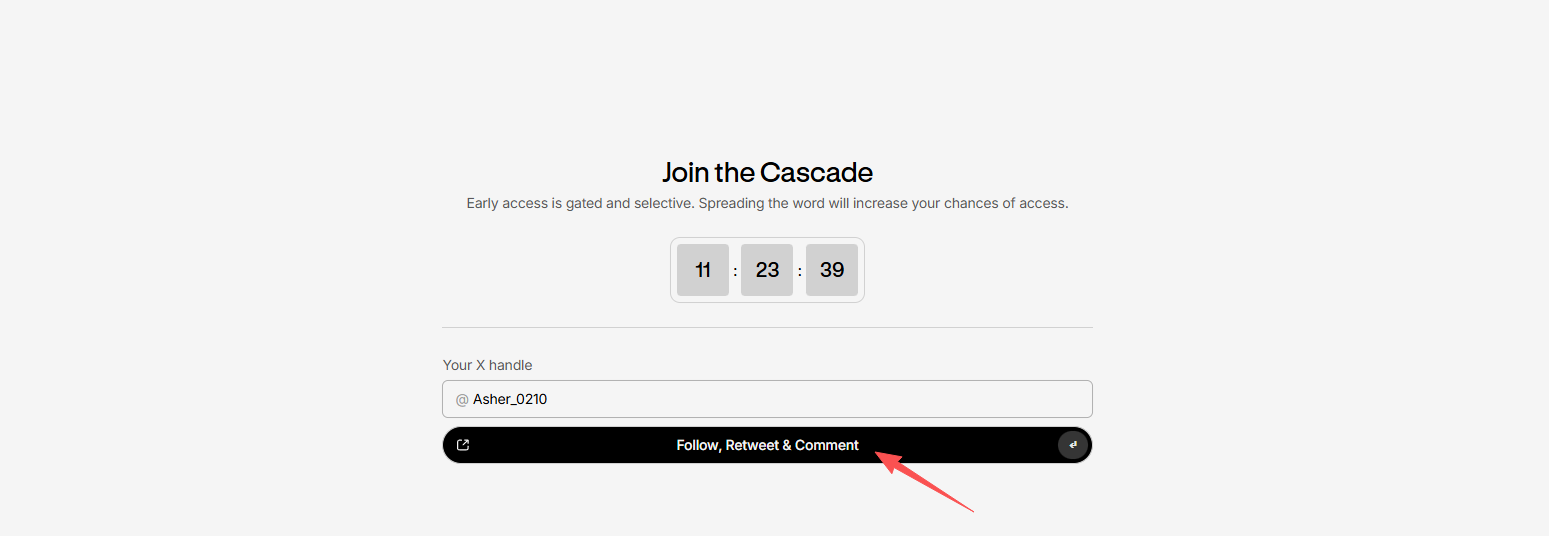
STEP 2. Join the official Discord community (Link: https://discord.com/invite/cascade-xyz) and claim the OG role (limited-time task).

OpenMind: Building a Universal Operating System and Decentralized Collaboration Network for Intelligent Machines

Project Introduction

OpenMind, founded by Stanford University Professor Jan Liphardt, is dedicated to building a universal operating system and decentralized collaboration network for intelligent machines, enabling robots from different manufacturers and of different forms to securely trust each other, share information, and collaborate globally.

In early August this year, OpenMind announced the completion of a $20 million financing round, led by Pantera Capital, with participation from Ribbit, Sequoia, Coinbase Ventures, DCG, Lightspeed Faction, Anagram, Pi Network Ventures, Topology, Primitive Ventures, Amber Group, and several other institutions and renowned angel investors.

Interaction Tutorial

STEP 1. Go to the interaction website (Link: https://fabric.openmind.org/sign-in) and register using your Google email.
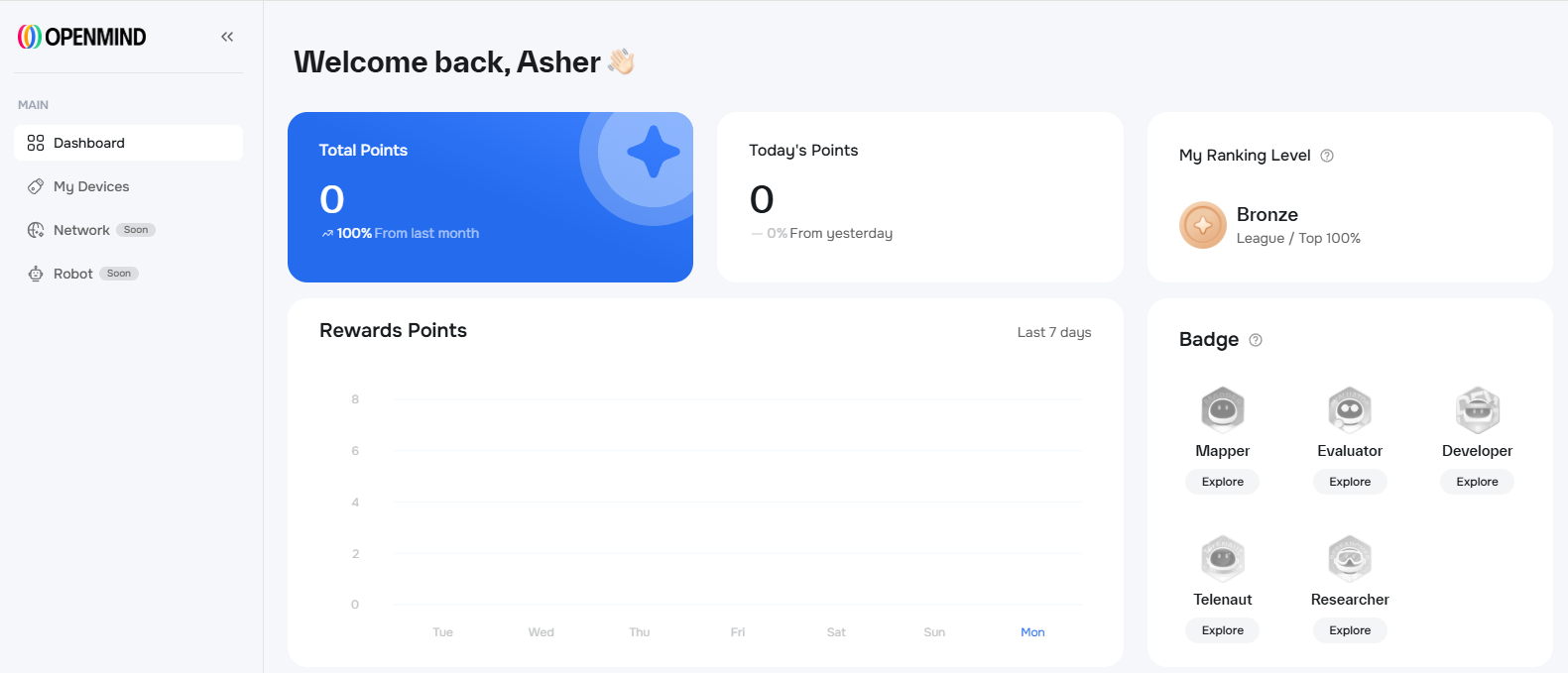
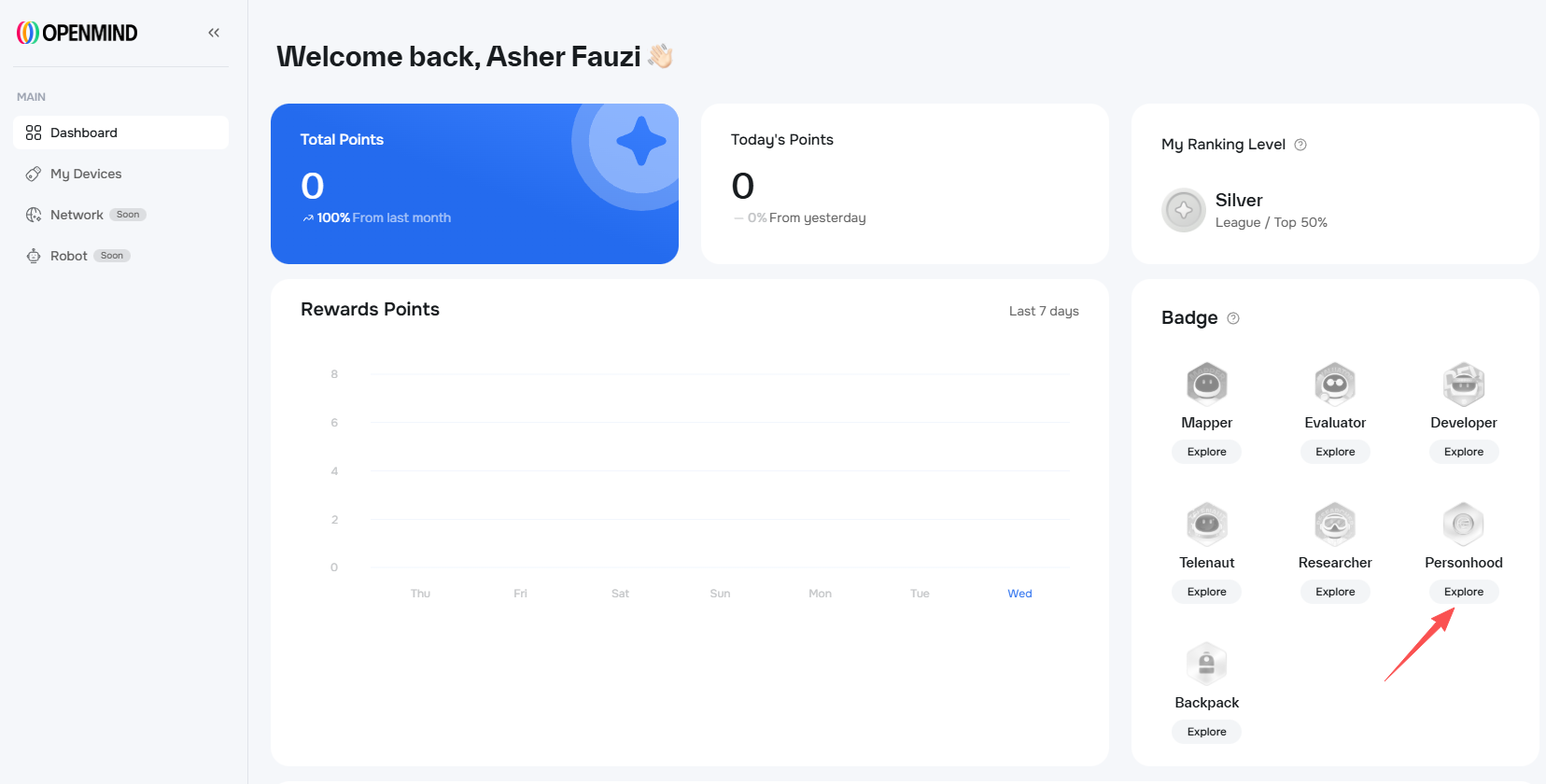
STEP 2. After installing the World Coin software on your phone, click "Personhood" and follow the process to register and receive the badge.
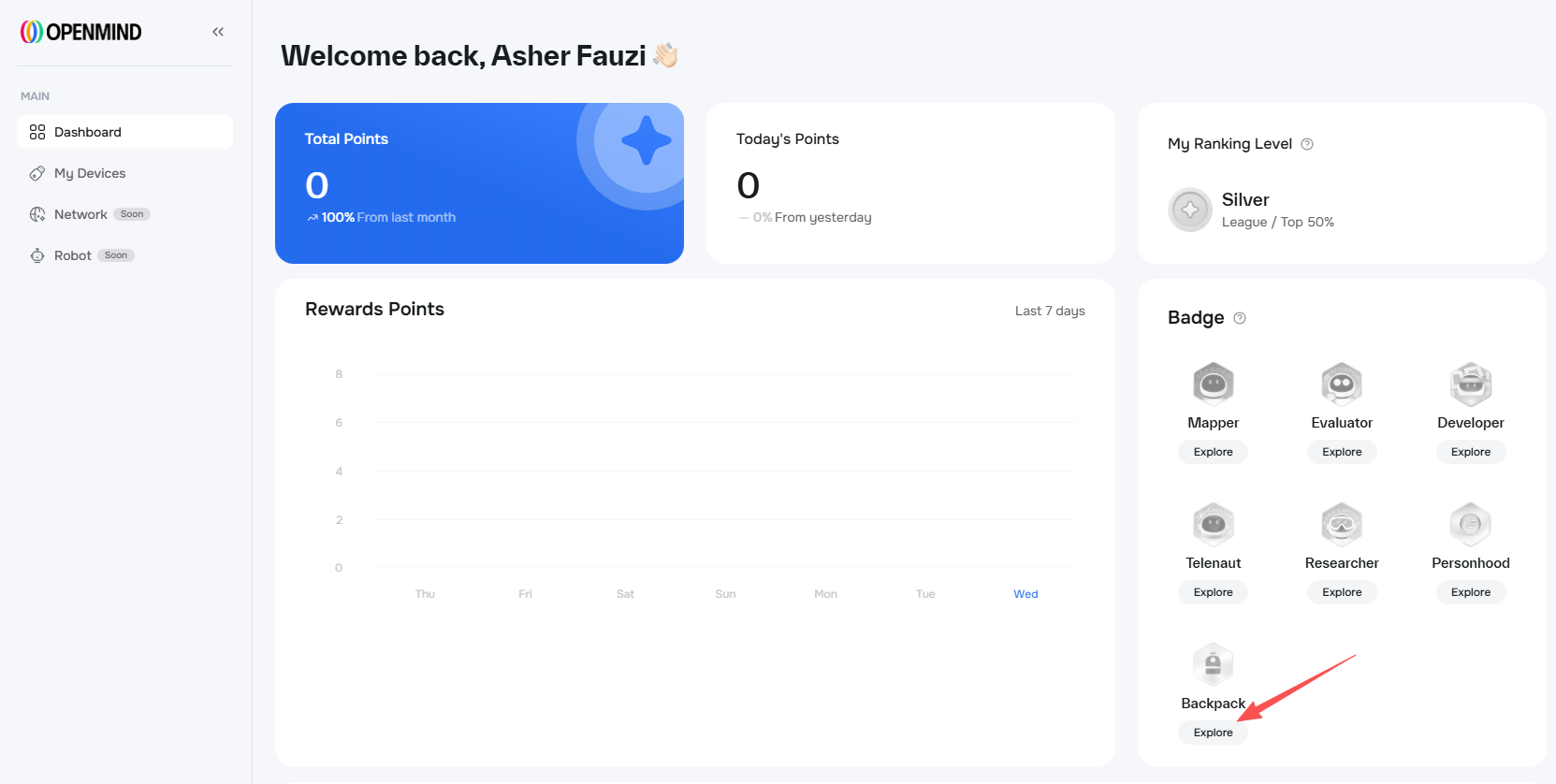
STEP 3. After installing the Backpack software on your phone and registering your personal wallet, click "Backpack", scan the QR code to connect, and receive the badge.
Altius: Committed to Developing a Virtual Machine-Agnostic Modular Execution Stack

Project Introduction

Altius is a set of high-performance on-chain execution infrastructure for the future, co-founded by former Hudson River Trading software engineer Anit Chakraborty and former Amber Group managing partner Annabelle Huang. It is committed to developing a virtual machine (VM)-agnostic modular execution stack.

In mid-February this year, Altius announced the completion of an $11 million Pre-Seed funding round, led by Founders Fund and Pantera, with participation from Archetype, Reforge, DCG, and others.

Interaction Tutorial

On December 13th, Altius, in collaboration with Open Academy, launched a Web3 knowledge test activity. 5 users can win limited edition Altius gift boxes, and 200 users can each receive 200 OA tokens. The deadline is December 23rd.

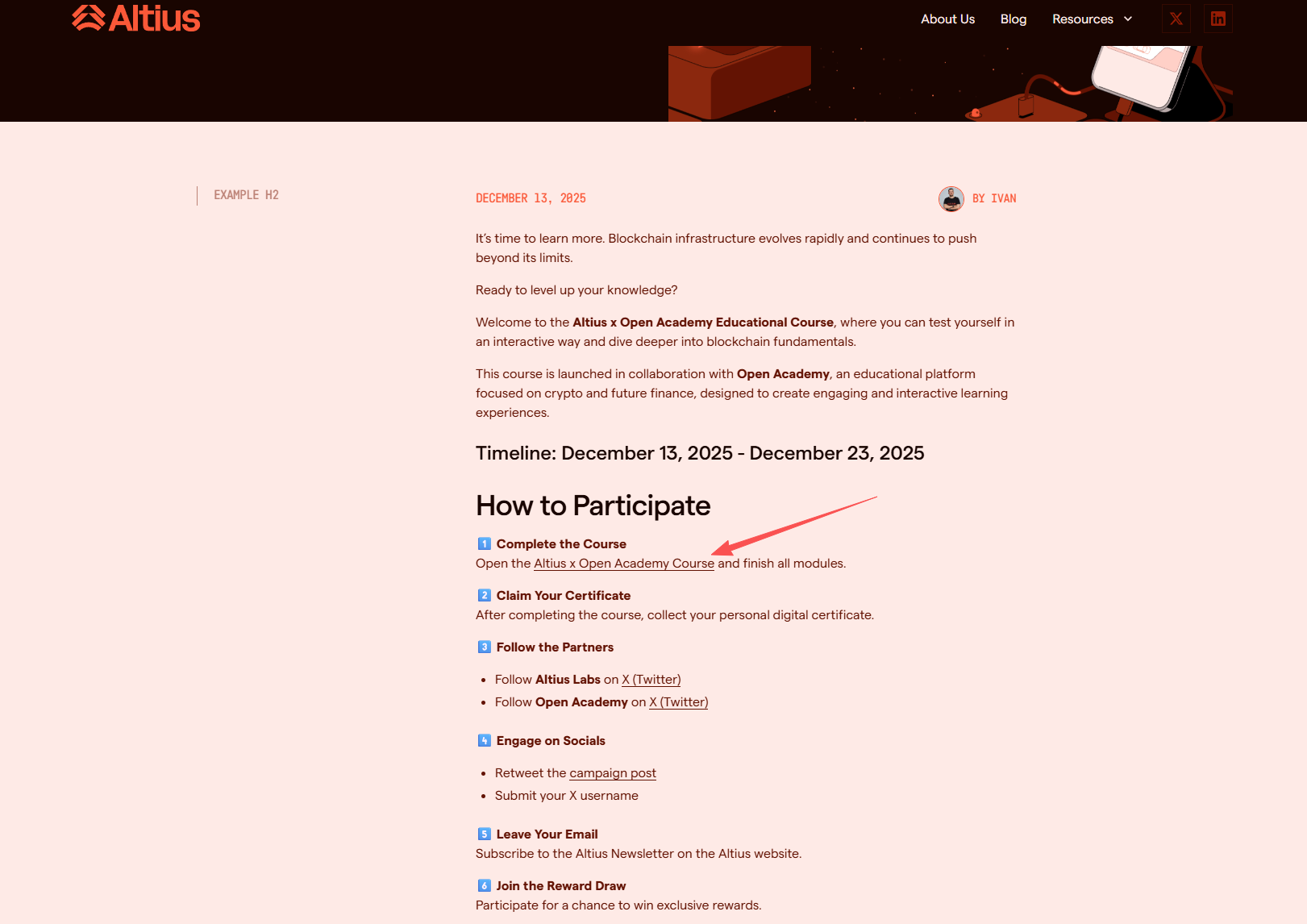
STEP 1. Go to the interaction website (Link: https://www.altiuslabs.xyz/blog/altius-x-open-academy-educational-course) and click the location shown below to jump to the Telegram link.
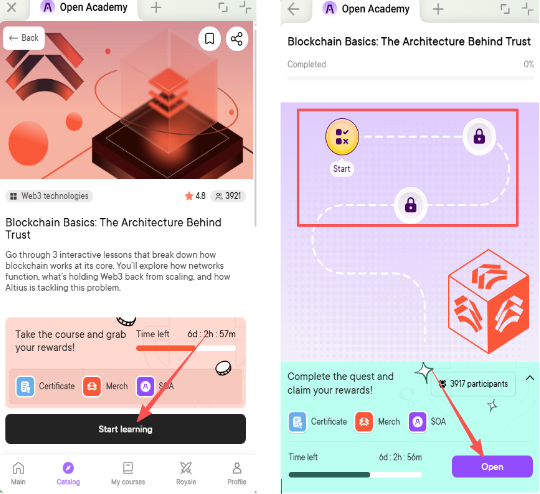
STEP 2. After entering the TG mini-app, click "Start learning". Complete the 3-level course tasks as prompted, then click "Open" below and complete the social tasks in order.
Criptomoedas em alta

Perguntas relacionadas

QWhat is Cascade and what services does it offer?

ACascade is a crypto brokerage firm that provides a 24/7 trading application. It supports perpetual contract trading for cryptocurrencies, US stocks, and private assets. Users can link their bank accounts and perform perpetual trading, portfolio-based lending, and asset transfers within a single margin account.

QHow can users apply for early access to Cascade?

AUsers can apply for early access by visiting the official website (https://cascade.xyz/join), providing their X (Twitter) account and Google email address. This is a limited-time task.

QWhat is the main goal of the OpenMind project and who founded it?

AOpenMind aims to build a universal operating system for intelligent machines and a decentralized collaboration network, enabling robots from different manufacturers to securely share information and work together globally. It was founded by Stanford University professor Jan Liphardt.

QWhat are the steps to earn a badge on OpenMind platform?

ATo earn a badge on OpenMind, users must first register on the interaction website (https://fabric.openmind.org/sign-in) using a Google email. Then, they can obtain a badge by either: 1) Installing the World Coin app, clicking 'Personhood', and completing the registration process, or 2) Installing and registering a Backpack wallet, then clicking 'Backpack' and scanning a QR code to connect.

QWhat is the purpose of the Altius project and what recent activity did it announce?

AAltius is developing a virtual machine (VM)-agnostic modular execution stack for high-performance on-chain execution infrastructure. Recently, on December 13th, it launched a Web3 knowledge test activity in collaboration with Open Academy, offering prizes like limited edition gift boxes and OA tokens, which runs until December 23rd.

Leituras Relacionadas

Two Legends Lost in Three Days: Is Google's AI Talent Dam Cracking?

In three days, Google lost two AI legends. On June 18, Noam Shazeer, co-author of the seminal "Attention is All You Need" paper and Gemini co-lead, left for OpenAI. Just 48 hours later, John Jumper, 2024 Nobel laureate and AlphaFold lead, departed DeepMind for Anthropic. This follows Andrej Karpathy joining Anthropic in May. These moves highlight a structural trend: top AI talent is concentrating at mission-driven, pre-IPO firms like OpenAI and Anthropic, while Google becomes a primary source. The exodus stems from a core mission mismatch. Google's ad-centric model often subordinates AI research to product and revenue goals, creating friction for pioneers like Shazeer, who returned in 2024 only to leave again. In contrast, OpenAI and Anthropic offer singular focus on pushing AI boundaries, whether towards AGI or safety-aligned models, which deeply appeals to top researchers like Jumper. Financial incentives amplify the pull. With both OpenAI and Anthropic nearing IPO, employees stand to gain immensely from equity, an upside Google's mature stock cannot match. Furthermore, the 2023 merger of Google Brain and DeepMind, intended to consolidate strength, has instead created cultural tension and slowed the path from research to product, as evidenced by Gemini's pace. This talent redistribution is reshaping the AI landscape. While Google retains vast data and compute resources, its true crisis is the quiet, continuous loss of the people who define the field's future. The real moat in AI is not infrastructure, but the concentration of brilliant minds—a battle Google is currently losing.

marsbitHá 16m

Two Legends Lost in Three Days: Is Google's AI Talent Dam Cracking?

marsbitHá 16m

Behind the AI Report Card, Lies a Chinese 'Exam Setter'

Beyond the familiar performance charts like MMLU-Pro and MMMU, which major AI models strive to ace, stands a key "examiner": Chinese-Canadian researcher Wenhu Chen. An assistant professor at the University of Waterloo and founder of TIGERLab, Chen addresses the crucial need for more rigorous AI evaluation. As models like GPT-4 began scoring near-perfect results on older benchmarks like MMLU, it became difficult to distinguish their true capabilities. In response, Chen introduced MMLU-Pro in 2024, featuring harder, more reasoning-focused questions with more answer choices, successfully reintroducing meaningful performance gaps. His work extends to multi-modal evaluation with MMMU and its enhanced version, MMMU-Pro. These benchmarks test a model's ability to understand and reason with complex information from images, charts, and text across diverse academic subjects, exposing the significant challenges even top models face in genuine comprehension. Chen's background in complex QA, table reasoning, and his experience at Google DeepMind on projects like Gemini inform his approach. He understands that effective benchmarks must anticipate how models might "cheat" by memorizing data or avoiding visual analysis. His lab also actively researches video understanding and generation models (e.g., UniVideo, Vamba), ensuring his evaluation work is grounded in practical model-building challenges. Now at Meta's Super Intelligence Lab, Chen continues his focus on multi-modal data and evaluation, representing the deep yet often unseen contributions of Chinese talent in shaping the fundamental tools of the AI industry.

marsbitHá 27m

Behind the AI Report Card, Lies a Chinese 'Exam Setter'

marsbitHá 27m

Alliance Co-founder's Letter to Entrepreneurs: Written at the Moment Cursor Sold for $600 Billion

Alliance Co-founder's Letter to Entrepreneurs: On Cursor's $60 Billion Sale Many aspiring founders see massive exits like Cursor's $60B sale and wonder why they can't achieve the same, often concluding opportunities are exhausted. But great companies aren't built in obvious, crowded spaces. Cursor, like Stripe, Figma, and Shopify before it, started with a non-consensus belief about the future. Before ChatGPT, they believed AI would transform knowledge work. They focused on a genuinely exciting domain, became their own customer, and obsessed over power users. Their journey involved years of "glass-chewing" effort before the market was ready. The pattern is consistent: identify a long-term technological shift, find a missed entry point, and execute for years before the trend becomes obvious. First-generation products (PayPal, Adobe, Amazon) prove a market exists. Second-generation winners (Stripe, Figma, Shopify) rebuild that market around new insights, technology, or changing customer behaviors. Founders must identify their phase in the cycle. Early entrants like Coinbase or Cursor focus on making new technology usable for power users. Later entrants find the "yin" to the established "yang"—the blind spots incumbents miss as they grow distant from individual users. The key is deep market immersion. Use every product in your space. Talk to users. Build an audience. Stop looking for ideas and start *seeing* them everywhere. Then, choose one. The idea must offer a 10x improvement or solve a "hair-on-fire" pain point—something severe enough that users are already crafting workarounds. When building, avoid feature bloat. Ask: why would someone switch? Great startups rarely force new behaviors; they improve familiar workflows with drastically lower friction (e.g., Cursor forked VS Code instead of creating a new editor). Distribution is the underestimated moat. Before product-market fit, achieve distribution-market fit. How do customers discover new tools? Founders like those at Airbnb, Stripe, and Cursor did unscalable, manual work to recruit early users. The final, unteachable ingredient is resilience. Cursor built for years pre-market, faced rejection, and persisted. So did Airbnb, Nvidia, and Rain (which launched post-FTX collapse). The lesson isn't that these founders were smarter, but that they stayed in the game long enough for their insights to compound. Framework: Spot technological cycles. Cultivate unique insight. Obsess over your market. Talk to customers. Find a hair-on-fire problem. Build the simplest wedge. Win your distribution channel. Above all, don't quit when it gets hard. Most people won't do these things consistently. The few who do build the next generation of great companies. Go build.

marsbitHá 31m

Alliance Co-founder's Letter to Entrepreneurs: Written at the Moment Cursor Sold for $600 Billion

marsbitHá 31m

Weekly Editor's Picks (0613-0619)

Weekly Editor's Picks (0613-0619): Market Insights & Analysis This weekly digest curates in-depth analysis often lost in the information flow, focusing on key insights across macro trends, investment, and technology. **Macro & Geopolitics:** With the Strait of Hormuz reopening and military conflict shifting to negotiation, markets are pivoting from "war shock" to "supply restoration." Trades include shorting crude risk premiums, longing airlines/tourism, Asian energy importers, and bond duration, while shorting inflation expectations. LNG, fertilizer, and chemical chains are also being repriced. **Investment & VC:** Ray Dalio advises against betting on concentrated AI giants dominating indices, advocating for diversified portfolios of high-quality, low-correlation assets instead. Analysis covers the 4-year crypto cycle, predicting the core surviving product by 2029 will be asset trading markets. Current BTC metrics suggest a potential bottoming zone, presenting a patient accumulation window. SpaceX's high-profile IPO at a $2.1T valuation faces scrutiny over fundamentals, with key watchpoints being its likely inclusion in the Nasdaq index and Q2 earnings. Concerns are raised about potential "gamma squeeze" and systemic risks if its narrative-driven valuation gets amplified by passive index funds. Robinhood (HOOD) is noted for breaking its high correlation with crypto, bolstered by its stock trading and new underwriting business. **Web3 & AI:** A warning highlights ~$1.8T in off-balance-sheet AI infrastructure commitments (purchase commitments, leases) as a potential systemic risk if AI monetization lags. AI models are being used for World Cup predictions, adding a new layer for betting markets. A cost breakdown of a $20 AI subscription reveals the supply chain from model companies to cloud, GPUs, and power. **Prediction Markets:** The emergence of prediction market "concept stocks" is noted, with Robinhood developing its own platform, Rothera, signaling a shift from market competition to a "channel war" for user access. **CeFi & DeFi:** The SpaceX IPO tested perpetual contract mechanisms for pre-IPO assets, highlighting challenges in handling corporate actions like stock splits on-chain. The de-pegging of STRC (Strategy's preferred share) to ~$89 reflects market concerns over MicroStrategy's capital structure and BTC-backed leverage model. BlackRock's covered-call Bitcoin ETF (BITA) offers yield but caps upside, appealing to yield-seeking institutions. **Ethereum:** An opinion piece argues Ethereum's core strength is its vast developer community and composability, solidifying its role as the default operating system for the financial internet. **Weekly Hot Topics:** Include the US-Iran deal reopening the Strait of Hormuz, Fed's hawkish hold, Anthropic restricting model access, SpaceX acquiring Cursor, and a humorous stock surge for "Liuliumei" due to its "LLM" ticker.

marsbitHá 36m

Weekly Editor's Picks (0613-0619)

marsbitHá 36m

Alliance's Co-Founder's Letter to Entrepreneurs: Written on the Occasion of Cursor's $60 Billion Sale

In this letter to entrepreneurs, Alliance reflects on the success of Cursor's $60 billion sale to Elon Musk, using it as a case study to counter the misconception that opportunities in crowded fields like AI or crypto are exhausted. The piece argues that great companies like Cursor, Stripe, Figma, and Shopify are not built by geniuses with perfect ideas, but by founders who start with a non-consensus belief about the future and build for years before that future becomes obvious to everyone. They identify long-term shifts, find overlooked entry points, and execute relentlessly. The framework for success involves: 1. **Identifying your place in the technology cycle**: Early-stage opportunities focus on making new tech usable for power users (e.g., Coinbase, Cursor). Later-stage opportunities involve finding the "yin" to an existing "yang"—the blind spots of first-generation players (e.g., Stripe vs. PayPal, Figma vs. Adobe). 2. **Cultivating unique insights**: Immerse yourself deeply in the market. Use every product, talk to users, and build an audience. Insights will emerge naturally from deep engagement. 3. **Finding a "hair-on-fire" problem**: Look for a 10x improvement or a severe, urgent pain point. The strongest signal is people already building clumsy workarounds. 4. **Building a focused MVP**: Don't just add features because you can. Ask why users would abandon their current tool for yours. The best startups rarely force new behaviors; they improve familiar workflows with drastically lower friction. 5. **Winning a distribution channel**: Distribution is often the moat. Before product-market fit, achieve channel-market fit. Find where your customers are and build an engine to reach them, even through unscalable, manual efforts initially. 6. **Persistence**: The final, unteachable ingredient is resilience. Success stories like Cursor, Airbnb, and Nvidia involved years of grinding, rejection, and perseverance when the path forward seemed unclear. The conclusion is that there is no secret. Most people fail to consistently execute these steps over the long term. The few who do build the companies that define the next era. The world is yours to create.

链捕手Há 41m

Alliance's Co-Founder's Letter to Entrepreneurs: Written on the Occasion of Cursor's $60 Billion Sale

链捕手Há 41m

Trading

Spot
Futuros

Artigos em Destaque

Como comprar HOT

Bem-vindo à HTX.com!Tornámos a compra de Holo (HOT) simples e conveniente.Segue o nosso guia passo a passo para iniciar a tua jornada no mundo das criptos.Passo 1: cria a tua conta HTXUtiliza o teu e-mail ou número de telefone para te inscreveres numa conta gratuita na HTX.Desfruta de um processo de inscrição sem complicações e desbloqueia todas as funcionalidades.Obter a minha contaPasso 2: vai para Comprar Cripto e escolhe o teu método de pagamentoCartão de crédito/débito: usa o teu visa ou mastercard para comprar Holo (HOT) instantaneamente.Saldo: usa os fundos da tua conta HTX para transacionar sem problemas.Terceiros: adicionamos métodos de pagamento populares, como Google Pay e Apple Pay, para aumentar a conveniência.P2P: transaciona diretamente com outros utilizadores na HTX.Mercado de balcão (OTC): oferecemos serviços personalizados e taxas de câmbio competitivas para os traders.Passo 3: armazena teu Holo (HOT)Depois de comprar o teu Holo (HOT), armazena-o na tua conta HTX.Alternativamente, podes enviá-lo para outro lugar através de transferência blockchain ou usá-lo para transacionar outras criptomoedas.Passo 4: transaciona Holo (HOT)Transaciona facilmente Holo (HOT) no mercado à vista da HTX.Acede simplesmente à tua conta, seleciona o teu par de trading, executa as tuas transações e monitoriza em tempo real.Oferecemos uma experiência de fácil utilização tanto para principiantes como para traders experientes.

105 Visualizações TotaisPublicado em {updateTime}Atualizado em 2026.06.02

Como comprar HOT

O que é HOLO

Compreender o HOLO: O Futuro das Aplicações Descentralizadas Introdução ao HOLO, $holo No panorama em rápida evolução das criptomoedas e tecnologias descentralizadas, o HOLO, também conhecido como Holo, emergiu como um jogador notável. Este projeto inovador facilita o desenvolvimento de aplicações descentralizadas (DApps) através da sua arquitetura subjacente conhecida como Holochain. Com uma visão de criar uma ponte entre a internet centralizada que conhecemos hoje e o ecossistema descentralizado do futuro, o HOLO visa tornar as DApps acessíveis ao utilizador comum, sem os obstáculos de instalações complexas e habilidades técnicas. O que é HOLO, $holo? No seu cerne, o HOLO é uma plataforma distribuída projetada para hospedar DApps construídas sobre Holochain. Ao contrário das plataformas de blockchain tradicionais, o Holochain adota uma abordagem única ao permitir que cada aplicação funcione com o seu próprio conjunto de regras. O mandato do HOLO é conectar estas aplicações Holochain (hApps) com os utilizadores através de tecnologias web familiares. O objetivo principal do HOLO é democratizar o acesso e uso das DApps, permitindo que os utilizadores acedam a estas aplicações diretamente através de navegadores web padrão. Esta acessibilidade é fundamental para reduzir a fricção para os utilizadores médios da internet, permitindo-lhes utilizar aplicações de próxima geração sem precisar de navegar nas complexidades frequentemente associadas às criptomoedas e ao uso de DApps. Criadores do HOLO, $holo O HOLO surge da visão dos seus criadores, Arthur Brock e Eric Harris-Braun. Ambos são desenvolvedores experientes e programadores de contratos, e embarcaram no projeto em dezembro de 2016 como parte do MetaCurrency Project. Esta iniciativa estava inicialmente focada no desenvolvimento de ferramentas e tecnologias destinadas a fomentar uma economia peer-to-peer. Os seus antecedentes em programação e empreendimentos empresariais posicionaram-nos de forma única para enfrentar os desafios do desenvolvimento e hospedagem de aplicações descentralizadas. Investidores do HOLO, $holo Embora detalhes específicos sobre investidores individuais no HOLO não estejam facilmente disponíveis, é evidente que o projeto recebeu um apoio significativo e atenção da comunidade mais ampla de criptomoedas. A sua abordagem inovadora para a hospedagem de aplicações descentralizadas, juntamente com uma comunidade de apoio, alimentou o interesse e investimento no projeto. Como funciona o HOLO, $holo? O HOLO opera criando um extenso ecossistema onde os anfitriões contribuem com armazenamento e poder de processamento para as DApps baseadas em Holochain. Ao transformar os seus dispositivos ou até mesmo hardware dedicado como HoloPorts em nós de hospedagem, os indivíduos podem efetivamente monetizar os recursos não utilizados dos seus computadores. Os principais componentes funcionais do HOLO incluem: Fornecedor de Aplicações: Estas entidades compram créditos de hospedagem do HOLO, que são mantidos numa conta de reserva. Este mecanismo permite que os desenvolvedores de DApp garantam os recursos necessários para executar as suas aplicações. Anfitrião: Indivíduos ou organizações que escolhem hospedar DApps geram registos de serviço assinados à medida que respondem a pedidos dos utilizadores. Este processo assegura que todas as interações na rede sejam rastreadas e autenticadas. Prova de Serviço: Um elemento crucial da integridade operacional do HOLO, os anfitriões submetem faturas aos fornecedores de aplicações, que então validam o serviço prestado. Após a validação, os anfitriões recebem compensação na forma de créditos de hospedagem. HoloFuel: Servindo como o token nativo da rede Holo, o HoloFuel é projetado para microtransações. Este token facilita o extenso throughput de transações necessário para que a plataforma suporte bilhões de transações simultâneas de forma fluida. A sinergia combinada destes componentes assegura um ambiente de hospedagem robusto e descentralizado, impulsionando a utilidade e alcance das aplicações Holochain. Cronologia do HOLO, $holo A jornada do HOLO tem sido marcada por vários marcos desde a sua criação: Dezembro de 2016: A criação do HOLO por Arthur Brock e Eric Harris-Braun como parte do MetaCurrency Project. 2018: A emissão de um token ERC20, conhecido como HoloToken (HOT), serviu como um “IOU” que é resgatável por HoloFuel após o lançamento do projeto. Desenvolvimento Contínuo: Avanços contínuos, testes e otimização da rede Holo e HoloFuel, garantindo que o projeto permaneça na vanguarda da tecnologia de hospedagem de aplicações descentralizadas. Características Únicas do HOLO, $holo O HOLO destaca-se no campo saturado das criptomoedas e plataformas descentralizadas devido às suas características distintivas e à estrutura inovadora em que opera: Hospedagem Peer-to-Peer: O HOLO abre a porta para que qualquer pessoa se torne um anfitrião de DApps simplesmente utilizando os seus computadores. Esta democratização da hospedagem é semelhante à forma como plataformas como o Airbnb perturbaram a indústria hoteleira tradicional, capacitando indivíduos a participar na economia. Estrutura Holochain: Central para as inovações do HOLO está a própria estrutura Holochain. Posicionada como uma tecnologia de próxima geração, o Holochain possui escalabilidade sem igual, velocidades de transação rápidas, eficiência energética excepcional e custo-efetividade em comparação com tecnologias de blockchain convencionais. HoloFuel para Microtransações: O HoloFuel é meticulosamente projetado para acomodar microtransações, permitindo que a rede Holo gerencie eficientemente bilhões de transações simultaneamente. Esta capacidade é fundamental para a adoção em massa, permitindo que os desenvolvedores criem aplicações que sejam economicamente viáveis em grande escala. Conclusão O HOLO representa um avanço significativo no panorama das aplicações descentralizadas e da tecnologia blockchain. Com a sua infraestrutura robusta, abordagem amigável ao utilizador e a inovadora estrutura Holochain, o HOLO está preparado para desempenhar um papel crucial no futuro da web. Se irá melhorar as experiências quotidianas na internet ou redefinir a forma como desenvolvedores e utilizadores interagem com aplicações digitais, permanece por ver, mas o seu progresso até agora vale a pena acompanhar à medida que o mundo continua a mover-se em direção a uma economia digital descentralizada. À medida que o projeto evolui, os seus desenvolvimentos contínuos e o envolvimento da comunidade serão componentes cruciais do seu sucesso, potencialmente estabelecendo o HOLO como uma plataforma mainstream para aplicações descentralizadas. Com o crescente interesse em torno das tecnologias descentralizadas, a importância e o impacto de projetos como o HOLO só aumentarão nos anos vindouros.

96 Visualizações TotaisPublicado em {updateTime}Atualizado em 2024.12.26

O que é HOLO

Discussões

Bem-vindo à Comunidade HTX. Aqui, pode manter-se informado sobre os mais recentes desenvolvimentos da plataforma e obter acesso a análises profissionais de mercado. As opiniões dos utilizadores sobre o preço de HOT (HOT) são apresentadas abaixo.

活动图片