Hoskinson Warns Of Cardano ‘Wave of Failures’ After TapTools Shutdown

bitcoinistPublicado em 2026-06-03Última atualização em 2026-06-03

Resumo

Cardano founder Charles Hoskinson warns the ecosystem could face a "wave of failures" following the shutdown announcement of data and analytics platform TapTools. Citing leadership departures and unsustainable platform economics, TapTools is winding down operations despite serving over a million users. Hoskinson framed this not as an isolated incident but as a symptom of broader funding, coordination, and incentive problems within Cardano. He predicts more project failures in the second half of the year due to difficult market conditions. Hoskinson expressed frustration that proposed solutions, like a sovereign wealth fund or strategic acquisitions, have failed to gain sufficient support or faced criticism for centralization. He emphasized his lack of unilateral control over Cardano's governance, treasury, or direction, shifting responsibility to DReps and delegators to choose a clear growth strategy. The livestream concluded with a critique of Cardano's political culture and a discussion of potential extreme measures, including governance reform or even a new chain, if the current structure cannot support builders.

Charles Hoskinson warned that Cardano could face a broader “wave of failures” across its ecosystem after TapTools said it is preparing to wind down operations over the next two weeks, citing leadership departures and difficult platform economics.

The June 2 livestream marked one of Hoskinson’s sharpest public interventions on Cardano’s current governance and commercialization debate. Responding to TapTools’ shutdown statement, the Cardano founder framed the episode not as an isolated project failure, but as a symptom of deeper funding, coordination and incentive problems inside the ecosystem.

TapTools, a widely used Cardano data, analytics and discovery platform, said it had become difficult to responsibly keep operating after the departure of multiple senior team members. According to the statement read by Hoskinson, two co-founders, including the CTO and COO, had left earlier this year. A back-end developer had stepped into the CTO role, but that person has now also decided to move on.

“The technical knowledge required to responsibly operate and maintain TapTools cannot be replaced overnight,” the team said. “At the same time, the economics of running a platform like this remain challenging. Infrastructure costs are real. Development costs are real. Support costs are real.”

TapTools said it had served more than one million users, supported hundreds of projects through its API, published hundreds of articles, generated hundreds of millions of social impressions and helped bring visibility to builders across Cardano. The team said it would remain open to acquisition talks or other resources that could allow the platform to continue sustainably.

Hoskinson Says More Cardano Projects Could Follow

Hoskinson said TapTools had been part of his “daily ritual” and argued that its exit reflected a problem he had warned about earlier in the year: ecosystem projects running out of runway in poor market conditions.

“This is where we’re at as an ecosystem,” Hoskinson said. “I said at the beginning of the year, we’re going to see a lot of people collapse because the markets are really bad and we need some way to bail out our ecosystem and get them the lifeblood that they need to get to the next level.”

He pointed to JPEG Store and TapTools as examples of projects already affected, adding that he expects more failures in the second half of the year. “I would suspect others are coming very soon,” he said. “There’s going to be a wave of failures in the ecosystem.”

Hoskinson said he had previously proposed several mechanisms to address the issue, including a Cardano sovereign wealth fund, an ecosystem index and strategic acquisitions. He argued that these ideas either failed to gain sufficient support or were criticized as attempts to centralize the ecosystem. He cited his acquisitions of Nami and Blockfrost as examples of infrastructure he had tried to preserve and commercialize, while saying similar interventions often drew backlash.

The broader frustration, according to Hoskinson, is that Cardano governance has not yet produced an effective mechanism for deploying treasury resources into commercial infrastructure. He said Draper had received a large amount of ADA, but suggested that venture capital funding would likely flow mostly into new ventures rather than distressed existing platforms that may not be in an investable state.

Governance, Treasury And Commercialization

Hoskinson repeatedly rejected the idea that he has unilateral control over Cardano’s direction. He said he does not have governance keys, cannot initiate a hard fork or protocol parameter change, does not control the treasury and does not own the Cardano trademark.

“I’d really like to understand what my agency is here,” he said. “I don’t have any special powers with Cardano. I don’t have any governance keys. I don’t have any ability to even initiate a hard fork, much less a protocol parameter change.”

The livestream then turned into a wider critique of Cardano’s political culture. Hoskinson accused parts of the ecosystem of opposing commercialization while also blaming leadership when commercial infrastructure fails. He directed much of his message at DReps and delegators, arguing they need to evaluate whether their representatives are enabling growth or blocking it.

“You need to pick a leader. You need to pick a vision. You need to pick a strategy and fix it,” Hoskinson said. “You need to or you cannot and let it die. That’s your choice.”

He also floated more extreme options, including constitutional changes, treasury reform, changes to executive function and, at the outer edge, a new Cardano launched through a proof-of-burn mechanism. Hoskinson described that as the “nuclear option,” while presenting it as one of several possible responses if the current governance structure cannot support builders.

At press time, ADA traded at $0.2177.
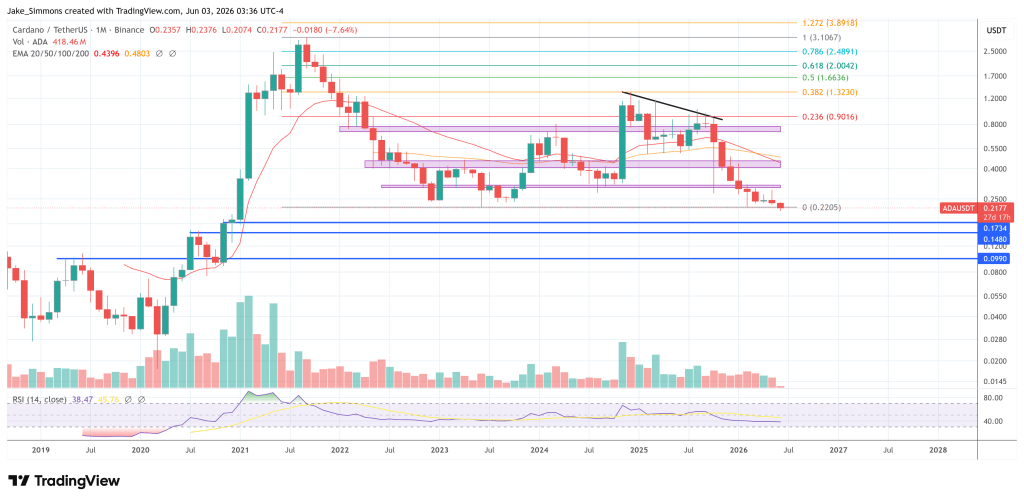
ADA drops below key support, 1-day chart | Source: ADAUSDT on TradingView.com

Criptomoedas em alta

Perguntas relacionadas

QWhat is the main reason TapTools gave for shutting down operations according to the article?

ATapTools cited the departure of multiple senior team members, including two co-founders (the CTO and COO) and a back-end developer who had stepped into the CTO role, as well as difficult platform economics involving high infrastructure, development, and support costs.

QHow does Charles Hoskinson frame the shutdown of TapTools in relation to the Cardano ecosystem?

AHoskinson frames it not as an isolated project failure, but as a symptom of deeper funding, coordination, and incentive problems within the ecosystem. He warns it could signal the start of a broader 'wave of failures' for projects running out of financial runway in poor market conditions.

QWhat mechanisms has Hoskinson previously proposed to address ecosystem funding issues, and what was the outcome?

AHe proposed mechanisms like a Cardano sovereign wealth fund, an ecosystem index, and strategic acquisitions. He stated these ideas either failed to gain sufficient support or were criticized as attempts to centralize control over the ecosystem.

QAccording to Hoskinson, what is a key frustration regarding Cardano's governance and treasury?

AHis key frustration is that Cardano's governance has not yet produced an effective mechanism for deploying treasury resources to support commercial infrastructure projects within the ecosystem.

QWhat extreme 'nuclear option' did Hoskinson mention as a possible response if current governance cannot support builders?

AHe mentioned the possibility of launching a new version of Cardano through a proof-of-burn mechanism as the most extreme 'nuclear option' among several potential responses to governance failure.

Leituras Relacionadas

Misjudged A-Shares: Resilience, Expectations, and Confidence

China's A-share market recently faced selling pressure, especially in tech sectors, initially triggered by a global tech sell-off that began in South Korea. However, the article argues this is a case of "mistaken injury" and highlights the market's underlying resilience. This resilience stems from three main pillars: **1) Tech Sector Fundamentals:** Unlike Korea's market dominated by a few memory chip stocks, China's tech sector is diversified across computing, communications, electronics, and semiconductors, supported by dual narratives of global AI supply chains and domestic substitution. Core areas like optical modules and fiber optics continue to show strong earnings growth. **2) "National Team" Support:** State-backed institutions and large corporations have made significant market purchases and announced buybacks, providing liquidity and signaling confidence. This is seen as a stabilizing policy signal, often associated with market bottoms. **3) Broader Market Pillars:** Other major sectors are showing endogenous recovery momentum. Consumer stocks benefit from stabilizing CPI and signs of sector recovery (e.g., liquor price hikes). Cyclical sectors like aluminum have high earnings, potential price increases due to tight supply, and low valuations. The financial sector offers stable dividends and low valuations. The conclusion is that the sell-off was driven by external contagion, not a collapse in fundamentals. With strong policy support and recovering momentum across key sectors, the A-share market possesses the toughness to regain stability.

marsbitHá 27m

Misjudged A-Shares: Resilience, Expectations, and Confidence

marsbitHá 27m

The Clarity Act's Journey Through Congress: The Thorny Path of Bipartisan Compromise in the U.S.

The U.S. Congress is struggling to advance the crypto market structure bill known as the Clarity Act, with bipartisan compromise proving difficult. Key hurdles include unresolved disputes over "yield" products and, more critically, the inclusion of strong ethics provisions for elected officials—a non-negotiable demand for many Democrats. While a compromise on yield was reached in May, securing only limited Democratic support in committee, the separate Senate Agriculture Committee version later passed with no Democratic votes due to the ethics impasse. As Republicans push for a full Senate vote in July, demands for ethics rules have expanded, and other contentious issues like developer protections and concerns from law enforcement and large banks further complicate negotiations. Despite consensus on the need for legislation, the path forward is unclear. Recent discussions between senators and White House officials aim to find acceptable ethics language. Some lawmakers question whether a compromise text can garner enough bipartisan support, with one Democrat stating the current proposal lacks the strong ethics provisions required for their vote. Potential short-term goals for the crypto community include symbolic Senate action before the August recess, a longer-term aim for passage by 2026, or establishing a detailed framework that addresses ethics and other compromises. The process remains arduous, relying on the traditional, vote-by-vote effort to build bipartisan support.

marsbitHá 46m

The Clarity Act's Journey Through Congress: The Thorny Path of Bipartisan Compromise in the U.S.

marsbitHá 46m

Are Kalshi and Polymarket Founders at Odds? This Business Rivalry Is More Brutal Than You Think

"The Rivalry Between Kalshi and Polymarket Founders Turns Bitter and Litigious" The intense feud between Tarek Mansour, CEO of Kalshi, and Shayne Coplan, founder of Polymarket, has escalated far beyond typical business competition into personal animosity and regulatory battles. Both lead billion-dollar prediction market platforms, but their approaches differ sharply. Kalshi positions itself as the compliant operator, securing U.S. regulatory approval before launching. In contrast, Polymarket initially operated offshore, allowing U.S. users to access its platform via VPN, which drew regulatory scrutiny. The conflict reached a peak in November 2024 when FBI agents raided Coplan's New York apartment. While Coplan publicly blamed political motives, his team privately suspected Kalshi was involved. According to sources, Kalshi's lawyers had previously reported Polymarket's operations to federal prosecutors, highlighting its accessibility to U.S. users despite a ban. This incident fueled mutual accusations and underhanded tactics, including social media smear campaigns and attempts to sabotage each other's major business deals. Their rivalry also played out in Washington, influencing regulatory debates. Kalshi actively lobbied against Polymarket's practices, framing them as illegal and unethical. Polymarket, after facing a CFTC fine and investigation, later acquired a licensed U.S. firm to launch a domestic app, regaining a foothold. Despite the hostility, both companies have seen massive growth, with combined trading volumes soaring. However, increased regulatory scrutiny, particularly around insider trading on Polymarket's platform, continues to pose challenges. The founders' deep-seated mutual disdain ensures their battle for market dominance remains as much a personal vendetta as a commercial one.

marsbitHá 55m

Are Kalshi and Polymarket Founders at Odds? This Business Rivalry Is More Brutal Than You Think

marsbitHá 55m

Trading

Spot

Artigos em Destaque

Como comprar ADA

Bem-vindo à HTX.com!Tornámos a compra de Cardano (ADA) simples e conveniente.Segue o nosso guia passo a passo para iniciar a tua jornada no mundo das criptos.Passo 1: cria a tua conta HTXUtiliza o teu e-mail ou número de telefone para te inscreveres numa conta gratuita na HTX.Desfruta de um processo de inscrição sem complicações e desbloqueia todas as funcionalidades.Obter a minha contaPasso 2: vai para Comprar Cripto e escolhe o teu método de pagamentoCartão de crédito/débito: usa o teu visa ou mastercard para comprar Cardano (ADA) instantaneamente.Saldo: usa os fundos da tua conta HTX para transacionar sem problemas.Terceiros: adicionamos métodos de pagamento populares, como Google Pay e Apple Pay, para aumentar a conveniência.P2P: transaciona diretamente com outros utilizadores na HTX.Mercado de balcão (OTC): oferecemos serviços personalizados e taxas de câmbio competitivas para os traders.Passo 3: armazena teu Cardano (ADA)Depois de comprar o teu Cardano (ADA), armazena-o na tua conta HTX.Alternativamente, podes enviá-lo para outro lugar através de transferência blockchain ou usá-lo para transacionar outras criptomoedas.Passo 4: transaciona Cardano (ADA)Transaciona facilmente Cardano (ADA) no mercado à vista da HTX.Acede simplesmente à tua conta, seleciona o teu par de trading, executa as tuas transações e monitoriza em tempo real.Oferecemos uma experiência de fácil utilização tanto para principiantes como para traders experientes.

1.3k Visualizações TotaisPublicado em {updateTime}Atualizado em 2026.06.02

Como comprar ADA

Discussões

Bem-vindo à Comunidade HTX. Aqui, pode manter-se informado sobre os mais recentes desenvolvimentos da plataforma e obter acesso a análises profissionais de mercado. As opiniões dos utilizadores sobre o preço de ADA (ADA) são apresentadas abaixo.

活动图片













