Hoskinson Warns Of Cardano ‘Wave of Failures’ After TapTools Shutdown

bitcoinistPublicado em 2026-06-03Última atualização em 2026-06-03

Resumo

Cardano founder Charles Hoskinson warns the ecosystem could face a "wave of failures" following the shutdown announcement of data and analytics platform TapTools. Citing leadership departures and unsustainable platform economics, TapTools is winding down operations despite serving over a million users. Hoskinson framed this not as an isolated incident but as a symptom of broader funding, coordination, and incentive problems within Cardano. He predicts more project failures in the second half of the year due to difficult market conditions. Hoskinson expressed frustration that proposed solutions, like a sovereign wealth fund or strategic acquisitions, have failed to gain sufficient support or faced criticism for centralization. He emphasized his lack of unilateral control over Cardano's governance, treasury, or direction, shifting responsibility to DReps and delegators to choose a clear growth strategy. The livestream concluded with a critique of Cardano's political culture and a discussion of potential extreme measures, including governance reform or even a new chain, if the current structure cannot support builders.

Charles Hoskinson warned that Cardano could face a broader “wave of failures” across its ecosystem after TapTools said it is preparing to wind down operations over the next two weeks, citing leadership departures and difficult platform economics.

The June 2 livestream marked one of Hoskinson’s sharpest public interventions on Cardano’s current governance and commercialization debate. Responding to TapTools’ shutdown statement, the Cardano founder framed the episode not as an isolated project failure, but as a symptom of deeper funding, coordination and incentive problems inside the ecosystem.

TapTools, a widely used Cardano data, analytics and discovery platform, said it had become difficult to responsibly keep operating after the departure of multiple senior team members. According to the statement read by Hoskinson, two co-founders, including the CTO and COO, had left earlier this year. A back-end developer had stepped into the CTO role, but that person has now also decided to move on.

“The technical knowledge required to responsibly operate and maintain TapTools cannot be replaced overnight,” the team said. “At the same time, the economics of running a platform like this remain challenging. Infrastructure costs are real. Development costs are real. Support costs are real.”

TapTools said it had served more than one million users, supported hundreds of projects through its API, published hundreds of articles, generated hundreds of millions of social impressions and helped bring visibility to builders across Cardano. The team said it would remain open to acquisition talks or other resources that could allow the platform to continue sustainably.

Hoskinson Says More Cardano Projects Could Follow

Hoskinson said TapTools had been part of his “daily ritual” and argued that its exit reflected a problem he had warned about earlier in the year: ecosystem projects running out of runway in poor market conditions.

“This is where we’re at as an ecosystem,” Hoskinson said. “I said at the beginning of the year, we’re going to see a lot of people collapse because the markets are really bad and we need some way to bail out our ecosystem and get them the lifeblood that they need to get to the next level.”

He pointed to JPEG Store and TapTools as examples of projects already affected, adding that he expects more failures in the second half of the year. “I would suspect others are coming very soon,” he said. “There’s going to be a wave of failures in the ecosystem.”

Hoskinson said he had previously proposed several mechanisms to address the issue, including a Cardano sovereign wealth fund, an ecosystem index and strategic acquisitions. He argued that these ideas either failed to gain sufficient support or were criticized as attempts to centralize the ecosystem. He cited his acquisitions of Nami and Blockfrost as examples of infrastructure he had tried to preserve and commercialize, while saying similar interventions often drew backlash.

The broader frustration, according to Hoskinson, is that Cardano governance has not yet produced an effective mechanism for deploying treasury resources into commercial infrastructure. He said Draper had received a large amount of ADA, but suggested that venture capital funding would likely flow mostly into new ventures rather than distressed existing platforms that may not be in an investable state.

Governance, Treasury And Commercialization

Hoskinson repeatedly rejected the idea that he has unilateral control over Cardano’s direction. He said he does not have governance keys, cannot initiate a hard fork or protocol parameter change, does not control the treasury and does not own the Cardano trademark.

“I’d really like to understand what my agency is here,” he said. “I don’t have any special powers with Cardano. I don’t have any governance keys. I don’t have any ability to even initiate a hard fork, much less a protocol parameter change.”

The livestream then turned into a wider critique of Cardano’s political culture. Hoskinson accused parts of the ecosystem of opposing commercialization while also blaming leadership when commercial infrastructure fails. He directed much of his message at DReps and delegators, arguing they need to evaluate whether their representatives are enabling growth or blocking it.

“You need to pick a leader. You need to pick a vision. You need to pick a strategy and fix it,” Hoskinson said. “You need to or you cannot and let it die. That’s your choice.”

He also floated more extreme options, including constitutional changes, treasury reform, changes to executive function and, at the outer edge, a new Cardano launched through a proof-of-burn mechanism. Hoskinson described that as the “nuclear option,” while presenting it as one of several possible responses if the current governance structure cannot support builders.

At press time, ADA traded at $0.2177.
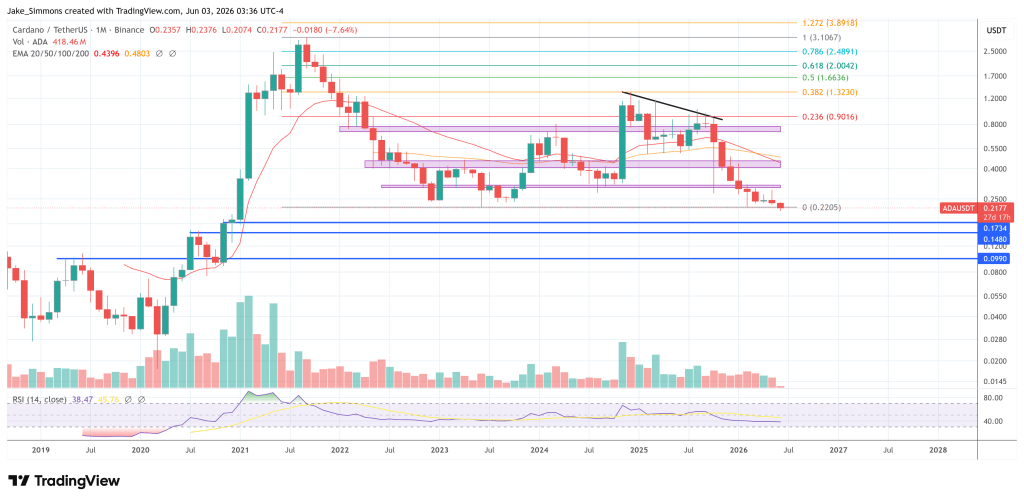
ADA drops below key support, 1-day chart | Source: ADAUSDT on TradingView.com

Criptomoedas em alta

Perguntas relacionadas

QWhat is the main reason TapTools gave for shutting down operations according to the article?

ATapTools cited the departure of multiple senior team members, including two co-founders (the CTO and COO) and a back-end developer who had stepped into the CTO role, as well as difficult platform economics involving high infrastructure, development, and support costs.

QHow does Charles Hoskinson frame the shutdown of TapTools in relation to the Cardano ecosystem?

AHoskinson frames it not as an isolated project failure, but as a symptom of deeper funding, coordination, and incentive problems within the ecosystem. He warns it could signal the start of a broader 'wave of failures' for projects running out of financial runway in poor market conditions.

QWhat mechanisms has Hoskinson previously proposed to address ecosystem funding issues, and what was the outcome?

AHe proposed mechanisms like a Cardano sovereign wealth fund, an ecosystem index, and strategic acquisitions. He stated these ideas either failed to gain sufficient support or were criticized as attempts to centralize control over the ecosystem.

QAccording to Hoskinson, what is a key frustration regarding Cardano's governance and treasury?

AHis key frustration is that Cardano's governance has not yet produced an effective mechanism for deploying treasury resources to support commercial infrastructure projects within the ecosystem.

QWhat extreme 'nuclear option' did Hoskinson mention as a possible response if current governance cannot support builders?

AHe mentioned the possibility of launching a new version of Cardano through a proof-of-burn mechanism as the most extreme 'nuclear option' among several potential responses to governance failure.

Leituras Relacionadas

7 Months After the Collapse of Huiwang, Southeast Asia's Escrow Platforms Undergo a Major Reshuffle

Following the collapse of Huione Pay—dubbed the "Alipay of Southeast Asia"—seven months ago, the region's underground financial guarantee platform sector is undergoing a significant reshuffle. This power vacuum has been swiftly filled by emerging platforms such as XinBi, Tiger/Navigator, JinBei (renamed JinBo), Dali/Tiancheng, and FullyLight. These platforms, operating largely via Telegram and offering services like escrow for illicit transactions, have absorbed the vast user base and markets left behind by Huione. While positioning themselves as "trust intermediaries," their primary clientele consists of networks involved in online scams, money laundering, illegal gambling, and even human trafficking. For instance, the Tiger/Navigator platform explicitly provides "escrow" services for kidnapping-for-ransom operations ("强押车交易"). Data underscores the immense scale: Huione alone processed over $103 billion in cryptocurrency payments and facilitated over $31 billion through its escrow market before its downfall, linking it to Cambodia's notorious Prince Group. Since its collapse, competitors have seen explosive growth. For example, the XinBi platform has accumulated over $1.6 billion in total USDT revenue, while platforms like NewPay, OkPay (under Dali), and FullyLight Wallet collectively processed over $4.8 billion in USDT in a single year. This ecosystem thrives in regions like Cambodia and Myanmar, where regulatory gaps allow these platforms to act as critical financial infrastructure for sprawling cybercrime industries, from scam compounds to online casinos. The article concludes that the moniker "Southeast Asian Alipay" is a misnomer, obscuring the platforms' fundamental role in enabling serious criminal enterprises rather than representing legitimate financial innovation.

Odaily星球日报Há 42m

7 Months After the Collapse of Huiwang, Southeast Asia's Escrow Platforms Undergo a Major Reshuffle

Odaily星球日报Há 42m

The Changing Landscape: What Are Crypto VCs Experiencing?

Title: The Shifting Landscape of Crypto Venture Capital The era of dedicated crypto venture capital funds is undergoing a significant transformation. Once essential for navigating the sector's complexity and high risk, these specialized funds are now facing an identity crisis as the market matures. This shift mirrors historical patterns in other specialized investment classes like cleantech and SPACs, where initial information advantages dissipate as technologies become mainstream and integrated into existing industry frameworks. The article argues that crypto is reaching a critical inflection point, transitioning from a "building phase" to an "integration phase." Major players like Stripe, BlackRock, and Visa now engage with crypto not for its novel mechanics but as a foundational financial infrastructure. Their needs—regulatory compliance, banking partnerships, distribution channels—align with traditional fintech, a domain easily understood by large, generalist funds like Sequoia and Founders Fund. This evolution creates a "barbell effect" within the VC landscape. On one end are massive, diversified platforms that can incorporate crypto as one vertical among many. On the other are small, nimble funds focused on niche, experimental projects. The middle ground—medium-sized dedicated crypto funds—is being squeezed out. Their typical fund size makes it impossible to generate sufficient returns solely from early-stage crypto bets, yet they cannot compete with giants for later-stage deals. Consequently, leading crypto-native firms like Paradigm and Framework Ventures are expanding into AI, robotics, and other sectors, driven partly by LP pressure for better returns amid a broader VC DPI crisis. Others, like Dragonfly and a16z, have narrowed their crypto focus predominantly to financial infrastructure like stablecoins, reframing the sector's core narrative. For crypto entrepreneurs, this consolidation presents challenges. While generalist funds offer larger checks and broader resources, crypto projects now compete fiercely with AI for attention and capital within these firms. Furthermore, the long-term, non-commercial foundational work that built the ecosystem—funded by dedicated crypto VCs—is less likely to attract generalist capital focused on direct returns. The conclusion is that "crypto investor" as a standalone category is becoming obsolete, akin to "internet investor." Crypto is becoming a baseline infrastructure layer. The future will see a barbell structure: large-scale growth financing handled by generalist funds, while pioneering, speculative projects are funded by small, specialized vehicles. The dedicated crypto funds of the 2017-2021 boom, which incubated core infrastructure, are giving way to this new, bifurcated reality.

Foresight NewsHá 59m

The Changing Landscape: What Are Crypto VCs Experiencing?

Foresight NewsHá 59m

As Consensus Accelerates, What Are Young Investors Betting On?

Title: As Consensus Forms Faster, What Are Young Investors Betting On? In the rapid evolution of tech investment, a new generation of young investors is navigating a landscape where AI, robotics, commercial aerospace, and quantum computing are advancing simultaneously. Traditional investment logic based on financial models is giving way to a need for deep technical understanding and the ability to act before industry consensus forms. An analysis of trends from the "WAIC FUTURE TECH" list of young investment leaders reveals key shifts in focus. The first major trend is the movement of AI from the digital screen into the physical world. Investment is shifting from large language models and chatbots towards embodied AI, robotics, AI hardware, and edge computing. While demonstrations generate excitement, the real challenge lies in achieving scalable, reliable, and cost-effective delivery in complex real-world environments like factories and logistics. Success depends not just on algorithms but on the integration of sensors, actuators, and control systems. Second, the competitive focus for large models is moving beyond raw capability toward building an "intelligence flywheel." The goal is to create self-reinforcing systems where user interaction generates data, improving the model, which in turn enhances the user experience and attracts more engagement. Companies that successfully embed AI into workflows to create these closed-loop systems can build lasting value that isn't easily erased by the next model upgrade. Third, facing a potential bottleneck in high-quality human-generated data, investors are looking at new underlying technologies. Reinforcement learning and self-play, as demonstrated by AlphaGo Zero, offer paths for AI to generate its own experience. Scientific foundation models, which aim to build general AI capabilities for fields like life sciences and materials discovery, represent a non-consensus direction that could unlock new frontiers of knowledge and data. Finally, in deep-tech areas like quantum computing, commercial aerospace, and space-based infrastructure, patient capital is essential. These fields have long, uncertain development and validation cycles involving complex engineering, supply chains, and regulations. Investment here requires a long-term view, focusing on foundational team capabilities and the eventual emergence of market demand, even if commercial returns are distant. Collectively, these trends illustrate how young investors are adapting to a new era. They are learning to make earlier, technically-informed judgments, balance hype with real-world viability, and provide the patient capital needed to build the deep-tech foundations of the future.

marsbitHá 1h

As Consensus Accelerates, What Are Young Investors Betting On?

marsbitHá 1h

Trading

Spot

Artigos em Destaque

Como comprar ADA

Bem-vindo à HTX.com!Tornámos a compra de Cardano (ADA) simples e conveniente.Segue o nosso guia passo a passo para iniciar a tua jornada no mundo das criptos.Passo 1: cria a tua conta HTXUtiliza o teu e-mail ou número de telefone para te inscreveres numa conta gratuita na HTX.Desfruta de um processo de inscrição sem complicações e desbloqueia todas as funcionalidades.Obter a minha contaPasso 2: vai para Comprar Cripto e escolhe o teu método de pagamentoCartão de crédito/débito: usa o teu visa ou mastercard para comprar Cardano (ADA) instantaneamente.Saldo: usa os fundos da tua conta HTX para transacionar sem problemas.Terceiros: adicionamos métodos de pagamento populares, como Google Pay e Apple Pay, para aumentar a conveniência.P2P: transaciona diretamente com outros utilizadores na HTX.Mercado de balcão (OTC): oferecemos serviços personalizados e taxas de câmbio competitivas para os traders.Passo 3: armazena teu Cardano (ADA)Depois de comprar o teu Cardano (ADA), armazena-o na tua conta HTX.Alternativamente, podes enviá-lo para outro lugar através de transferência blockchain ou usá-lo para transacionar outras criptomoedas.Passo 4: transaciona Cardano (ADA)Transaciona facilmente Cardano (ADA) no mercado à vista da HTX.Acede simplesmente à tua conta, seleciona o teu par de trading, executa as tuas transações e monitoriza em tempo real.Oferecemos uma experiência de fácil utilização tanto para principiantes como para traders experientes.

1.3k Visualizações TotaisPublicado em {updateTime}Atualizado em 2026.06.02

Como comprar ADA

Discussões

Bem-vindo à Comunidade HTX. Aqui, pode manter-se informado sobre os mais recentes desenvolvimentos da plataforma e obter acesso a análises profissionais de mercado. As opiniões dos utilizadores sobre o preço de ADA (ADA) são apresentadas abaixo.

活动图片













