Hoskinson Says Cardano Faces A Make-Or-Break Web3 Problem

bitcoinistPublicado em 2026-04-24Última atualização em 2026-04-24

Resumo

Charles Hoskinson argues that Cardano's next phase must address a critical Web3 weakness: the industry's reliance on centralized off-chain infrastructure, which contradicts decentralization ideals. Citing Moxie Marlinspike's essay, he acknowledges Cardano faces the same problem, where user experience often depends on centralized services. Hoskinson proposes that Midnight's cryptographic tools and BlockFrost's transformation into a decentralized infrastructure network are key solutions. He connects this vision to current treasury proposals, emphasizing the need to build scalable, decentralized off-chain systems instead of recreating Web2 centralization.

Charles Hoskinson used his latest livestream to argue that Cardano’s next phase should focus less on abstract decentralization rhetoric and more on fixing a structural weakness he says still defines crypto: the reliance on centralized off-chain infrastructure. In the process, he tied that critique directly to Cardano’s treasury debates around BlockFrost, Midnight, partner chains and the broader direction of the network.

Speaking from Wyoming in a late-night broadcast recorded on April 23, Hoskinson framed the discussion around “My First Impressions of Web3,” a January 2022 essay by Signal co-founder Moxie Marlinspike. He described the piece as one of the texts that convinced him to acquire BlockFrost, saying Moxie had identified “the uncomfortable hidden truths” behind the industry’s decentralization claims.

Cardano Can Succeed Where Web3 Fell Back

Hoskinson spent much of the stream reading and unpacking Marlinspike’s central argument: that users do not want to run their own servers, protocols move slowly, and most supposedly decentralized applications still depend on centralized companies for the actual user experience. One of the essay’s most important passages, in Hoskinson’s telling, was this: “Once a distributed ecosystem centralizes around a platform for convenience, it becomes the worst of both worlds. Centralized control but still distributed enough to become mired in time.”

That line became the throughline of Hoskinson’s own case for Cardano. He acknowledged that the problem is not unique to Ethereum, even though Marlinspike’s original examples focused on Infura, Alchemy, MetaMask and OpenSea. “So, we’ll stop for a moment and we’ll ask is Cardano any different?” Hoskinson said. “The answer is no. That’s the uncomfortable hidden truth that Moxy’s talking about.”

From there, he shifted from diagnosis to strategy. Hoskinson argued that Midnight had to come first because it brings the cryptographic building blocks needed for a more coherent trust model, citing multi-party computation, zero-knowledge cryptography and trusted execution environments. But, he said, privacy and cryptography alone are not enough if the infrastructure layer remains dependent on centralized service providers.

That is where BlockFrost entered the picture. Hoskinson said the company’s long-term role should be to become “a decentralized infrastructure network,” effectively a decentralized alternative to the developer platforms that now sit between users and blockchains. “BlockFrost destiny, should we fund it, is to become the decentralized infra Alchemy that we all wish we would have had,” he said, “and something that Moxy could write about as the proper good alternative, the thing that actually is philosophically consistent.”

He bolstered that point with the economics of crypto infrastructure. Citing a February 2022 funding round, Hoskinson noted that Alchemy reached a $10 billion valuation after raising $200 million, up sharply from a prior $3.5 billion valuation. For Hoskinson, those numbers were not just venture-market trivia. They were evidence that the real control points in crypto often live outside the chain itself, in the companies that host, index and shape the interfaces through which users interact with the network.

Hoskinson also used the stream to connect this thesis to Cardano’s treasury voting process. He said the proposals now in front of the ecosystem are not random funding asks, but part of an end-to-end push to decentralize the application layer, improve scalability, connect Cardano to other systems and build off-chain infrastructure that does not simply recreate Web2 chokepoints.

“There’s always going to be a part that’s offchain,” he said. “It bothered me deeply to say that we are these web three people, but we’ve created an incentive system for companies to accelerate and grow and basically take the off-chain component and define and sculpt the user experience.”

At press time, ADA traded at $0.25.
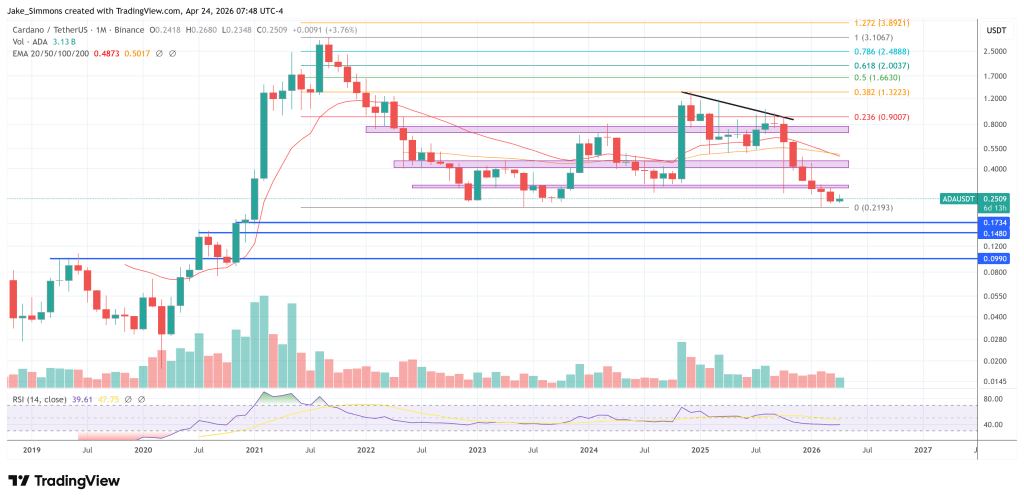
ADA remains below key resistance, 1-monthly chart | Source: ADAUSDT on TradingView.com

Perguntas relacionadas

QWhat is the main problem Charles Hoskinson identified for Cardano and the broader Web3 ecosystem?

AThe main problem is the reliance on centralized off-chain infrastructure, which contradicts the decentralization claims of the industry and creates centralized control points.

QWhich essay by Moxie Marlinspike did Hoskinson reference, and what was its key argument?

AHoskinson referenced the January 2022 essay 'My First Impressions of Web3.' Its key argument was that users don't want to run their own servers, protocols move slowly, and most decentralized applications still depend on centralized companies for the user experience.

QWhat is the proposed long-term role for BlockFrost within the Cardano ecosystem according to Hoskinson?

AHoskinson stated that BlockFrost's long-term role should be to become 'a decentralized infrastructure network,' serving as a decentralized alternative to centralized developer platforms like Alchemy.

QHow did Hoskinson connect the infrastructure problem to Cardano's treasury voting process?

AHe stated that the current treasury proposals are not random funding requests but are part of a strategic, end-to-end push to decentralize the application layer and build off-chain infrastructure that avoids recreating Web2 centralization chokepoints.

QWhat technologies did Hoskinson cite as the cryptographic building blocks that Midnight will bring to Cardano?

AHe cited multi-party computation, zero-knowledge cryptography, and trusted execution environments as the key cryptographic building blocks that Midnight will provide.

Leituras Relacionadas

Bitwise: Crypto Becomes a Contrarian Investment, Three Logics to Understand the Current Market

**Summary** Matt Hougan, Bitwise's CIO, analyzes the current crypto market through three key lenses, arguing it has shifted from a momentum-driven to a contrarian investment. **1) Crypto Becomes a Contrarian Play:** The market is weak, with major assets like Bitcoin and Ethereum down significantly. Capital has moved to hot sectors like AI, leaving crypto as an "unloved" asset class. This transforms crypto investing from trend-following to a test of patience and fundamental analysis. Investors now favor projects with solid fundamentals (e.g., Hyperliquid) over speculative ones. **2) Regulatory Overhang:** The uncertain fate of the U.S. CLARITY Act, a major crypto regulatory framework, is a key headwind. With its passage in 2024 seen as far from guaranteed (estimates range from 30-55%), institutional capital remains on the sidelines, choosing less risky alternatives like AI stocks. The market needs clarity—whether the bill passes or fails—more than any specific outcome to move decisively. **3) Capital Rotates to New Fundamentals:** This cycle differs from past bear markets where money fled to Bitcoin. Now, capital seeks smaller assets with strong use cases. While major cryptos fell in May 2024, tokens like Hyperliquid (+72%), Zcash (+50%), and XLM (+44%) rallied on their specific fundamentals. This rotation confirms the new contrarian, fundamentals-driven logic and signals the bear market may be in its later stages. **Conclusion:** Short-term pressure persists due to regulatory uncertainty and competition from AI narratives. Investing in crypto now requires a contrarian mindset—acting against the crowd and focusing on fundamental value. Patience and targeting high-quality projects based on their merits are essential for capturing long-term gains.

marsbitHá 30m

Bitwise: Crypto Becomes a Contrarian Investment, Three Logics to Understand the Current Market

marsbitHá 30m

ChatGPT Might Be Disappearing Soon

OpenAI announced at its "Intelligence at Work" event that its coding assistant, Codex, will be fully integrated into the ChatGPT app within weeks. This move marks a strategic shift from a conversational AI (Chat) towards a unified "agentic" platform capable of execution. Codex, originally launched to compete with Anthropic's Claude Code, has grown rapidly to 5 million weekly active users, with 20% being non-developers like analysts and designers. Its enterprise revenue now constitutes 40% of OpenAI's total. The integration is the first step in creating a super-app combining ChatGPT (interface), Codex (execution engine), and the Atlas browser (web access). OpenAI also unveiled new Codex features: specialized Agent plugins for six professional roles, an "Annotations" tool for direct document editing, and a "Sites" function to turn work into shareable web apps. Internally, this reflects a power shift; the Codex team now leads core product strategy. While the ChatGPT brand remains for its vast user base, the platform's future is focused on autonomous agents that perform tasks, not just chat. The article notes that competition with Claude Code pushed OpenAI's development, with Codex competing on cost-effectiveness and accessibility rather than raw coding quality. It concludes that the essence of "ChatGPT" is evolving from a chatbot into an AI agent platform, with the name potentially becoming a legacy symbol of its original function.

marsbitHá 40m

ChatGPT Might Be Disappearing Soon

marsbitHá 40m

WWDC26 Ultimate Preview: The All-New Siri is the Main Course, iOS 27 is Another Year of Refinements

Apple has confirmed WWDC26 will begin on June 8, with the keynote at 10 AM PT (1 AM Beijing Time, June 9). This year's focus is expected to shift significantly from routine OS updates to Apple's progress in AI, particularly a major overhaul of Siri. Reports indicate the highlight will be a new Siri, reportedly powered by Google's Gemini technology. This upgraded assistant is expected to appear as a lightweight bubble from the Dynamic Island and be accessible via a unified "Search or Ask" system-wide entry point. It aims to deeply integrate with iOS 27, iPadOS 27, and macOS 27, accessing personal data like messages, photos, and documents, with a potential standalone Siri app also in development. For iOS 27, leaks suggest incremental improvements rather than major redesigns. Key updates may include a redesigned, more customizable Camera app, enhanced photo editing tools within the Photos app, and potential early system optimizations for a future foldable iPhone. The update is also rumored to prioritize bug fixes, stability, and performance optimization. iPadOS 27 is anticipated to focus on improving productivity features like window management, file systems, and external display support to better utilize the iPad's hardware. macOS 27 is seen as a core platform for Apple Intelligence, likely receiving an optimized Siri, new AI features, and continued refinement of the "Liquid Glass" design language. Notably, macOS 27 may finally drop support for Intel-based Macs. The overarching theme for WWDC26 is whether Apple can effectively integrate AI across its ecosystem. The success of the new Siri and Apple Intelligence will be judged on their ability to move beyond standalone features and become a cohesive, context-aware system layer that understands user workflows across iPhone, iPad, Mac, and other devices, while maintaining Apple's emphasis on privacy and stability. The conference represents Apple's critical attempt to catch up and redefine the AI assistant experience after a perceived slow start in the generative AI era.

marsbitHá 1h

WWDC26 Ultimate Preview: The All-New Siri is the Main Course, iOS 27 is Another Year of Refinements

marsbitHá 1h

Trading

Spot
Futuros

Artigos em Destaque

Como comprar ADA

Bem-vindo à HTX.com!Tornámos a compra de Cardano (ADA) simples e conveniente.Segue o nosso guia passo a passo para iniciar a tua jornada no mundo das criptos.Passo 1: cria a tua conta HTXUtiliza o teu e-mail ou número de telefone para te inscreveres numa conta gratuita na HTX.Desfruta de um processo de inscrição sem complicações e desbloqueia todas as funcionalidades.Obter a minha contaPasso 2: vai para Comprar Cripto e escolhe o teu método de pagamentoCartão de crédito/débito: usa o teu visa ou mastercard para comprar Cardano (ADA) instantaneamente.Saldo: usa os fundos da tua conta HTX para transacionar sem problemas.Terceiros: adicionamos métodos de pagamento populares, como Google Pay e Apple Pay, para aumentar a conveniência.P2P: transaciona diretamente com outros utilizadores na HTX.Mercado de balcão (OTC): oferecemos serviços personalizados e taxas de câmbio competitivas para os traders.Passo 3: armazena teu Cardano (ADA)Depois de comprar o teu Cardano (ADA), armazena-o na tua conta HTX.Alternativamente, podes enviá-lo para outro lugar através de transferência blockchain ou usá-lo para transacionar outras criptomoedas.Passo 4: transaciona Cardano (ADA)Transaciona facilmente Cardano (ADA) no mercado à vista da HTX.Acede simplesmente à tua conta, seleciona o teu par de trading, executa as tuas transações e monitoriza em tempo real.Oferecemos uma experiência de fácil utilização tanto para principiantes como para traders experientes.

1.2k Visualizações TotaisPublicado em {updateTime}Atualizado em 2026.06.02

Como comprar ADA

Discussões

Bem-vindo à Comunidade HTX. Aqui, pode manter-se informado sobre os mais recentes desenvolvimentos da plataforma e obter acesso a análises profissionais de mercado. As opiniões dos utilizadores sobre o preço de ADA (ADA) são apresentadas abaixo.

活动图片