Hoskinson Says Cardano Faces A Make-Or-Break Web3 Problem

bitcoinistPublicado em 2026-04-24Última atualização em 2026-04-24

Resumo

Charles Hoskinson argues that Cardano's next phase must address a critical Web3 weakness: the industry's reliance on centralized off-chain infrastructure, which contradicts decentralization ideals. Citing Moxie Marlinspike's essay, he acknowledges Cardano faces the same problem, where user experience often depends on centralized services. Hoskinson proposes that Midnight's cryptographic tools and BlockFrost's transformation into a decentralized infrastructure network are key solutions. He connects this vision to current treasury proposals, emphasizing the need to build scalable, decentralized off-chain systems instead of recreating Web2 centralization.

Charles Hoskinson used his latest livestream to argue that Cardano’s next phase should focus less on abstract decentralization rhetoric and more on fixing a structural weakness he says still defines crypto: the reliance on centralized off-chain infrastructure. In the process, he tied that critique directly to Cardano’s treasury debates around BlockFrost, Midnight, partner chains and the broader direction of the network.

Speaking from Wyoming in a late-night broadcast recorded on April 23, Hoskinson framed the discussion around “My First Impressions of Web3,” a January 2022 essay by Signal co-founder Moxie Marlinspike. He described the piece as one of the texts that convinced him to acquire BlockFrost, saying Moxie had identified “the uncomfortable hidden truths” behind the industry’s decentralization claims.

Cardano Can Succeed Where Web3 Fell Back

Hoskinson spent much of the stream reading and unpacking Marlinspike’s central argument: that users do not want to run their own servers, protocols move slowly, and most supposedly decentralized applications still depend on centralized companies for the actual user experience. One of the essay’s most important passages, in Hoskinson’s telling, was this: “Once a distributed ecosystem centralizes around a platform for convenience, it becomes the worst of both worlds. Centralized control but still distributed enough to become mired in time.”

That line became the throughline of Hoskinson’s own case for Cardano. He acknowledged that the problem is not unique to Ethereum, even though Marlinspike’s original examples focused on Infura, Alchemy, MetaMask and OpenSea. “So, we’ll stop for a moment and we’ll ask is Cardano any different?” Hoskinson said. “The answer is no. That’s the uncomfortable hidden truth that Moxy’s talking about.”

From there, he shifted from diagnosis to strategy. Hoskinson argued that Midnight had to come first because it brings the cryptographic building blocks needed for a more coherent trust model, citing multi-party computation, zero-knowledge cryptography and trusted execution environments. But, he said, privacy and cryptography alone are not enough if the infrastructure layer remains dependent on centralized service providers.

That is where BlockFrost entered the picture. Hoskinson said the company’s long-term role should be to become “a decentralized infrastructure network,” effectively a decentralized alternative to the developer platforms that now sit between users and blockchains. “BlockFrost destiny, should we fund it, is to become the decentralized infra Alchemy that we all wish we would have had,” he said, “and something that Moxy could write about as the proper good alternative, the thing that actually is philosophically consistent.”

He bolstered that point with the economics of crypto infrastructure. Citing a February 2022 funding round, Hoskinson noted that Alchemy reached a $10 billion valuation after raising $200 million, up sharply from a prior $3.5 billion valuation. For Hoskinson, those numbers were not just venture-market trivia. They were evidence that the real control points in crypto often live outside the chain itself, in the companies that host, index and shape the interfaces through which users interact with the network.

Hoskinson also used the stream to connect this thesis to Cardano’s treasury voting process. He said the proposals now in front of the ecosystem are not random funding asks, but part of an end-to-end push to decentralize the application layer, improve scalability, connect Cardano to other systems and build off-chain infrastructure that does not simply recreate Web2 chokepoints.

“There’s always going to be a part that’s offchain,” he said. “It bothered me deeply to say that we are these web three people, but we’ve created an incentive system for companies to accelerate and grow and basically take the off-chain component and define and sculpt the user experience.”

At press time, ADA traded at $0.25.
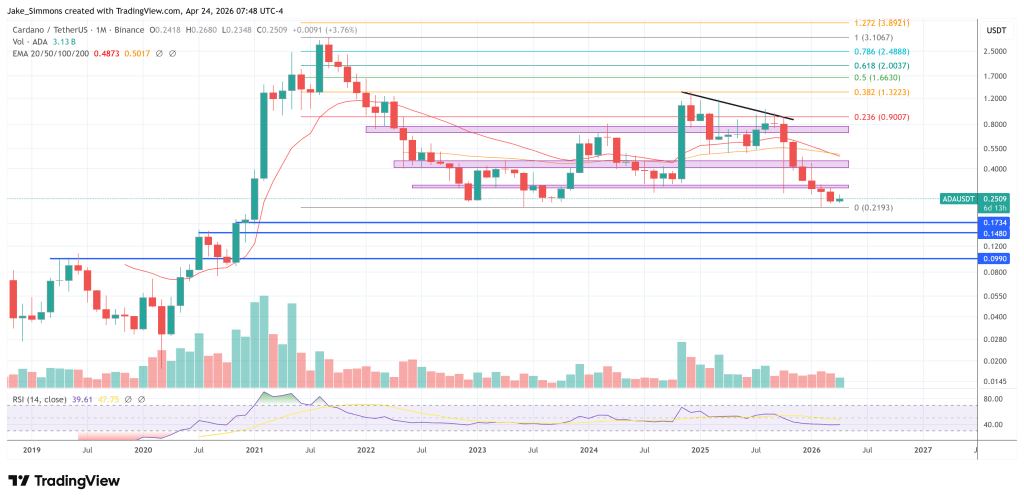
ADA remains below key resistance, 1-monthly chart | Source: ADAUSDT on TradingView.com

Perguntas relacionadas

QWhat is the main problem Charles Hoskinson identified for Cardano and the broader Web3 ecosystem?

AThe main problem is the reliance on centralized off-chain infrastructure, which contradicts the decentralization claims of the industry and creates centralized control points.

QWhich essay by Moxie Marlinspike did Hoskinson reference, and what was its key argument?

AHoskinson referenced the January 2022 essay 'My First Impressions of Web3.' Its key argument was that users don't want to run their own servers, protocols move slowly, and most decentralized applications still depend on centralized companies for the user experience.

QWhat is the proposed long-term role for BlockFrost within the Cardano ecosystem according to Hoskinson?

AHoskinson stated that BlockFrost's long-term role should be to become 'a decentralized infrastructure network,' serving as a decentralized alternative to centralized developer platforms like Alchemy.

QHow did Hoskinson connect the infrastructure problem to Cardano's treasury voting process?

AHe stated that the current treasury proposals are not random funding requests but are part of a strategic, end-to-end push to decentralize the application layer and build off-chain infrastructure that avoids recreating Web2 centralization chokepoints.

QWhat technologies did Hoskinson cite as the cryptographic building blocks that Midnight will bring to Cardano?

AHe cited multi-party computation, zero-knowledge cryptography, and trusted execution environments as the key cryptographic building blocks that Midnight will provide.

Leituras Relacionadas

SpaceX, OpenAI, Anthropic: The Three AI Giants Racing for IPO, Which One Is Worth Betting On?

SpaceX, OpenAI, and Anthropic are poised for historic IPOs within weeks, potentially raising a combined $180 billion—a sum exceeding the entire internet bubble's fundraising. The hosts of the Limitless Podcast argue this isn't just individual company financing but an unprecedented capital concentration for AI infrastructure, driven by an insatiable need for compute, data centers, power, and chips. SpaceX's IPO is notable for reportedly changing market index rules to allow faster inclusion, potentially funneling trillions in passive retirement funds into its stock, despite its unproven space-based data center business model. In contrast, Anthropic demonstrates explosive growth, with ARR reportedly hitting $45 billion and approaching profitability, fueled by strong enterprise adoption of products like Claude Code. Google's separate $80 billion raise highlights the immense capital pressure, even for giants. The discussion acknowledges bubble risks but leans optimistic. The hosts contend the massive spending is building essential physical infrastructure for the next technological era. A key bottleneck isn't capital but the real-world limits of chip manufacturing and construction speed. As long as demand for AI compute outstrips supply, this investment cycle represents a foundational build-out rather than a purely financial bubble. All three companies are seen as foundational bets on the future, with Anthropic often cited as the most immediately compelling due to its proven revenue trajectory.

marsbitHá 1h

SpaceX, OpenAI, Anthropic: The Three AI Giants Racing for IPO, Which One Is Worth Betting On?

marsbitHá 1h

From 'Old Guys' to 'New Favorites': How AI Is Revaluing Old Infrastructure from Dell to Nokia?

From "Vintage Tech" to "New AI Darlings": How AI Revalues Old Infrastructure One year ago, tech giants like Dell, Nokia, Cisco, and Western Data were seen as slow-growth, low-valuation stories, far from the AI spotlight dominated by players like Nvidia. Now, these legacy tech stocks are gaining market attention, sparking debate on whether this is genuine industry revaluation or a temporary narrative. As AI moves from model parameters to real-world data centers, the market is recognizing companies with proven delivery and infrastructure capabilities. This shift marks a change in the AI investment thesis: from pure model and GPU focus to the complex systems engineering required for deployment. Companies like Dell, HPE, and Corning are being revalued not for being "sexy" AI innovators, but for their decades of accumulated expertise in supply chains, enterprise delivery, and infrastructure—assets that have become critical in the AI buildout phase. The revaluation is unfolding across three key infrastructure lines: 1. **Servers & System Integration:** Dell and HPE are emerging as crucial system integrators or "general contractors" for AI data centers, translating GPU orders into complete, deployable server racks integrated with power, cooling, and networking. 2. **Networking & Connectivity:** AI's scale demands robust high-speed connections. Corning (fiber optics), Nokia (AI-RAN, 6G), and Cisco (data center switches) are gaining importance for enabling efficient data transfer within and between AI clusters. 3. **Storage:** Beyond high-speed memory (HBM/DRAM), the AI data explosion is driving demand for high-capacity hard drives (HDDs) from companies like Western Digital and Seagate to handle training data, logs, and cold storage cost-effectively. For this revaluation to be substantive and not just a narrative, three criteria are key: 1) Concrete AI-related order and revenue growth (e.g., Dell's AI server sales), 2) Upward revisions to company financial guidance, and 3) Sustainable improvements in profit quality, not just top-line revenue spikes. In essence, AI's transition to a real construction phase is re-pricing "old assets" against "new demand." The opportunity, however, is selective. Only those legacy firms that are demonstrably integrated into the capital expenditure chains of data center and enterprise AI deployment are likely to experience a true "logic re-rating" rather than just a temporary valuation bounce.

marsbitHá 1h

From 'Old Guys' to 'New Favorites': How AI Is Revaluing Old Infrastructure from Dell to Nokia?

marsbitHá 1h

The Merger of Codex and ChatGPT Marks the Beginning of a Major Reshuffle in Programming Tools

OpenAI is shifting its strategic focus from ChatGPT to Codex, merging them along with the browser tool Atlas into a unified desktop super-app. This move signals an internal belief that Codex, originally a programming tool, represents the next evolution of AI more than conversational models like ChatGPT. Over the past year, Codex's weekly active users have surged past 5 million. The key distinction is that while ChatGPT answers questions, Codex executes tasks. Enterprises increasingly value this ability to get work done over simply receiving advice. Consequently, Codex is attracting professionals beyond developers, including analysts, bankers, marketers, and product managers. OpenAI's reorganization and increased investment in Codex stem from recognizing that the future of AI competition lies in execution capabilities, not just conversation. The company is launching role-specific plugins (e.g., for data analysis, sales, design) to transform Codex into a broad knowledge work platform that automates and redefines white-collar workflows. Beyond being a tool, Codex reflects OpenAI's ambition to redefine software. New features like "Sites"—which generates interactive websites from documents—and collaborative "Annotations" aim to create a paradigm where the AI understands the goal and handles the tools and steps, functioning more like a digital colleague than traditional software. The ultimate goal is a unified experience where the user cares only about the completed task.

marsbitHá 1h

The Merger of Codex and ChatGPT Marks the Beginning of a Major Reshuffle in Programming Tools

marsbitHá 1h

Interpreting Investment Opportunities in the Age of Great Navigation, Invesco Great Wall Fund Releases '2026 Report on Chinese Enterprises Going Global'

Invesco Great Wall Fund has released its "2026 China Corporate Globalization Report," titled "The 'Great Navigation Era' of Chinese Enterprises." The report analyzes the new trends and investment opportunities as Chinese companies expand globally, moving from simple product exports to comprehensive overseas operations involving services, branding, and local production. Driven by factors like trade friction, the pursuit of higher profit margins abroad, and policy support, globalization is becoming essential for Chinese companies. The report outlines an evolution: from early product export ("Globalization 1.0") to the current "Globalization 2.0," characterized by overseas capacity, capital goods investment, consumer brand expansion, and service exports. Chinese firms' competitive advantages are highlighted, including a vast engineer talent pool, low-cost and robust infrastructure, and complete industrial clusters. Specific sectors with significant出海 potential are identified: * **Capital Goods** (e.g., engineering machinery, power equipment): Benefiting from global demand, especially in Belt & Road markets and the AI-driven power grid upgrade cycle. * **Consumer Brands**: Transitioning from cost to brand advantage, leveraging供应链 efficiency. * **Technology & Innovation**: Including AI applications, optical modules within global tech supply chains, and new energy vehicles focusing on local production. * **Pharmaceuticals**: Chinese biotech firms are becoming preferred partners for global pharma, with potential for breakthrough drugs in areas like oncology and weight loss. The report concludes that corporate globalization represents a sustained, core theme for China's capital markets, though companies must navigate challenges like geopolitics and localization.

marsbitHá 1h

Interpreting Investment Opportunities in the Age of Great Navigation, Invesco Great Wall Fund Releases '2026 Report on Chinese Enterprises Going Global'

marsbitHá 1h

Trading

Spot
Futuros

Artigos em Destaque

Como comprar ADA

Bem-vindo à HTX.com!Tornámos a compra de Cardano (ADA) simples e conveniente.Segue o nosso guia passo a passo para iniciar a tua jornada no mundo das criptos.Passo 1: cria a tua conta HTXUtiliza o teu e-mail ou número de telefone para te inscreveres numa conta gratuita na HTX.Desfruta de um processo de inscrição sem complicações e desbloqueia todas as funcionalidades.Obter a minha contaPasso 2: vai para Comprar Cripto e escolhe o teu método de pagamentoCartão de crédito/débito: usa o teu visa ou mastercard para comprar Cardano (ADA) instantaneamente.Saldo: usa os fundos da tua conta HTX para transacionar sem problemas.Terceiros: adicionamos métodos de pagamento populares, como Google Pay e Apple Pay, para aumentar a conveniência.P2P: transaciona diretamente com outros utilizadores na HTX.Mercado de balcão (OTC): oferecemos serviços personalizados e taxas de câmbio competitivas para os traders.Passo 3: armazena teu Cardano (ADA)Depois de comprar o teu Cardano (ADA), armazena-o na tua conta HTX.Alternativamente, podes enviá-lo para outro lugar através de transferência blockchain ou usá-lo para transacionar outras criptomoedas.Passo 4: transaciona Cardano (ADA)Transaciona facilmente Cardano (ADA) no mercado à vista da HTX.Acede simplesmente à tua conta, seleciona o teu par de trading, executa as tuas transações e monitoriza em tempo real.Oferecemos uma experiência de fácil utilização tanto para principiantes como para traders experientes.

1.3k Visualizações TotaisPublicado em {updateTime}Atualizado em 2026.06.02

Como comprar ADA

Discussões

Bem-vindo à Comunidade HTX. Aqui, pode manter-se informado sobre os mais recentes desenvolvimentos da plataforma e obter acesso a análises profissionais de mercado. As opiniões dos utilizadores sobre o preço de ADA (ADA) são apresentadas abaixo.

活动图片













