Hoskinson Blasts Ripple CEO Garlinghouse In Fresh Public Rant

bitcoinistPublicado em 2026-01-19Última atualização em 2026-01-19

Resumo

Cardano founder Charles Hoskinson criticized Ripple CEO Brad Garlinghouse in a video on January 18, 2026, for supporting the US Clarity Act, which Hoskinson argues would expand the SEC's authority and harm the crypto industry. He claimed the bill, with 137 amendments, would treat all new projects as securities by default, forcing them to seek regulatory relief. Hoskinson called this worse than the current regulatory uncertainty, accusing Garlinghouse and others of compromising too easily. He warned that passing a flawed bill would make meaningful change nearly impossible, citing the long-standing Securities Exchange Act of 1933. Hoskinson also expressed concerns about the industry moving toward custodial wallets, KYC, and reversible transactions, which he believes betray crypto's original revolutionary ethos. At the time of reporting, XRP was trading at $1.95.

Cardano founder Charles Hoskinson took aim at Ripple CEO Brad Garlinghouse in a January 18, 2026 video, criticizing what he framed as an industry push to accept the US Clarity Act on terms that would expand the Securities and Exchange Commission’s authority over new projects.

Speaking on Jan 18, Hoskinson used a wide-ranging monologue on market fatigue, industry morale, and the mission behind Cardano and Midnight to zero in on a regulatory flashpoint: a bill he described as swollen by “137 amendments” and tilted toward the SEC. In his telling, the proposal would force crypto projects to “go beg and plead” for relief, with “all new projects” treated as securities by default.

Why Hoskinson Blasted Ripple CEO Garlinghouse

Hoskinson argued that the outcome would be a strategic own-goal, worse, in his view, than the policy uncertainty the industry has been trying to escape. “How is that any better than what Scary Gary [Gensler] gave us under Biden?” he said, referring to the SEC’s enforcement action against the crypto industry under former US President Joe Biden, before extending the critique to lobbying and political dealmaking more broadly.

Hoskinson’s sharpest remarks came when he cited unnamed industry figures he suggested are urging compromise, then called out Garlinghouse directly. “Still got people like Brad [Garlinghouse] saying well it’s not perfect but we just got to get something,” he said. “You know, it’s better than no clarity. Hand it to the same people who sued us. Hand it to the same people who put us out of business, who subpoenaed us, who put us in jail. That’s better. That’s what we fought for.”

He then framed the decision as effectively irreversible once legislated, invoking the long life of US securities law to argue that a flawed framework would calcify. “And tell me, how do we change it? Like we changed the Securities Exchange Act of 1933,” Hoskinson said. “93 years later, have we been able to change it? No. You pass it, you own it forever. Sorry, Brad. It’s not better than chaos. Take the chaos and fight for what’s right. Fight for integrity.”

While the Garlinghouse jab was the most explicit, Hoskinson placed it inside a larger narrative: that crypto’s purpose is being reduced to a lobbying-driven contest for acceptable market access rather than an attempt to redesign how value and identity are handled online.

He argued that the industry is at risk of normalizing a world of “custodial wallet” defaults, pervasive KYC, and reversible transactions, outcomes he associated with legacy power structures rather than the original “revolution” ethos.

“I didn’t sign up to hand the revolution to 15 banks,” he said, describing a future where transactions can be “frozen at a whim.” Hoskinson linked those concerns to a broader critique of technological surveillance and what he called the loss of individual “agency,” suggesting the industry’s incentive structure is pulling leaders toward comfort and access rather than confrontation.

The remarks landed amid a separate thread in his talk: a rebuke of what he called “toxic learned hopelessness” in crypto discourse. Hoskinson said he had stopped using X/Twitter, still broadcasting, but not reading or engaging—arguing that constant outrage and demands for instant announcements distort how long negotiations and product development actually work.

At press time, XRP traded at $1.95.
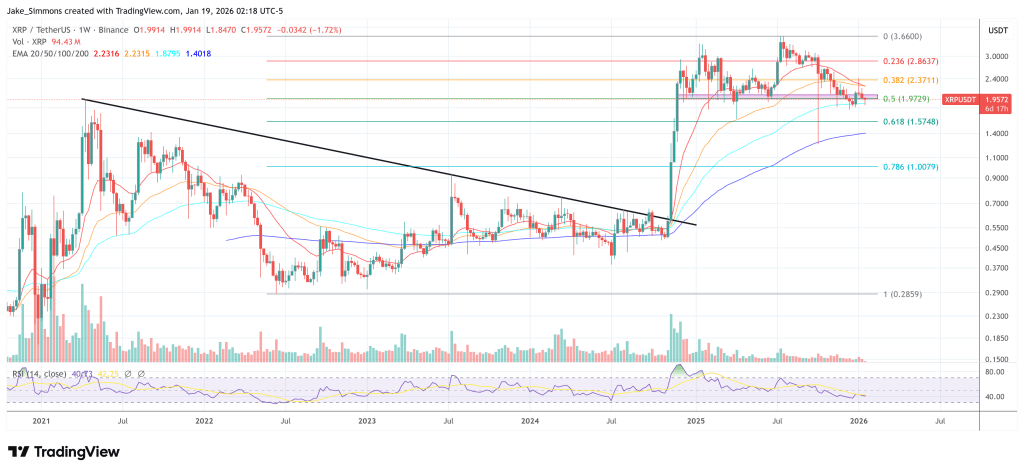
XRP falls into the red support zone again, 1-week chart | Source: XRPUSDT on TradingView.com

Perguntas relacionadas

QWhat was the main criticism Charles Hoskinson directed at Brad Garlinghouse in his January 18, 2026 video?

AHoskinson criticized Garlinghouse for advocating to accept the US Clarity Act despite its flaws, arguing that compromising with a bill that expands SEC authority and treats all new projects as securities by default is worse than regulatory chaos.

QAccording to Hoskinson, what negative outcomes would the proposed regulatory framework lead to for the crypto industry?

AHoskinson argued it would force crypto projects to beg for relief, treat all new projects as securities by default, normalize custodial wallets, pervasive KYC, and reversible transactions, ultimately handing control to traditional banks and allowing transactions to be frozen at a whim.

QWhy does Hoskinson believe that passing a flawed regulatory framework would be effectively irreversible?

AHe invoked the long life of US securities law, specifically referencing the Securities Exchange Act of 1933 which hasn't been changed in over 93 years, arguing that once such a framework is passed, the industry would be stuck with it forever.

QBeyond criticizing Garlinghouse, what broader concern did Hoskinson express about the crypto industry's direction?

AHe expressed concern that the industry's purpose is being reduced to a lobbying-driven contest for acceptable market access rather than a revolution to redesign how value and identity are handled online, and that leaders are being pulled toward comfort and access rather than confrontation.

QWhat did Hoskinson say about his own engagement with social media platform X/Twitter?

AHoskinson stated that he had stopped using X/Twitter in terms of reading or engaging with content, though he still broadcasts, due to what he called 'toxic learned hopelessness' and the distortion that constant outrage and demands for instant announcements create.

Leituras Relacionadas

Coldcard Hardware Wallet Hacked: 594 Bitcoin Withdrawn in 25 Minutes

The Coldcard hardware wallet has been compromised, with hackers stealing approximately 594.5 Bitcoin (~$40 million) from 500 addresses in just 25 minutes. The root cause was a critical software bug, undetected for five years, which disabled the device's secure chip for generating true random numbers. This led to the creation of private keys based on predictable data like the processor's serial number, drastically reducing cryptographic security. The attackers exploited this offline by brute-forcing possible seed phrases, finding active addresses on the public ledger, and signing transactions. Initially, Coinkite (Coldcard's maker) claimed only older models were at risk but later admitted all devices running the compromised firmware were vulnerable. CEO Rodolphe Novak (NVK) apologized but ruled out financial compensation for affected users. To secure funds, owners must urgently update their firmware to specific safe versions, generate a completely new seed phrase on the updated device, and transfer all assets to new addresses created with that new seed. While a BIP-39 passphrase can help, it does not replace this migration process. Other Coinkite products like TAPSIGNER were not affected. This incident underscores that even specialized hardware requires rigorous, independent code audits, especially for cryptographic functions. It parallels past failures, like a 2006 OpenSSL bug in Debian, and raises questions about whether automated code analysis can ever fully replace human scrutiny in critical security areas.

cryptonews.ruHá 3m

Coldcard Hardware Wallet Hacked: 594 Bitcoin Withdrawn in 25 Minutes

cryptonews.ruHá 3m

Trading

Spot
活动图片