Hormuz Strait Sparks Oil War, Will the Fed Cut Rates in June First?

marsbitPublicado em 2026-03-12Última atualização em 2026-03-12

Resumo

U.S. February CPI data showed inflation remained at 2.4% year-on-year, with core CPI at 2.5%, indicating persistent price pressures. The report, collected before U.S.-Israel airstrikes on Iran, did not fully reflect potential energy price impacts from recent geopolitical tensions. Morgan Stanley maintains expectations for two 25-basis-point Fed rate cuts in June and September, though rising oil prices could delay this timeline. Market probabilities currently favor a 64% chance of a June cut. Escalating military conflict between the U.S./Israel and Iran has heightened risks of a major oil supply shock. Iran's threat to close the Strait of Hormuz, a critical chokepoint for 20% of global oil shipments, has already driven Brent crude above $100 per barrel. A prolonged closure could push prices to $150 or higher, reminiscent of 1970s-style energy crises, potentially forcing the Fed to maintain higher rates for longer. Bitcoin continues to trade between $54,000 and $78,400, showing relative resilience compared to traditional assets like stocks and bonds. While short-term holders are selling at a loss—a typical bearish signal—crypto market leverage has significantly reduced, decreasing forced selling pressure. The upcoming FOMC meeting remains a key catalyst for both traditional and crypto markets.

On March 11, the U.S. Bureau of Labor Statistics released the February Consumer Price Index (CPI) report, showing a seasonally adjusted CPI increase of 0.3% month-on-month and a year-on-year rise of 2.4%, unchanged from January; core CPI rose 0.2% month-on-month and 2.5% year-on-year.

Also consistent with the previous month. The energy index rose 0.5% month-on-month, with gasoline prices up 0.8% monthly but still down 5.6% annually; the food index rose 0.4% month-on-month, with an annual increase of 3.1%; the housing component rose 3.0% year-on-year, with only a 0.2% monthly increase, indicating that rent and owner's equivalent rent pressures have eased.

This report was largely in line with market expectations, with inflation stagnating at 2.4% and core indicators showing no significant signs of accelerated decline. The February data collection ended in late February, just before the first U.S.-Israel airstrike on Iran, so it did not fully reflect the subsequent impact of energy price fluctuations. Multiple institutions pointed out that if the slight downward bias from data filling methods during the government shutdown is excluded, actual inflation may be close to 2.8%; conversely, if tariff transmission effects are excluded, it may fall to around 2.2%. However, regardless of the adjustment, inflation remains some distance from the Fed's 2% target, especially with sticky components like housing and services remaining at high levels.

Morgan Stanley noted that the Fed may still cut rates as early as June, but the oil price shock triggered by the Iran conflict could delay this process.

The bank's economists maintain their previous forecast, expecting the Fed to cut rates by 25 basis points each in June and September this year—despite rising energy prices potentially exacerbating inflationary pressures. However, they also believe that the Fed may delay the first rate cut to September or even December, both of which could push the next rate cut to 2027.
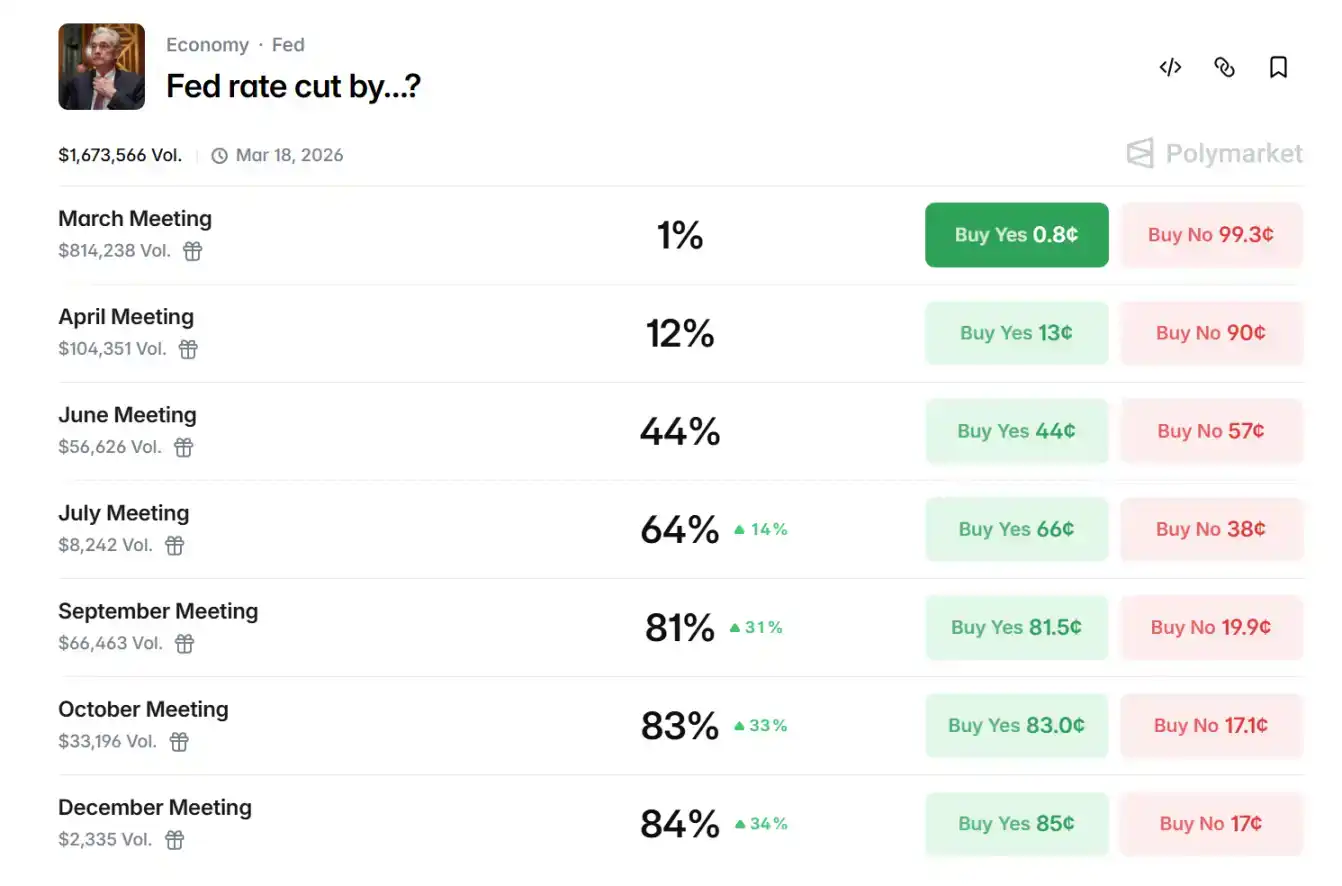
Data from Polymarket shows that the market is currently betting on an 81% probability of a rate cut in September this year, a 64% probability in June, and a 12% probability in April.

Looking ahead to the second half of the year, the Fed's rate cut path remains uncertain. The evolution of the war, inflation trajectory, and employment data will be key variables. If energy prices continue to rise, the Fed may choose to extend the high-interest-rate cycle; conversely, if geopolitical risks ease and core inflation declines, it could open the door for one or two rate cuts. For crypto assets, maintaining high interest rates will continue to suppress risk appetite and valuations, but once a clear signal of rate cuts emerges, market liquidity will recover, providing momentum for Bitcoin's price rise.

Hormuz Strait Becomes Focus, Oil Crisis Imminent

The simultaneous U.S.-Iran military conflict further complicates the policy balance.

On February 28, the U.S. and Israel launched a joint airstrike on Iran. The conflict has lasted nearly two weeks, involving multiple rounds of strikes, energy facility risks, and regional chain reactions. Iran's potential control over the Hormuz Strait has raised global energy supply concerns, with the CPI energy component's month-on-month rebound being an initial reflection.

Iran's Islamic Revolutionary Guard Corps (IRGC) explicitly warned that it would not allow "a single liter of oil" to pass through the Hormuz Strait and claimed that if the blockade continues, oil prices could soar to $200/barrel. The Strait, as a global energy chokepoint, is effectively closed. Satellite data shows most oil tankers are stranded or detouring on both sides of the Strait. Iranian broadcasts warn that any ship attempting to pass will be attacked. The U.S. Navy provides limited escort coverage, leading to a sharp decline in actual traffic.
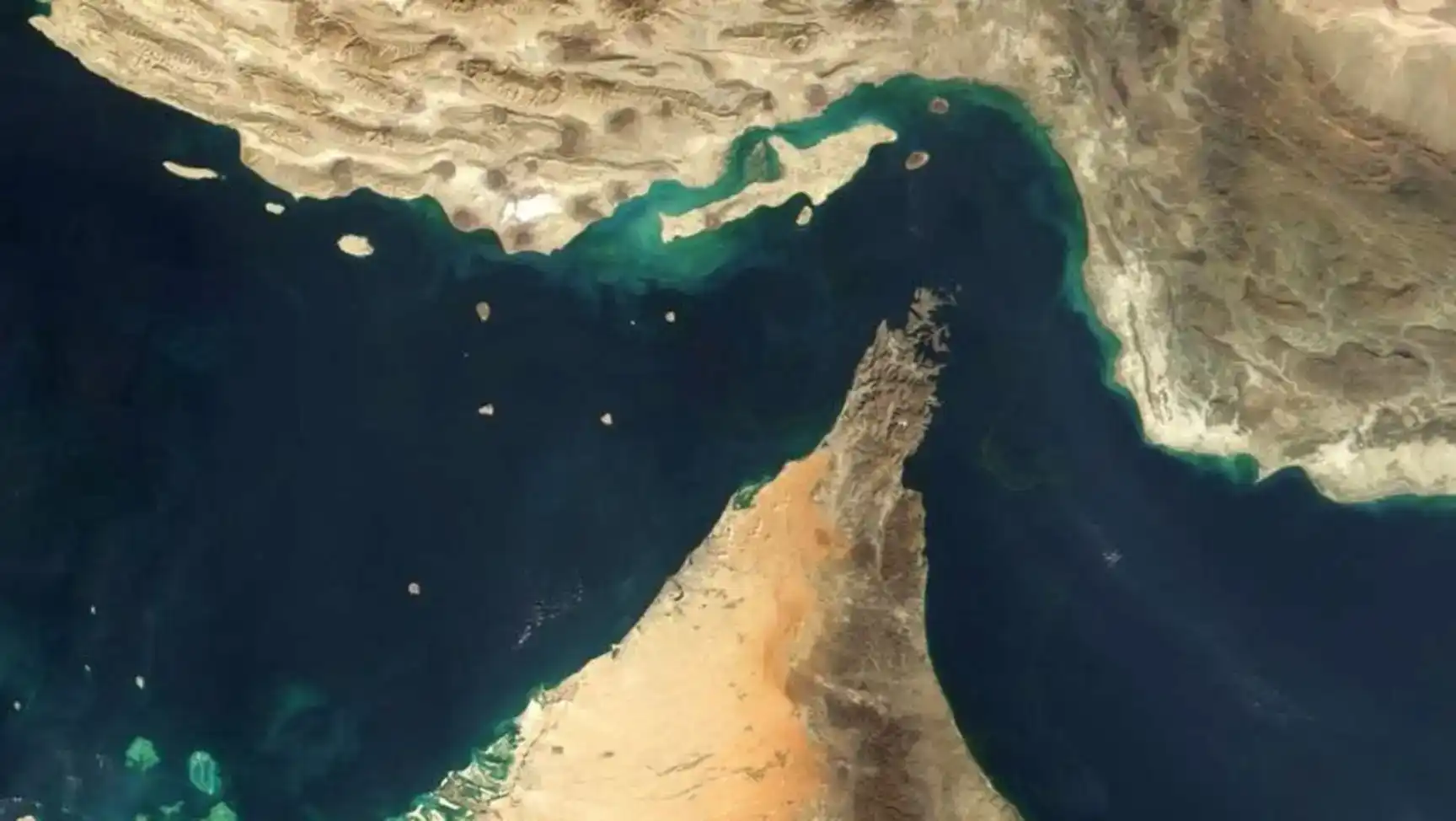
The Hormuz Strait carries approximately 20 million barrels of crude oil and petroleum products daily, accounting for about 20% of global oil consumption and one-fifth of global seaborne liquefied natural gas (LNG), mainly from exports by Saudi Arabia, Iraq, the UAE, Kuwait, and Iran itself, with destinations primarily in Asia (led by China, India, Japan, and South Korea). Once this bottleneck is cut off, a structural gap in global supply immediately emerges.

From a macroeconomic transmission mechanism perspective, the U.S.-Iran conflict systematically constrains the Fed's rate cut path through the core channel of oil prices. First, the conflict directly impacts global oil supply security. The Hormuz Strait handles about 21% of global seaborne oil trade. Any shipping disruption risk or military threats will immediately push up risk premiums, leading to significant upward pressure on international oil prices. Iran has threatened to maintain the blockade if the conflict persists. Analysts warn that prices could test the $120-150/barrel range in the short term, or even higher; in the long term, if the Strait remains closed for weeks, it could recreate a 1970s-style energy shock,叠加 cost-push inflation.

Historical cases clearly support this logic: During the 1990 Gulf War, soaring oil prices led the Fed to pause its easing cycle; after the 2011 Middle East turmoil and the 2022 Russia-Ukraine conflict, energy price shocks forced the Fed to maintain a tightening stance or delay easing. Although the current U.S.-Iran situation has not yet evolved into a full-blown energy crisis, its persistent disturbance to oil prices is enough to make the FOMC more conservative in assessing financial conditions and inflation prospects, avoiding any easing signals that could amplify risks.

Market data shows that on March 12, Brent crude futures returned above the $100 mark, rising nearly 9% intraday. WTI crude oil is currently at $93.52, up over 8% intraday.

What’s Next for BTC

Since October 2025, Glassnode on-chain data shows that the 7-day exponential moving average for short-term holders has remained below 1, currently at 0.985, confirming that recent buyers are selling at a loss—a typical characteristic of a bear market phase.
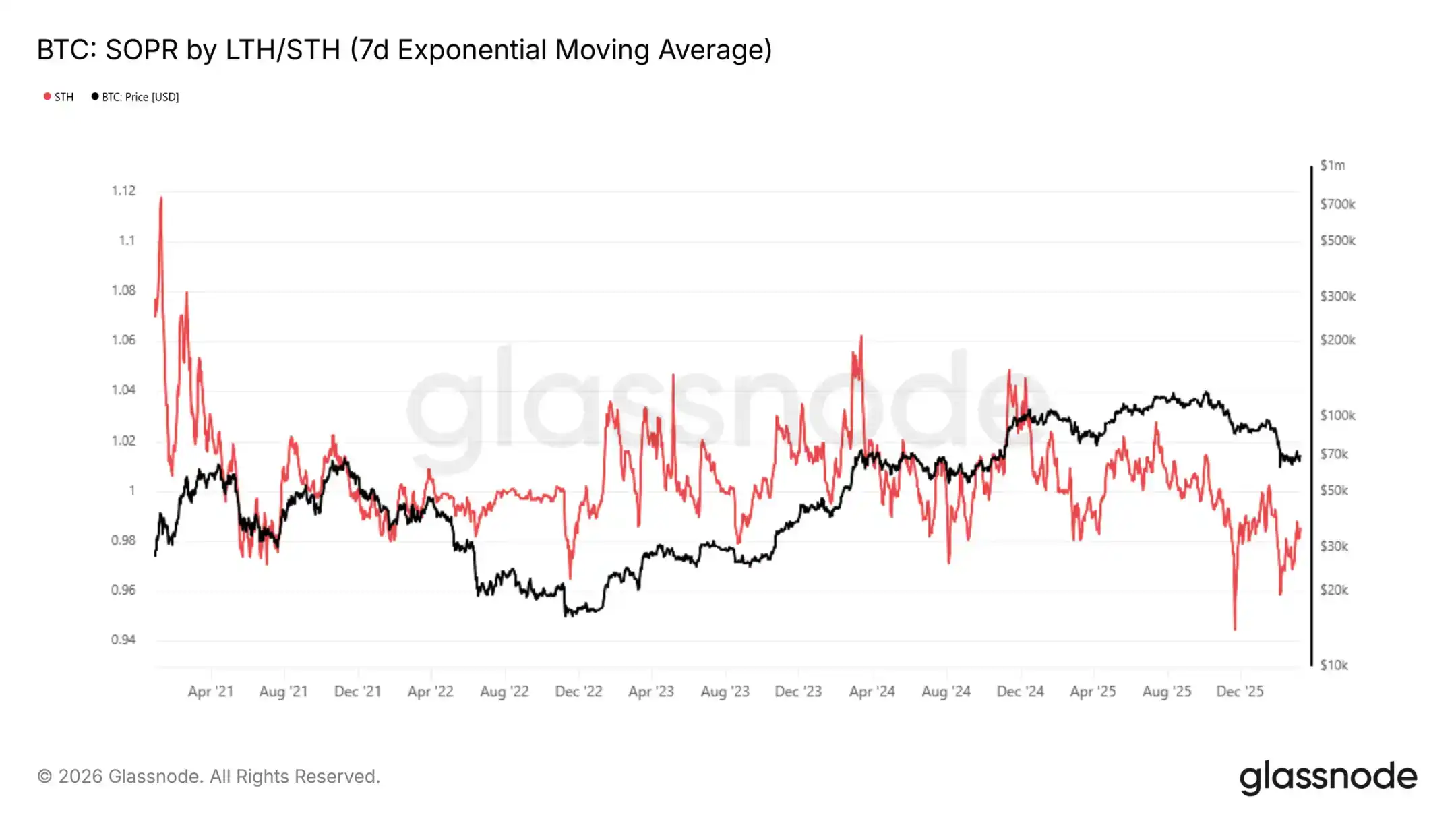
Prices continue to be constrained between the realized price of $54,400 and the true market average price of $78,400. Before decisively stabilizing above $70,000, returns show a明显的 negative skew.

Wintermute stated that macro factors are currently dominating everything, but cryptocurrencies showed resilience last week while stocks, bonds, and even gold fell. The high correlation between cryptocurrencies and stocks in recent quarters is beginning to show cracks. The most likely explanation is that marginal sellers are scarce. The leverage scale in the cryptocurrency market is about $60 billion, roughly half of the peak level. In contrast, speculative positions in gold have accumulated significantly. When all assets fall, cryptocurrencies need to absorb much less forced selling pressure.

From a 12-18 month cycle perspective, the current price level is quite attractive, although the range where BTC buyers are willing to enter extends from the current price down to the low $50,000s. The market still has room to fall further, but most of the deleveraging phase seems to be over. Currently, cryptocurrencies are holding their ground and narrowing the performance gap with other risk assets. Whether this trend can continue once trading volume recovers remains to be seen. Next week's FOMC meeting is a near-term catalyst.

For precious metals, according to Bitget market data, gold is currently oscillating around $5,153, while silver is hovering around $85. The U.S. dollar index (DXY) is currently fluctuating in the 99.35-99.48 range. For U.S. bonds, the 10-year Treasury yield is about 4.21%-4.25%, with a slight intraday increase.
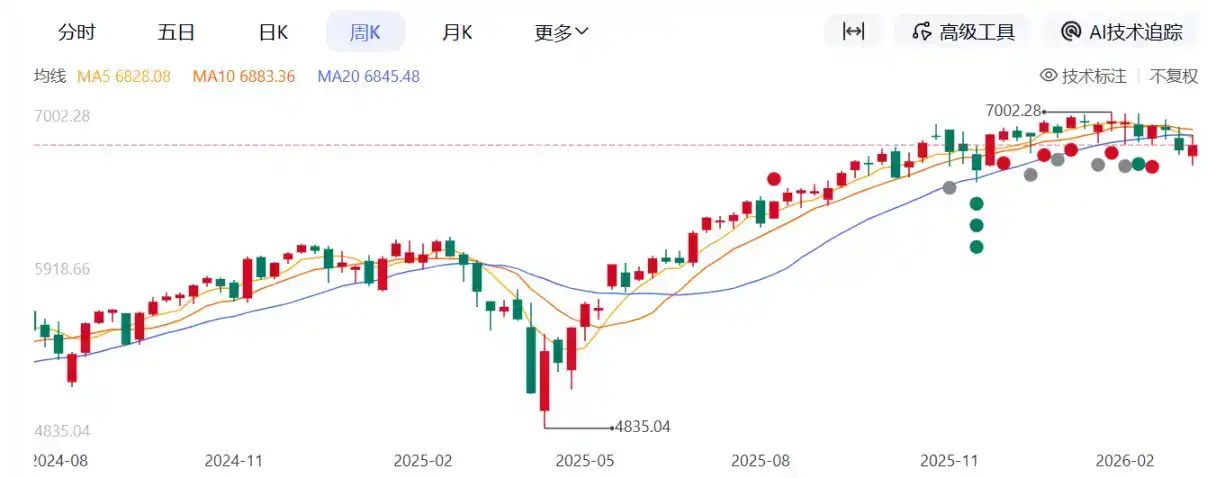
The S&P 500 index is still correcting, currently at 6,775.8. The Nasdaq index is up slightly, currently at 22,716.


Perguntas relacionadas

QWhat was the year-over-year CPI inflation rate reported for February, and how did it compare to January?

AThe year-over-year CPI inflation rate for February was 2.4%, which was unchanged from January.

QAccording to the article, what is the primary macroeconomic mechanism through which the US-Iran conflict is impacting the Federal Reserve's potential interest rate cuts?

AThe conflict is impacting the Fed's rate cut path through its effect on oil prices. A blockade or threat to the Strait of Hormuz creates a risk premium and pushes international oil prices higher, which can lead to cost-push inflation and force the Fed to maintain a more conservative, higher-for-longer interest rate stance.

QWhat specific warning did the Iranian Islamic Revolutionary Guard Corps (IRGC) issue regarding the Strait of Hormuz?

AThe IRGC warned that it would not allow "a single liter of oil" to pass through the Strait of Hormuz and declared that any ship attempting to pass would be attacked.

QBased on Polymarket data cited in the article, what was the probability the market was assigning to a Federal Reserve rate cut in June at the time of writing?

AAccording to Polymarket data, the probability of a rate cut in June was 64%.

QWhat does the article suggest is a key difference between the current state of the cryptocurrency market and traditional markets like stocks and gold?

AThe article suggests that the cryptocurrency market is showing resilience and a decoupling from traditional assets. It states that while stocks, bonds, and gold were falling, crypto held its ground, partly because its leverage has been reduced to about half its peak, meaning there is less forced selling pressure to absorb compared to gold, which has seen a large buildup of speculative positions.

Leituras Relacionadas

That Year, Elon Musk and I Talked About His "Space Dream"

"The Year I Talked to Musk About His 'Space Dream'" by Zhang Peng. On June 12, 2024, SpaceX, now incorporating X, xAI, and Starlink, completed a historic IPO, reaching a $2 trillion valuation. This piece reflects on a 2014 conversation between the author, founder of GeekPark, and Elon Musk during his first public appearance in China at the GeekPark Singularity Summit. Their discussion centered on Musk's motivations and unique mindset. Musk described himself not as a CEO but as an "engineer" driven to solve fundamental problems. He explained his work on Tesla aimed to shift the automotive industry's paradigm toward sustainable transport, while SpaceX was born from a desire to make humanity a multi-planetary species, drastically reducing space access costs through reusability. He emphasized persistence in the face of likely failure, noting that traditional entities like NASA, with abundant resources, often lacked the imperative for radical innovation that drives commercial ventures. Musk dismissed the idea of entering politics, believing change is best achieved through compelling products. The author sees the 2020 successful Crew Dragon launch as a pivotal moment, marking the maturation of commercial spaceflight and the true beginning of a scalable, industry-driven space age. He views Musk as a pioneer clearing the path for broader participation, expressing hope that affordable space travel will become a reality, fueled by commercial momentum.

marsbitHá 7m

That Year, Elon Musk and I Talked About His "Space Dream"

marsbitHá 7m

US Government Suddenly Halts Anthropic's Strongest Model, "Quasi-IPO Stock Price" Plunges 3.7% Overnight

U.S. Government Halts Anthropic's Top AI Models, 'Pre-IPO' Price Drops 3.7% On June 12, the U.S. government ordered Anthropic to shut down access to its two most powerful AI models, Claude Fable 5 and Claude Mythos 5, citing national security concerns. The directive, issued by the Department of Commerce, required Anthropic to block access for all foreign nationals, leading the company to disable the models globally for all users. Anthropic strongly opposed the move, arguing the government's basis was a "narrow jailbreak vulnerability" and warning that applying such a standard industry-wide would effectively halt all frontier model deployments. The news impacted Anthropic's implied valuation in speculative markets. The Anthropic perpetual contract on Hyperliquid fell approximately 3.7% to around $1,627, down from highs above $1,800 following the models' release. Unauthorized tokenized products linked to Anthropic on Solana also saw significant declines. The models, launched just days earlier on June 9, represented a major capability leap for Anthropic. Fable 5 was its first public release of a "Mythos"-tier model above its flagship Claude Opus. The shutdown creates an ironic situation for Anthropic, a company founded on "AI safety" principles, and adds uncertainty to its ongoing IPO preparations. The company is actively engaging with regulators to resolve what it calls a "misunderstanding" and restore service.

marsbitHá 27m

US Government Suddenly Halts Anthropic's Strongest Model, "Quasi-IPO Stock Price" Plunges 3.7% Overnight

marsbitHá 27m

SpaceX IPO Creates Trillion-Dollar Billionaire: Musk's Wealth Equals Half of Crypto Market

SpaceX's record-breaking IPO has propelled Elon Musk to become the first modern billionaire with a personal net worth exceeding $1 trillion, reaching $1.11 trillion according to Bloomberg. This staggering wealth surpasses the total market capitalization of all cryptocurrencies excluding Bitcoin and equals roughly half of the entire crypto market's value. The milestone highlights extreme wealth concentration and the significant devaluation of the altcoin market, whose total cap has nearly halved since late 2025 as capital flows into large tech stocks. SpaceX's Nasdaq debut saw its valuation hit $2.2 trillion, with shares soaring from a $135 offer price to close at $161. Its first-day trading volume of $85 billion set a new global IPO record. Musk owns 42% of the company. Despite his wealth dwarfing the altcoin sector, Musk maintains deep ties to digital assets. He personally holds Bitcoin, Ethereum, and Dogecoin, while his companies, SpaceX and Tesla, collectively hold over 30,000 Bitcoin, ranking among the top corporate BTC holders globally. His acquisition and integration of financial data tools into X (formerly Twitter) further connect his ecosystem to the markets. Ultimately, Musk's trillion-dollar status underscores the immense wealth controlled by tech founders, though this fortune remains largely tied to volatile stock prices rather than liquid assets.

Foresight NewsHá 35m

SpaceX IPO Creates Trillion-Dollar Billionaire: Musk's Wealth Equals Half of Crypto Market

Foresight NewsHá 35m

Hardcore First Look | Ocean Embodied Intelligence Company 'Shihang Intelligence' Secures Record-Breaking 1 Billion in Funding, Zhu Xiaohu, Temasek Place Bets

Breaking News | Ocean Embodied Intelligence company "Shihang Intelligent" secures a record-breaking 1 billion RMB (approximately 10 billion yuan) in Series A financing, with investment from Zhu Xiaohu and Temasek. Author: Qiu Xiaofen | Editor: Yuan Silai Ocean Embodied Intelligence company "Shihang Intelligent" has completed its Series A funding round, raising over 1 billion RMB. This marks the largest single funding round in the global marine robotics field to date. Investors include upstream momentum funds from chip companies "Moore Thread" and "Kunlunxin," Singapore's state-owned investment platform Vertex Growth, and listed company Dyneo, among others. Existing investors like GSR Ventures (whose founder Zhu Xiaohu has invested for the fifth time), Vertex Ventures China, Hua Ying Capital, and Long Capital also significantly increased their investments. Founder and CEO Chen Xiaobo, a 1989-born alumnus of Harbin Engineering University, is a long-time expert in underwater robotics. He received the National Defense Science and Technology Progress Award at age 28 (the youngest recipient) and led the development of China's first commercial underwater cleaning robot. The funds will be used for core technology R&D, global market expansion, and building the industry chain ecosystem to scale the application of marine robots in complex underwater scenarios. The ocean is considered one of the most challenging environments for robotics due to low light, high turbidity, complex currents, limited communication, high pressure, and corrosion. "Shihang Intelligent" focuses on developing core underlying technologies for marine robots, covering six key systems: power, control, sensing, navigation, sealing, and deployment. Its robots are capable of operating at depths from 0 to 10,000 meters with full degrees of freedom, performing complex maneuvers, autonomous navigation, and multi-robot collaboration. Applications include ship cleaning, underwater security, offshore wind power, marine ranching, and seabed inspection. The company's order value for the first half of 2026 alone has exceeded 1 billion RMB. Its "Orca Robot" is used by major shipping companies and has performed maintenance on over a thousand large vessels. In April of this year, the company launched its ocean embodied large model "Cangqiong CEORION." Unlike traditional remote-controlled or pre-programmed robots, this model integrates environmental perception, task understanding, and action generation into a single end-to-end architecture. Trained on millions of hours of commercial operation data and simulation data, it covers 12 major underwater operation scenarios. In simulations, it achieved over 90% task success rate and over 70% zero-shot adaptation capability to unseen environments. A built-in physics reasoning module reduces collision risk by 80%, enabling autonomous operation even with weak or no communication. Recently, "Shihang Intelligent" was selected as a core technology partner for Singapore's Maritime and Port Authority national hull inspection and cleaning program. These advancements indicate marine robotics is moving from pilot projects to scaled applications, with real-world operations generating valuable data to continuously improve robot capabilities. CEO Chen Xiaobo stated the company will continue investing in core marine robotics technology, the embodied intelligence model, and global application scenarios to expand into more high-risk, high-difficulty, and high-value underwater operations.

marsbitHá 1h

Hardcore First Look | Ocean Embodied Intelligence Company 'Shihang Intelligence' Secures Record-Breaking 1 Billion in Funding, Zhu Xiaohu, Temasek Place Bets

marsbitHá 1h

Three Months, 35 Billion Yuan: Investors Rush to Grab the OpenAI of the Physical World

Investors flock to a physical AI startup as the race for the "OpenAI of the physical world" heats up. Ji Jia Shi Jie (GigaWorld), a company dedicated to developing Artificial General Intelligence (AGI) for the physical world, has raised 3.5 billion RMB (approximately $490 million) in just three months, according to a report from investment media outlet Touzijie. The latest B2 funding round of 1 billion RMB attracted a wide range of top-tier investors, including sovereign wealth funds, industrial capital, and financial institutions. This brings the total funding for the young company, now valued over 10 billion RMB, to 3.5 billion RMB across three recent rounds. The company is led by Huang Guan, a post-90s Tsinghua University PhD with extensive experience in AI, autonomous driving, and entrepreneurship. Its core innovation is a "dual-pyramid" system comprising a five-layer data pyramid (from internet videos to real-world robot data) and a three-layer algorithm pyramid focused on world simulation, action alignment, and reinforcement learning. This system underpins its key models: the "World Action Model" (e.g., GigaBrain series for robot control) and the "World Generation Model" (e.g., GigaWorld series for simulating and understanding the physical world). Its models have reportedly achieved top rankings in global robotics benchmarks. Ji Jia Shi Jie argues that while current digital AGI excels in information processing, the next frontier is physical AGI—systems that can understand and interact with the real world. The company believes the field is approaching its "GPT-3 moment," a key inflection point in capability scaling. To achieve this, the company is pursuing a dual-market strategy. For the consumer (C) market, it launched the "SeeLight" brand and its S1 general-purpose humanoid robot, which has secured initial orders for deployment in real homes. For the business (B) market, it focuses on industrial automation with its Maker series robots, having signed agreements for large-scale deployment in factories, and its DriveDreamer world model for autonomous driving, which is already in use with over 30 automakers and tech companies. The report concludes that by bridging the gap between digital intelligence and physical action, Ji Jia Shi Jie aims to unlock a new wave of productivity, ultimately bringing physical AGI into everyday life.

marsbitHá 1h

Three Months, 35 Billion Yuan: Investors Rush to Grab the OpenAI of the Physical World

marsbitHá 1h

Trading

Spot
Futuros
活动图片




