Hormuz Strait Reopening: Will the Fed Turn "Dovish" and the Market Reprice "Rate Cuts"?

marsbitPublicado em 2026-06-16Última atualização em 2026-06-16

Resumo

The article outlines two key factors that may lead the U.S. Federal Reserve, under Chair Wash, to adopt a more dovish stance at the upcoming FOMC meeting. First, the anticipated reopening of the Strait of Hormuz is expected to ease oil and energy prices, thereby reducing upward inflationary pressures. This shift could lead the Fed to view energy prices as a neutral or even deflationary factor. Second, recent core CPI data showed significant cooling, with a monthly increase of only 0.21%, contrasting with the still-strong core PCE. This divergence supports a dovish interpretation. Market implications are significant. While the FOMC is expected to remove "easing bias" language and project unchanged rates for the year—moves already priced in—Chair Wash's potential for more dovish commentary presents an upside risk. Consequently, there is room for the market to further price out remaining hike expectations and increase expectations for rate cuts. The report notes that the 2-year Treasury yield, though down recently, remains well above February levels, indicating further potential downside as inflation risks fade.

Written by: Zhao Ying

Source: Wall Street News

Two major catalysts for disinflation are simultaneously unfolding, providing ample justification for Fed Chair Wash to adopt a more dovish stance at this week's Federal Open Market Committee (FOMC) meeting.

According to a report from Citi Research released on June 15th via Wind Trading Desk, the planned reopening of the Strait of Hormuz is expected to push oil prices lower, eliminating the upside risk to inflation from energy prices. Meanwhile, last week's core CPI data came in surprisingly cool, with a month-on-month increase of only 0.21%.

The combination of these two developments further weakens the rationale for the Fed to maintain a hawkish stance, bringing the path to eventual rate cuts back onto the table.

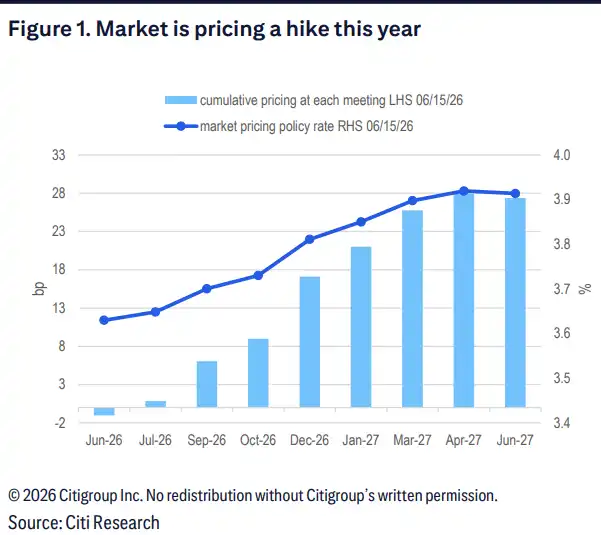
For the markets, this assessment has direct pricing implications. The two-year Treasury yield has fallen by about 13 basis points compared to a week ago, but remains more than 60 basis points higher than its February level. There is still room for market pricing of rate hikes to be compressed, and for pricing of rate cuts to be further increased.
Energy Price Pressures Ease, Upside Inflation Risks Blunt

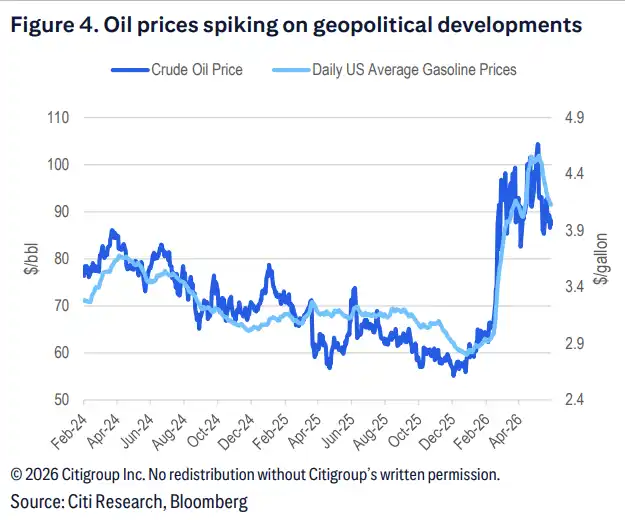
Expectations for the reopening of the Strait of Hormuz are a core driver of the current dovish narrative. Once the strait resumes passage, increased crude oil supply will lead to lower oil and other energy prices.

Gasoline prices have been declining for a full month, with the national average dropping from around $4.50 per gallon to $4.00. Citi expects further declines following other energy commodities. This trend is likely to produce at least several months of negative overall inflation readings in the coming months, prompting Fed officials to shift their characterization of energy prices from an "inflation risk" to a "neutral or even disinflationary factor."
Core CPI Cools, Divergence Among Inflation Metrics Intensifies

On the core inflation front, although May's core PCE is still expected to remain strong, core CPI has shown clear signs of cooling, with a month-on-month increase of only 0.21%.

Core PCE is increasingly becoming an "outlier" among current inflation metrics—both trimmed-mean PCE and core CPI are closer to target levels and show a clearer downward trend. This divergence is being increasingly recognized by both markets and Fed officials, also providing data support for a dovish stance.

FOMC Hawkish Adjustments Fully Priced In, Dovish Signals Have Upside Potential

The report expects this week's FOMC statement to remove the "easing bias" wording, and the median dot in the interest rate projections (dot plot) will indicate rates held steady this year. However, these hawkish adjustments are already fully anticipated by the market and do not constitute new information.

The real variable lies in Chair Wash's wording. Considering the latest developments regarding the Strait of Hormuz reopening and the cooling trend in core inflation, the risk of Wash delivering more dovish signals at this meeting is tilting to the upside. If his wording proves more accommodative than expected, the market's repricing of the rate cut path could accelerate.

Room for Treasury Yields to Fall Further, Market Pricing Has Adjustment Room

From a market pricing perspective, the report believes implied probabilities of rate hikes in interest rate futures remain elevated. Although the two-year Treasury yield has fallen about 13 basis points from a week ago, it is still over 60 basis points higher than its February level, indicating the market has not fully priced in the impact of receding inflation risks.

As the previously supporting upside inflation risks to the hawkish outlook gradually dissipate, the market is expected to further compress pricing for rate hikes while simultaneously increasing pricing for rate cuts, leaving further room for Treasury yields to decline.
Perguntas relacionadas

QAccording to the article, what are the two catalysts for inflation decline that could push the Fed towards a dovish turn?

AThe two catalysts are: 1) The planned reopening of the Strait of Hormuz, which is expected to push down oil prices and reduce energy price pressure on inflation. 2) The cooler-than-expected core CPI data for the previous week, which showed a monthly increase of only 0.21%.

QHow does the article describe the trend of gasoline prices and its expected impact?

AGasoline prices have been falling for a month, with the national average dropping from about $4.50 per gallon to $4.00. Citi expects them to fall further in line with other energy prices. This trend is projected to deliver several months of negative overall inflation readings and lead the Fed to view energy prices as a neutral or even deflationary factor rather than an inflation risk.

QWhat divergence in inflation indicators does the article highlight, and why is it significant?

AThe article highlights a divergence between core PCE and other inflation metrics like core CPI and trimmed-mean PCE. While core PCE remains strong, core CPI and trimmed-mean PCE are closer to the Fed's target and show a clearer disinflationary trend. This growing recognition of the divergence provides data support for a more dovish Fed stance.

QWhat is the market's current pricing for interest rates according to the report, and what potential adjustment does it see?

AThe market has already priced in expected hawkish adjustments from the FOMC, such as removing "accommodative bias" language. However, the report states that interest rate futures still imply an overly high probability of rate hikes. There is room for the market to further price out hikes and increase pricing for rate cuts, suggesting Treasury yields have more room to fall.

QWhat is the key variable for the market at the upcoming FOMC meeting, according to the article's analysis?

AThe key variable is the tone and wording of Fed Chair Wash's statements. Given the latest developments (Strait of Hormuz reopening, cooling core inflation), the risk is tilted towards Wash delivering a more dovish message than expected. If his wording is more temperate, the market's repricing of the rate cut path could accelerate.

Leituras Relacionadas

In Such a Crowded Cross-border Payment Track, Where Does the Next Stop Lie in the Future?

The crowded cross-border payments industry faces a paradox: intense competition above water with financing and narratives, while beneath, price wars and shrinking margins in basic PSP services are common. The path forward lies not in simple "cross-border" solutions but in deep **localization**. Success requires mastering the fragmented and tightening regulations of fiat currencies in each market—the "last mile" of compliance, banking, and settlement. Many Chinese PSPs have succeeded by following Chinese merchants overseas but have not deeply penetrated mainstream local merchant ecosystems abroad. Their strong product capabilities need to be applied to new, complex markets. The future belongs to companies that evolve from single-channel providers to **cross-border capital network operators**. This means moving beyond competing on transaction fees to creating internal networks that optimize capital efficiency through multi-directional matching, netting, and position reuse across countries and currencies. For Web3 and stablecoins, the key is integration, not replacement. Stablecoins offer efficiency gains but cannot bypass the foundational trust, compliance, and legal frameworks of traditional finance. The realistic path is the gradual adoption and "taming" of Web3 technologies by established financial institutions. The ultimate solution is a **dual clearing infrastructure** combining deep local fiat capabilities (local accounts, compliance, banking) with lightweight stablecoin-native capabilities (on-chain settlement, wallets). The biggest opportunity lies not in oversaturated mainstream corridors but in complex, underserved regional corridors (e.g., specific CIS, Middle East-Southeast Asia, or Latin American trade pairs). The winners will be those who build hard-to-replicate, deep capabilities in these areas—acting as the essential "clearing shovels" or infrastructure providers. The future keywords are **more local, more networked, and more stablecoin-native**. High-profit opportunities remain in the non-standardized, difficult-to-replicate deep waters of the industry, requiring genuine on-the-ground presence and long-term patience.

链捕手Há 1h

In Such a Crowded Cross-border Payment Track, Where Does the Next Stop Lie in the Future?

链捕手Há 1h

Lightning Fast Five-Whip Combo! Strategy's Self-Rescue Plan Officially Released

Strategy, amidst the STRC de-pegging crisis, has unveiled its "Digital Credit Capital Framework" self-rescue plan. The five-part framework includes: 1) **Cash Reserves**: Management of ~$2.55B in USD reserves, dedicated solely to covering ~17.4 months of preferred stock dividends and debt interest, with a 12-month minimum coverage floor. 2) **Dividend Policy**: STRC's dividend yield rises to 12% from July 1st, with monthly reviews. Strategy clarifies de-pegging does not automatically trigger further hikes. 3) **Preferred Stock Buyback**: A $1B authorization, prioritizing STRC repurchases to support its price, reduce future dividend obligations, and signal commitment, using funds separate from dividend reserves. 4) **Common Stock Buyback**: A separate $1B authorization for MSTR stock, aimed at creating shareholder value when the stock is deemed undervalued, establishing a two-way capital management mechanism. 5) **Bitcoin Monetization**: Formal authorization to sell BTC (up to $1.25B earmarked) to build USD reserves, cover dividends/interest, or fund buybacks, marking a strategic shift where BTC becomes a managed asset rather than a strictly "hold-only" reserve. Market reaction saw MSTR and STRC shares rise pre-market, while BTC remained stable. The plan aims to restore confidence in STRC, ensure dividend sustainability, and reopen Strategy's funding channels.

Odaily星球日报Há 3h

Lightning Fast Five-Whip Combo! Strategy's Self-Rescue Plan Officially Released

Odaily星球日报Há 3h

Trading

Spot
活动图片