Hong Kong Professionals Association Urges Regulators To Ease Crypto Reporting Rules

bitcoinistPublicado em 2026-01-20Última atualização em 2026-01-20

Resumo

Hong Kong Securities & Futures Professionals Association (HKSFPA) has urged regulators to ease certain aspects of the OECD’s Crypto Asset Reporting Framework (CARF) and related amendments to Hong Kong’s Common Reporting Standard (CRS). While generally supportive, the association raised concerns about record-keeping obligations for dissolved entities and uncapped penalties for minor technical errors. It proposed appointing third-party custodians for dissolved firms and introducing penalty caps for unintentional errors. The group also recommended a simplified registration process for crypto service providers with no annual filings. Hong Kong is among 76 jurisdictions committed to implementing CARF by 2028 as part of its broader strategy to become a global crypto hub.

A Hong Kong industry group has urged the city’s regulators to ease aspects of the Organisation for Economic Co-operation and Development’s (OECD) crypto reporting rules ahead of its implementation.

Association Pushes To Soften CARF Requirements

On Monday, the Hong Kong Securities & Futures Professionals Association (HKSFPA) released a response to the implementation of the OECD’s Crypto Asset Reporting Framework (CARF) and the related amendments made to Hong Kong’s Common Reporting Standard (CRS).

In their official response, the association shared its concerns about certain elements of the CARF and CRS amendments, warning that they could create operational and liability risks for market participants.

Notably, the HKSFPA affirmed that it mostly supports the proposals, but urged regulators to ease the record-keeping requirements for dissolved entities. “We generally agree with the six-year retention period to align with existing inland revenue and CRS standards,” they explained, “but we have concerns regarding the obligations placed on individuals post-dissolution.”

The industry group argued that holding directors or principal officers personally liable for record-keeping after dissolution poses significant practical challenges, noting that former officers of dissolved companies may lack the resources, infrastructure, and legal standing to maintain sensitive personal data of former clients.

As a result, they suggested the government “allow for the appointment of a designated third-party custodian (such as a liquidator or a licensed corporate service provider) to fulfill this obligation, rather than placing indefinite personal liability and logistical burden on former individual officers.”

Moreover, the association also cautioned that the proposed uncapped per-account penalties for minor technical errors. They asserted that this could lead to “disproportionately astronomical fines for systemic software errors affecting thousands of accounts where there was no intent to defraud.”

To solve this, they proposed a “reasonable cap” on total penalties for unintentional administrative errors or first-time offenses to ensure that the per-account calculation “is reserved for cases of willful negligence or intentional evasion.”

Additionally, the group suggested a “lite” registration or a simplified annual declaration process for Reporting Crypto-Asset Service Providers (RCASPs) that anticipate filing Nil Returns, to reduce administrative costs while still satisfying the Inland Revenue Department’s oversight requirements.

Hong Kong’s Crypto Hub Efforts

Notably, Hong Kong is among the 76 markets committed to implementing the upcoming crypto reporting framework, which is the OECD’s new global standard for exchanging tax information on crypto assets.

The CARF is designed to prevent tax evasion by bringing crypto users across borders under global tax transparency rules, similar to the OECD’s existing CRS for traditional finance. Hong Kong will be among the 27 jurisdictions that will begin their first cross-border exchanges of crypto reporting data in 2028.

Over the past few years, Hong Kong financial authorities have been actively working to develop a comprehensive framework that supports the expansion of the digital assets industry, part of its strategy to become a leading crypto hub in the world.

As reported by Bitcoinist, the city is exploring rules to allow insurance companies to invest in cryptocurrencies and the infrastructure sector. The Hong Kong Insurance Authority recently proposed a framework that could channel insurance capital into cryptocurrencies and stablecoins.

Moreover, the Hong Kong Monetary Authority (HKMA) is expected to grant the first batch of stablecoin issuer licenses in the first few months of the year. The HKMA enacted the Stablecoins Ordinance in August, which directs any individual or entity seeking to issue a stablecoin in Hong Kong, or any Hong Kong Dollar-pegged token, to obtain a license from the regulator.

Multiple companies have applied for the license, with over 30 applications filed in 2025, including logistics technology firm Reitar Logtech and the overseas arm of Chinese mainland financial technology giant Ant Group.
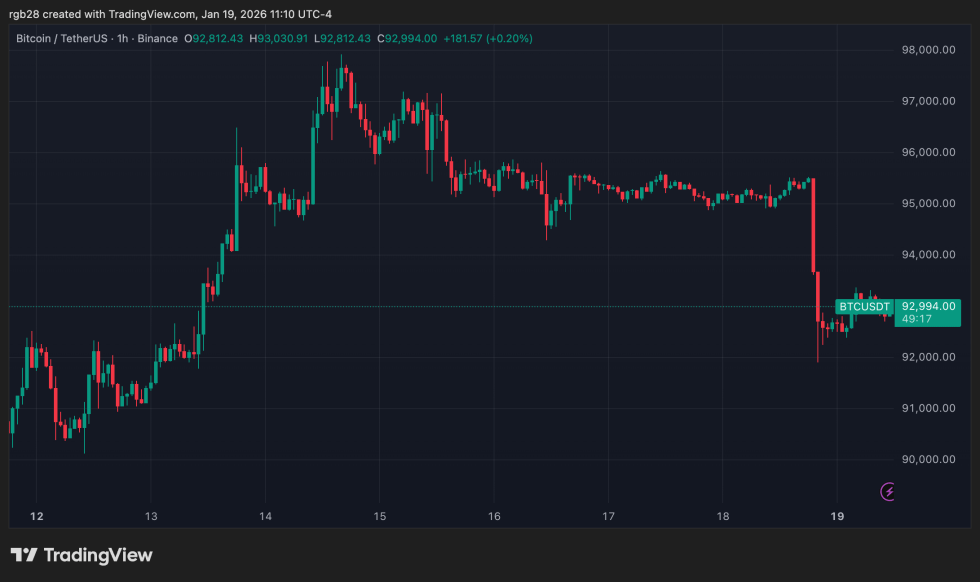
Bitcoin (BTC) trades at $92,994 in the one-week chart. Source: BTCUSDT on TradingView


Perguntas relacionadas

QWhat is the main concern raised by the Hong Kong Securities & Futures Professionals Association (HKSFPA) regarding the OECD's Crypto Asset Reporting Framework (CARF)?

AThe HKSFPA is concerned that certain elements of CARF and related CRS amendments could create operational and liability risks for market participants, particularly regarding record-keeping requirements for dissolved entities and uncapped penalties for minor technical errors.

QWhat specific suggestion did the HKSFPA make to address the record-keeping burden on dissolved entities?

AThe association suggested allowing the appointment of a designated third-party custodian (such as a liquidator or licensed corporate service provider) to fulfill record-keeping obligations instead of placing indefinite personal liability on former individual officers.

QHow did the HKSFPA propose to handle penalties for unintentional administrative errors in crypto reporting?

AThey proposed implementing a reasonable cap on total penalties for unintentional administrative errors or first-time offenses, reserving per-account penalty calculations for cases of willful negligence or intentional evasion.

QWhen will Hong Kong begin its first cross-border exchanges of crypto reporting data under CARF?

AHong Kong will begin its first cross-border exchanges of crypto reporting data in 2028, as one of the 27 jurisdictions committed to implementing the framework.

QWhat recent regulatory development in Hong Kong involves stablecoin issuance?

AThe Hong Kong Monetary Authority (HKMA) enacted the Stablecoins Ordinance in August, requiring any individual or entity seeking to issue a stablecoin in Hong Kong to obtain a license, with the first batch of licenses expected to be granted in early 2025.

Leituras Relacionadas

Goldman Sachs: July Smashes Through Crowded Trades, U.S. Stock Bull Market Not Broken but Harder to Navigate

Goldman Sachs: July Sees Crowded Trades Unwound, U.S. Bull Market Intact but Getting Tougher. The U.S. stock market in July did not see an index-level crash, but rather a significant unwinding of speculative positions. While the S&P 500 remained stable—trading within a narrow 3.5% range and staying within 2% of its high—underlying market dynamics were volatile. Heavily crowded trades, particularly in high-momentum tech, AI-linked stocks, and Asian strategies, faced severe pressure and forced deleveraging. Data indicates this was a meaningful cleanse, not a minor adjustment. Global tech exposure saw its largest sell-off in over five years, leverage in Korean equity ETFs plummeted, and Goldman's prime brokerage recorded the largest gross exposure reduction since late 2022. Leverage on momentum factors among fundamental long/short clients fell to the 28th percentile of its one-year range. The AI trade narrative shifted from pure potential to a focus on tangible returns. While Meta failed to show clear AI monetization, Microsoft and Amazon provided evidence that massive capital expenditure is translating into scalable revenue and product growth, preventing a blanket sell-off of the AI sector. The Federal Reserve's more opaque communication style and volatility in long-end Treasury yields have introduced new friction, particularly for rate-sensitive growth and tech stocks. The broader outlook for U.S. equities remains favorable, supported by a strong economy, robust earnings, and substantial AI capital expenditure. However, risk/reward is no longer cheap, and the market's upward elasticity has weakened. The Nasdaq 100's trajectory—up 12% year-to-date despite significant pullbacks—illustrates that the bull trend persists but the path is becoming more difficult. The key lesson from July is that the market no longer rewards crowded, highly leveraged trades, requiring more disciplined and liquid portfolio approaches.

marsbitHá 59m

Goldman Sachs: July Smashes Through Crowded Trades, U.S. Stock Bull Market Not Broken but Harder to Navigate

marsbitHá 59m

Interview with Robinhood Executive: Meme + Tokenized US Stocks as "Barbell" Customer Acquisition Strategy, All Business Lines Achieve Hundreds of Millions in Revenue

Interview with Robinhood executive Johann Kerbrat reveals the company's "barbell" customer acquisition strategy for its new Robinhood Chain, combining meme tokens with tokenized stocks. Three weeks after mainnet launch, the chain has seen over $3B in weekly DEX volume and 105M transactions. Kerbrat explains the logic behind the permissionless chain: meme tokens attract DeFi users, while tokenized real-world assets (RWA), currently over 90 US stocks and ETFs accessible in 120+ countries, serve global users. The goal is to bring Robinhood's 27 million funded accounts on-chain by simplifying DeFi with a user-friendly interface, exemplified by features like Robinhood Earn which offers yield without requiring wallet management. Built on Arbitrum's technology stack for its speed, low cost, and Ethereum's security, the chain focuses on financial products like Earn, spot trading, and perpetuals. Kerbrat downplays direct competition with platforms like Base, emphasizing the goal of expanding the overall market for on-chain assets. He details selective partnerships (e.g., Morpho, Lighter) based on compliance, unique UX, and differentiation. While regulatory clarity is pending for US perpetuals, the expansion continues via Bitstamp in Europe. Finally, Kerbrat positions Robinhood as a "super app" integrating stocks, options, crypto, banking, and AI trading, with all major business lines generating hundreds of millions in revenue. For the chain, current priority is driving adoption over maximizing gas fee revenue.

marsbitHá 3h

Interview with Robinhood Executive: Meme + Tokenized US Stocks as "Barbell" Customer Acquisition Strategy, All Business Lines Achieve Hundreds of Millions in Revenue

marsbitHá 3h

Fidelity Q3 Report: BTC, ETH, and SOL Continue to Build Bottoms; How Much Further Will This Crypto Bear Market Go?

Fidelity's Q3 Crypto Signal Report analyzes the current bear market, noting Bitcoin (BTC), Ethereum (ETH), and Solana (SOL) are in a prolonged bottoming phase. Key indicators like the weighted Net Unrealized Profit/Loss (NUPL) have turned negative (-0.01), signaling the market is slightly below its aggregate cost basis, with BTC acting as the primary stabilizing asset. BTC's dominance has risen to 68%, indicating a lack of capital rotation to other digital assets. Performance has been weak across the board, with BTC, ETH, and SOL down significantly year-to-date. Market sentiment is depressed, exacerbated by substantial outflows from spot ETPs and a challenging macro environment. The report compares the current ~203-day downtrend to historical ~300-day bottoming cycles, suggesting the process may be two-thirds complete, with late 2026 as a potential timeframe to monitor. For Bitcoin, NUPL at 0.09 indicates cautious sentiment, while momentum signals remain negative. The Yardstick metric points to potential undervaluation relative to network security (hashrate). Ethereum's NUPL is deep in the "capitulation" zone at -0.43, a historically positive signal for future returns, though its momentum and network fee revenue are negative. Solana shows the deepest NUPL at -0.72 but demonstrates relative resilience in on-chain activity and stablecoin transfer volume. The report concludes that while several metrics are near historical capitulation levels, a definitive market bottom has not yet been established. The path forward likely involves continued consolidation, with BTC's relative strength and fundamental on-chain usage for ETH and SOL providing key areas for investor observation.

marsbitHá 3h

Fidelity Q3 Report: BTC, ETH, and SOL Continue to Build Bottoms; How Much Further Will This Crypto Bear Market Go?

marsbitHá 3h

Trading

Spot
活动图片