Hong Kong Aims to Act as Global Connector Between Crypto and Traditional Finance

TheNewsCryptoPublicado em 2026-02-02Última atualização em 2026-02-02

Resumo

Hong Kong lawmaker Johnny Ng emphasizes that the city is positioning itself as a global connector between cryptocurrency and traditional finance, rather than competing directly with other nations. He argues that crypto is not a zero-sum game and should function as an interconnected global system. Hong Kong’s advantages include its common law system, English-language courts, and free capital flow, which help build a regulated and trusted crypto environment. The city also leverages the Greater Bay Area, collaborating with hubs like Shenzhen and Macau to combine fundraising and regulatory expertise with technological innovation. Recent efforts include inviting global crypto firms, such as Coinbase, to establish operations in Hong Kong and introducing clearer custody and OTC trading rules to better integrate crypto with institutional and corporate finance.

Johnny Ng, a Hong Kong lawmaker and a strong supporter of Web3 and digital assets, says that Hong Kong is not trying to “Beat” other countries in crypto; instead, it can act as a global connector between crypto markets and traditional finance across the U.S., Europe, and China.

Ng says that crypto should not be treated as the Zero sum game, meaning Crypto doesn’t belong to one country and is global, which works best when it is connected. He also stated that Hong Kong’s goal is to link East and West, Crypto startups and traditional banks, and innovation and regulations.

Why Hong Kong has a strong advantage

According to him, Hong Kong already has the strong advantages of a common law system that the global investors could understand and the English language court, trusted by the international businesses, with a free movement of money in and out of the city. This helps Hong Kong to build a crypto market that is regulated, safer, and accepted by the global financial institutions.

A key part of Hong Kong’s strategy involves the Greater Bay Area, which connects cities and Chinese hubs such as Shenzhen and Macau. Ng explained that Hong Kong helps to raise money and handle rules, whereas these main cities turn ideas into real products, which makes the region powerful.

Inviting the global crypto firms
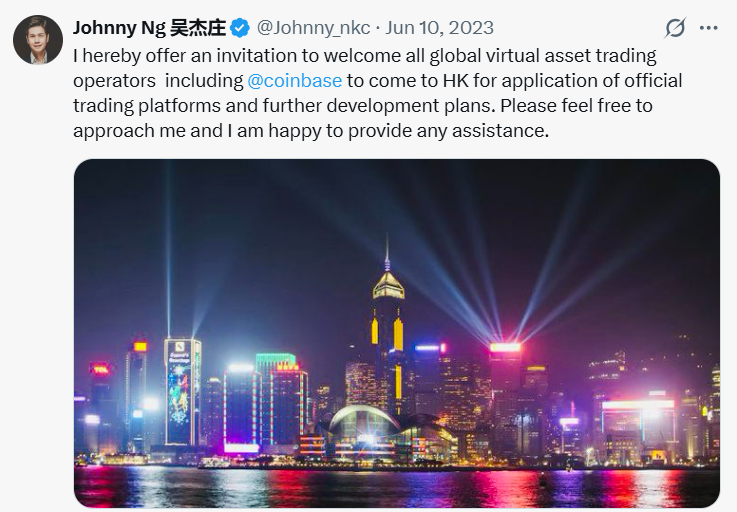
Ng pointed out that Vitalik Buterin spent a lot of time in Hong Kong during Ethereum’s early stages, which shows that the region has long supported blockchain innovations. In 2023, during the period of strict enforcement by the U.S. regulations, he invited the major crypto companies like Coinbase to operate in Hong Kong.

In 2026, Hong Kong plans to introduce clearer custody rules and regulate OTC crypto trading with larger trading limits for professional investors. Ng says that the next phase is about the infrastructure, and these steps aim to make crypto work smoothly with real businesses and large investors.

Highlighted Crypto News:

XRP Slides Below $1.60 Amid Broader Crypto Market Pullback

TagsBlockchainCryptoHongKong

Perguntas relacionadas

QWhat role does Hong Kong aim to play in the global crypto market according to Johnny Ng?

AHong Kong aims to act as a global connector between crypto markets and traditional finance, linking East and West, crypto startups and traditional banks, and innovation and regulations.

QWhat advantages does Hong Kong have in building a regulated crypto market?

AHong Kong has a common law system, English language courts trusted by international businesses, and free movement of money, which help build a regulated, safer crypto market accepted by global financial institutions.

QHow does the Greater Bay Area contribute to Hong Kong's crypto strategy?

AThe Greater Bay Area connects cities like Shenzhen and Macau, where Hong Kong handles fundraising and regulations while these cities turn ideas into real products, making the region powerful.

QWhat did Johnny Ng do in 2023 regarding global crypto companies?

AIn 2023, during strict U.S. regulations, Johnny Ng invited major crypto companies like Coinbase to operate in Hong Kong.

QWhat regulatory steps is Hong Kong planning for 2026 to support crypto integration?

AIn 2026, Hong Kong plans to introduce clearer custody rules and regulate OTC crypto trading with larger limits for professional investors to make crypto work smoothly with real businesses and large investors.

Leituras Relacionadas

In Jinjiang, Fujian, a Storage Super Unicorn Lies Quiet

In Fujian's Jinjiang, a city known for sportswear, lies a quiet semiconductor giant: Fujian Jinhua Integrated Circuit Co. (JHICC). Once a promising domestic DRAM manufacturer alongside Yangtze Memory and ChangXin Memory Technologies (CXMT), its journey was derailed in 2018 when the U.S. placed it on an Entity List and filed criminal charges for alleged trade secret theft. This halted production for years. A turning point came in February 2024 when a U.S. federal court found JHICC not guilty. However, it had lost crucial time. While CXMT soared to become a top-valued A-share company in 2024, JHICC, with an estimated valuation of 80 billion RMB, was just restarting. Its current output is primarily customized DDR4 chips, not the advanced DDR5/HBM demanded for AI, but it still benefits from the broader memory chip upcycle. JHICC's story is tied to Chen Zhengkun, a veteran engineer who left Micron to lead the venture. Founded in 2016 with state-backed funding, JHICC partnered with Taiwan's UMC to develop DRAM technology. Rapid progress was cut short by the U.S. actions, which Micron initiated, partly due to its heavy reliance on the Chinese market. Post-sanctions, Chen's team worked to rebuild the production line with reduced reliance on U.S. technology. According to its records, JHICC achieved small-scale production and revenue growth under immense pressure. It now focuses on the stable "niche" DRAM market (e.g., TVs, routers) with a monthly capacity of ~40,000 wafers, aiming for 60,000 by 2026. It holds over 1,000 patents but remains on the Entity List. For Jinjiang, investing in JHICC was a bold industrial leap. The local government provided unwavering financial and logistical support during the crisis, helping the company survive. JHICC has become the anchor for a growing local semiconductor cluster. Though its scale lags behind domestic peers, JHICC's persistence symbolizes a hard-won foothold in a global market long dominated by Samsung, SK Hynix, and Micron. Having missed one boom, it seeks a place in the new AI-driven memory supercycle.

marsbitHá 50m

In Jinjiang, Fujian, a Storage Super Unicorn Lies Quiet

marsbitHá 50m

Trading

Spot
活动图片





