Hong Kong Aims to Act as Global Connector Between Crypto and Traditional Finance

TheNewsCryptoPublicado em 2026-02-02Última atualização em 2026-02-02

Resumo

Hong Kong lawmaker Johnny Ng emphasizes that the city is positioning itself as a global connector between cryptocurrency and traditional finance, rather than competing directly with other nations. He argues that crypto is not a zero-sum game and should function as an interconnected global system. Hong Kong’s advantages include its common law system, English-language courts, and free capital flow, which help build a regulated and trusted crypto environment. The city also leverages the Greater Bay Area, collaborating with hubs like Shenzhen and Macau to combine fundraising and regulatory expertise with technological innovation. Recent efforts include inviting global crypto firms, such as Coinbase, to establish operations in Hong Kong and introducing clearer custody and OTC trading rules to better integrate crypto with institutional and corporate finance.

Johnny Ng, a Hong Kong lawmaker and a strong supporter of Web3 and digital assets, says that Hong Kong is not trying to “Beat” other countries in crypto; instead, it can act as a global connector between crypto markets and traditional finance across the U.S., Europe, and China.

Ng says that crypto should not be treated as the Zero sum game, meaning Crypto doesn’t belong to one country and is global, which works best when it is connected. He also stated that Hong Kong’s goal is to link East and West, Crypto startups and traditional banks, and innovation and regulations.

Why Hong Kong has a strong advantage

According to him, Hong Kong already has the strong advantages of a common law system that the global investors could understand and the English language court, trusted by the international businesses, with a free movement of money in and out of the city. This helps Hong Kong to build a crypto market that is regulated, safer, and accepted by the global financial institutions.

A key part of Hong Kong’s strategy involves the Greater Bay Area, which connects cities and Chinese hubs such as Shenzhen and Macau. Ng explained that Hong Kong helps to raise money and handle rules, whereas these main cities turn ideas into real products, which makes the region powerful.

Inviting the global crypto firms
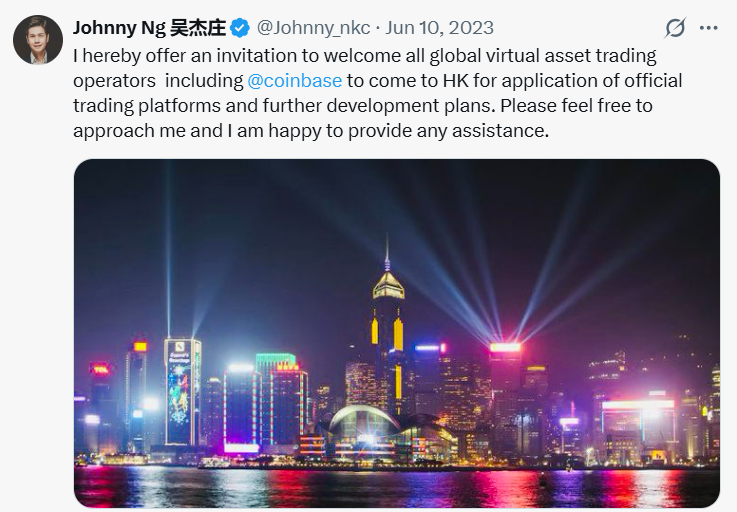
Ng pointed out that Vitalik Buterin spent a lot of time in Hong Kong during Ethereum’s early stages, which shows that the region has long supported blockchain innovations. In 2023, during the period of strict enforcement by the U.S. regulations, he invited the major crypto companies like Coinbase to operate in Hong Kong.

In 2026, Hong Kong plans to introduce clearer custody rules and regulate OTC crypto trading with larger trading limits for professional investors. Ng says that the next phase is about the infrastructure, and these steps aim to make crypto work smoothly with real businesses and large investors.

Highlighted Crypto News:

XRP Slides Below $1.60 Amid Broader Crypto Market Pullback

TagsBlockchainCryptoHongKong

Perguntas relacionadas

QWhat role does Hong Kong aim to play in the global crypto market according to Johnny Ng?

AHong Kong aims to act as a global connector between crypto markets and traditional finance, linking East and West, crypto startups and traditional banks, and innovation and regulations.

QWhat advantages does Hong Kong have in building a regulated crypto market?

AHong Kong has a common law system, English language courts trusted by international businesses, and free movement of money, which help build a regulated, safer crypto market accepted by global financial institutions.

QHow does the Greater Bay Area contribute to Hong Kong's crypto strategy?

AThe Greater Bay Area connects cities like Shenzhen and Macau, where Hong Kong handles fundraising and regulations while these cities turn ideas into real products, making the region powerful.

QWhat did Johnny Ng do in 2023 regarding global crypto companies?

AIn 2023, during strict U.S. regulations, Johnny Ng invited major crypto companies like Coinbase to operate in Hong Kong.

QWhat regulatory steps is Hong Kong planning for 2026 to support crypto integration?

AIn 2026, Hong Kong plans to introduce clearer custody rules and regulate OTC crypto trading with larger limits for professional investors to make crypto work smoothly with real businesses and large investors.

Leituras Relacionadas

Has Bitcoin Bottomed, or Is a 'Shakeout' Approaching? What's the Situation with XRP?

Cryptocurrency analytics platform Santiment shared key insights on Bitcoin and altcoin markets, highlighting significant signals from on-chain data. Analysis shows Bitcoin's 365-day MVRV ratio has fallen to -26%, indicating substantial losses for long-term holders, a level historically associated with market bottom formations and long-term buying opportunities. While short-term MVRV is near breakeven, suggesting no clear directional signal, the annual perspective points to a bottom before bullish cycles. On-chain data reveals divergent behavior: large wallets (10-10,000 BTC) have been accumulating, adding ~18,500 BTC in 10 days, while smaller retail investors continue buying dips. Analysts caution that high retail demand can sometimes create a risk of a final market shakeout or correction. The altcoin market shows a mixed picture. Ethereum's 365-day MVRV is around -33%, but recent monthly gains combined with overly optimistic social sentiment pose a short-term correction risk. XRP is in oversold territory with 30-day and 365-day MVRVs at -57.5% and -45.5% respectively, signaling potential for a strong mid-to-long term rebound. Social activity and optimism are rising for Solana, while investor sentiment remains calmer towards Cardano. Future direction for Bitcoin and altcoins depends not only on on-chain metrics but also on macroeconomic and regulatory developments. The Federal Reserve's interest rate decision and upcoming policy rulings are increasing market volatility expectations, while uncertainty around the U.S. Congressional clarity process continues to pressure pricing. *This is not investment advice.

cryptonews.ruHá 28m

Has Bitcoin Bottomed, or Is a 'Shakeout' Approaching? What's the Situation with XRP?

cryptonews.ruHá 28m

Bank of Korea Reveals Results of Tokenized Deposit Testing

The Bank of Korea has announced the results of its pilot test for tokenized deposits. Involving 28 central banks and international financial organizations, the project saw participation from major South Korean banks including KB Kookmin Bank, NH NongHyup Bank, Shinhan Bank, Woori Bank, and Hana Bank. Transactions, from payment orders to final settlement, were completed in real time, averaging just 80 seconds. The test involved 30 transactions across 17 different scenarios—such as corporate and interbank transfers—and was conducted in six currencies, including the Korean won, US dollar, and euro, with a total transaction value reaching approximately $995,000. The central bank reported that the platform operated stably throughout, despite being only partially connected to the existing banking infrastructure. Settlements using tokenized deposits were executed seamlessly, quickly, and transparently. An internal transfer of 20 million won (about $13,890) between NH NongHyup Bank and Shinhan Bank was also successfully processed via the Project Agora platform, which involved connecting to the Bank of Korea's CBDC test platform, Project Hangang. Additionally, KB Kookmin Bank and Japan's MUFG Bank tested cross-border payments using these deposit tokens—digital certificates issued by commercial banks within the pilot, not directly by the central bank. The Bank of Korea plans to continue testing payments with tokenized deposits. This follows last year's pledge by South Korean authorities to tighten regulations for won-based stablecoins, which will require approval from both the central bank and the Financial Services Commission.

cryptonews.ruHá 2h

Bank of Korea Reveals Results of Tokenized Deposit Testing

cryptonews.ruHá 2h

Trading

Spot
活动图片