The Hong Kong Stock Exchange remains bustling.
Today (July 8), Momenta successfully listed on the Hong Kong stock market, becoming the "first physical AI stock." The IPO price was set at HKD 295.6 per share, with a slight increase at the opening, pushing its market capitalization past HKD 70 billion, making it the company with the largest market capitalization among the five bell-ringing companies on HKEX today. Notably, assuming the full exercise of the "green shoe" (over-allotment option), the global offering of approximately 22.93 million shares raised a total of about HKD 6.8 billion, reflecting strong market enthusiasm. Momenta introduced an exceptionally strong lineup of 14 cornerstone investors: top-tier international long-only funds and sovereign wealth funds, strategic investors from the industry's "premium" tier, and top Chinese long-only private equity, public funds, and insurance capital, making the cornerstone slots "difficult to obtain."
Headquartered in Suzhou, Momenta is helmed by Cao Xudong, an '85-born Tsinghua alumnus. He graduated with a bachelor's degree from Tsinghua University and later gave up a direct Ph.D. admission opportunity to enter the field of artificial intelligence. He worked at Microsoft Research Asia and SenseTime before founding Momenta in 2016, focusing on physical AI research through autonomous driving.
After a 10-year journey, Momenta is the first to bring "physical AI" to the global capital market stage.
Admitted to Tsinghua at 18, Gave Up Doctoral Studies
Building the First Physical AI Stock
The story of Momenta began with a Tsinghua alumnus who "didn't follow the conventional path."
Born in Gansu in 1986, Cao Xudong was admitted to the Engineering Mechanics program at Tsinghua University at the age of 18. After his undergraduate studies, he was offered a direct Ph.D. opportunity, initially focusing on physics-related research, but he developed a keen interest in artificial intelligence.
Consequently, Cao Xudong made a surprising decision: he withdrew from the Ph.D. program to embark on a path in AI research. He first joined Microsoft Research Asia as a researcher in 2010, then moved to SenseTime. Through these experiences, the idea of starting his own business gradually took shape.
Finally, in September 2016, Cao Xudong and a group of like-minded partners officially founded Momenta. Explaining the meaning behind the company's name, he once said, "'Momenta' is the plural form of 'Momentum.' Each one of us is a 'Momentum.' When everyone comes together, moving in a common direction to fight tough battles and win victories, such a team is what we consider 'Momenta.'"
As is well known, the AI field is vast with numerous sub-sectors, but Momenta set its sights on autonomous driving. Cao Xudong believed at the time, "Many problems in autonomous driving don't have ready-made answers. We hope to start from first principles, creatively solve problems, and continuously push the boundaries of the AI field."
However, autonomous driving was just starting in China then, with unclear standards, inconsistent technologies, and a mix of hype and bubbles. The industry also showed a polarized landscape: most startup teams either heavily invested in capital-intensive L4 high-level autonomous driving R&D or focused solely on mass-producing L2 assisted driving systems.
Cao Xudong, however, charted a unique course, establishing a strategic vision for Momenta distinct from its peers—"One Flywheel, Two Legs." This refers to a data-driven "flywheel" technical insight and a product strategy combining mass-production business with scaled unmanned business. In other words, the "two legs" share the same algorithm architecture. Every kilometer driven by mass-produced assisted driving vehicles contributes data for L4 development, and advancements in L4 technology, in turn, enhance mass-production solutions.
The prerequisite for this flywheel to spin is having enough vehicles on the road, and Momenta has delivered impressive results in this regard: currently, over 1 million mass-produced vehicles are equipped with Momenta's systems, with successful delivery of over 100 mass-production models. The cumulative number of designated models exceeds 210, achieving efficient deployment rates such as delivering 100,000 units in less than 40 days.
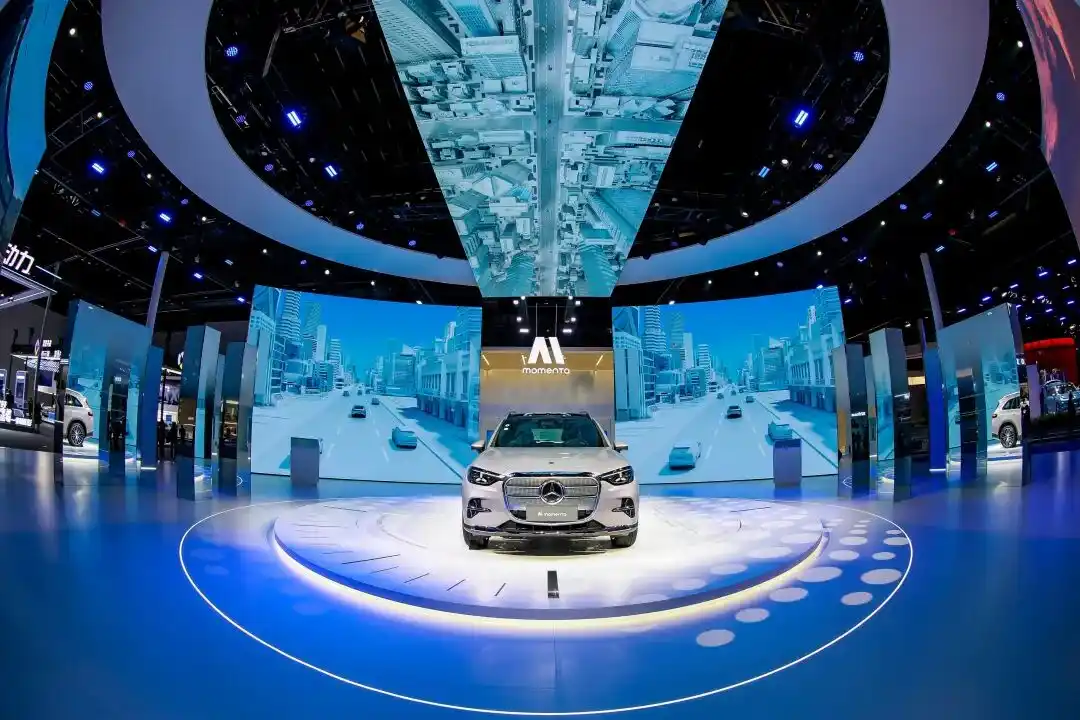
These 1 million vehicles represent not just installation volume but act as mobile data collectors, generating vast amounts of real-world road condition data daily—invaluable cognitive material about the physical world that no lab or simulation environment can replace.
For this reason, Cao Xudong boldly asserted that autonomous driving is the prologue to physical AI. "The core of physical AI is data scaling and business scaling, forming a positive feedback loop. Currently, the only area achieving both simultaneously is autonomous driving."
It's important to note that traditional technical approaches cannot truly understand the operating laws of the physical world. Momenta pioneered the core technical system of physical AI, thereby reconstructing the industry's underlying logic.
A highly symbolic moment arrived—in April this year, Momenta's self-developed R7 World Model announced its first mass-production launch, marking the transition of physical AI from a technical concept to scaled, mass-produced implementation.
This is a foundational model capable of understanding physical laws and inferring world evolution. It supports Momenta's scaled deployment in passenger cars, Robotaxis, and Robovans, with future potential expansion to Robotrucks and embodied intelligence. In other words, Momenta isn't content with just providing technology; it aims to build a physical AI platform covering all scenarios.
In Cao Xudong's vision, physical AI represents a revolution in AI at the cognitive level. Its core is enabling AI to deeply learn, understand, and infer all laws of the real physical world—including vehicle motion inertia, road condition interaction logic, traffic participant博弈 relationships, and dynamic environmental changes—achieving a leap from "passive perception and execution" to "active thinking, prediction, inference, and autonomous evolution."
This is also the core distinction between Momenta and other players. By comparison, the vast majority of autonomous driving companies are essentially "automotive intelligence service providers," with core products being in-vehicle algorithms and mobility services. General large model enterprises are essentially "digital content service providers," with core capabilities in virtual data processing.
It seems that only Momenta has completed the leap from digital intelligence to physical intelligence. With the world model as its core foundation, it has opened the critical channel for AI to land in the physical world, elevating itself to a platform-level physical AI company. This is precisely the key to its becoming the "first physical AI stock" on HKEX.
VC/PE Gather
Why the Collective Bet?
Undoubtedly, physical AI is a marathon-like technological race.
This means that physical AI R&D inevitably requires significant investment and long cycles. Cao Xudong once proposed a "ticket theory"—physical AI requires a ticket, and this ticket necessitates the company having a cash flow business because, in the long run, relying solely on financing to achieve general-purpose physical AI or AGI for the physical world is unrealistic.
This judgment conveys a clear signal: the investment required to train general-purpose physical AI could reach tens or even hundreds of billions of dollars. Without stable cash flow, it's impossible to persist until the technology matures. Therefore, commercialization becomes the first battle cry for physical AI companies seeking to break through.
Consider some data—according to CIC灼识咨询, from March 2025 to February 2026, Momenta achieved a 65% market share by sales volume in China's third-party urban NOA supplier market. This indicates that in this细分赛道 of China's third-party urban NOA, Momenta has established a de facto leading position. Any automaker wanting to launch urban NOA功能 in the Chinese market, if choosing a third-party supplier, Momenta is almost an unavoidable name.
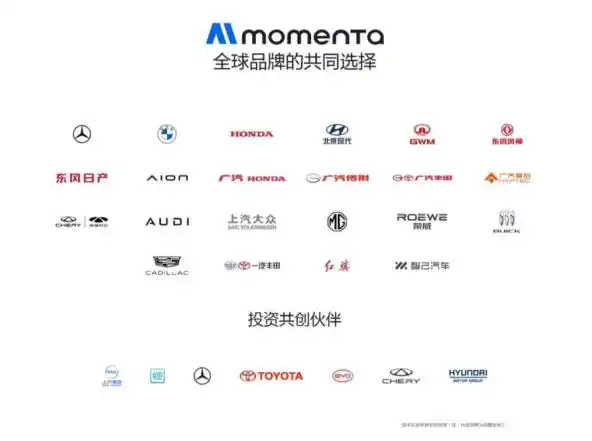
The prospectus also shows that Momenta has established partnerships with 24 global automakers, covering all mainstream Chinese passenger car manufacturers. Moreover, 9 out of the world's top 10 automakers have collaborated with it, making it the "common choice of global brands."
However, this is no easy feat; it requires strong first-mover advantage. Cao Xudong candidly admitted that for many OEM businesses, it takes about 3 years of knocking on doors—from meeting the customer to securing the contract. For international OEMs, it might take 5 to 7 years. "For example, Mercedes-Benz invested in us back in 2017, but our first mass-production project together launched in the second half of 2025, taking a full 8 years."
This case fully illustrates that from POC to Pre-SOP, then small-batch mass-production development, to真正的量产交付, each stage presents a new and more difficult门槛. Precisely because Momenta has navigated these various关卡, it has gained极强的 customer stickiness, thereby providing strong support for mid-to-long-term revenue growth and stable cash flow.
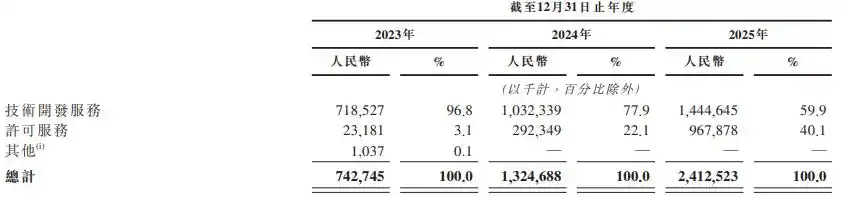
The prospectus披露, from 2023 to 2025, Momenta's revenue grew from RMB 743 million to RMB 2.413 billion, with a compound annual growth rate exceeding 80%. Notably, Momenta's revenue mainly comprises technology development income and licensing income. The latter showed particularly bright growth, surging from RMB 2.3 million in 2023 to RMB 968 million in 2025, a 42-fold increase over three years.
Admittedly, Momenta currently still incurs阶段性的研发亏损, but thanks to持续提升的收入和毛利率, its adjusted annual loss has rapidly narrowed to RMB 303 million, approaching breakeven. It is foreseeable that with the推进 of scaled implementation, Momenta's profitability拐点 is nearing.
Thanks to this, Momenta also entered the视野 of VC/PE investors early on.
The prospectus披露, shortly after its establishment in 2016, Momenta secured a USD 5 million Series A financing. Subsequently, investors began queuing up, and Momenta completed up to 20 rounds of financing.
Thus, behind Momenta gathered the world's most核心的产业和科技战略投资人, as well as顶级财务投资人. A细梳 reveals that industrial capital囊括了全球汽车产业链的核心玩家, including: 7 global leading automakers such as SAIC, General Motors, Mercedes-Benz, Toyota, BYD, Hyundai, Chery; also top industry chain enterprises like Bosch, Desay SV, Luxshare; and Robo partners like Uber, Grab, Stone Venture.
Tech giants include Tencent, Alibaba Cloud, Ant Group, JD.com, etc. Financial investors cover Temasek, IDG Capital, Oman Investment Authority, E-Town Capital, Granite Asia, Shunwei, NIO Capital, Cathay Capital, Yunfeng Capital, Blue Lake Capital, Innovation Works, ZhenFund, CDH Investments, Gaorong Capital, Gaocheng Capital, Z&W Capital, Joy Capital, Zhongding Capital, Infore Capital, CMB International, Huatai Innovation Capital, Chaos Capital, Primavera Capital, Greater Bay Area Homeland Investments, Gaw Capital, Guoxin Fund, Guanghe Capital, 9He Capital, Jinqiu Fund, and other全球顶尖投资机构.
If the financing journey witnessed Momenta's appeal in the primary market, then this IPO is a secondary market "referendum" on its commercial value.
First, look at Momenta's anchor认购 for this IPO,来自 Singapore's GIC, Fidelity International, BlackRock, Franklin Templeton, China Investment Corporation (CIC), Abu Dhabi Investment Authority (ADIA), Canada Pension Plan Investment Board (CPPIB), Wellington, Schroders, Temasek, J.P. Morgan Asset Management (JPMAM), T. Rowe Price, Barings, Pictet, Goldman Sachs Asset Management (GSAM), UBS Asset Management (UBS GAM), Aberdeen, Oman Investment Authority (OIA), Dragoneer, Janus Henderson, Amundi, Deka Investment, DWS Group, Union Investment, etc. This presents a very rare scene of global long-only investors collectively注资. It is reported that仅长线的认购金额就超过15倍.
Simultaneously, Momenta introduced 14 cornerstone investors, with total cornerstone commitments of approximately HKD 3 billion (about USD 376 million),接近本次发行规模的一半.据知情人士透露, the火爆程度 of Momenta's cornerstone slots was "difficult to obtain,"堪比 the cornerstone阵容 of CATL.
Specifically, Singapore's GIC and Fidelity International led strongly, each allocated USD 100 million; BlackRock invested USD 25 million, Oaktree Capital USD 20 million, Franklin Templeton USD 10 million. Industry "premium"级战略投资人 include leaders among international and Chinese automakers—Mercedes-Benz and BYD, investing USD 25 million and USD 15 million respectively; industry chain partner GigaDevice invested USD 6 million. Top Chinese long-only私募、公募和险资 include top Chinese私募基金 Gaoyi Capital and Boyu Capital, top Chinese公募基金 ChinaAMC and GF Fund,以及长线险资领军者 Pacific Insurance, each investing USD 10 million. Additionally, Suzhou Mosu is among the cornerstone investors.
This scene is the most直观体现 of Momenta's庞大且稳健的生态系统. The "All-Star" cornerstone阵容 builds a complete生态壁垒 covering technology R&D,整车量产, supply chain配套, global markets, and capital运作, which is实属罕见 across the entire industry and serves as a crucial core支撑 for Momenta securing its position as the "first physical AI stock."
Furthermore, Momenta's上市 marks the capital market finally welcoming the first listed company with physical AI as its core business, possessing a mature commercial system and continuous iteration capability. Investors have cast their precious vote with real money.
Welcoming Physical AI's "GPT Moment"
Era of Value Reassessment
As you can see, the watershed of the AI era is arriving.
Recall in July 2025, Jensen Huang首次明确提出 that the next wave of artificial intelligence is "physical AI." At CES 2026, he again宣告 in a 90-minute keynote that physical AI's "ChatGPT moment" is即将到来.
Simultaneously, a world model storm swept the globe.
In March this year, world model company AMI officially completed approximately USD 1.03 billion in seed funding, with a post-money valuation exceeding USD 4.5 billion,一举刷新 Europe's largest seed round record. Behind it is the globally renowned "Godfather of AI" Yann LeCun. Looking further back, World Labs, founded by知名科学家 Fei-Fei Li, also completed a new USD 1 billion (about RMB 7 billion) financing in early February.
The reason world models are so火爆 is that they are被视为 the core engine of physical AI,补上 the key一环 of "understanding reality, interacting with reality" for AI. This enables AI to transition from "capable of generating" to "capable of understanding, inferring, and acting," representing the key突破口 to激发 physical AI's "GPT moment."
Cao Xudong once stated that prediction is the基石 of intelligent evolution; the core of physical AI lies in deep认知 of the world's fundamental physical laws. World models, through World Model Prediction, predict the future state and interaction logic of the physical world, gaining understanding of objects' physical properties, causal relationships of motion, and potential possibilities of interaction.
Bringing our focus back to Momenta's world model: as the spatiotemporal基座 for physical AI, it is divided into three layers: The first layer, world model pre-training, compresses physical laws,常识, and causal relationships into the model through pre-training on massive real-world driving data, making the model懂物理;
The second layer, world model simulation, provides the model with a练兵场 through closed-loop simulation, allowing it to infer how the world will evolve when its own behavior changes, and evaluate performance on long-tail scenarios;
The third layer, reinforcement learning within the world model, is like giving the model a coach highly接近 the "real world," enabling the system to move from "imitation learning" to "imagination and exploration," autonomously acquiring the ability to make optimal decisions in complex博弈, with performance exceeding human drivers in极端场景.
More crucially, based on over 12 billion kilometers of实车里程 brought by Momenta's mass-production business, and the超 100 million segments of黄金数据提炼 therefrom, Momenta's R7 World Model can自我博弈进化 through reinforcement learning training, significantly enhancing关键场景能力.
至此,纵观 the three core elements of physical AI—world model technology, real-world data scale, and commercial落地—Momenta leads on all fronts. From the 1 million vehicle installation scale to a 65%细分市场份额,再到 annual revenue of RMB 2.4 billion, these数字共同勾勒出 a complete闭环 of a physical AI company from technology to business, also诠释了 where Momenta's产业地位定义权 comes from.
Of course, technology must ultimately兑现 industrial value.
Momenta精准定位 as a "platform-level" company—relying on the R7 World Model, it彻底打通了 the full技术链路 from L2++ mass-production assisted driving to L4 fully无人驾驶, achieving通用化 of underlying technology,多元化 of scenario adaptation, and自主化 of iteration capabilities. This core system of physical AI not only adapts to intelligent mobility scenarios but can also extend to多元实体场景 like无人 logistics,无人 freight, and embodied intelligence, possessing万亿级赛道拓展空间,彻底拉开ing the technology代差 with traditional autonomous driving enterprises.
And真正的行业龙头必然 possess global competitiveness. Focusing on global布局, Momenta's mass-production solutions have already landed in over 10 countries and regions across Asia, Europe, Oceania, Latin America, and North Africa. This Hong Kong IPO not only provides Momenta with an additional platform to connect with the world but also facilitates the expansion of its global business.
At this moment, an AI valuation重构 is上演ing in the Hong Kong stock market. Everyone is期待ing the emergence of the next phenomenal AI company.
This article is from WeChat Official Account "Touzi Jie" (ID:pedaily2012), Author: Liu Bo