Hiring Plummets by 80%, Is the Crypto Talent Market Saturated?

比推Publicado em 2026-01-19Última atualização em 2026-01-19

Resumo

The cryptocurrency job market in early 2026 has seen a significant slowdown, with an 80% year-on-year decline in new job postings during the first two weeks of January compared to the same period in 2025. Only 85–90 new roles were detected across major crypto-focused job platforms, excluding direct corporate pages. Despite this sharp drop, the market isn't entirely saturated. Most openings (60%) are technical or engineering roles, with a strong preference for experienced professionals—65% of positions target mid-to-senior level candidates, often requiring 5+ years of experience (7+ for management roles). Key hiring is concentrated in infrastructure, stablecoins, and fintech/payment startups, with growth-stage companies (Series A and beyond) leading recruitment efforts. A notable shift is the rising competition for talent between ecosystems, particularly Solana’s growing challenge to Ethereum’s long-standing dominance. In 2024, Solana attracted a larger share of new developers (22%) than Ethereum (16%) for the first time since 2016, fueled by increased funding and ecosystem growth. The author suggests that 2026 will favor projects with strong fundamentals, real users, and sustainable revenue models, as the industry moves away from speculative token launches and focuses on tangible value creation.

Written by: willthetrill

Compiled by: Chopper, Foresight News


Is the hiring market in the cryptocurrency industry saturated now? Both yes and no. Although there were layoffs sporadically in December, overall, hiring momentum remained strong in the fourth quarter.

To uncover the truth, I specifically extracted data from major vertical recruitment websites in the crypto industry for the first two weeks of January 2026 (this data does not include official company recruitment pages). The results showed that only 85-90 new unique positions were added during this period.

This year's start has been quite quiet. In contrast, the data for January 2025 was quite impressive, with a total of 1,192 positions posted in that single month, making it the highest month for recruitment in all of 2025.
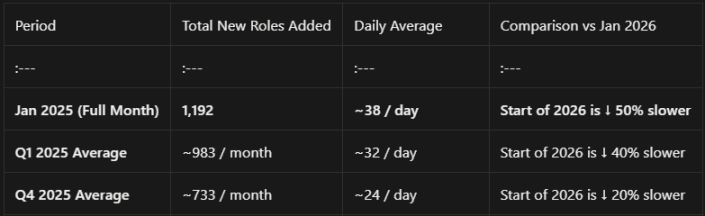
Data as of January 12, 2026

In the first two weeks of January 2025, the average number of daily job postings was about 38; in the same period of 2026, the average number of daily job postings was only about 6.5.

Recruitment activity in early January decreased by approximately 80% compared to the same period last year. This data confirms the widespread speculation: the industry's start this year is far less heated than last year.

Analyzing the details of the above job data, the main characteristics of the current recruitment market are as follows:

  • Job Type Distribution: Technical / Engineering positions account for 60%, Non-Technical / Business Development positions account for 40%.

  • Job Grade Distribution: Specialist / Senior Specialist / Manager / Department Head and other mid-to-senior level positions account for about 65%. This signal indicates that companies are prioritizing the recruitment of experienced talent to lead key projects related to core product development and business growth.

  • Experience Requirements: Most positions require candidates to have more than 5 years of relevant experience; management positions require more than 7 years of experience.

When conducting screening interviews with candidates, I often ask them: What currently attracts you to the crypto industry? The answers are invariably two: prediction markets and stablecoins. Therefore, it's not surprising that the data shows about 60% of recruitment demand is concentrated in infrastructure teams, stablecoin projects, and payment / fintech infrastructure startups. Furthermore, the talent war between the Kalshi and Polymarket platforms continues, and this competition is expected to persist.

Currently, the most aggressive recruiters are those growth-stage companies (i.e., companies that have completed Series A funding or later rounds). A quick glance at the recruitment pages of several companies and information on the Ashby platform also confirms this conclusion.

  • Series A Companies: Lifi Protocol has 13 open positions, Privy IO (acquired) has 10 open positions, Crossmint has 10 open positions, Coinflow Labs has 14 open positions;

  • Series B Companies: TurnkeyHQ has 12 open positions;

  • Series C Companies: Raincards has 49 open positions;

  • Series D Companies: Anchorage has 66 open positions.

However, perhaps more interesting is the change in talent flow.

Having worked full-time in crypto recruitment for 5 years, I can't help but recall: "Has there ever been a public chain ecosystem, like Solana, that challenged Ethereum's dominance in the recruitment and developer growth arena?" The answer is: No, at least never on this scale.

Looking back, other public chains like Polkadot and Cosmos have all experienced phases of rapid developer growth, but they never managed to pose a challenge to Ethereum of the same magnitude in terms of market share and sustained recruitment scale.

Solana is the first ecosystem with the real strength to compete with Ethereum. In 2024, it set a historic record, achieving, for the first time since 2016, a higher percentage of new contributing developers than Ethereum. Solana attracted over 22% of the crypto industry's new developers, while Ethereum's share was about 16%. This phenomenon is quite rare, considering that in the past, Ethereum almost monopolized the vast majority of new talent.
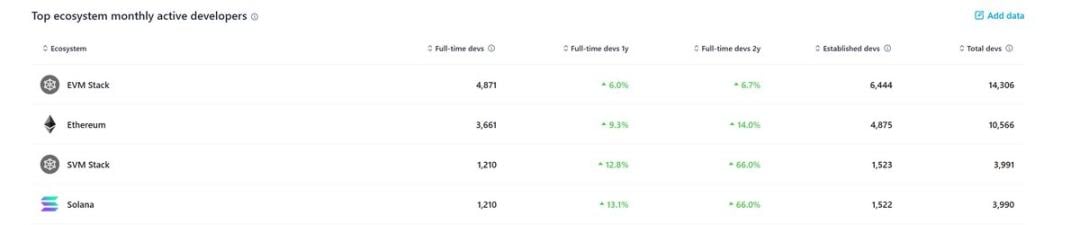
Data source: Electric Capital "Developer Report", as of January 14, 2026

In the third quarter of 2025 alone, 23 Solana ecosystem projects completed financing, raising $211 million, a 70% year-on-year increase in ecosystem financing scale.

For example: When a project completes a $13.5 million financing round (like Raikucom did in Q3 2025), its first priority is to recruit 5-10 senior engineers to build the core engineering team and business development team. These types of positions often do not appear on public recruitment websites but are filled through investor / angel investor networks, hackathon events, and targeted headhunting.

The crypto industry is constantly evolving, and the landscape of the recruitment market will change accordingly. Through token issuance, crypto technology can push internet capital markets to maximize development, but the reality is that the vast majority of tokens issued in the past two years have seen their prices fall.

I believe that in 2026, the ripple effects of this phenomenon will gradually become apparent, affecting how companies raise risk capital, their market expansion strategies, and, of course, their talent recruitment strategies.

The projects that will stand out this year will undoubtedly be those with solid business fundamentals, a real user base, solving actual needs, and most importantly, generating revenue.


Twitter:https://twitter.com/BitpushNewsCN

Bitpush TG Discussion Group:https://t.me/BitPushCommunity

Bitpush TG Subscription: https://t.me/bitpush

Original link:https://www.bitpush.news/articles/7604019

Perguntas relacionadas

QAccording to the data, by what percentage did the daily job posting rate in the crypto industry drop in the first two weeks of January 2026 compared to the same period in 2025?

AThe daily job posting rate dropped by approximately 80% in the first two weeks of January 2026 compared to the same period in 2025.

QWhat are the two main areas that candidates cite as their reason for joining the crypto industry, which also account for 60% of the hiring demand?

AThe two main areas are prediction markets and stablecoins.

QWhich blockchain ecosystem is highlighted as the first to seriously challenge Ethereum's dominance in developer recruitment and growth?

AThe Solana ecosystem is highlighted as the first to seriously challenge Ethereum's dominance.

QWhat type of companies are currently the most aggressive in their hiring, according to the article?

AGrowth-stage companies (those that have completed Series A funding or later) are currently the most aggressive in their hiring.

QWhat key characteristic is mentioned for projects that are predicted to stand out in 2026?

AProjects that are predicted to stand out in 2026 are those with solid business fundamentals, a real user base, that solve actual needs, and, most importantly, are able to generate revenue.

Leituras Relacionadas

$9.4 Billion: The Largest Robotics Funding This Year Has Emerged

Munich-based humanoid robotics company Neura has completed a $1.4 billion (approximately RMB 94.9 billion) Series C funding round, valuing the company at around $7 billion and positioning it among the global leaders in the sector. The investment round is notable not just for its size—reportedly the largest in robotics this year—but also for its strategic backers, which include tech giants like NVIDIA and Amazon, alongside established industrial players such as German engineering firms Bosch and Schaeffler. This mix of investors signals a significant shift in the industry's focus from technological demonstrations and general-purpose narratives toward practical, industrial deployment and commercialization. Neura's approach centers on developing humanoid robots for defined, high-value industrial tasks rather than pursuing a general-purpose model. Its early validation comes from a partnership with BMW, where its robots are being tested on actual production lines. The involvement of Bosch and Schaeffler, companies deeply embedded in global manufacturing, underscores a growing belief that humanoid robots are transitioning from labs to viable factory-floor solutions. The article highlights two converging trends driving investment: advancements in AI and large language models, which enhance robots' perception and decision-making in unstructured environments, and mounting pressure from labor shortages and rising costs in major manufacturing regions. The funding landscape is now bifurcating between companies like Figure AI, focusing on versatile general-purpose robots, and firms like Neura, targeting specific vertical industrial applications with clearer, shorter paths to ROI. While technical hurdles remain, the core challenges for widespread adoption are increasingly seen as engineering and commercial in nature: managing the high integration and customization costs for different factory environments and establishing robust, localized maintenance and service networks. The record investment in Neura, particularly from industrial capital, indicates the industry's growing confidence in moving from proving feasibility to solving the practical problems of scalability, reliability, and building sustainable business models around humanoid robots in real-world settings like automotive manufacturing and hazardous labor environments.

marsbitHá 3h

$9.4 Billion: The Largest Robotics Funding This Year Has Emerged

marsbitHá 3h

"119 to 176 Dollars": Behind SpaceX's Listing, MSX Once Again Successfully Executes the Pre-IPO Closed Loop

Following May's 300% gain on Cerebras, MSX delivered another outstanding performance during SpaceX's listing night. On June 12, SpaceX (SPCX) launched on Nasdaq, reaching a high of $176. This marked the successful culmination of MSX's Pre-IPO project launched in March, where users subscribed at $119, achieving gains of approximately 40-48%. This event validated MSX's complete Pre-IPO mechanism, a crucial advantage in a market where access to top-tier private company equity is typically limited to institutions. MSX's model provides a full cycle for users: subscription (at $119 for SpaceX), real-time on-chain portfolio tracking, optional early redemption, seamless conversion to tradable spot assets (SPCX.M) upon IPO, and final settlement in stablecoins. This end-to-end process distinguishes MSX from platforms that faced settlement issues during the SpaceX IPO, highlighting that the core challenge of Pre-IPO is not just access, but a clear exit and conversion path post-listing. This success with SpaceX is MSX's second major Pre-IPO verification, following the Cerebras listing in May, which yielded ~300% returns for early participants. These back-to-back achievements demonstrate MSX's capability to source, structure, and deliver real assets through a replicable on-chain model. The true barrier for Pre-IPO products lies not in providing an entry point, but in ensuring reliable fulfillment from subscription through to post-IPO liquidity. MSX's proven闭环 (closed-loop) process addresses this, offering Web3 users a structured way to access high-growth, pre-public companies in sectors like AI and frontier tech. MSX plans to continue expanding its Pre-IPO portfolio with this focus on authenticity, transparency, and post-listing execution.

Odaily星球日报Há 15h

"119 to 176 Dollars": Behind SpaceX's Listing, MSX Once Again Successfully Executes the Pre-IPO Closed Loop

Odaily星球日报Há 15h

Trading

Spot
Futuros
活动图片





