Here’s what happened in crypto today: $414M ETF outflows, “Mined in America” bill & more

ambcryptoPublicado em 2026-03-31Última atualização em 2026-03-31

Resumo

Amid heightened US-Iran tensions, the crypto market faced significant pressure, with altcoins hit particularly hard—40% were at or near all-time lows, a more severe state than the previous cycle. Bitcoin spot ETFs saw $414 million in outflows, breaking a four-week inflow streak, as rising oil prices and inflation fears dampened investor sentiment. Meanwhile, US Senators proposed the "Mined in America" bill to promote domestic cryptocurrency mining and establish a Strategic Bitcoin Reserve. Additionally, the Speaker of Iran’s Parliament offered trading advice, suggesting that pre-market news often acts as a "reverse indicator." Both crypto and stock markets reacted sharply to geopolitical developments, with BTC briefly rallying before declining again.

As tensions between the United States and Iran remained high, the altcoin market was approaching cycle extremes, with 40% of altcoins at or near all-time lows, according to a CryptoQuant research report. The total valuation of the crypto market was down 45% from its peak of $4.27 trillion, reached in October 2025.

The report laid out how current conditions are slightly more severe compared to the previous cycle, where only 38% of altcoins fell to or around their all-time lows. The figure was already at 40% this time, and the long-term downtrend of Bitcoin was still in place.

Here’s a full breakdown of top headlines that shaped crypto in the past 48 hours.

ETF flows respond to US-Iran tensions
Source: SoSoValue

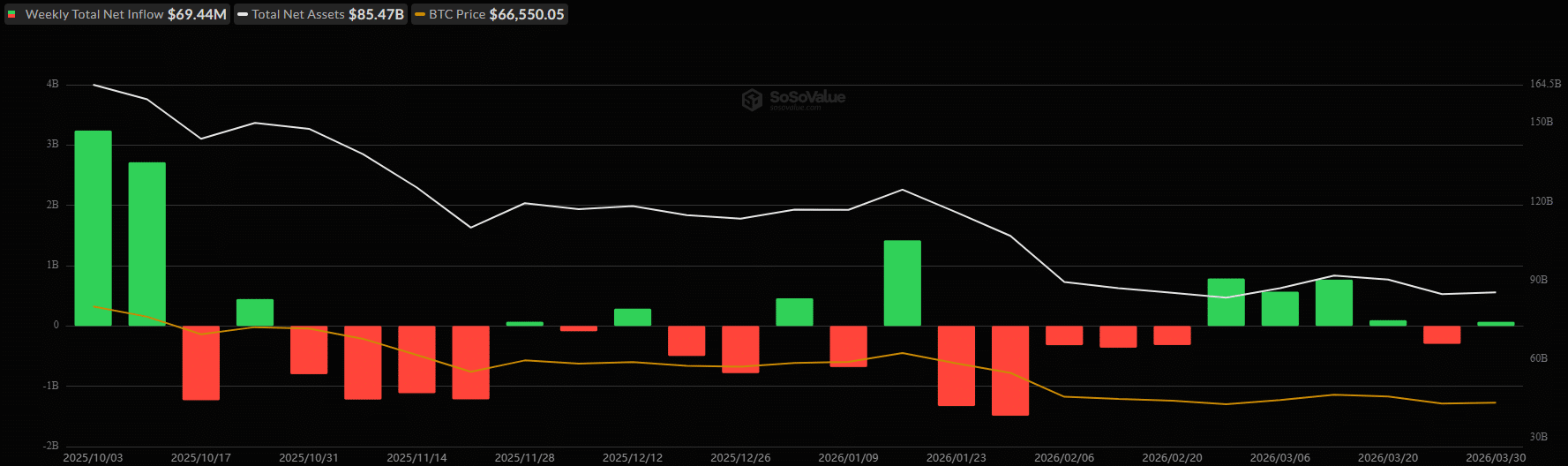
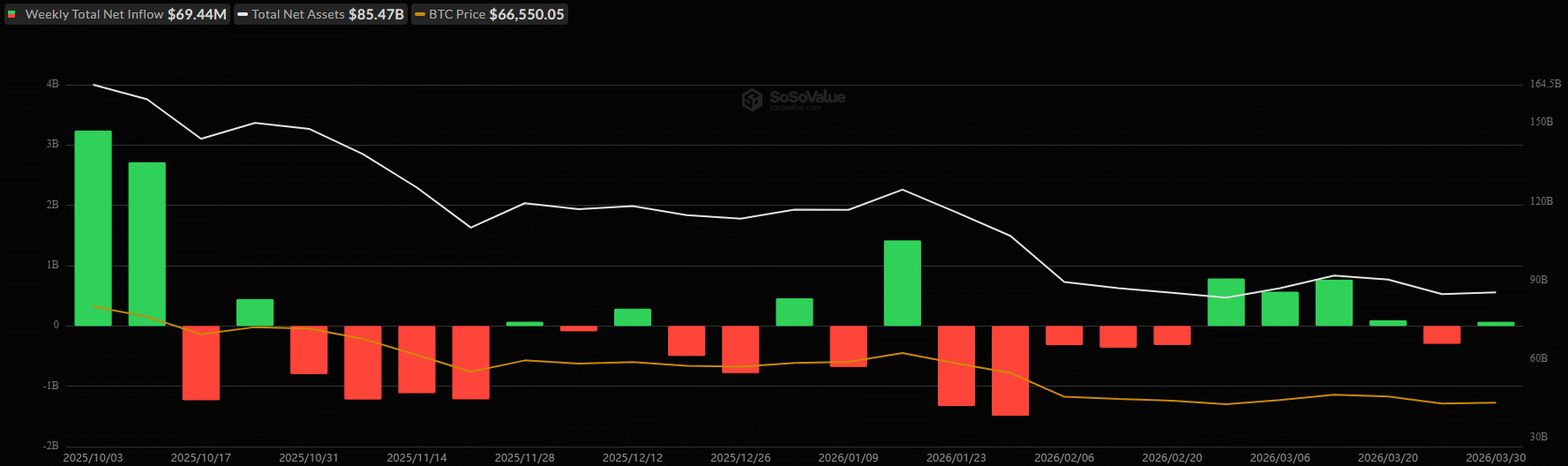
Starting in the final week of February, the Bitcoin spot ETF flows were positive and racked up a 4-week streak of inflows. This streak measured $2.218 billion, but the week ending on Friday, the 27th of March, brought $414 million in outflows.

Even before the inflow streak broke, the inflows massively slowed down in the third week of March, with just $95.18 million in inflows.

This was due to the rising oil prices, inflation worries, and it was becoming increasingly clear that the conflict would not see a quick resolution.

Farside Investors’ data showed that Bitcoin ETFs saw positive flows on Monday, the 30th of March, as BTC fell to the swing low at $65.6k.

U.S. Senators propose “Mined in America” bill

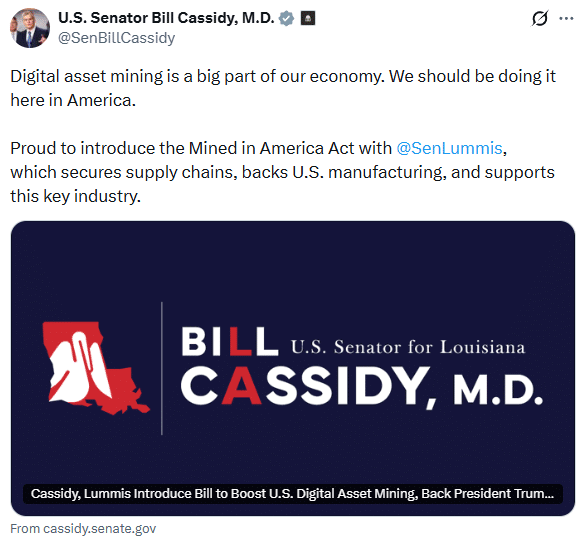
Introduced by Senators Bill Cassidy and Cynthia Lummis, the “Mined in America” act seeks to expand U.S.-based cryptocurrency mining. It also codifies a Strategic Bitcoin Reserve, as was the earlier executive push.
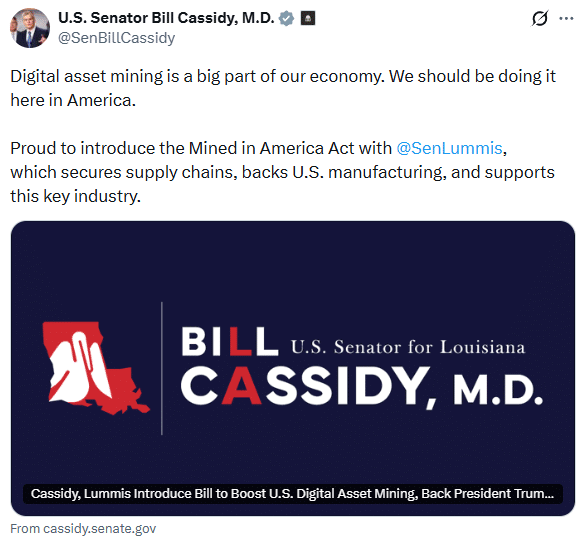
Source: Senator Bill Cassidy

The legislation allows facilities to qualify as “Mined in America” if they meet certain criteria through a voluntary certification program. The aim is to move away from mining hardware linked to foreign adversaries.

The previous executive actions outlined the Strategic Bitcoin Reserve idea, but this legislation seeks to embed it into law. This could strengthen U.S. leadership in digital assets.

Iran’s Speaker of the Parliament’s trading advice

In a post on X on the 29th of March, Mohammad Ghalibaf, Iran’s Speaker of the Parliament, said,

Pre-market news is a ‘reverse indicator’ and if they ‘dump’ the market, then “go long.”
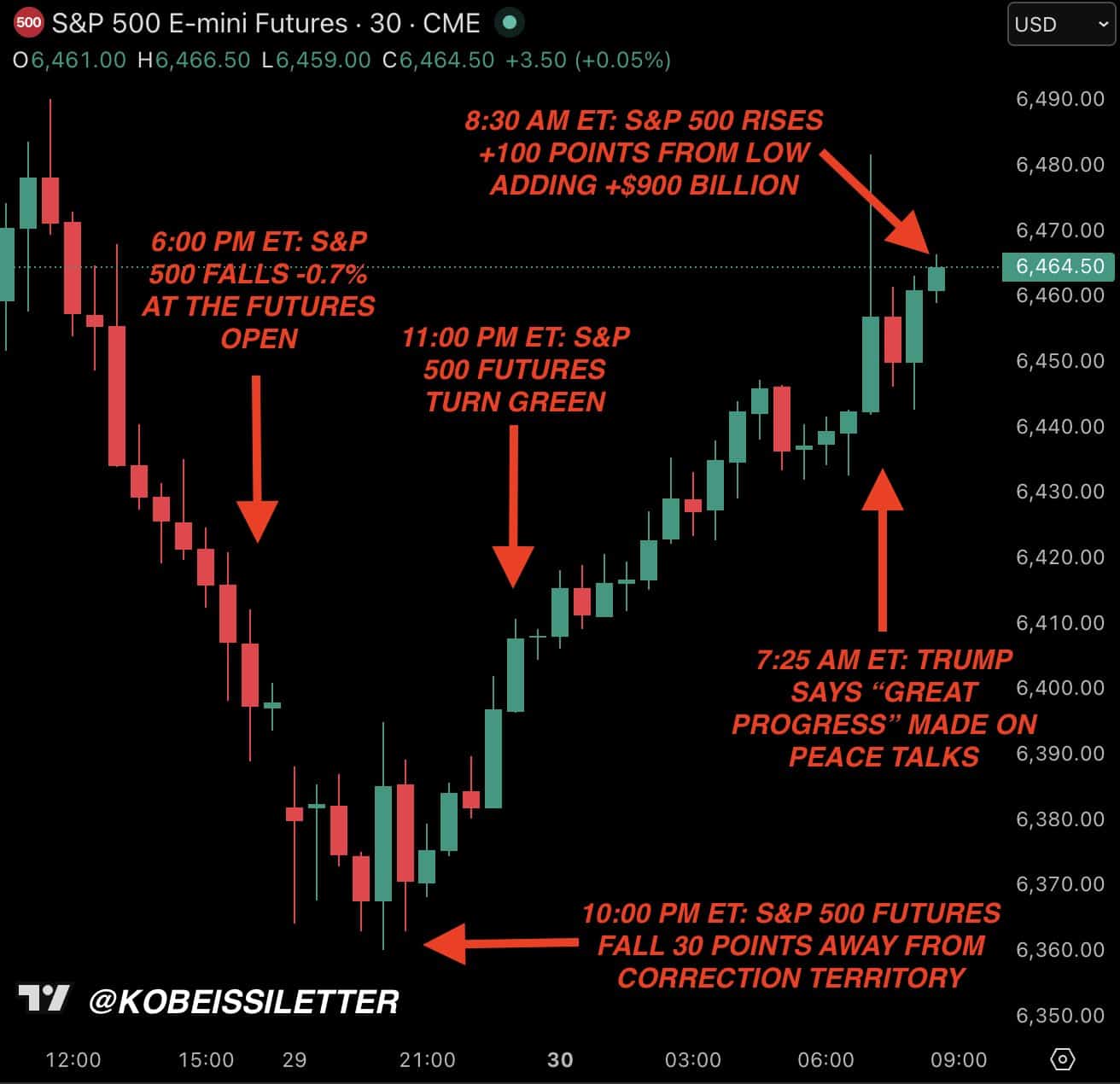
Source: The Kobeissi Letter

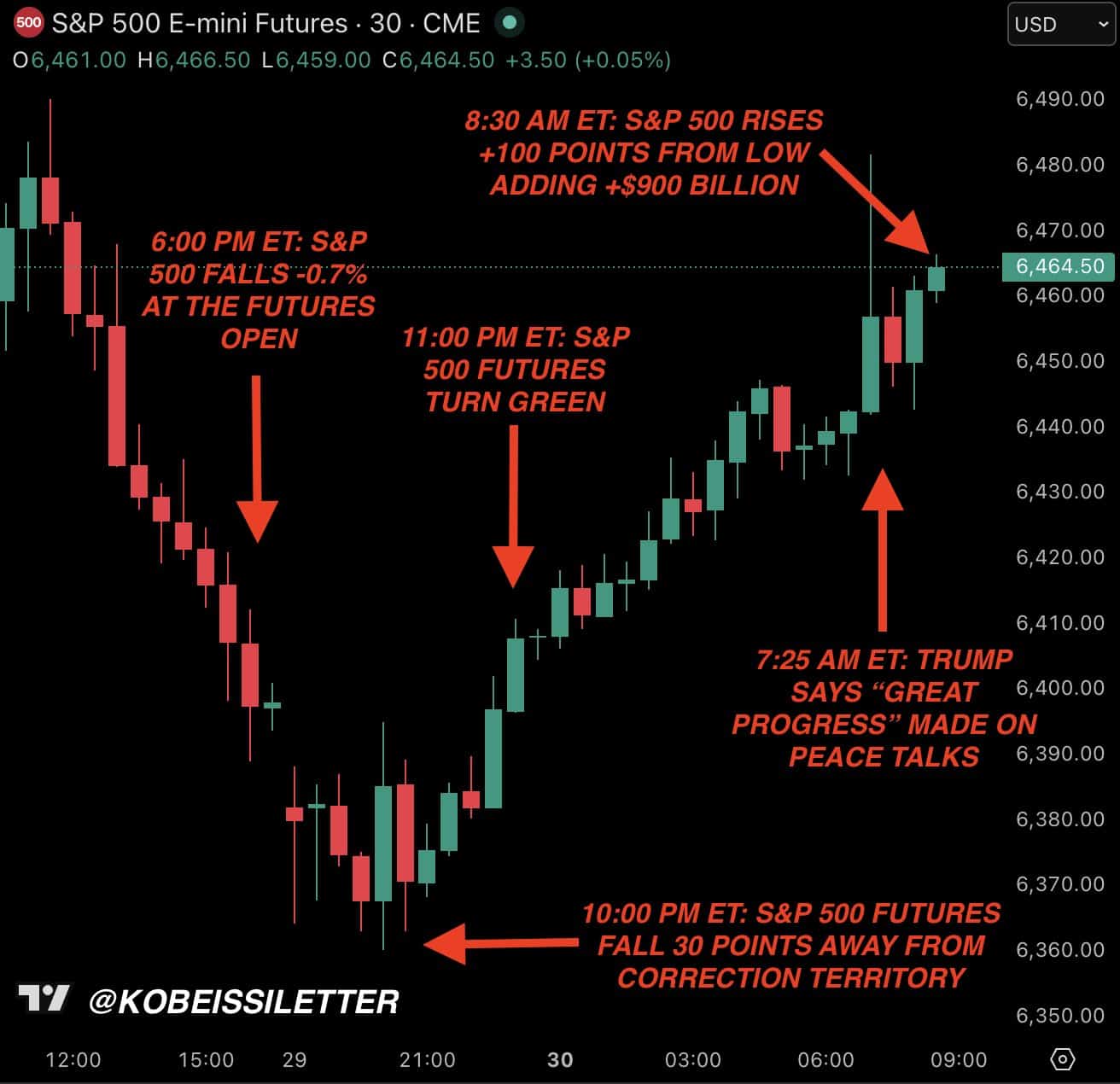
On the 30th of March, before the market opened, President Trump announced that “great progress” was being made in Iran peace talks. The S&P 500 rallied off the news but was quick to slump and was 1.3% down from the local high on the 30th of March.

Crypto was also affected by the stock markets, with BTC rallying 3.2% from recent lows before slumping lower at press time.

No matter which way you slice it, peace talks blossoming before Monday’s market opens and fading away days later is an interesting pattern.


Final Summary

  • The US-Iran tensions saw Bitcoin investors take profits earlier in March, and selling pressure has ramped up over the previous week.
  • The bill pushing toward domestic Bitcoin mining hardware also sought to establish a Strategic Bitcoin Reserve.


Perguntas relacionadas

QWhat percentage of altcoins were at or near all-time lows according to the CryptoQuant report, and how does this compare to the previous cycle?

AAccording to the CryptoQuant report, 40% of altcoins were at or near all-time lows. This is slightly more severe than the previous cycle, where only 38% of altcoins fell to or around their all-time lows.

QWhat was the total amount of outflows for Bitcoin spot ETFs in the week ending March 27th, and what broke the previous 4-week inflow streak?

AThe total outflows for Bitcoin spot ETFs in the week ending March 27th were $414 million. This broke the previous 4-week streak of inflows, which had reached a total of $2.218 billion.

QWhat is the main goal of the 'Mined in America' bill proposed by Senators Cassidy and Lummis?

AThe main goal of the 'Mined in America' bill is to expand U.S.-based cryptocurrency mining and codify a Strategic Bitcoin Reserve. It establishes a voluntary certification program for facilities that meet certain criteria, aiming to move away from mining hardware linked to foreign adversaries and strengthen U.S. leadership in digital assets.

QWhat trading advice did Iran's Speaker of the Parliament, Mohammad Ghalibaf, give in his post on X?

AIn his post on X, Mohammad Ghalibaf advised that pre-market news is a 'reverse indicator.' He suggested that if they 'dump' the market, then traders should 'go long.'

QHow did the announcement of progress in Iran peace talks by President Trump on March 30th affect the financial markets?

APresident Trump's announcement of 'great progress' in Iran peace talks on March 30th initially caused the S&P 500 to rally. However, it quickly slumped and was down 1.3% from its local high later that day. Similarly, Bitcoin rallied 3.2% from recent lows but then slumped lower again.

Leituras Relacionadas

In Jinjiang, Fujian, a Storage Super Unicorn Lies Quiet

In Fujian's Jinjiang, a city known for sportswear, lies a quiet semiconductor giant: Fujian Jinhua Integrated Circuit Co. (JHICC). Once a promising domestic DRAM manufacturer alongside Yangtze Memory and ChangXin Memory Technologies (CXMT), its journey was derailed in 2018 when the U.S. placed it on an Entity List and filed criminal charges for alleged trade secret theft. This halted production for years. A turning point came in February 2024 when a U.S. federal court found JHICC not guilty. However, it had lost crucial time. While CXMT soared to become a top-valued A-share company in 2024, JHICC, with an estimated valuation of 80 billion RMB, was just restarting. Its current output is primarily customized DDR4 chips, not the advanced DDR5/HBM demanded for AI, but it still benefits from the broader memory chip upcycle. JHICC's story is tied to Chen Zhengkun, a veteran engineer who left Micron to lead the venture. Founded in 2016 with state-backed funding, JHICC partnered with Taiwan's UMC to develop DRAM technology. Rapid progress was cut short by the U.S. actions, which Micron initiated, partly due to its heavy reliance on the Chinese market. Post-sanctions, Chen's team worked to rebuild the production line with reduced reliance on U.S. technology. According to its records, JHICC achieved small-scale production and revenue growth under immense pressure. It now focuses on the stable "niche" DRAM market (e.g., TVs, routers) with a monthly capacity of ~40,000 wafers, aiming for 60,000 by 2026. It holds over 1,000 patents but remains on the Entity List. For Jinjiang, investing in JHICC was a bold industrial leap. The local government provided unwavering financial and logistical support during the crisis, helping the company survive. JHICC has become the anchor for a growing local semiconductor cluster. Though its scale lags behind domestic peers, JHICC's persistence symbolizes a hard-won foothold in a global market long dominated by Samsung, SK Hynix, and Micron. Having missed one boom, it seeks a place in the new AI-driven memory supercycle.

marsbitHá 3m

In Jinjiang, Fujian, a Storage Super Unicorn Lies Quiet

marsbitHá 3m

Must-Watch Events Next Week|CLARITY Act Could Face Senate Vote; SpaceX, Circle to Report Earnings (8.3-8.9)

**Summary: Key Events and Developments to Watch (August 3-9)** The upcoming week is marked by significant financial disclosures, key legislative deadlines, and notable product updates. **Major Financial Events:** Several companies are scheduled to release their Q2 2026 earnings. American Bitcoin (ABTC) will report on August 3, followed by SpaceX and Hut 8 Mining Corp. on August 4, and Circle on August 5. Notably, a significant portion of SpaceX shares (up to 12% of total shares) will be unlocked on August 6 following their earnings release. **Key Legislative Deadline:** The U.S. Senate faces an August 7 deadline to secure 60 votes for the CLARITY Act, a bipartisan bill aiming to establish a federal regulatory framework for cryptocurrencies. The Senate may hold a full vote on the bill during the week. **Economic Data:** The U.S. July Non-Farm Payrolls report will be released on August 7, providing crucial labor market data. **Technology & Product Updates:** * **Shutdowns:** DeFi portfolio tracker Zapper and wallet app Ctrl Wallet will cease operations on August 3. * **Upgrades:** LayerZero will deprecate its v1 relayers on August 3. XRP Ledger's new version 3.3.0, featuring five new functions, is expected next week. * **AI:** Elon Musk announced that the advanced Grok 4.6 AI model is set for release around August 7. * **Bitcoin:** The BIP-110 forced signaling for a potential Bitcoin network change is scheduled to begin around August 8. **Other Notable Events:** Chinese robotics firm Unitree Tech has set its preliminary price inquiry for its IPO for August 5. South Korean exchange Upbit will delist AQT and AERGO tokens on August 3.

marsbitHá 2h

Must-Watch Events Next Week|CLARITY Act Could Face Senate Vote; SpaceX, Circle to Report Earnings (8.3-8.9)

marsbitHá 2h

Trading

Spot
活动图片