Here’s what happened in crypto today: 1 sell-off, 4 major shocks

ambcryptoPublicado em 2026-02-02Última atualização em 2026-02-02

Resumo

The cryptocurrency market experienced a significant sell-off, with Bitcoin dropping to around $76K. Despite the decline, historical patterns suggest such downturns—like those following Mt. Gox, the ICO bubble burst, COVID-19, and the FTX collapse—are often temporary, with Bitcoin historically recovering from losses as high as 80%. In other major developments: - World Liberty Financial (WLFI), linked to former President Trump, sold a 49% stake to UAE-based Aryam Investment in a $500 million deal. The transaction occurred just before Trump’s second inauguration, though WLFI had no live products at the time. - Igor Runets, CEO of Russian Bitcoin mining firm BitRiver, was detained in Moscow on tax evasion charges. The company, once worth hundreds of millions, has faced challenges since U.S. sanctions in 2022. - CrossCurve’s cross-chain bridge was exploited due to a smart contract flaw, resulting in an estimated $3 million loss. The team has offered a 10% reward for the return of funds and warned of potential legal action. Despite short-term concerns, Bitcoin’s long-term resilience remains a key theme.

Crypto had one of those days. The market was hit by a big sell-off that saw Bitcoin [BTC] lose key levels, alongside many other unsettling headlines piling up.

Here’s a quick rundown.

BTC falls, history repeats

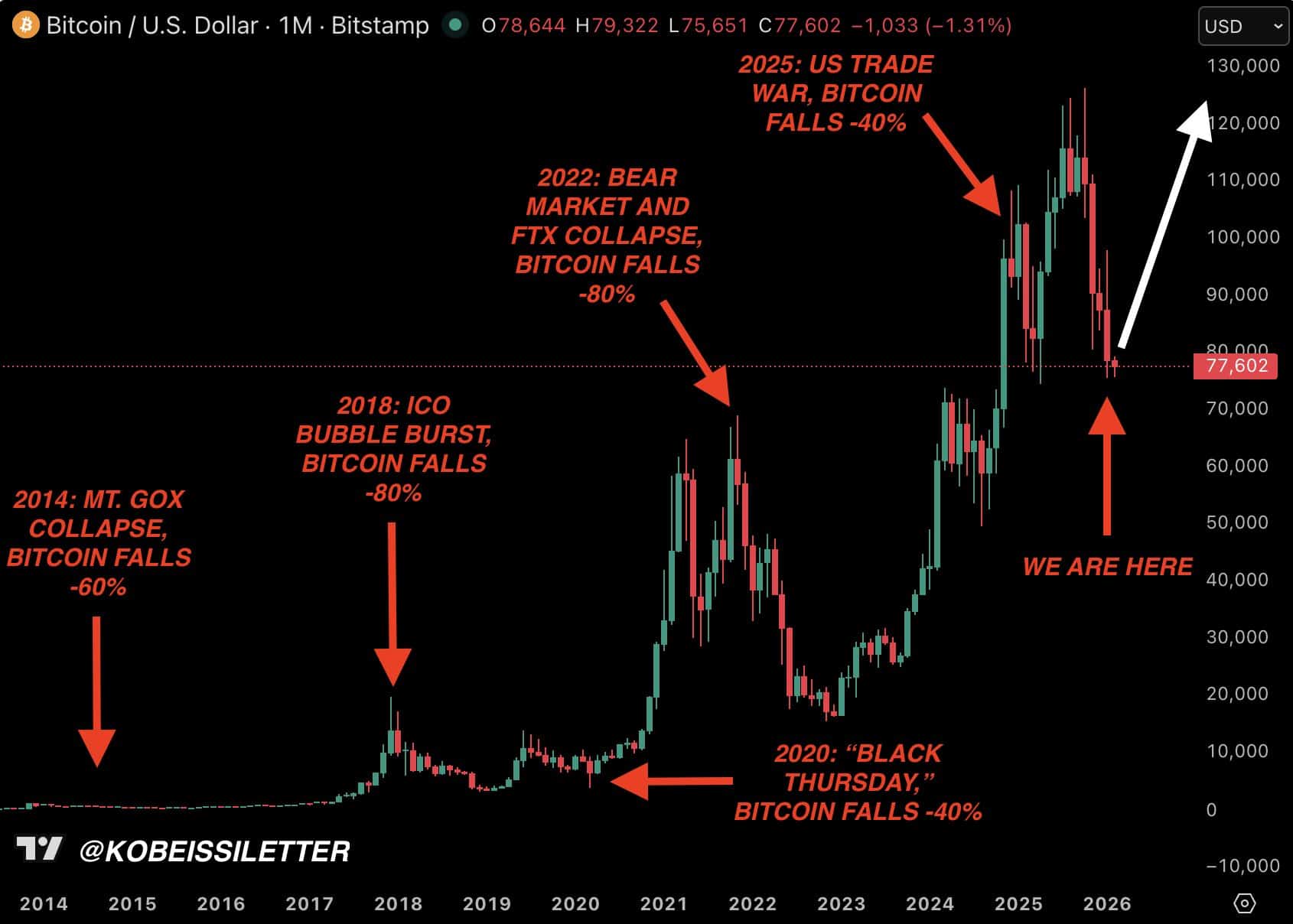
Bitcoin slid to around $76K at press time, with a market sell-off dragging major tokens lower in a matter of hours. While this seems like a reason to panic, zooming out will give you the real picture.

Source: X

The Kobeissi Letter’s recent X post puts this drop in familiar company.

Bitcoin has lived through far deeper falls: the Mt. Gox collapse in 2014, the ICO bubble burst in 2018, the Covid-era crash in 2020, and the 2022 bear market caused by FTX.

Each time, losses ranged from 40% to as much as 80%. Each time, Bitcoin eventually recovered. Every major crypto crash feels terminal in the moment but becomes a rounding error over time.

49% of Trump-linked WLFI bought out

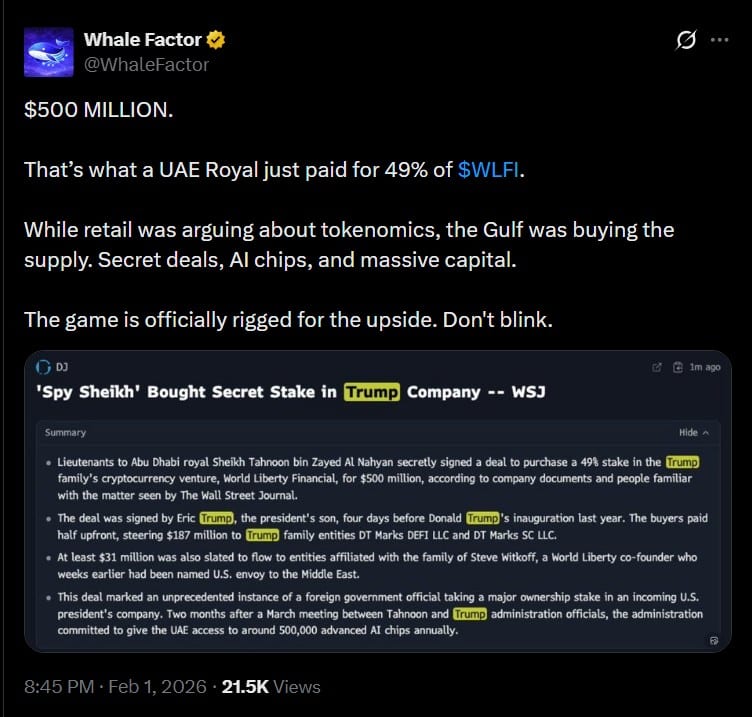
The Wall Street Journal has reported that World Liberty Financial sold a 49% stake to UAE-based Aryam Investment. The deal is said to be worth $500 million.

The agreement was allegedly signed just days before President Trump’s second inauguration, despite the company having no live products at the time. Notably, Aryam does not receive any rights tied to the WLFI token.

Source: X

Aryam is backed by Sheikh Tahnoon bin Zayed Al Nahyan, the UAE’s national security advisor and brother of the country’s president. Sheikh Tahnoon also chairs AI-focused firms MGX and G42.

Earlier this year, MGX invested $2 billion into Binance, settling the transaction using WLF’s newly launched stablecoin, USD1.

This was without disclosing its indirect ownership in WLF.

Russian Bitcoin mining firm CEO detained

Igor Runets, founder and CEO of Russian Bitcoin mining firm BitRiver, has reportedly been detained by authorities in Moscow on allegations of tax evasion.

Local media reports say Runets was taken into custody on Friday and formally charged the following day with three counts related to hiding assets to avoid paying taxes.

A Moscow court has ordered him to remain under house arrest, a decision his legal team can still appeal before it takes full effect later this week.

Runets built BitRiver into one of Russia’s largest Bitcoin mining operators after founding the company in 2017. At its peak, his crypto mining business was reported to be worth hundreds of millions of dollars.

Since being sanctioned by the U.S. in 2022, the firm has lost key clients, faced lawsuits, and struggled with delayed employee payments.

Cross-chain bridge breach causes emergency stop

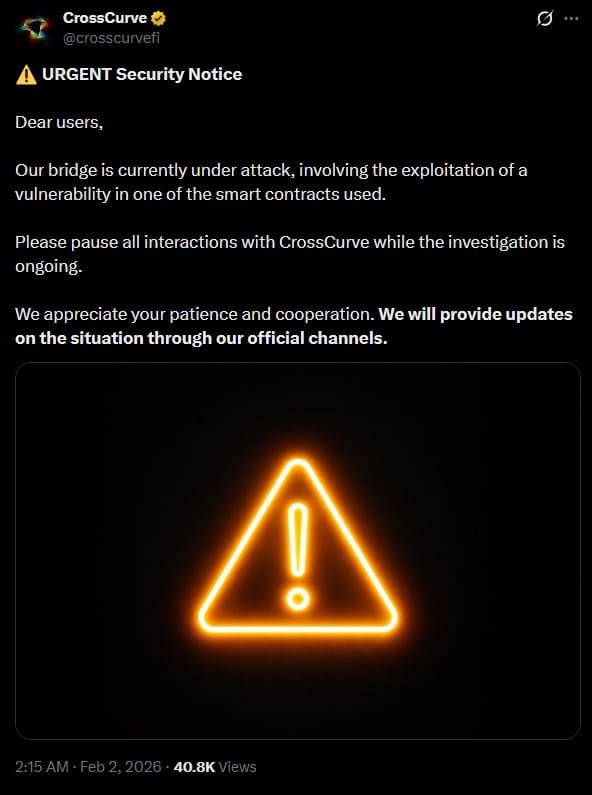
Crypto protocol CrossCurve has asked users to stop interacting with its platform after confirming that its cross-chain bridge was compromised in a smart contract attack.

An estimated $3 million was reportedly drained across multiple blockchain networks.

The team said the issue stemmed from a flaw in one of the contracts used by the bridge. This allowed unauthorized transactions to slip through normal checks.

Blockchain security trackers flagged the exploit shortly after it happened. They warned that the vulnerability could be used to unlock tokens without proper validation.

Source: X

The incident prompted partner protocol Curve Finance to caution users who had exposure to CrossCurve-related pools. They’ve asked users to reassess their positions and consider withdrawing support.

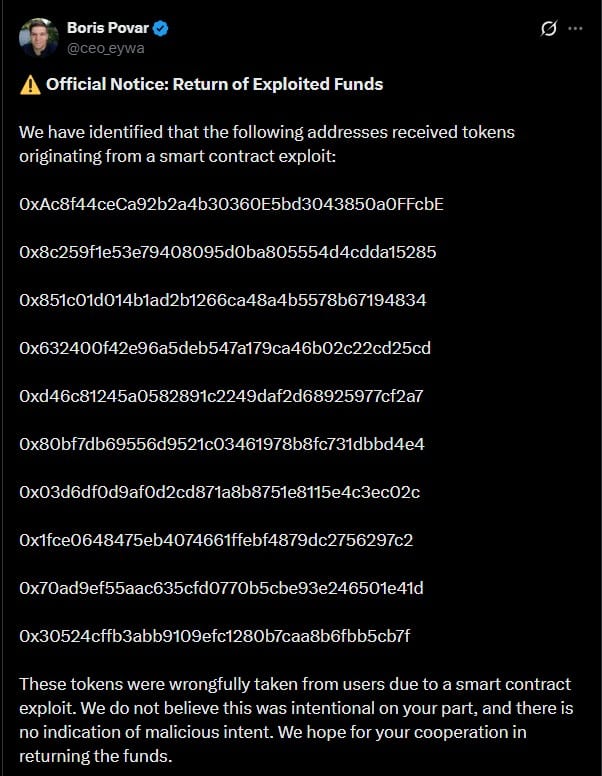
In response, CrossCurve CEO Boris Povar publicly addressed the wallets believed to have received the stolen funds. If the assets are returned in 72 hours, he’s offered a reward of up to 10%.

Source: X

The team has stated that it is prepared to involve law enforcement and pursue legal action if needed.


Final Thoughts

  • Bitcoin slipped to $76K, but patterns say the worries won’t last long.
  • In other news, WLFI has sold a major chunk of equity while the CEO of BitRiver got detained.
Next: Uniswap breaks multi-year support: Will UNI see a larger crash?
Share
  • Share
  • Tweet

Perguntas relacionadas

QWhat was the main event that caused Bitcoin to drop to around $76K?

AA market sell-off dragged major tokens lower, causing Bitcoin to slide to around $76K.

QWhich company sold a 49% stake to UAE-based Aryam Investment, and what was the deal's value?

AWorld Liberty Financial sold a 49% stake to Aryam Investment in a deal worth $500 million.

QWhy was Igor Runets, CEO of BitRiver, detained by authorities in Moscow?

AIgor Runets was detained on allegations of tax evasion, specifically for hiding assets to avoid paying taxes.

QWhat was the cause of the CrossCurve cross-chain bridge breach, and how much was estimated to be drained?

AThe breach was caused by a flaw in one of the smart contracts used by the bridge, allowing unauthorized transactions, and an estimated $3 million was drained.

QWhat did CrossCurve CEO Boris Povar offer to the wallets that received the stolen funds if they returned the assets within 72 hours?

ABoris Povar offered a reward of up to 10% if the stolen assets were returned within 72 hours.

Leituras Relacionadas

a16z: AI's 'Amnesia', Can Continuous Learning Cure It?

The article "a16z: AI's 'Amnesia' – Can Continual Learning Cure It?" explores the limitations of current large language models (LLMs), which, like the protagonist in the film *Memento*, are trapped in a perpetual present—unable to form new memories after training. While methods like in-context learning (ICL), retrieval-augmented generation (RAG), and external scaffolding (e.g., chat history, prompts) provide temporary solutions, they fail to enable true internalization of new knowledge. The authors argue that compression—the core of learning during training—is halted at deployment, preventing models from generalizing, discovering novel solutions (e.g., mathematical proofs), or handling adversarial scenarios. The piece introduces *continual learning* as a critical research direction to address this, categorizing approaches into three paths: 1. **Context**: Scaling external memory via longer context windows, multi-agent systems, and smarter retrieval. 2. **Modules**: Using pluggable adapters or external memory layers for specialization without full retraining. 3. **Weights**: Enabling parameter updates through sparse training, test-time training, meta-learning, distillation, and reinforcement learning from feedback. Challenges include catastrophic forgetting, safety risks, and auditability, but overcoming these could unlock models that learn iteratively from experience. The conclusion emphasizes that while context-based methods are effective, true breakthroughs require models to compress new information into weights post-deployment, moving from mere retrieval to genuine learning.

marsbitHá 30m

a16z: AI's 'Amnesia', Can Continuous Learning Cure It?

marsbitHá 30m

Can a Hair Dryer Earn $34,000? Deciphering the Reflexivity Paradox in Prediction Markets

An individual manipulated a weather sensor at Paris Charles de Gaulle Airport with a portable heat source, causing a Polymarket weather market to settle at 22°C and earning $34,000. This incident highlights a fundamental issue in prediction markets: when a market aims to reflect reality, it also incentivizes participants to influence that reality. Prediction markets operate on two layers: platform rules (what outcome counts as a win) and data sources (what actually happened). While most focus on rules, the real vulnerability lies in the data source. If reality is recorded through a specific source, influencing that source directly affects market settlement. The article categorizes markets by their vulnerability: 1. **Single-point physical data sources** (e.g., weather stations): Easily manipulated through physical interference. 2. **Insider information markets** (e.g., MrBeast video details): Insiders like team members use non-public information to trade. Kalshi fined a剪辑师 $20,000 for insider trading. 3. **Actor-manipulated markets** (e.g., Andrew Tate’s tweet counts): The subject of the market can control the outcome. Evidence suggests Tate’sociated accounts coordinated to profit. 4. **Individual-action markets** (e.g., WNBA disruptions): A single person can execute an event to profit from their pre-placed bets. Kalshi and Polymarket handle these issues differently. Kalshi enforces strict KYC, publicly penalizes insider trading, and reports to regulators. Polymarket, with its anonymous wallet-based system, has historically been more permissive, arguing that insider information improves market accuracy. However, it cooperated with authorities in the "Van Dyke case," where a user traded on classified government information. The core paradox is reflexivity: prediction markets are designed to discover truth, but their financial incentives can distort reality. The more valuable a prediction becomes, the more likely participants are to influence the event itself. The market ceases to be a mirror of reality and instead shapes it.

marsbitHá 1h

Can a Hair Dryer Earn $34,000? Deciphering the Reflexivity Paradox in Prediction Markets

marsbitHá 1h

Trading

Spot
Futuros

Artigos em Destaque

Como comprar 4

Bem-vindo à HTX.com!Tornámos a compra de 4 (4) simples e conveniente.Segue o nosso guia passo a passo para iniciar a tua jornada no mundo das criptos.Passo 1: cria a tua conta HTXUtiliza o teu e-mail ou número de telefone para te inscreveres numa conta gratuita na HTX.Desfruta de um processo de inscrição sem complicações e desbloqueia todas as funcionalidades.Obter a minha contaPasso 2: vai para Comprar Cripto e escolhe o teu método de pagamentoCartão de crédito/débito: usa o teu visa ou mastercard para comprar 4 (4) instantaneamente.Saldo: usa os fundos da tua conta HTX para transacionar sem problemas.Terceiros: adicionamos métodos de pagamento populares, como Google Pay e Apple Pay, para aumentar a conveniência.P2P: transaciona diretamente com outros utilizadores na HTX.Mercado de balcão (OTC): oferecemos serviços personalizados e taxas de câmbio competitivas para os traders.Passo 3: armazena teu 4 (4)Depois de comprar o teu 4 (4), armazena-o na tua conta HTX.Alternativamente, podes enviá-lo para outro lugar através de transferência blockchain ou usá-lo para transacionar outras criptomoedas.Passo 4: transaciona 4 (4)Transaciona facilmente 4 (4) no mercado à vista da HTX.Acede simplesmente à tua conta, seleciona o teu par de trading, executa as tuas transações e monitoriza em tempo real.Oferecemos uma experiência de fácil utilização tanto para principiantes como para traders experientes.

596 Visualizações TotaisPublicado em {updateTime}Atualizado em 2025.10.20

Como comprar 4

Discussões

Bem-vindo à Comunidade HTX. Aqui, pode manter-se informado sobre os mais recentes desenvolvimentos da plataforma e obter acesso a análises profissionais de mercado. As opiniões dos utilizadores sobre o preço de 4 (4) são apresentadas abaixo.

活动图片