Hedge Fund Q1 Interpretation: Everyone Is Selling Software, Buying Chips

marsbitPublicado em 2026-05-27Última atualização em 2026-05-27

Resumo

Hedge Funds and Mutual Funds Aligned in Q1: Dumping Software, Buying Chips A clear consensus emerged among major U.S. hedge funds and mutual funds in Q1: they were simultaneously selling software stocks and pouring capital into the semiconductor sector. This aggressive rotation pushed semiconductor exposure in hedge fund long portfolios to a record high. Hedge funds delivered a 7% return year-to-date, while only 30% of large-cap active mutual funds outperformed their benchmarks. The average short interest for S&P 500 constituents rose to 3% of market cap, the highest since 2011. Within technology, the structural shift was stark. Hedge funds' semiconductor weighting hit an all-time high, while software fell to its lowest since 2019. Excluding Microsoft, mutual funds' relative overexposure to semis vs. software was the largest since 2012. Microsoft was among the most net-sold stocks by both groups. Hedge funds net purchased semiconductor names like LRCX and AMAT. Strategies diverged on leverage and cash. Hedge funds increased their net exposure to near a one-year high after an initial cut. Mutual funds raised their cash allocation, though it remains historically low at 1.4%. Sector alignment was high in Industrials (both overweight) but divergent in Tech: hedge funds increased their Tech net tilt by a record 853 basis points, while mutual funds reduced theirs. Clear splits also appeared in Financials and Consumer Discretionary. Four stocks appeared on both Goldman's hedge...

Author: Zhao Ying

Source: Wall Street News

In the first quarter, U.S. hedge funds and large mutual funds reached a rare consensus: selling software and rushing into semiconductors, pushing the long-side weight of semiconductors in hedge fund portfolios to a record high.

According to Goldman Sachs' latest "Hedge Fund Trend Monitor" and "Mutual Fund Fundamentals" reports, this analysis covers 1,059 hedge funds (total equity holdings of $4.6 trillion) and 509 large active mutual funds (equity assets under management of $3.9 trillion). The reports show that hedge funds have achieved a return of 7% year-to-date, while only 30% of large mutual funds outperformed their benchmarks, lower than the historical average of 37% since 2007.

The Q1 13F filing data from the U.S. reveals a clear market consensus: hedge funds and mutual funds are simultaneously selling software stocks and flocking to the semiconductor sector. The intensity of this rotation is so great that it has pushed semiconductors' weight in hedge fund long portfolios to an all-time high.

In terms of positioning structure, hedge fund net leverage has rebounded to the 85th percentile over the past five years, near a one-year high; meanwhile, the average short interest as a percentage of market capitalization for S&P 500 constituents has risen to 3%, the highest level since 2011, indicating simultaneous intensification of market long/short activity.

Semiconductor Positioning Hits Record High, Software Faces Systematic Reduction

The structural rotation within the technology sector was the most prominent theme this quarter.

Goldman Sachs data shows that semiconductors' weight in hedge fund long portfolios has risen to its highest level on record, while software's weight has fallen to its lowest since 2019. Regarding mutual funds, their positioning in software has dropped to its lowest level since 2012. Excluding Microsoft, the magnitude of mutual fund overweight in semiconductors relative to software is also the largest since 2012.

At the individual stock level, Microsoft (MSFT) became one of the stocks with the largest net selling by both hedge funds and mutual funds last quarter. Mutual funds also reduced holdings across the remaining members of the "Magnificent Seven." While hedge funds trimmed most "Magnificent Seven" holdings, they achieved net buying in META and AAPL.

For semiconductor stocks, hedge funds net bought LRCX, AMAT, and ASML; mutual funds net bought INTC and SITM.

Leverage and Cash: Hedge Funds Aggressive, Mutual Funds Conservative

Faced with escalating geopolitical tensions in Q1, the response strategies of the two types of institutions showed clear divergence.

Hedge funds initially cut net leverage but then quickly increased positions as markets rebounded in Q2, with net exposure rebounding to near a one-year high. Overall leverage relative to historical levels remains elevated.

Mutual funds, on the other hand, opted to increase cash allocations, raising the cash-to-assets ratio from a historical low of 1.1% at the start of 2026 to 1.4% in early April. However, this level remains historically very low, indicating that mutual funds overall have not significantly withdrawn from equity markets.

Sector Consensus and Divergence: Overweight Industrials, Tech Divergence

Regarding sector allocations, there is high consensus between the two types of institutions, but also clear exceptions. Both hedge funds and mutual funds are overweight the Industrials sector and underweight the Information Technology sector, but their reallocation directions were opposite.

Hedge funds increased their net tilt towards Information Technology by 853 basis points in Q1, the largest single-quarter move for the sector on record, while simultaneously reducing their net tilt towards Industrials by 297 basis points. Mutual funds operated in reverse, increasing Industrials exposure by 24 basis points and cutting Information Technology by 20 basis points.

The two sectors with the most prominent divergence are Financials and Consumer Discretionary: mutual funds are overweight Financials while hedge funds are underweight; hedge funds are overweight Consumer Discretionary while mutual funds are underweight.

Four 'Shared Favorites' Outperform the Market Year-to-Date

Goldman Sachs screened for four stocks appearing simultaneously on both the hedge fund VIP list (GSTHHVIP) and the mutual fund overweight list (GSTHMFOW) this quarter: Boeing (BA), Mastercard (MA), Marvell Technology (MRVL), and Visa (V). MRVL is a new member this quarter, while Citigroup (C) and Vertiv (VRT) exited the list.

These four stocks have generated a year-to-date return of 10%, outperforming the equal-weighted S&P 500 index by 3 percentage points. Over a longer horizon, since 2013, the "Shared Favorites" basket has an annualized return of 16%, but with a high standard deviation of 22%, indicating significantly higher volatility. Currently, the median stock in this basket trades at a P/E of 34x, a significant premium to the S&P 500 median stock's 18x.

Notably, all "Magnificent Seven" stocks are included in the hedge fund VIP list, yet all are underweighted by mutual funds, forming a sharp contrast in attitudes between the two types of institutions towards these core assets.


Perguntas relacionadas

QAccording to the analysis of US 13F holdings, what major shift in positioning did both hedge funds and mutual funds make in the tech sector during the first quarter?

ABoth hedge funds and mutual funds engaged in a significant sector rotation within tech: they sold software stocks and aggressively bought into the semiconductor sector. This shift pushed hedge funds' semiconductor long weight to a record high, while software weight fell to its lowest since 2019.

QWhat was the contrasting strategy between hedge funds and mutual funds regarding their use of leverage and cash in response to market conditions?

AHedge funds and mutual funds adopted divergent strategies. Hedge funds increased their net leverage to near a one-year high. In contrast, mutual funds became more conservative, raising their cash allocation from a record low of 1.1% at the start of 2024 to 1.4% by early April, although this level remains historically low.

QWhich specific stock was net sold the most by both hedge funds and mutual funds last quarter, and which two semiconductor stocks did hedge funds net buy?

AMicrosoft (MSFT) was one of the largest net sells for both hedge funds and mutual funds last quarter. Hedge funds were net buyers of Lam Research (LRCX) and Applied Materials (AMAT), among other semiconductor stocks.

QWhich four stocks were identified as 'Shared Favorites' by Goldman Sachs this quarter, and how has their performance been year-to-date?

AThe four 'Shared Favorites' stocks (appearing on both the hedge fund VIP list and mutual fund overweight list) are Boeing (BA), Mastercard (MA), Marvell Technology (MRVL), and Visa (V). This group has delivered a 10% return year-to-date, outperforming the equal-weighted S&P 500 index by 3 percentage points.

QHow did the positioning of hedge funds and mutual funds differ regarding the 'Magnificent Seven' stocks and the Financials and Consumer Discretionary sectors?

ARegarding the 'Magnificent Seven,' all members are on the hedge fund VIP list but are underweighted by mutual funds. For sector positioning, mutual funds are overweight Financials while hedge funds are underweight. Conversely, hedge funds are overweight Consumer Discretionary, while mutual funds are underweight that sector.

Leituras Relacionadas

Bitcoin Is Ready for "Parabolic Growth". Is Altseason Upon Us?

Amid a general market uptrend, experts are discussing the potential start of an 'altcoin season', where major cryptocurrencies could outpace Bitcoin's growth. This follows Bitcoin surpassing $81,000, predictions of a new bull market, and a capital shift from AI stocks toward Bitcoin and gold. Since August 17th, the crypto market has risen over 22%, primarily driven by Bitcoin (BTC) and Ethereum (ETH), which gained 25% and 30% respectively, reaching highs last seen in May. Analysts suggest the Bitcoin bear cycle has ended, anticipating a historically strong rally, with renewed institutional demand for cryptocurrency ETFs. BitMEX founder Arthur Hayes, in a recent interview, declared the start of a new bull market, predicting Bitcoin could quickly reach "hundreds of thousands" of dollars. Market observers interpret this as an expectation for 'parabolic growth.' Signs of a bull market revival include Bitcoin ETFs re-entering the top 10 most-traded ETFs, displacing some AI-focused funds. Analysts at CryptoQuant note capital is flowing from Bitcoin into riskier altcoins, with their bull market indicators showing the most optimistic signals since October 2025. However, the reality is more nuanced. The current surge is a rebound from yearly lows; Bitcoin's price is still down nearly 40% from its October peak. The Altcoin Season Index has dropped to 39 from 67 in early August, and Bitcoin's dominance remains around 60%, indicating investor focus is still on Bitcoin rather than altcoins. Experts predict the market is entering a phase where project fundamentals and real revenue, rather than speculation, will increasingly determine asset value.

cryptonews.ruHá 49m

Bitcoin Is Ready for "Parabolic Growth". Is Altseason Upon Us?

cryptonews.ruHá 49m

$120 Million Vanishes Overnight! Crypto's 'Steadiest Giant' Stumbles in South America

Summary: Tether's $120 million Bitcoin mining venture in Uruguay, initiated in May 2023, was abruptly shut down in July 2025 when the national power utility UTE cut off electricity. The project, developed in partnership with local firm Microfin in Florida province, was touted as a model for leveraging the country's nearly 98% renewable energy grid. The collapse stemmed from a fundamental contract dispute over electricity supply. Tether interpreted the agreed power volume as a "minimum guaranteed supply," expecting to request more as the mining operation expanded. UTE, however, viewed it as a "strict maximum cap." This disagreement led to frequent power curtailments for the 24/7 mining facility, causing significant revenue loss from lost computing power. Following the 2025 election of left-wing President Yamandú Orsi and a management change at UTE, negotiations broke down. Microfin stopped paying electricity bills in May 2025, formally notified UTE of contract termination in June, and did not attend a final meeting where UTE presented a revised contract. By the July 25 power cut, Microfin's debt approached $5 million. The operation ceased, laying off 30 of its 38 local staff, with all outstanding debts settled by December 2025. The failure highlights key risks for heavy-asset overseas investments: Uruguay's green energy proved not to be cheap energy, especially after the 2024 Bitcoin halving squeezed industry profits. Furthermore, political changes can swiftly alter utility company policies, undermining the long-term regulatory stability critical for such projects. While financially absorbable for Tether, the incident underscores that operational success depends on unambiguous contracts and genuine cost advantages, not just technological scale.

marsbitHá 1h

$120 Million Vanishes Overnight! Crypto's 'Steadiest Giant' Stumbles in South America

marsbitHá 1h

Is Bitcoin Price Lagging? Record Global M2 Money Supply Could Be a Springboard for BTC's Rise

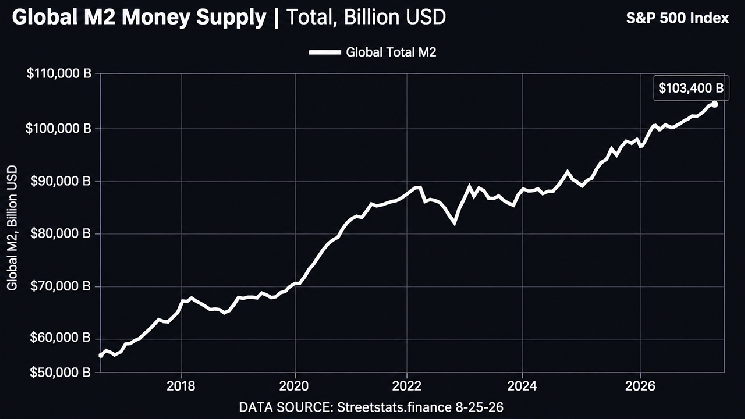
Bitcoin Price Lagging? Record Global Money Supply M2 Could Springboard BTC Growth The global money supply (M2) is expanding rapidly, similar to global debt. The US M2, representing all money circulating in its economy, has reached a record $23.16 trillion. Combined with figures from major economies like the Eurozone, China, and Japan, the global M2 is approximately $103 trillion. Some estimates, however, place it closer to $195 trillion. This surge in liquidity is significant because excess capital often seeks higher returns in assets like precious metals, stocks, and cryptocurrencies. Bitcoin's recent price surge above $81,000 has brought the global M2 metric back into focus. Following a sharp rise in early August after a US Treasury bond buyback announcement, BTC still trades about 37% below its October 2025 all-time high exceeding $126,000. This gap presents a potential "catch-up" trade thesis. Bitcoin's fixed supply of 21 million contrasts with governments' ability to print fiat currency, making scarce assets like BTC attractive if monetary expansion continues. Historically, Bitcoin's bull cycles in 2017-2018 and 2020-2021 coincided with M2 expansion and increased liquidity. Over the past year, the correlation seemed broken as M2 grew while Bitcoin's price fell sharply from its peak. Observers believe fresh dollars may have remained locked in cash-favorable investments. Some, like Ash Crypto, now suggest a long-awaited alignment between Bitcoin and M2 may be starting, especially as a weakening US Dollar Index this month has seen assets like gold and Bitcoin surge. A softer dollar pressures cash havens and prompts holders to act. While record M2 doesn't guarantee higher Bitcoin prices, a sustained influx of liquidity, a weak dollar, and capital flowing into alternative assets could trigger a catch-up rally sooner than expected. However, changes in these conditions could lead to the opposite outcome.

cryptonews.ruHá 1h

Is Bitcoin Price Lagging? Record Global M2 Money Supply Could Be a Springboard for BTC's Rise

cryptonews.ruHá 1h

Trading

Spot
活动图片